wayground logo

Free Printable Worksheets

Font size

S
M
L
XL
Worksheets

Genetics and Heredity Practice

Total questions: 60

Worksheet time: 55mins

Name
Class
Date
1.
The passing of traits from parent to offspring 
a)
Heredity 
b)
Genetics 
c)
Hybrid 
d)
Probability 
2.
Who was the father of genetics 
a)
Sagan 
b)
Issac Newton 
c)
Gregor Mendel 
d)
C.jenkins 
3.
A homozygous dominant dog with brown fur is crossed with a heterozygous dog with brown fur. What are the percentages of the possible genotypes?
a)
100% BB
b)
75% BB and 25%Bb
c)
50 % BB and 50% Bb
d)
50% Bb and 50% bb
4.
Squidward has light blue skin, and his genotype for this trait is Bb. Would Squidward be considered a purebred or hybrid for light blue skin?
a)
Purebred
b)
Hybrid
5.
How many alleles (letters) do each person carry for a trait?
a)
1
b)
2
c)
3
d)
4
6.
How many alleles (letters) does a child get from each parent for each trait?
a)
1
b)
2
c)
3
d)
4
7.
Aa, DD, bB, yy are all examples of
a)
genotypes
b)
phenotypes
8.
What you see, or the physical appearance.
a)
Genotype
b)
Phenotype
c)
Homozygous
d)
Heterozygous
9.
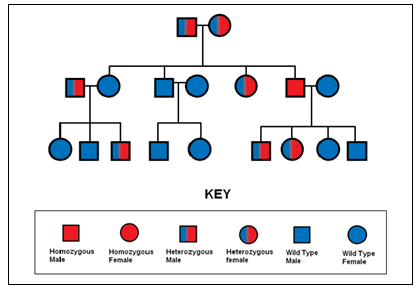
B = brown eyes
b = blue eyes
What is true about these two brothers that have brown eyes?
One has genotype BB the other Bb.
a)
they have same phenotype and genotype
b)
they have different genotypes and phenotypes
c)
they have same phenotype but different genotypes
d)
they have same genotype but different phenotypes
10.
Which of the following genotypes is homozygous dominant?
a)
A
b)
Aa
c)
AA
d)
aa
11.
Which of the following genotypes is heterozygous?
a)
Bb
b)
BB
c)
bb
d)
B
12.
Which of the following is homozygous recessive?
a)
Tt
b)
tt
c)
TT
d)
T
13.
In a pedigree, what shape represents a male?
a)
circle
b)
square
c)
triangle
d)
diamond
14.
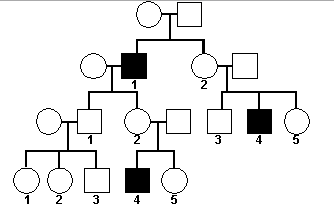
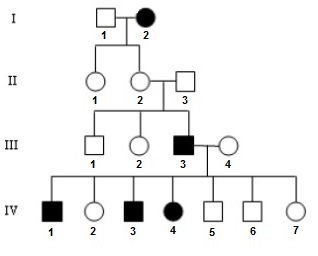
What type of heredity is shown in the pedigree?
(hint: check your notes - "modes of inheritance")
a)
Sex-Linked Dominant
b)
Sex-Linked Recessive
c)
Autosomal Dominant
d)
Autosomal Recessive 
15.
What gender has an X and a Y chromosome?
a)
male
b)
female
c)
transgender 
d)
all of the above
16.
W=white hair
w= non-white hair
If you cross a horse with WW and a horse with ww what fraction of the offspring would be expected to have white hair?
a)
none
b)
3/4
c)
1/2
d)
all
17.
In a punnet square where are the parent alleles written?
a)
Top and inside the boxes
b)
Only on the left and right side of the boxes. 
c)
outside of the boxes (top and left side)
d)
All on the top side of the boxes
18.
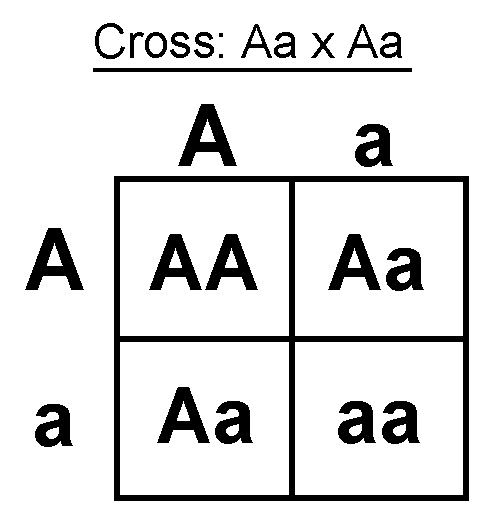
Each one of the boxes on the Punnett Square represents what probability of an offsprings' genotype?
a)
25%
b)
1%
c)
10%
d)
0%
19.
What is the phenotype of the offspring? (A-Brown hair; a-blond hair) 
a)
50 % Brown Hair and 50% Blond Hair 
b)
25 % Brown Hair and 75% Blond Hair 
c)
75 % Brown Hair and 25% Blond Hair 
d)
0% Brown Hair and 100% Blond Hair 
20.
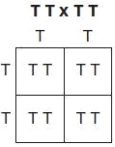
A green pea plant (GG) is being crossed with a green pea plant (Gg). What is the phenotype?
a)
100 % rainbow 
b)
50% yellow and 50% green 
c)
100% green
d)
100% yellow 
21.
What ratio of the offspring from the cross shown will be homozygous recessive for the  trait of tallness? 
a)
0 in 4
b)
1 in 4
c)
2 in 4
d)
4 in 4
22.
How many generations are shown in this pedigree?
a)
1
b)
2
c)
3
d)
4
23.
How many kids did the mother and father from the first generation have?
a)
2
b)
4
c)
5
d)
6
24.
How many boys did the mother and father from the first generation have?
a)
2
b)
4
c)
5
d)
6
25.
Which individual in the first generation is a carrier?
a)
The male
b)
The female
c)
individual 1
d)
None of the above
26.
How many girls did the mother and father from the first generation have?
a)
2
b)
4
c)
5
d)
6
27.
In the second generation-how many people have the disease or display the physical trait?
a)
2
b)
4
c)
5
d)
6
28.
In the second generation-how many people are carriers of the trait?
a)
2
b)
3
c)
5
d)
6
29.
How many individuals are there in the 3rd generation?
a)
2
b)
3
c)
4
d)
6
30.
How many people in this whole pedigree have the trait/disease?
a)
2
b)
3
c)
4
d)
6
31.
This pedigree represents the inheritance of hemophilia in this family. How many of the females have the hemophilia trait?
a)
8
b)
5
c)
2
d)
3
32.
Huntington's Disease is a dominant trait.
What is the correct genotype for individual I-2?
a)
HH
b)
Hh
c)
hh
d)
H_
33.
Does this pedigree show a dominant or recessive trait?
a)
Dominant
b)
Recessive
34.
What gamete possibilities could come from this parent's genotype?
a)
AB, AB, aB, aB
b)
Ab, AB, Ab, ab
c)
Ab, Ab, Ab, Ab
d)
AB, aB, ab, aB
35.
What gamete possibilities could come from this parent's genotype?
a)
aB, ab, AB, Ab
b)
aB, Ab, AB, AB
c)
AB, aB, AB, Ab
d)
aB, ab, aB, ab
36.
What gamete possibilities could come from this parent's genotype?
a)
aB, ab, AB, Ab
b)
Ab, AB, Ab, AB
c)
AB, AB, Ab, AB
d)
Ab, AB, ab, aB
37.
What goes in box 1
a)
AABb
b)
AABB
c)
aabb
d)
AaBb
38.
What goes in box 15
a)
abab
b)
ABAB
c)
aBaB
d)
AbAb
39.
What genotype is missing from this Punnett Square?
a)
RrYy
b)
RRYY
c)
rryy
d)
RrYY
40.
Based off this punnett square, what fraction of the offspring will have wrinkled, yellow seeds?
a)
9/16
b)
3/16
c)
1/16
d)
16/16
41.
when one allele is not completely dominant over the other - blending of two traits
a)
Codominance
b)
Complete dominance
c)
incomplete dominance
d)
none of these
42.
condition in which both alleles for a gene are expressed when present - both traits are visible
a)
Codominance
b)
Dominance
c)
Complete dominance
d)
Incomplete dominance
43.
this image is an example of
a)
codominance
b)
dominance
c)
incomplete dominance
44.
this image is an example of
a)
codominance
b)
dominance
c)
incomplete dominance
45.
A calico cat shows both the traits for orange fur and black fur. What kind of allele expression is this?
a)
Incomplete Dominance
b)
Co dominance
46.
This is an example of ___________.
a)
Incomplete Dominance
b)
Codominance
47.
If you cross a black chicken with a white chicken, only checkered chickens would be produced.  What kind of inheritance pattern does this follow?
a)
incomplete Dominance
b)
Co-Dominance
48.
If you cross a red snapdragon with a white snapdragon, only pink snapdragons will be produced.  What type of inheritance pattern does this follow?
a)
Complete Dominance
b)
Incomplete Dominance
c)
Co-Dominance
d)
Sex-linked
49.
Which of the following is purebred?
a)
AA
b)
aa
c)
Aa
d)
Both AA and aa
50.
Which of the following is a hybrid?
a)
BB
b)
bb
c)
Bb
51.

In chickens, feather color is codominant. If a black chicken BB is mated with one that is black and white (BW) what are the chances of having a chicken that is black and white?

a)

50%

b)

0%

c)

25%

d)

100%

52.

A red flowered plant (RR) is crossed with a white flowered plant (WW). The gene for petal color in these plants expresses incomplete dominance. What percentage of the offspring will have pink (RW) flowers?

a)

0%

b)

25%

c)

50%

d)

100%

53.

A tall plant (TT) is crossed with a short plant (SS). The result is a medium plant (TS). This is what type of inheritance pattern?

a)

Incomplete dominance

b)

Codominance

54.

The hair form gene shows incomplete dominance. Straight hair (SS) is dominant, curly hair (CC) is recessive, and wavy hair (SC) is heterozygous. Mr. and Mrs. Anderson both have wavy hair (SC). What percentage of their children will also have wavy hair (SC)?

a)

25%

b)

50%

c)

75%

d)

100%

55.

If your genotype is Bb, then you can only pass a B or b to your child but you can't pass both.

a)

Law of Dominance

b)

Law of Segregation

c)

Law of Independent Assortment

56.

An organism is a hybrid genotype (Tt) but is appears tall instead of short.

a)

Law of Dominance

b)

Law of Segregation

c)

Law of Independent Assortment

57.

Person A is smart and has brown hair while Person B is also smart but has blonde hair.

a)

Law of Dominance

b)

Law of Segregation

c)

Law of Independent Assortment

58.

Which of Mendel's laws states that alleles are separated during meiosis?

a)

Law of Dominance

b)

Law of Segregation

c)

Law of Independent Assortment

59.

Which of Mendel's laws states that alleles are distributed to gametes independent of one another?

a)

Law of Dominance

b)

Law of Segregation

c)

Law of Independent Assortment

60.

If a dominant allele is present, the trait will always appear in the organism.

a)

Law of Segregation

b)

Law of Dominance

c)

Law of Independent Assortment