wayground logo

Free Printable Worksheets

Font size

S
M
L
XL
Worksheets

2024-Category 1 Cell Structure and Function

Total questions: 63

Worksheet time: 2hrs 36mins

Name
Class
Date
1.

Where is the DNA of a eukaryotic cell located?

a)

ribosome

b)

Golgi vessicle

c)

nucleus

d)

cytoplasm

2.

Where can you find the DNA in a prokarotic cell?

a)

in the nucleus

b)

in the cytoplasm

c)

in the flagellum

d)

in the ribosomes

3.

Many types of pneumonia are caused by the pneumenococcus bacterium (bacteria). Which of the following must be true?

a)

There is no DNA in pneumenococcus

b)

There is no nucleus in pneumenococcus

c)

There are no ribosomes in pneumenococcus

d)

There is no plasma membrane in pneumenococcus

4.

Can a bacterium (bacteria) have a nucleus?

a)

Yes

b)

No

c)

Sometimes

5.
Which type of cell?
a)
Prokaryote
b)
Eukaryote
6.
Which type of cell?
a)
Prokaryote
b)
Eukaryote
7.
Which type of cell?
a)
Prokaryote
b)
Eukaryote
8.
Which type of cell?
a)
Prokaryote
b)
Eukaryote
9.
A single-celled organism that lacks a membrane-bound nucleus, mitochondria, or any other membrane -bound organelle .
a)
Prokaryote
b)
Eukaryote
c)
Nucleus
d)
Single-celled organism
10.
Plants, animals, fungi and protists are all examples of _______ cells
a)
Prokaryotic
b)
Eukaryotic
c)
animal
d)
plant
11.

13. how do eukaryotic and prokaryotic cells differ?

a)

only prokaryotic cells contain ribosomes

b)

only eukaryotic cells come from pre-existing cells.

c)

only prokaryotic cells come from pre-existing cells.

d)

only eukaryotic cells contain membrane-bound organelles.

12.

53. how are eukaryotic cells and prokaryotic cells similar?

a)

both contain a plasma membrane, a nucleus, and ribosomes suspended within cytoplasm.

b)

both contain a plasma membrane, cytoplasm, and circular DNA strands referred to as plasmids.

c)

both contain cytoplasm, mitochondria, and small nuclei with pairs of linear chromosomes made up of DNA.

d)

both contain a plasma membrane, cytoplasm, and ribosomes suspended within the cytoplasm.

13.
Osmosis is the movement of _____ across a membrane.
a)
food
b)
energy
c)
oxygen
d)
water
14.
Which type of transport requires an input of energy?
a)
Passive Transport
b)
Osmosis
c)
Simple Diffusion
d)
Active Transport
15.
What is the difference between active and passive transport?
a)
Active does not need energy and passive uses ATP (energy)
b)
Active uses ATP (energy) and passive does not need energy
c)
Active stores transport proteins and passive releases 
d)
Active uses hormones and passive does not 
16.
_______ regulates what enters and leaves a cell.  
a)
Cell Membrane
b)
Nucleus
c)
Mitochondria
d)
Cytoplasm
17.

Cell membranes are described as selectively permeable.

Four students were asked to explain what this means. Which one is correct?

a)

Student 1: Cell membranes prevent all materials from entering the cell.

b)

Student 2: Cell membranes only provide structural support for the cell.

c)

Student 3: Cell membranes regulate which substances can enter and exit the cell.

d)

Student 4: Cell membranes allow water and water-soluble substances to enter the cell.

18.
Moving from areas of LOW concentration to areas of HIGH concentration is called?
a)
Passive Transport
b)
Active Transport
c)
Diffusion
d)
Osmosis
19.
When the concentration of molecules on both sides of a membrane is the SAME, the solution is
a)
isotonic
b)
hypertonic
c)
hypotonic
20.
If a cell is placed in a hypertonic solution, what will happen?
a)
Water will move into the cell causing it to swell.
b)
Water will move out of the cell causing it to shrink.
c)
nothing.
d)
Water will move out of the cell causing it to swell.
21.
A molecule that diffuses down a concentration gradient goes from an area of ______ concentration into an area of ______ concentration.
a)
high, low
b)
low, high
c)
passive, active
d)
active, passive
22.

A virus consists of:

a)

RNA or DNA and a cell membrane

b)

RNA or DNA and a protein coat capsid

c)

RNA or DNA, ribosomes and a protein coat capsid

d)

proteins, cell membrane, and RNA

23.

Which of the following pictures is NOT a example of a virus?

a)

a

b)

b

c)

c

d)

d

24.

Observe the diagram of the two viruses.

Part C is the ______________

a)

Genetic material

b)

Capsid

c)

Ligand

d)

Envelope

25.

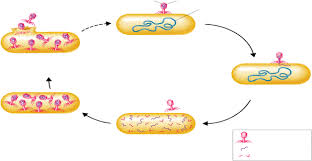
Which viral life cycle is shown?

a)

Lysogenic Cycle

b)

Lytic Cycle

c)

Binary Fission

d)

Conjugation

26.
What process is this?
a)
phagocytosis
b)
lytic cycle
c)
lysogenic cycle
d)
formation of antibodies
27.
Viruses are...
a)
prokaryotic
b)
eukaryotic
c)
non-living
d)
endospores
28.
What is the main function of the projections on the surface of a virus?
a)
They aid in respiration
b)
They help the virus grow
c)
They help the virus invade its host by attaching to specific sites on the host
d)
They help the virus digest food molecules
29.
What do viruses have in common with living cells? They both...
a)
store genetic information
b)
have chloroplasts
c)
use glucose for cellular respiration
d)
have endoplasmic reticulum
30.
What is the first step of the virus reproduction cycle?
a)
The viruses genetic material (DNA) starts to take over the functions of the cell
b)
The host cell bursts open, releasing the new viruses
c)
The virus injects its genetic material into the cell
d)
A virus attaches to the surface of a host cell
31.
What is one way that a lysogenic infection differs from a lytic infection?
a)
A lysogenic virus does not act on bacteria as a lytic virus does.
b)
A lysogenic virus can remain in the host DNA for a longer period without becoming active.
c)
A lysogenic virus contains RNA instead of DNA.
d)
A lysogenic virus directs the production of new viruses right away.
32.
Reasons that viruses are considered to be nonliving is because
a)
They are not cellular
b)
They cannot reproduce on their own
c)
They cannot make proteins
d)
all of the above
33.

Which viral life cycle allows viral genetic material to lay dormant while the host cell reproduces?

a)

lytic

b)

mitosis

c)

lysogenic

d)

S phase

34.

Organize these options into the right categories

Categorize the following

genetic material

ribosomes

cell membrane

cytoplasm

small and simple

large and complex

golgi apparatus

BACTERIA

Rough and smooth ER

lysosomes

nucleus

vacuoles

Eukaryote
Prokaryote
All Cells
35.

There are four organelles that every cell has.  The ​ (a)   controls what enters and exits the cell.  The ​ (b)   make proteins for the cell.  ​ (c)   is the jelly-like substance that suspends all the organelles, and ​ (d)   is a genetic material that instructs the cell what to do.

Choose from the below words
cell membrane
ribosomes
Cytoplasm
DNA or RNA
36.

Which viral cycle takes the longest to show symptoms?

a)

Lysogenic

b)

Lytic

37.

Which conclusion about HIV infection of a host cell is best supported by the diagram?

a)

It takes place outside of living cells

b)

It relies on the host cell to reproduce

c)

It involves the process of meiosis

d)

It requires carbon dioxide

38.

Which of these describes a difference between viruses and cells?

a)

Cells contain protein, and viruses contain only carbohydrates

b)

Viruses have flagella, and cells only cillia

c)

Cells reproduce independently, and viruses require a host to reproduce.

d)

Viruses have membranes made of proteins, and cells have membranes made of nucleic acid.

39.

How do vaccines protect us from viruses

a)

The immune system develops antibodies in response the weakened virus

b)

The weakened viruses attach to unaffected viruses in the host and interrupt the viral reproductive cycle

c)

The rate of genetic mutation in the host is decreased due to the introduction of weakened viruses

d)

the weakened viruses are unable to enter the host organism

40.

Cancer creates abnormal cells by disrupting

a)

the cell cycle

b)

DNA replication

c)

cellular respiration

41.

An abnormal mass of cancer cells is called a 

a)

tumor

b)

cyst

c)

lesion

42.

What causes cancer?

a)

Errors in the regulatory process of the cell cycle that results in uncontrolled cell growth

b)

There is no known cause for cancer

c)

Viruses and other pathogens

d)

Catching it from someone you know that has cancer

43.

Cancer is defined as the

a)

uncontrolled division of mutated cells

b)

normal division of cells

c)

normal DNA replication

d)

abnormal ATP synthesis

44.
Tumors are...
a)
A big fatty lump
b)
mass of abnormal cells that can grow uncontrollably
c)
Something that sticks out from your body
d)
It's not a tumor
45.
What is a checkpoint in the cell cycle?
a)
A check to see if the cell is ready to move on
b)
A check to slow mitosis down
c)
A check to see if the cell is performing mitosis or meiosis
d)
A check to make sure the cell doesn't die
46.

Match the following: Base Pairing Rule

a)

Adenine

1.

Thymine

b)

Cytosine

2.

Guanine

c)

Thymine

3.

Adenine

d)

Guanine

4.

Cytosine

47.

What stage of mitosis is depicted here? The spindle fibers are pulling the chromosomes apart.

a)

Prophase

b)

Metaphase

c)

Anaphase

d)

Telophase

48.

What stage of mitosis is depicted here? The spindle Fibers are attaching to the chromosomes.

a)

Prophase

b)

Metaphase

c)

Anaphase

d)

Telophase

49.

What stage of mitosis is depicted here? The Nuclear Membrane is disappearing and you can see the chromosomes.

a)

Prophase

b)

Anaphase

c)

Telophase

d)

Metaphase

50.

What stage of mitosis is depicted here? The nuclear membrane is coming back to life.

a)

Prophase

b)

Metaphase

c)

Anaphase

d)

Telophase

51.

Reorder the following

a)

Prophase

b)

Metaphase

c)

Anaphase

d)

Telephase

e)

cytokenises

1)
2)
3)
4)
5)
52.

What phase is anaphase?

a)

b)

c)

d)

53.
In mitosis, the two resulting cells are
a)
different from the starting cell and identical to each other.
b)
different from the starting cell and different from each other.
c)
identical to the starting cell and different from each other.
d)
identical to the starting cell and identical to each other.
54.

What phase is metaphase?

a)
b)
c)
d)
55.
Chromosomes are copied during which phase of the cell cycle?
a)
M phase
b)
G1 phase
c)
G2 phase
d)
S phase
56.

Put the following stages of the cell cycle in order: G2, S, G1, M. 

a)

S, G1, G2, M

b)

G1, S, G2, M

c)

G1, M, G2, S

d)

M, G1, S, G2

57.
During which phase of the cell cycle does the cell spend the most time?
a)
Mitosis
b)
Cytokinesis
c)
Interphase
58.

What is the next phase of mitosis?

a)
Prophase
b)
Metaphase
c)
Anaphase
d)
Telophase
59.
DNA is replicated during the ______ phase of the cell cycle.
a)
G1
b)
Synthesis
c)
G2
d)
G0
60.
Which best explains why muscle cells are different from blood cells?
a)
Muscle cells are produced by the brain, but blood cells are produced by the heart. 
b)
Different genes are activated in muscle cells than in blood cells. 
c)
Muscles cells experience different environmental influences than blood cells. 
d)
A mutation occurs during the development of muscle cells but not in blood cells. 
61.

Why do stomach cells function differently than skin cells?

a)

They contain entirely different DNA

b)

They use different genes in the DNA

62.

What is cell differentiation?

a)

Process by which cells produce MORE cells.

b)

Process by which cells become UNSPECIALIZED

c)

Process by with cells become SPECIALIZED

d)

Process by which cells become old and DIE

63.

What is the complementary base pairing for the following sequence?

A T A T C G C G

(a)