Worksheets
EOC Test Section 1
Total questions: 41
Worksheet time: 2hrs 33mins

Which statement best describes the energy conversions illustrated in the image?
light energy is converted to chemical energy (glucose) which is then converted to chemical energy (ATP)
Chemical energy (ATP) is converted to Chemical energy (glucose) which is converted to radiant energy
radiant energy is converted to chemical energy (ATP) which is converted to chemical energy (glucose)
chemical energy (glucose) is converted to chemical energy (ATP) which is converted to solar energy

Which stage of the cell cycle is involved in DNA replication?
A
B
C
D

This macromolecule serves as the main component of this organelle.
carbohydrates
lipids
proteins
nucleic acids


After conducting several tests, a scientist determines that the nucleic acid sample he is studying has the following characteristics:
• Contains nucleotides linked in a chain
• Contains 4 nitrogen bases
• Made of single strand
• Uracil is present
What is the BEST conclusion the scientist can make based on the observations?
DOK 2 because students interpret the facts between the structure of DNA and RNA
The nucleic acid is DNA.
The nucleic acid is RNA
The nucleic acid is a protein
More tests would be needed to determine the type of nucleic acid in the sample.

DOK 2 because student is being asked to make an inference from the graph.
Rhesus monkeys and mice do not share a common ancestor.
Hemoglobin is more important to frogs than to other organisms.
Humans and rhesus monkeys are more similar than chickens and frogs.
Amino acids are the building blocks of hemoglobin in all organisms except humans.

An organism is multicellular and can be seen without a microscope. The bar graph shows the numbers of some of the organelles in one of the cells from the organism.
From which kingdom is this organism?
DOK 1 because student is asked to recall the differences between different kingdoms
Animalia
Archaebacteria
Fungi
Plantae

Which graph shows the most effective enzyme reduction of the amount of required activation energy?
DOK 2 because student is asked to apply their knowledge of activation energy, and explain how a larger decrease in activation energy makes an enzyme more effective.
A
B
C
D
Scientists conducted an experiment to determine how different wavelengths of light affected photosynthesis. They used two groups of the same plants.
The leaves of Group 1 were covered with transparent green plastic. The leaves of Group 2 were not covered with any plastic.
The results show that the plants photosynthesized best when their leaves were not covered in any plastic.
Which hypothesis do the results support?
DOK 2 because student is asked to explain the how or why of the results from an experiment
If leaves are uncovered, then their chloroplasts will produce more oxygen than the leaves that are covered in green plastic.
If leaves are covered in green plastic, then their mitochondria will absorb more carbon dioxide than the mitochondria of uncovered leaves.
If leaves are uncovered, then their chloroplasts will release more carbon dioxide than the chloroplasts of leaves covered in green plastic.
If leaves are covered in green plastic, then their mitochondria will produce more oxygen than the leaves that are uncovered
Energy is transferred between trophic levels in a food pyramid. If 150,000 joules of sunlight are captured by plants, how much energy is transferred to secondary consumers?
DOK 2 because students are asked to calculate energy transfer
150 joules
1,500 joules
15,000 joules
150,000 joules

Scientists have studied organisms near steel mills. In one study, the scientists compared the DNA of two groups of mice. One group lived near a steel mill, and the other group lived in a rural area away from the steel mill. The scientists collected data on the number of mutations occurring in each group and created the table shown.
Which prediction can be made from this data?
Mice that live in rural areas will have more genes expressed than mice near steel mills.
Mice that live near steel mills will have more genes expressed than mice in rural areas
Mice that live in rural areas will have higher rates of abnormalities due to mutations than mice near steel mills
Mice that live near steel mills will have higher rates of abnormalities due to mutations than mice in rural areas.

Scientists and farmers studied how populations of insects on a farm changed after the farmer started using an insecticide on the crops. The diagram shows population sizes, both before and after the insecticide was applied.
What conclusion can be made about the Insect A and Insect B populations?
The insecticide was specific to Insect B
The insecticide became less effective for Insect A
Some insects passed a beneficial mutation to offspring
The farmer missed spraying insecticide on some plants

A student is demonstrating how water moves across cell membranes to maintain homeostasis. The student uses dialysis bags, which are semipermeable and model cell membranes. The student fills each of the three bags with 100 mL of a 10% salt solution and ties the end of each bag. In Beaker 1, the student places 200 mL of a 5% salt solution. In Beaker 2, the student places 200 mL of a 10% salt solution. In Beaker 3, the student places 200 mL of a 20% salt solution
What kind of environments are in Beakers 1, 2, and 3?
Beaker 1: hypertonic, Beaker 2: hypotonic, Beaker 3: isotonic
Beaker 1: hypertonic, Beaker 2: isotonic, Beaker 3: hypotonic
Beaker 1: isotonic, Beaker 2: hypertonic, Beaker 3: hypotonic
Beaker 1: hypotonic, Beaker 2: isotonic, Beaker 3: hypertonic
In 1976, the enzyme DNA helicase was discovered. DNA helicase breaks bonds between nitrogenous bases. Which statement BEST describes how the discovery of DNA helicase furthered the understanding of DNA replication?
It revealed the mechanism by which two DNA strands are “unzipped” from each other.
It resulted in the development of laboratory methods of replicating RNA.
It led scientists to discover that DNA is made up of nucleotides.
It helped uncover the double-helix structure of DNA.

The diagram shows a plant’s responses to stimuli.
Which represents explanations for the plant’s responses?
In response to light, a plant hormone causes the shoot to lengthen more on one side, and the stem bends toward the light. In response to gravity, a plant hormone accumulates in certain areas, and the roots grow downward.
In response to light, the chloroplasts begin to photosynthesize, and the shoot leans toward the light. In response to water, the vacuoles on one side of the roots swell, and the roots grow downward.
In response to the heat, sensors in the shoot are activated, and the shoot bends toward the Sun. In response to touching the soil, sensors in the root are activated, and the roots grow downward.
In response to gravity, a plant hormone causes cell replication, and the shoot grows upward. In response to light, a plant hormone causes cells to move away from the Sun, and the roots grow downward.
Scientists noted that each of several anole lizard species in the Caribbean islands has a body type that seems to be well suited for its own habitat. For example, the anole species that live mainly on tree trunks have stocky bodies and long legs. Anoles that live in grassy areas are slender and have very long legs. Scientists also noted that distinct anole species with the same body types can be found on several different islands.
These findings are consistent with the mechanism of natural selection, which favors adaptations that allow a species to survive in its environment. The scientists developed a few hypotheses for the finding that the twig-dwelling anole species found on several of the islands have thin bodies, large toe pads, and short legs and tails. They then performed DNA analysis on each of these twig-dwelling species. This analysis revealed that the twig-dwelling species on different islands did not share a recent common ancestor.
Which of these hypotheses is supported by the findings?
A species of twig-dwelling anoles developed on one island, and then descendents spread out to other islands.
The twig-dwelling anoles are much better adapted to living in the Caribbean islands than the trunk-dwelling and grass-dwelling anoles.
Each twig-dwelling species came from distant ancestors but evolved in similar ways despite separated habitats.
Twig-dwelling anoles, trunk-dwelling anoles, and grass-dwelling anoles all evolved from the same ancestor.

DOK 2 because students is ask to compare relationships
Species 1 is a predator of Species 2.
Species 2 is a predator of Species 1.
Species 1 and 2 have a mutualistic relationship.
Species 1 and 2 have a commensalistic relationship.

Looking at the figure which cell structure should the student use to BEST complete the table?
DOK1 because it requires the student to recall information. It is a simple definition.
nucleus
cytoplasm
cell membrane
endoplasmic reticulum




low to high
uses energy/ATP
Bacteria are classified as prokaryotic cells because they
do not require oxygen to perform respiration
are unable to produce amino acids
lack membrane-bound nuclei.
cannot produce their own food

A student follows this procedure during a science class.
Chewing the bread for two minutes allowed enzymes in the student’s saliva to act on the bread. What did the enzymes do to the bread to change its flavor?
Enzymes acted on starch to break it down into simple sugars
Enzymes produced lipid substrates that altered the reaction
Enzymes added chemical energy to the reaction.
Enzymes caused the proteins to release more product.
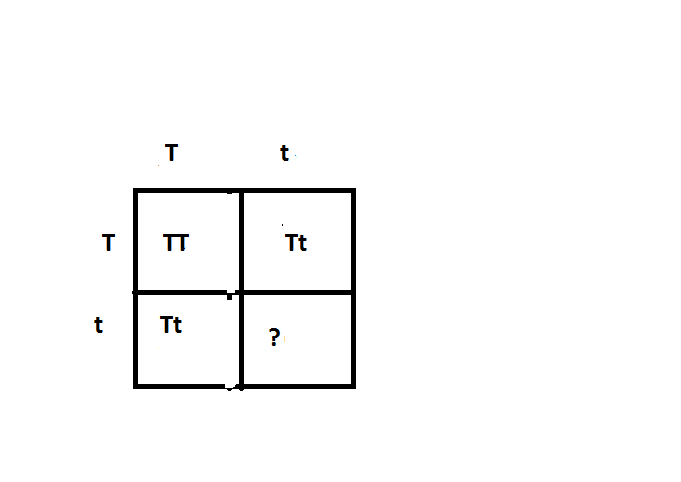
In the punnett square below, what belongs in the missing square