

Wayground logo

Free Printable Worksheets

Font size

S
M
L
XL
Worksheets

Newton's Laws of Motion

Total questions: 40

Worksheet time: 37mins

Name
Class
Date
1.
A magician pulls a tablecloth out from under dishes and glasses on a table without disturbing them.
a)
Newton's 1st Law
b)
Newton's 2nd Law
c)
Newton's 3rd Law
2.
Pushing a child on a swing is easier than pushing an adult on the same swing, because the adult has more mass and requires more force to accelerate.
a)
Newton's 1st Law
b)
Newton's 2nd Law
c)
Newton's 3rd Law
3.
A student leaves a pencil on a desk and the pencil stays in the same spot until another student picks it up.
a)
Law of Inertia
b)
Law of Acceleration
c)
Law of Conservation of Momentum
4.
This person bought coffee and put it on the seat next to them. If they stopped quickly and the coffee spilled which law would that represent?
a)
Newton's 1st Law
b)
Newton's 2nd Law
c)
Newton's 3rd Law
5.
When you step on a Lego. You push on the Lego and the Lego pushes back on you.
a)
Newton's 1st Law
b)
Newton's 2nd Law
c)
Newton's 3rd Law
6.
a)
1st
b)
2nd
c)
3rd
7.
a)
1st
b)
2nd
c)
3rd
8.
a)
1st
b)
2nd
c)
3rd
9.
a)
1st
b)
2nd
c)
3rd
10.
a)
1st
b)
2nd
c)
3rd
11.
Object at rest stays at rest.
a)
1st
b)
2nd
c)
3rd
12.
F = MxA
a)
1st
b)
2nd
c)
3rd
13.
Acceleration is due to a force put on an objects mass. 
a)
1st
b)
2nd
c)
3rd
14.
Two balls that collide will have an equal but opposite force upon one another
a)
First Law
b)
Second Law
c)
Third Law
d)
Law of Inertia
15.
A rocket with less ________ will have a greater acceleration.
a)
Mass
b)
At Rest
c)
Reaction
d)
Resist
16.

If a baseball and a cannonball are dropped from the same height at the same time, which ball will hit the ground first?

a)

The Cannonball

b)

The Baseball

c)

The Balls lands at the Same Time

d)

The Ball with the Larger Volume

17.

According to Newton’s first law of motion, a moving object that is not acted on by an unbalanced force will

a)

remain in motion

b)

eventually come to a stop

c)

change its momentum

d)

accelerate

18.

An ice skater at rest pushes against a sled at rest, causing both the skater and sled to move away from each other with different accelerations. This is an example best described by

a)

Newton’s first law of motion for objects at rest

b)

Newton’s first law of motion for objects in motion

c)

Newton’s second law of motion

d)

Newton’s third law of motion

19.

How does Newton’s third law explain how a rocket takes off?

a)

The rocket’s acceleration is positive, while the gasses acceleration is negative but the direction is the same

b)

The rocket is at rest until ignition

c)

The hot gasses move in one direction, while the rocket moves in the opposite direction but with equal force
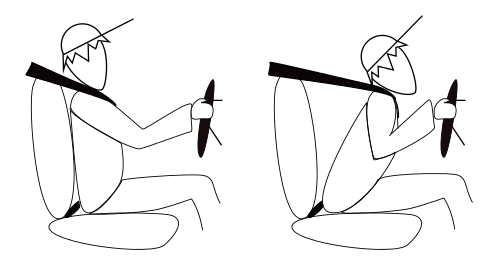
20.
What Newtons law does this picture represent
a)
Newtons 2nd law 
b)
Law of gravity 
c)
Newtons 1st law
d)
Newtons 5th law
21.
One way to increase acceleration is by...
a)
increasing mass 
b)
decreasing mass 
c)
decreasing force 
d)
increasing force 
22.
What happens when two forces act in the same direction?
a)
they cancel each other out 
b)
the stronger one prevails 
c)
they add together 
d)
their sum divided by two is the total force 
23.
According to Newton's third law of motion, when a hammer strikes and exerts force on a nail, the nail
a)
creates a friction with the hammer 
b)
disappears into the wood 
c)
exerts an equal force back on the hammer 
d)
moves at a constant speed 
24.
"An object in motion (or at rest) will to stay in motion (or at rest) until an outside force acts upon it."
a)
Newton's 1st Law
b)
Newton's 2nd Law
c)
Newton's 3rd Law
d)
Newton's 4th Law
25.
Force = Mass x Acceleration
a)
Newton's 1st Law
b)
Newton's 2nd Law
c)
Newton's 3rd Law
d)
Newton's 4th Law
26.
"For every action, there is an equal and opposite reaction."
a)
Newton's 1st Law
b)
Newton's 2nd Law
c)
Newton's 3rd Law
d)
Newton's 4th Law
27.
In the picture, the blocks are flying out of the truck based on which of Newton's laws?
a)
Newton's 1st Law
b)
Newton's 2nd Law
c)
Newton's 3rd Law
d)
Newton's 6th Law
28.
To compare the two pictures would require...
a)
Newton's 1st Law
b)
Newton's 2nd Law
c)
Newton's 3rd Law
d)
Newton's 11th Law
29.
If the same force was applied to both shopping carts, which cart will have more acceleration?  
a)
The empty shopping cart
b)
The full shopping cart
c)
They will be the same
30.
If you push a ping pong ball & a basketball with the same amount of force, which one will have a greater acceleration?
a)
The ping pong ball because it has less mass.
b)
The basketball because it has more mass.
c)
They will accelerate the same since they are pushed with the same force.
31.
When Amelia is swimming, which way does she have to push with her hands to move forward?
a)
upward
b)
downward
c)
forward
d)
backward
32.
What kind of objects have inertia?
a)
all objects with mass
b)
only objects at rest
c)
only objects in motion
d)
only objects whose motion is being changed
33.
An archer pulls the bowstring back, then releases the string and the arrow flies forward. Pulling the string back is the...
a)
action force
b)
reaction force
c)
net force
d)
balanced force
34.
F=MA 
Going down a hill a 12 kg sled has a force of 36 N. What is it's acceleration? 
a)
2 m/s2
b)
3 m/s2
c)
I don't know
d)
What?
35.
Keep in mind F=MA
If you are pushing a 1000 kg car at 0.5 m/s2, how many newtons would that be? 
a)
2000 N
b)
60N
c)
500 N
d)
12 N
36.

Which law is this picture an example of?

a)

Law of Inertia

b)

Law of Action / Reaction

c)

Law of Force and Acceleration

37.

Which law is this picture an example of?

a)

Law of Inertia

b)

Law of Force and Acceleration

c)

Law of Action / Reaction

38.

Ted is playing with a yoyo outside. When he pushes the yoyo downward it returns back to him with the same force. Which law is this an example of?

a)

1st Law

b)

2nd Law

c)

3rd Law

39.

Beth's bike remains stopped at the intersection until she begins pedaling again. Which law is this an example of?

a)

1st Law

b)

2nd Law

c)

3rd Law

40.

Which law is this picture an example of?

a)

Law of Inertia

b)

Law of Force and Acceleration

c)

Law of Action / Reaction
