wayground logo

Free Printable Worksheets

Font size

S
M
L
XL
Worksheets

Waves and Sound Test Review

Total questions: 82

Worksheet time: 1hrs 22mins
Name
Class
Date
1.
What do we call the bottom of a transverse wave?
a)
crest
b)
trough
c)
wavelength
d)
amplitude
2.
What do we call the top of the wave?
a)
crest
b)
trough
c)
amplitude
d)
frequency
3.
Paul is fishing out on the Resevoir.  He sees a fish from his boat and goes to spear it but misses by a lot but sees that the fish has not moved.  What caused him to think the fish was some where else?
a)
reflection
b)
transmission
c)
absorption
d)
refraction
4.
What happens when you increase the amplitude of a sound?
a)
it makes the sound louder
b)
it makes the sound travel faster
c)
it increases the wavelength of the sound
d)
it increases the frequency of the sound
5.
Waves that require a medium are called 
a)
mechanical waves
b)
transverse waves
c)
light waves
d)
gamma rays
6.
This behavior occurs when waves bend from changing speed.
a)
refraction
b)
reflection
c)
transmission
d)
absorption
7.
What kind of wave moves at right angles to the direction of the wave?
a)
compressional waves
b)
mechanical waves
c)
transverse waves
d)
ultraviolet rays
8.
This behavior is what happens when waves bounce back when meeting a surface.
a)
refraction
b)
reflection
c)
transmission
d)
absorption
9.
An example of this is an echo
a)
refraction
b)
reflection
c)
transmission
d)
absorption
10.
What do we call the part of a compressional wave that is when the waves are squeezed together?
a)
compression
b)
rarefaction
c)
crest
d)
trough
11.
What do we call the part of a compressional wave that is spread a part?
a)
compression
b)
rarefaction
c)
crest
d)
trough
12.
What can electromagnetic waves travel through?
a)
mediums
b)
empty space
c)
solely solids
d)
both mediums and empty space
13.
What do waves carry from place to place?
a)
Energy, but not matter or particles
b)
Energy and matter or particles
c)
Matter or particles but not energy
d)
Neither energy nor matter or particles
14.
Which wave travels parallel in relation to a medium?
a)
Transverse
b)
Longitudinal
c)
Both
d)
Neither
15.

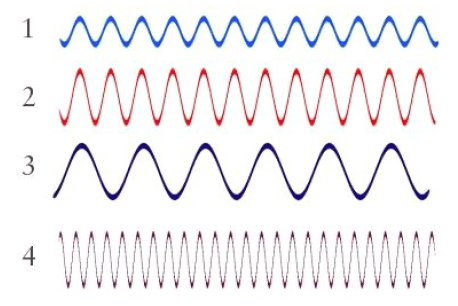
Which wave in the diagram has the greatest wavelength?

a)

1

b)

2

c)

3

d)

4

16.

Which wave in the diagram has the greatest frequency?

a)

1

b)

2

c)

3

d)

4

17.
What is the speed of a wave that has a wavelength of 2 and a frequency of 2.5?
a)
2.5 m/s
b)
5 m/s
c)
4.5 m/s
d)
6 m/s
18.

What is the variable and unit for wave length?

a)

f, hertz

b)

T, seconds

c)

v, Meters/second

d)

λ, wavelength

19.

Frequency and period are __________ to each other

a)

directly proportional

b)

inversely proportional

20.
The number of waves produced per unit time.
a)
A. amplitude
b)
B. wave speed
c)
C. frequency
d)
D. wavelength
21.
The distance from any point on a wave to an identical point on the next wave
a)
A. frequency
b)
B. wavelength
c)
C. wave speed
d)
D. amplitude
22.
High energy waves have a ____. 
a)
high frequency
b)
low frequency
c)
small amplitude
d)
big wavelength
23.
What is a repeating disturbance or vibration that transfers or moves energy from place to place?  
a)
Medium
b)
Wave
c)
Compression
d)
Rarefaction
24.
The time needed for an object to complete one full cycle of simple harmonic motion is the ____ .
a)
period
b)
frequency
c)
harmonic
d)
amplitude
25.
A wave has a frequency of 8 Hz.  What is the period of the wave?
a)
16 sec
b)
2 m
c)
0.5 sec
d)
0.125 sec
26.
Wave that has a frequency of 2 Hz has a period of...
a)
2 seconds
b)
0.5 seconds
c)
more info please
27.

What type of interference is represented in this diagram?

a)

Constructive

b)

Destructive

28.

What type of interference is represented in the diagram?

a)

Constructive

b)

Destructive

29.
A standing wave appears to be staying in one place.
a)
True
b)
False
30.
Constructive interference is
a)
When two waves affect one another in  a positive way.
b)
Produce a single wave of greater amplitude (add together)
c)
Both
31.
What is interference?  
a)
occurs when two or more waves overlap and combine 
b)
occurs when two or more waves combine and neutralize each other 
c)
when one waves travels alone
32.
How loud or soft a sound is, is related to the _____________ of the wave
a)
amplitude
b)
frequency
c)
wave length
d)
rest position
33.
The high or low pitch of a sound is related to the ___________ of the wave
a)
decibel
b)
amplitude
c)
frequency
d)
rest position
34.
If two sound waves differ in intensity, the wave that is more intense sounds________
a)
softer
b)
louder
c)
higher pitch
d)
lower pitch
35.
The changing pitch of a police siren as the car moves past you
a)
sound interfernce
b)
doppler effect
c)
constructive interference
d)
destructive interference
36.
In a standing wave, destructive interference creates points of zero amplitude called nodes. Which letters represent this.
a)
A,E,F
b)
B,D,F
c)
B,C,D
d)
A,C,F
37.
In a standing wave, constructive interference creates larger amplitudes.  The points of maximum amplitude are antinodes.  The letters for these are?
a)
B,C,D
b)
A,E,F
c)
A,C,F
d)
B,D,E
38.
Resonance occurs when
a)
an object is forced to vibrate at its natural frequency.
b)
sound changes speed in going from one medium to another.
c)
the amplitude of a wave is amplified.
d)
sound makes multiple reflections
39.
Sound travels fastest through what type of medium?
a)
pond water
b)
cold air
c)
iced tea
d)
wooden desk
40.
This image is representing what wave interaction?
a)
Refraction
b)
Diffraction
c)
Reflection
d)
Interference
41.
The lower the frequency, 
a)
the lower the pitch
b)
the higher the pitch
c)
the pitch stays the same 
42.

a girl counts 9 seconds between the lightning and thunder and works out the distance to the storm. The speed of sound is 330m/s. how much distance the sound travels

a)

3300m

b)

2970m

c)

3300km

d)

2970km

43.

what are frequencies that are above 20,000 hertz called?

a)

Supersound

b)

Infrasound

c)

Ultrasound

d)

Megasound

44.

What are frequencies that are below 20 hertz called?

a)

Millisound

b)

Ultrasound

c)

Infrasound

d)

Microsound

45.

An open pipe (80 cm long) makes a tone travelling at 330 m/s. Calculate the first harmonic wavelength.

a)

40 cm

b)

80 cm

c)

120 cm

d)

160 cm

46.

A closed pipe (0.36 m long) makes a tone travelling at 342 m/s. Calculate the fundamental frequency of the closed pipe.

a)

237.5 Hz

b)

170 Hz

c)

275 Hz

d)

594 Hz

47.

larger amplitude =

a)

louder sound

b)

softer sound

c)

high pitch

d)

low pitch

48.

Wave that requires a medium to propagate.

a)

electromagnetic

b)

mechanical

49.

Sound will travel the fastest in which type of medium.

a)

steel

b)

water

c)

air

d)

rubber

50.

The bending of a wave around an obstacle.

a)

refraction

b)

reflection

c)

diffraction

d)

medium

51.

The bouncing back of a wave when it strikes a boundary.

a)

reflection

b)

refraction

c)

diffraction

d)

mechanical

52.

The bending of a wave as it passes from one medium to another.

a)

reflection

b)

refraction

c)

diffraction

d)

mechanical

53.

Which type of wave will travel faster?

a)

light

b)

sound

54.

Maximum density / pressure of a longitudinal wave.

a)

crest

b)

trough

c)

compression

d)

rarefaction

55.

The minimum density / pressure of a longitudinal wave.

a)

crest

b)

trough

c)

compression

d)

rarefaction

56.

Audible hearing range of humans

a)

50 Hz - 45,000 Hz

b)

50,000 - 120,000 Hz

c)

20 -20,000 Hz

d)

100,000 - 200,000 Hz

57.

Two sound waves with a frequency of 200Hz & 1500Hz are traveling through nitrogen gas, which of the two waves will travel faster.

a)

200 Hz

b)

1500Hz

c)

both will have the same speed

d)

the wavelength is needed

58.

If the frequency of a wave increases the ___________ will also increase.

a)

wavelength

b)

pitch

c)

amplitude

59.
Bruce plays his violin every Friday night for the symphony. Before he plays, he plucks each string to see if his violin is in tune. Which is most responsible for the generation of sound waves from his violin?
a)
material of the violin
b)
vibrations of the string
c)
movement of the violin
d)
composition of the string
60.

A wave that is 2 m long passes by with a frequency of 6 Hz. What is the speed at which this wave travels?

a)

12 m/s

b)

3 m/s

c)

0.5 m/s

d)

36 m/s

61.
Any point where any amplitude occurs on a standing wave is called...
a)
antinode
b)
node
c)
crest
d)
trough
62.

A wave is traveling at a speed of 500 m/s. If the wave is as long as a soccer field, 100 m, what is the frequency of the wave?

a)

500,000 Hz

b)

5 Hz

c)

0.2 Hz

d)

1/5 Hz

63.

What is the definition of Period?

a)

How long it takes to complete one wave.

b)

How often a wave goes by.

c)

How many waves can be completed in one second.

d)

None of these.

64.

What is any spot on a wave where there is no amplitude called?

a)

node

b)

antinode

c)

trough

d)

crest

65.
When the frequency of a wave increases, what happens to the wavelength?
a)
The wavelength is not directly affected by the frequency of a wave.
b)
The wavelength increases.
c)
The wavelength decreases.
d)
More specific information is needed to form a conclusion about the wavelength.
66.
When a sound is louder what measurement gets bigger?
a)
Frequency 
b)
Amplitude 
c)
Wavelength 
d)
Crest
67.

Frieda the fly flaps its wings back and forth 121 times each second. The period of the wing flapping is

a)

0.008 Hz

b)

0.008 s

c)

121 Hz

d)

121 s

68.
A string is clamped at both ends and plucked so it vibrates in a standing mode as shown below. How many nodes and antinodes are there?
a)
2 nodes, 3 antinodes
b)
3 nodes, 2 antinodes
c)
4 nodes, 3 antinodes
d)
3 nodes, 4 antinodes
69.
Standing waves are the result of which of the follow?
 
I. Reflection
II. Interference
III. Diffraction
a)
I only
b)
II only
c)
I and II only
d)
I and III only
70.
When the sound made by one tuning fork causes another tuning fork to vibrate, the principle demonstrated is
a)
reflection
b)
interference
c)
resonance
d)
Doppler effect
71.
A pipe in a calliope is closed at one end and is 0.5 m long. The calliope uses hot air so that the speed of sound in the tube is 400 m/s. What is the fundamental frequency of the calliope tube?
a)
100 Hz
b)
200 Hz
c)
300 Hz
d)
400 Hz
72.
If the velocity of a wave must remain constant, which of the following best describes the relationship between wavelength and period?
a)
If the wavelength increases, the period decreases proportionately.
b)
If the wavelength increases, the period increases proportionately.
c)
If the wavelength increases, the period remains the same.
d)
The velocity must change if the wavelength changes.
73.
Compared to wave E, wave B
a)
has half the wavelength and twice the loudness
b)
has twice the frequency and one-fourth the loudness
c)
has twice the frequency and half the loudness
d)
has half the wavelength, half the amplitude, and is 180o out of phase
74.
An amusement park ride swings back and forth (like a pendulum) once every 17.4 s. What is the ride’s frequency?
a)
0.0575 sec
b)
0.0575 hz
c)
17.4 sec
d)
17.4 hz
75.
Which harmonic occurs in FIGURE 2
a)
The fundamental
b)
The first
c)
The second
d)
The third
76.
What is the only thing the affects the speed of a wave?
a)
frequency
b)
wavelength
c)
period
d)
the medium it travels through
77.
You may have heard the pitch of a siren change as it passed you. This is known as the __________ a change in sound frequency caused by motion of sound source, motion of the listener, or both.
a)
Doppler Effect
b)
Echolocation
c)
Transverse
78.

A car’s horn emits a constant frequency as it accelerates away from a stationary listener. Which of the following quantities actually changes for the listener?


I.frequency of the sound

II.pitch of the sound I

III. amplitude of the sound

IV. loudness of the sound

a)

I only

b)

I and II

c)

III and IV

d)

II & IV

e)

All.

79.

You are given a hollow tube with an adjustable length and a tuning fork with its frequency printed on it. What measurement would you need to make in order to calculate the speed of sound in that room?

a)

The period of the tuning fork

b)

The length of the tube at which that frequency resonates

c)

The temperature in the room

d)

The diameter of the tube.

80.

A sound source moves to the right at constant velocity Vobj and generates a sound wave. The speed of sound is Vsound. Which of the following is true about the apparent sound wave?

a)

In front of the sound has a lower frequency

b)

In front of the sound has a longer wavelength

c)

Behind the sound has a higher frequency

d)

Behind the sound has a lower frequency and longer wavelength.

e)

The frequency is the same.

81.
A mechanical wave cannot travel through...
a)
a vacuum(empty space).
b)
water.
c)
air. 
d)
glass.
82.
A reflected sound wave
a)
frequency
b)
pitch
c)
echo
d)
rarefaction