wayground logo

Free Printable Worksheets

Font size

S
M
L
XL
Worksheets

SOUND WAVES

Total questions: 78

Worksheet time: 1hrs 28mins

Name
Class
Date
1.

In the diagram which letters represent the nodes

a)

A B C

b)

A C E

c)

B D

d)

B D E

e)

A C D

2.
What is frequency?
a)
the number of vibrations per second
b)
how high or low a sound is
c)
the loudness or softness of a sound
d)
the back and forth movement of matter
3.
High frequency waves have _________ wavelength.
a)
varying
b)
high
c)
the same
d)
low
4.
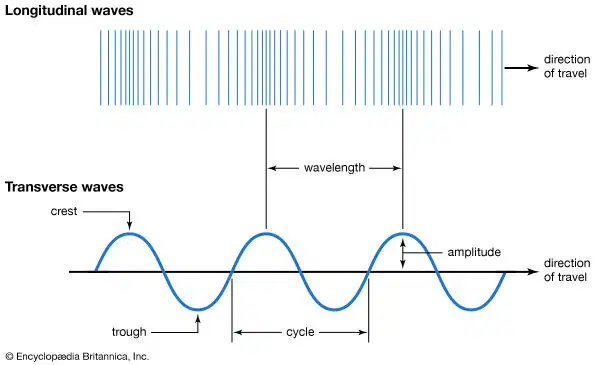
Based on the picture, choose the best description of how wavelength and frequency are related
a)
As wavelength increases, frequency increases
b)
As frequency increases, wavelength remains the same
c)
As frequency increases, wavelength decreases
d)
frequency and wavelength mean the same thing
5.
The orange line is measuring the _________________________.
a)
wavelength
b)
amplitude
c)
crest
d)
trough
6.
____________________  is the number of waves that move past one spot in a second
a)
energy
b)
amplitude
c)
wavelength
d)
frequency
7.
____________________  is the distance between two crests
a)
wavelength
b)
amplitude
c)
trough
d)
frequency
8.

The height of a wave crest is called

a)

wavelenght

b)

frequency

c)

amplitude

d)

energy

9.

For waves moving at a constant speed, if wavelength is doubled, the frequency is

a)

doubled

b)

halved

c)

unchanged

d)

quadrupled

10.

A large speaker is better than a small speaker for producing sounds with

a)

low frequency

b)

high frequency

c)

low intensity

d)

high intensity

11.

The highest-frequency sound human ears can usually hear is about

a)

20 Hz

b)

10,000 Hz

c)

20,000 Hz

d)

30,000 Hz

12.

Sonar can make use of

a)

the Doppler effect

b)

ultrasound

c)

infrasound

d)

resonance

13.

Sonar can make use of

a)

the Doppler effect

b)

ultrasound

c)

infrasound

d)

resonance

14.

Waves carry ______.

a)

matter

b)

momentum

c)

energy

d)

mass

15.
These waves require a medium to transfer energy.
a)
electromagnetic waves
b)
light waves
c)
x-rays
d)
mechanical
16.

This occurs when a wave bounces off of a boundary or object.

a)

diffraction

b)

reflection

c)

refraction

d)

absorption

17.

A change is frequency of a sound wave would change the

a)

volume

b)

pitch

c)

loudness

d)

pressure

18.

Sound can travel through a vacuum.

a)

True

b)

False

19.

In ____________________ interference, the energy of the combined wave is greater than the energy of each of the two waves.

a)

constructive

b)

destructive

c)

rarefraction

d)

combination

20.

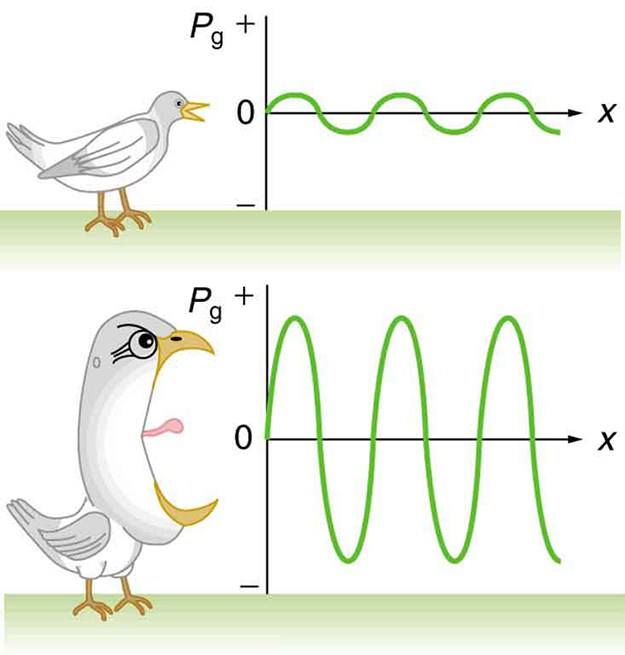
What happens when you increase the amplitude of a sound?

a)

The sound becomes louder.

b)

The soundwave travels faster

c)

The wavelength also increases.

d)

The frequency decreases.

21.

What can you tell about this object's motion from this illustration?

a)

Slowing down

b)

Standing still

c)

Moving to the left

d)

Moving to the right

22.
When the crest of one wave passes through the trough of another wave, ______ takes place.
a)
resonance
b)
diffraction
c)
destructive interference
d)
constructive interference
23.

One vibrating 440-hertz tuning fork transfers energy to another 440-hertz tuning fork, causing the second tuning fork to vibrate. This phenomenon is an example of

a)

reflection

b)

diffraction

c)

resonance

d)

refraction

24.

In the diagram which letters represent the nodes

a)

A B C

b)

A C E

c)

B D

d)

B D E

e)

A C D

25.

The moving black dot is called:

a)

a node

b)

an antinode

c)

an anti-amplitude

d)

the wavelength

26.

What is a sound wave?

a)

A pattern of vibrations caused by a disturbance

b)

ocean water moving back and forth

c)

guitar strings moving back and forth

27.

Sound waves can travel through a medium. What is a medium?

a)

Any solid, liquid, or gas sound travels through

b)

Anything that is not matter

c)

Empty space

28.

What is the WAVELENGTH of a sound wave? *

a)

How many waves pass through a point in 1 second

b)

The height of a wave from the resting point to crest

c)

The measurement from crest to crest or trough to trough

29.

What is the AMPLITUDE of a sound wave?

a)

The measurement from crest to crest or trough to trough

b)

The height of a wave from the resting point to crest

c)

How many waves pass through a point in 1 second

30.

What is the FREQUENCY of a sound wave? *

a)

The measurement from crest to crest or trough to trough

b)

The height of a wave from the resting point to crest

c)

How many waves pass through a point in 1 second

31.

FREQUENCY of a sound relates to the sound's ...

a)

Volume

b)

Pitch

c)

Loudness

d)

Sound

32.

AMPLITUDE of a sound relates to the sound's ...

a)

Volume

b)

Pitch

c)

Highness

d)

Sound

33.

What is #3?

(a)  

34.
Through which medium will sound waves travel the fastest?
a)
iron metal
b)
the vacuum of outer space
c)
air 
d)
water
35.
The general term for determining the position of an object by reflecting sound off of it is called...
a)
reverberation
b)
echolocation
c)
beats
d)
resonance
36.
A wave in which the oscillations are at right angles to the direction of wave travel is called a
a)

angular wave

b)

longitudinal wave

c)

oscillating wave

d)

transverse wave

37.
The technology that uses frequencies above those that we can hear is called...
a)
ultrasound
b)
infrasound
c)
supersound
d)
hypersound
38.
Which of the following actions will not produce sound?
a)
striking
b)
holding
c)
dropping
d)
rubbing
39.
All waves transmit...
a)
energy
b)
particles
c)
matter
d)
sound
40.
A jet fighter approaches, passes low overhead, and flies away. How does the pitch of its engine when it is flying away compare to the pitch when it was approaching you?
a)

louder

b)

lower

c)

higher

d)

unchanged

41.
A wave in which the oscillation are parallel to the direction of wave travel is a...
a)
transverse wave
b)
parallel wave
c)
longitudinal wave
d)
oscillating wave
42.
The phenomenon of a wave bouncing off a surface is called...
a)

refraction

b)

reflection

c)

rarefaction

d)

interference

43.
When a sound has become painfully loud it is called the...
a)

threshold of hearing

b)

threshold of pain

c)

fundamental frequency

d)

reverberation

44.
When a violin string responds to another violin string, we call that...
a)
acoustics
b)
reverberations
c)
resonance
d)
harmonics
45.
Multiple echoes of a sound is called...
a)
reverberations
b)
resonance
c)
acoustics
d)
harmonics
46.

In a transverse wave, the medium vibrates:

a)

at right angles to the wave direction

b)

in the same direction as the wave

c)

in a direction opposite that of the wave

d)

at a 45° angle to the wave direction

47.
These waves do not require a medium to transfer energy.
a)
electromagnetic waves
b)
mechanical waves
c)
sound waves
d)
longitudinal wave
48.
What is a repeating disturbance or movement that transfers energy through a medium or space?
a)
Energy
b)
Wave
c)
Trough
d)
Wavelength
49.
What is represented by A?
a)
amplitude
b)
wavelength
c)
crest
d)
trough
50.
True or false: Sound waves are mechanical waves.
a)
True
b)
False
51.
Sound waves travel fastest through _________.
a)
Solids
b)
Liquids
c)
Gases
52.
As frequency increases, wavelength ____________. 
a)
increases
b)
decreases
53.
Which wave has the longer wavelength?
a)
A
b)
B
54.
This is the number of waves passing a point in a second
a)
Frequency
b)
Amplitude
c)
wavelength
d)
crest
55.
All sounds start with a ________.
a)
light
b)
instrument
c)
vibration
56.
True or false: Sound can travel through a vacuum. 
a)
True
b)
False
57.
Which of these factors affects how fast a sound wave moves?
a)
the material it moves through
b)
the force of the vibration
58.

A wave is moving through a stretched-out rope, as shown. If the frequency of the waves being created is 1.40 Hz, the speed of the waves going down this rope is ___ m/s

59.

A wave is moving through a stretched-out spring, as shown. (a) If the speed of the waves moving down the spring is 2.20 m/s, the frequency of the waves being generated is ___ Hz.

60.

Pick the picture that shows: Doppler shift

a)
b)
c)
d)
e)
61.
When a sound is louder what measurement gets bigger?
a)
Frequency 
b)
Amplitude 
c)
Wavelength 
d)
Crest
62.
A wave with a large wavelength will have a ______ frequency and _____ energy
a)
high, low
b)
high, high
c)
low, high
d)
low, low
63.
Highest point of a wave
a)
crest
b)
trough
c)
wavelength
d)
frequency
64.
Sound is produced by
a)
music
b)
vibrations of molecules
c)
Electromagnetic Waves 
d)
Transverse Waves 
65.
A disturbance that transfers energy from one place to another without transferring matter.
a)
wave
b)
trough
c)
pitch
d)
sound
66.

If a wave is traveling at 250 m/s and has a wavelength of 2 m, what is its frequency?

a)

125 Hz

b)

500 Hz

c)

430 Hz

d)

160 Hz

67.

Which temperature causes sound to travel more slowly?

a)

hot

b)

cold

68.

A vibrating object makes 40 complete back and forth vibrations in 10 seconds. The frequency of vibration for the object is _____ Hertz.

a)

1

b)

4

c)

50

d)

400

69.

Consider Diagram A and Diagram B above. Compared to the wave in Diagram B, the wave in Diagram A has -

a)

the same amplitude and a larger wavelength.

b)

a larger amplitude and smaller wavelength.

c)

a smaller amplitude and the same wavelength.

d)

the same amplitude and a smaller wavelength.

70.

How many nodes does this standing wave have?

a)

5

b)

6

c)

7

d)

8

71.

The two pulses shown at the right are moving in opposite directions along the same medium. When they meet, _____ interference will occur.

a)

doppler

b)

resonance

c)

destructive

d)

constructive

72.

The two pulses shown at the right are moving in opposite directions along the same medium. When they meet, _____ interference will occur.

a)

destructive

b)

constructive

c)

doppler

d)

resonance

73.

Areas of increased pressure on a sound wave are known as a ----

a)

Rarefaction

b)

Compression

c)

Frequency

d)

Amplitude

74.
Waves transfer ________, but they do not transfer _________.
a)
Matter, Energy
b)
Energy, Matter
75.

Loudness of waves is measured in

a)

Hertz

b)

Decibels

c)

Watts

76.

Light and x-rays are examples

a)

Mechanical waves

b)

Electromagnetic waves

c)

Both

77.

Waves carry matter from place to place.

a)

True

b)

False

78.

What is the distance of a lightning bolt if it takes 3 seconds for you to hear the thunder after you see the flash. (speed of sound = 330 m/s)

a)

About 1 km

(1000 m)

b)

10,000 m

c)

330 m

d)

300 000 km