Worksheets
Physical Science Mid-Term
Total questions: 80
Worksheet time: 3hrs 30mins
A brick is resting on a level smooth surface. When a student applies a horizontal force of 5 N to the brick, the force of friction on the brick is also 5 N. Which statement BEST describes the effect of these two forces on the brick?
The net force on the brick is 0 N, and the brick begins to move.
The net force on the brick is 0 N, and the brick remains at rest.
The net force on the brick is 10 N, and the brick begins to move.
The net force on the brick is 0 N, and the brick remains at rest.

One person pulls on a rope with a force of 400 N to the left. Another person pulls on the rope opposite end with a force of 600 N to the right. What is the unbalanced net force?
200 N to the right
400 N to the right
600 N to the right
1000 N to the right
What is the Most reasonable explanation for why a toy car rolls farther on a wood floor than on thick carpet?
The car weighs more on the carpet.
The car weighs more on the floor.
The car has more resistance.
The car weighs less on the wood floor.
In a lab investigation, a student notes that two metal blocks have the same mass. Based on this observation, if the two blocks were put on opposite sides of a balance, they would BEST represent
balanced forces
unbalanced forces
equal and opposite reactions
objects in motion
When two unequal forces act in opposite directions on a moving object, the object will
absorb the forces
come to an immediate stop
move in the direction of the larger force
change direction
A ball rolls across the floor and slows down to a stop. Which force caused the ball to slow down.
friction
gravity
inertia
magnetic
A 20 N object is placed on a surface and starts to slide. What is the MOST likely reason the object begins to move.
Gravity exerts a balanced force on the object
An unbalanced force causes acceleration
Friction is applied to the object
The force acting on the object is in equilibrium

The diagram above shows
friction
gravity
balanced forces
unbalanced forces
A box is being pushed to the right with a force of 300 newtons, and to the left with a force of 400 newtons. What is the net force on the box.
300 newtons
400 newtons
700 newtons
100 newtons
Which statement BEST compares a parked car to a car moving along a straight line at a constant speed.
There are no forces acting on either car
Only the moving car is being subjected to forces
Both cars are being subjected to balanced forces
Only the parked car is subjected to balanced forces
Newton's first law of motion states:
An object in motion will remain in motion and an object at rest will remain at rest unless acted upon by an outside force.
Acceleration is produced when a force acts on an outside mass.
The greater the mass of the object, the greater the force needed to accelerate
For every action, there is an equal and opposite reaction
Newton's second law of motion states:
An object in motion will remain in motion and an object at rest will remain at rest unless acted upon by an outside force.
Acceleration is produced when gravity acts upon it.
The greater the mass of the object, the greater the force needed to accelerate
For every action, there is an equal and opposite reaction
Newton's third law of motion states:
An object in motion will remain in motion and an object at rest will remain at rest unless acted upon by an outside force.
Acceleration is produced when gravity acts upon it.
The greater the mass of the object, the greater the force needed to accelerate
For every action, there is an equal and opposite reaction

A student runs a distance of 2 meters in 15 seconds. What is his speed?
13 m/s
.133 m/s
133 m/s
13.30 m/s
Patrick traveled at a speed of 18 km/h for two hours. What was the distance traveled?
18 km
9 km
36 km
20 km
A train travels at a speed of 30 mph and travel a distance of 240 miles. How long did it take the train to complete it’s journey?
7200 hours
8 hours
80 hours
8.5 hours

An object with a mass of 2.0 kg accelerates 2.0 m/s2 when an unknown force is applied to it. What is the amount of the force?
40 N
4.0 N
.40 N
400 N


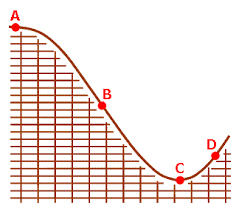
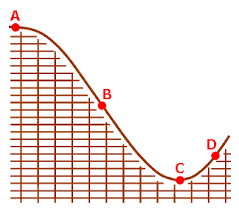
The energy associated with motion is called
gravitational potential energy.
kinetic energy.
elastic potential energy.
nuclear energy.
Unlike kinetic energy, potential energy is
energy of motion.
stored.
conserved.
not measurable.
A change from one form of energy into another is called
an energy transformation.
energy conservation.
work.
an energy increase.
When you rub your hands together on a cold day, you use friction to transform
mechanical energy into thermal energy.
thermal energy into nuclear energy.
nuclear energy into electrical energy.
electrical energy into electromagnetic energy.
What happens to the energy of a ball as it is dropped from a height of 10 m?
Potential energy is transformed into mechanical energy.
Mechanical energy is transformed into potential energy.
Potential energy is transformed into kinetic energy.
Kinetic energy is transformed into potential energy.
How can you minimize the transfer of thermal energy?
use a conductor
use an insulator
specific heat
use the Kelvin scale
A ball is about to roll down a ramp. What happens to the transfer of potential energy to kinetic energy if you make the ramp steeper?
No change
Kinetic energy increases
Kinetic energy decreases
There is no kinetic energy
In a machine, work output is less than work input because some energy is converted into ___________energy.
conservation of energy
thermal
electromagnetic
kinetic
mass
A large truck and a small car are moving at the same speed. The truck has greater kinetic energy because its __________ is greater
conservation of energy
thermal
electromagnetic
kinetic
mass


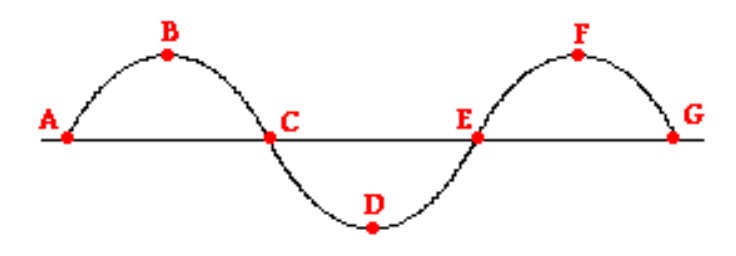



A stretched spring attached to two fixed points is compressed on one end and released as shown in the image. The resulting wave travels back and forth between the two fixed ends of the spring until it comes to a stop. This mechanical wave is an example of a
Transverse Wave
Longitudinal Wave
Refracted Wave
Reflection

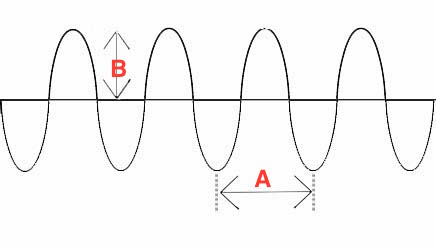
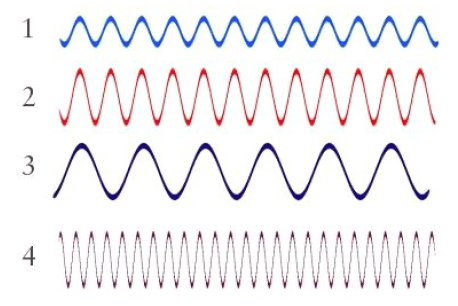
The two waves in the images are traveling at the same speed. Which statement best describes the difference between the waves?
Wave A has a higher frequency than wave B.
Wave A has a lower frequency than wave B.
Wave A has a higher amplitude than wave B.
Wave A has a lower amplitude than wave B.

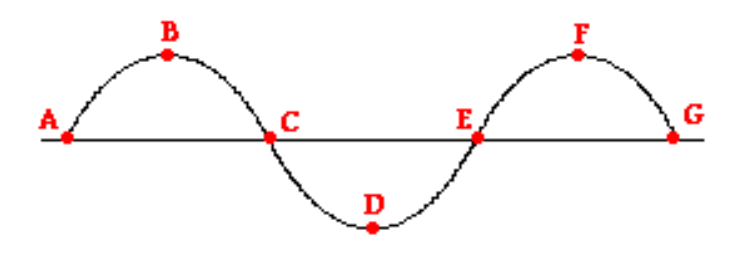
Distance Z is a measure of
amplitude
frequency
wavelength
wave speed
Which of the following statements applies to a longitudinal wave?
The motion of the medium is perpendicular to the motion of the wave
The motion of the medium is parallel to the motion of the wave
The motion of the medium is circular
The motion of the medium is random
What is the wavelength of a 264-Hz sound wave when the speed of sound is 345 m/s ? (v = λ⋅f)
0.77m
1.31m
6.09m
9.11m
You are responsible to log in to your classes and complete assignments regardless if we are in-person or remote learning.
True
False
Which is needed to determine the amount of gravitational force between two objects?
distance and mass
weight and time
area and weight