wayground logo

Free Printable Worksheets

Font size

S
M
L
XL
Worksheets

Ionic and Covalent Bonds

Total questions: 75

Worksheet time: 1hrs 23mins

Name
Class
Date
1.

What is a positive ion called?

a)

anion

b)

cation

c)

isotope

d)

covalent

2.

What is a negative ion called?

a)

anion

b)

cation

c)

covalent

d)

isotope

3.

How many electrons would a Nitrogen ion gain/lose? If it has 5 valence electrons.

a)

lose 5

b)

gain 5

c)

lose 3

d)

gain 3

4.

What is the ion formed from Sulfur? If it has 6 valence electrons.

a)

S+2

b)

S-2

c)

S+6

d)

S-6

5.

How many electrons would a Calcium ion gain/lose? If it has 2 valence electrons.

a)

lose 1

b)

gain 1

c)

lose 2

d)

gain 2

6.

If an atom loses electrons, the charge will be positive.

a)

true

b)

false

7.

A Bromine ion gains 1 electron, which of the following is the correct symbol for a Bromine ion?

a)

Br-1

b)

Br+1

c)

Br+7

d)

Br-7

8.
What is the charge of an atom that has lost one electron?
a)
-1
b)
-2
c)
+1
d)
+2
9.

An atom with 2 protons, 3 neutrons, and 4 electrons has a charge of ____.

a)

+2

b)

-2

c)

+3

d)

0

10.

If an element has 3 valence electrons, what charge will likely form on its ion ?

a)

+3

b)

+5

c)

-3

d)

-5

11.
Ions are: 
a)
atoms with a positive or negative charge
b)
atoms with no charge
c)
atoms with ONLY a positive charge
d)
atoms with ONLY a negative charge
12.

Na has 1 valence electron. It will have a charge of _______

a)

+1

b)

+2

c)

-1

d)

-2

13.

Be has 2 valence electron. It will have a charge of _______

a)

+1

b)

+2

c)

-1

d)

-2

14.

Ca has 2 valence electron. It will have a charge of _______

a)

+1

b)

+2

c)

-1

d)

-2

15.

Al has 3 valence electron. It will have a charge of _______

a)

+3

b)

-3

c)

+2

d)

-2

16.

P has 5 valence electron. It will have a charge of _______

a)

+3

b)

-3

c)

+2

d)

-2

17.

S has 6 valence electron. It will have a charge of _______

a)

-2

b)

-1

c)

+1

d)

+2

18.

Iodine has 7 valence electron. It will have a charge of _______

a)

-2

b)

-1

c)

+1

d)

+2

19.

F has 7 valence electron. It will have a charge of _______

a)

-2

b)

-1

c)

+1

d)

+2

20.

Oxygen has 6 valence electron. It will have a charge of _______.

a)

+1

b)

-1

c)

+2

d)

-2

21.
Why are ions formed?
a)
To make our lives difficult
b)
Because atoms want 8 valence electrons
c)
Because atoms have the same number of protons and electrons
d)
Because atoms gained neutrons
22.
Group 17 always has ions with a charge of 
a)
+1
b)
+2
c)
-1
d)
-2
23.
Which of the following has a -3 charge?
a)
Boron
b)
Fluorine
c)
Nitrogen
d)
Neon
24.
Elements on the LEFT side of the periodic table will most likely form:
a)
Positive ions
b)
Negative ions
c)
Neutral Ions
d)
None of these
25.
Ionic bonds form between two ions that have...
a)
ionic compounds
b)
negative charges
c)
positive charges
d)
opposite charges
26.
Which of the following is the correct name for MgCl2....
a)
Magnesium Clorine
b)
Magnesium Dicholorine
c)
Magnesium Cloride
d)
Magnesium Dichloride
27.
In order to have a stable arrangement of 8 valence electrons, metal atoms are likely to _________electrons.
a)
gain
b)
lose
28.
In an ionic compound, the total positive charge of all the positive ions ___________ the total negative charge of all the negative ions.
a)
equals
b)
is more than
29.
Ionic bonds are between...
a)
Metal and Non-metal
b)
Non-metal and Non-metal
c)
Metal and Metal
30.
How are ionic bonds formed?
a)
Transfer of electrons
b)
Sharing of electrons
31.
Why do elements bond?
a)
To be friends
b)
To create a new element
c)
To become stable
32.
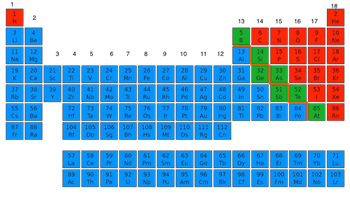
Where are the nonmetals located on the periodic table? 
a)
Blue
b)
Red
c)
Green
33.
Where are metals located on the periodic table?
a)
Blue
b)
Green
c)
Red
34.
Is this ionic bond drawn correctly?
a)
Yes
b)
No
35.

How many Aluminum atoms are in Al2O3?

a)

3

b)

5

c)

2

d)

1

36.

Valence electrons are found

a)

in the innermost energy level of an atom

b)

in the middle energy levels of an atom

c)

in the outermost energy levels of an atom

37.
Elements in the same _________ have the same number of valence electrons
a)
Row
b)
Group
c)
Metals
d)
Nonmetals
38.

A compound that has a formula of SrF2 is named:

a)

Calcium Fluoride

b)

Strontium Fluoride

c)

Fluorine Strontide

d)

Strontium Difluoride

39.

Which of the following is the correct ionic formula for calcium sulfide?

a)

Ca2S2

b)

CaS

c)

S2Ca2

d)

SCa

40.

Name the compound from it's formula: BaI2

a)

Iodine barium

b)

Iodine bariumide

c)

Barium iodine

d)

Barium iodide

41.
How do covalent bonds form?
a)
Donating & receiving valence e- between atoms.
b)
Opposite slight charges attract each other between compounds.
c)
Scientists are still not sure how they form.
d)
Sharing valence e- between atoms.
42.
What two types of atoms make a covalent bond?
a)
2 Nonmetals
b)
1 Nonmetal and 1 Metal
c)
2 Metals
d)
2 Noble Gases
43.
Group numbers on the periodic table help us determine 
a)
The number of valence electrons
b)
Color of the elements
44.
H2O
a)
Ionic Bond
b)
Covalent Bond
c)
Both bonds
d)
Neither bond
45.
Low melting point
a)
Ionic Bonds
b)
Covalent Bonds
c)
Both bonds
d)
Neither bond
46.

A neutral group of atoms held together by covalent bonds is a

a)

chemical formula

b)

molecular formula

c)

molecule

d)

polyatomic ion

47.
Name the following compound: 
N2O4
a)
dinitrogren tetraoxide
b)
tetranitrogen dioxide
c)
nitrogen oxide
d)
dinitrogen tetraoxygen
48.
Name the following compound: 
CO2
a)
monocarbon dioxide
b)
carbon oxide
c)
carbon dioxide
d)
oxygen carbonide
49.
Name the following compound: 
CCl4
a)
monocarbon quadchloride
b)
carbon tetrachloride
c)
carbon chloride
d)
monocarbon quadchloide
50.
Name the following compound:
NF3
a)
nitrogen triflouride
b)
mononitrogen triflouride
c)
nitrogen flouride
d)
tetranitroflouide
51.
Name the following compound:
H2O
a)
hydrogen oxide
b)
dihydrogen oxide
c)
trihydroxide
d)
dihydrogen monoxide
52.
Write the formula for:
dinitrogen tetroxide
a)
N2O4
b)
NO2
c)
NO
d)
N4O8
53.
Write the formula for:
dinitrogen pentoxide
a)
NO
b)
N2O5
c)
2NO5
d)
O5N
54.
Write the formula for:
disulfur decafluoride
a)
2SF10
b)
SF5
c)
S2F10
d)
F10S2
55.
Write the formula for:
chlorine trifluoride
a)
ClF3
b)
ClF
c)
Cl3F
d)
3ClF
56.
Write the formula for:
trilithium mononitride
a)
Li2N1
b)
Li3N3
c)
LiN3
d)
Li3N
57.
In an electron dot diagram, two pairs of shared electrons represents a ...
a)
single bond
b)
double bond
c)
triple bond
d)
quadruple bond
58.
A Nitrogen molecule (N2) has one triple bond. How many electrons do the nitrogen atoms share?
a)

1

b)
3
c)
4
d)
6
59.
Which of the following is NOT formed by a covalent bond?
a)
K2S
b)
H2O
c)
I2
d)
CO2
60.

An atom with 3 valence electrons "wants" a full shell, so it can either gain 5 or lose 3. Which is more likely to occur?

a)

Gain 5

b)

Lose 3

c)

Nothing

61.

Which two elements will form a covalent bond?

a)

Magnesium and Chlorine

b)

Sodium and Bromine

c)

Iron and Sulfur

d)

Carbon and Oxygen

62.

What is true about covalent compounds? (Check all that apply.)

a)

bonds are generally weak

b)

formed between metals and nonmetals

c)

low melting and boiling points

d)

solids are usually soft

63.

How are covalent compounds formed?

a)

when electrons are gained or lost

b)

when electrons are transferred

c)

when electrons are shared

d)

none of the above

64.

What is the name of CH3?

a)

Carbon (III) hydride

b)

Carbon hydroxide

c)

Carbon trihydride

d)

Carbon hydride

65.

What is the name of H2O2?

a)

Hydrogen oxide

b)

Hydrogen (II) oxide

c)

Dihydrogen dioxide

d)

Hydroxide

66.

What is the chemical formula for Carbon tetrachloride?

a)

C(ClO3)4

b)

C4Cl

c)

CCl4

d)

CClO3

67.

Which type of bond is the strongest?

a)

single bond

b)

double bond

c)

triple bond

d)

They are all the same.

68.

Sodium and Bromine will make a _____ bond

a)

Ionic

b)

Hydrogen

c)

Covalent

d)

Exploding

69.
What is the formula for Magnesium Carbonate?
a)
MgCO3
b)
Mg(CO3)2
c)
Mg2CO6
d)
Mg2CO3
70.
What is the FORMULA for....
beryllium iodide
a)
Be2I
b)
BeI
c)
BeI2
d)
BI2
71.
What is the NAME of....
Mg3N2
a)
magnesium (III) nitride
b)
magnesium (II) nitride
c)
magnesium (II) nitrogen
d)
magnesium nitride
72.
What is the NAME of....
Na2S
a)
sodium (II) sulfide
b)
sodium sulfide
c)
disodium sulfide
d)
sodium sulfur
73.

What is the correct formula for potassium oxide?

a)

KO2

b)

KO

c)

K2O

d)

OK2

74.

What is the formula for copper(II) phosphide?

a)

Cu2P3

b)

Cu3P2

c)

Cu3(PO4)2

d)

Cu2P

75.

In a bond between sodium and chlorine, which loses its valence electrons and why?

a)

sodium, because it is a metal

b)

chlorine, because it is a metal

c)

sodium, because it is a nonmetal

d)

chlorine, because it is a nonmetal