wayground logo

Free Printable Worksheets

NEW

Font size

S
M
L
XL
Worksheets

Trophic Levels Review

Total questions: 75

Worksheet time: 42mins

Name
Class
Date
1.
The efficiency of energy transfer from a lower trophic level to the next highest level is roughly
a)
1%
b)
10%
c)
100%
d)
1000%
2.
Trophic levels are represented by 
a)
squares
b)
circles
c)
pyramids
d)
lines
3.
Which animal is the apex predator?
a)
hawk
b)
lizard
c)
snake
d)
grass
4.
Which animal is not the apex predator but, a predator to a mouse?
a)
hawk
b)
rabbit
c)
snake
d)
grass
5.
Why is a shark a carnivore.
a)
because it eats seaweed
b)
because it eats dead animals
c)
because it eats sand 
d)
because it eats other animals
6.
The arrows in a food chain or web represents what?
a)
They point to the organism that is being eaten.
b)
It shows how sunlight flows within an ecosystem.
c)
They show what direction the energy is flowing between organisms. 
d)
They represent how water is transferred within a habitat.
7.
An organism that gets energy from breaking down dead organisms, non-living material or waste is a(an) ___________.
a)
producer
b)
consumer
c)
decomposer
d)
autotroph
8.
Organisms that create their own energy from sunlight or chemicals
a)
Herbivore
b)
Omnivore
c)
Autotroph
d)
Heterotroph 
9.
Eat primary consumers (can be carnivores and omnivores)
a)
Tertiary Consumers
b)
Secondary Consumers
c)
Quaternary Consumers 
d)
Top Predators 
10.
An organism that obtains energy from eating meats
a)
Omnivores
b)
Carnivores
c)
Herbivores
d)
Animals 
11.
An organism that obtains energy by consuming plants and animals.
a)
Omnivores
b)
Carnivores
c)
Herbivores
d)
Humans 
12.
An organism that uses an outside source of energy like the sun to create energy-rich food molecules.
a)
Consumer
b)
Producer
c)
Decomposer
d)
Parasite 
13.
Biomass refers to
a)
Chemical Energy
b)
Light Energy
c)
Rank in the feeding heirarchy
d)
Amount of living tissue at the tropic level
14.
The process of plants using energy from the sun to create the first trophic level is called?
a)
Photosynthesis
b)
Chemosynthesis
c)
Cellular Respiratation
d)
Primary Producers
15.

A producer

a)

Eats grass

b)

Makes its own food

c)

Does not need food(energy)

d)

Is a primary consumer

16.

A primary consumer

a)

makes its own food

b)

eats other animals

c)

is a carnivore

d)

consumes the producer

17.

An animal that only feeds on plants is called

a)

Vegetarian

b)

Herbivore

c)

Carnivore

d)

Vegan

18.

A secondary consumer

a)

A secondary consumer

b)

Only eats plants

c)

makes its own food

19.

Carnivores

a)

Animals that feeds on flesh and plants

b)

An animal that doesn't like meat

c)

An animal that feeds on flesh

d)

A human

20.

The first trophic level is

a)

Carnivore

b)

Producer

c)

Primary Consumer

d)

Herbivore

21.

tertiary consumers

a)

Eat the primary consumer

b)

Eat plants and animals

c)

Consume the producer

d)

eat the secondary consumer

22.

How much energy is moved from one trophic level to the next trophic level?

a)

100%

b)

1/2

c)

10%

d)

25%

23.

A food chain shows ___ feeding relationship(s)

a)

2

b)

multiple

c)

1

d)

all

24.

How many calories will be passed on from 250 to the next trophic level?

a)

2,500

b)

25

c)

2.5

d)

10%

25.

a primary consumer is always a

a)

omnivore

b)

carnivore

c)

omnivore or herbivore

d)

herbivore

26.

a producer always

a)

eats other producers

b)

gets energy from the sun

c)

is a herbivore

d)

is a plant

27.

Which trophic level makes its own food?

a)

producer

b)

carnivore

c)

herbivore

d)

animals

28.

A large community of organisms in a certain area is

a)

a trophic level

b)

an ecosystem

c)

a family

d)

consumers

29.

A food chain shows more feeding relationships than a food web

a)

true

b)

false

30.

What percent of calories will be passed from one trophic level to the next?

a)

100%

b)

25%

c)

10%

d)

50%

31.

A producer makes its own food.

a)

True

b)

False

32.

If a primary consumers have 650 kcals of energy available to them in the producers they eat, how many kcals of energy make it into the primary consumer trophic level?

a)

6.5

b)

65000

c)

650

d)

65

33.

An owl eats a rat that lived in an ecosystem where there was 2,800 kcals of energy in the insect population that the rat consumed. How many kcals would transfer to the trophic level the owl is in?

a)

28

b)

280

c)

2,800

d)

28,000

34.

A hawk eats a mouse that lived in an ecosystem where there is 10,000 kcals of energy in the insect population the mouse consumes. How much energy, in kcals, moves up to the trophic level the hawk is in?

a)

1 kcals

b)

10 kcals

c)

100 kcals

d)

1000 kcals

35.

What percent energy from the producers is available to primary consumers?

a)

25%

b)

12%

c)

8%

d)

10%

36.

In this food chain, what is the producer?

a)

Plants

b)

Freshwater Shrimp

c)

Minnow

d)

Perch

e)

Pike

37.

In this food chain, what is the primary consumer?

a)

Plants

b)

Freshwater Shrimp

c)

Minnow

d)

Perch

e)

Pike

38.

In this food chain, what is the secondary consumer?

a)

Plants

b)

Freshwater Shrimp

c)

Minnow

d)

Perch

e)

Pike

39.

In this food chain, what is the tertiary consumer?

a)

Plants

b)

Freshwater Shrimp

c)

Minnow

d)

Perch

e)

Pike

40.

In this food chain, what is the quaternary consumer?

a)

Osprey

b)

Freshwater Shrimp

c)

Minnow

d)

Perch

e)

Pike

41.

Look carefully at the image. If energy is lost as it moves up the food chain, what trophic level has the most amount of energy?

a)

1st level - producers

b)

2nd level - primary consumers

c)

3rd level - secondary consumers

d)

4th level - tertiary consumers

42.
Trophic levels are represented by 
a)
squares
b)
circles
c)
pyramids
d)
lines
43.

What organisms can take energy from the sun to create its own energy in the form of glucose?

a)

Primary consumers

b)

Primary producers

c)

Secondary consumers

d)

Tertiary consumers

44.

The primary consumer in this image is the....

a)

Hawk

b)

Grass

c)

Grasshopper

45.

The omnivores in this diagram are the .....

a)

Grass

b)

Rabbits

c)

Snakes

d)

Hawk

46.

If a primary producer has 1,000 Joules of energy, then how much energy would a primary consumer get?

a)

100 J

b)

10 J

c)

1 J

d)

10,000 J

47.

Which organisms go through photosynthesis?

a)

Primary producers

b)

Primary consumers

c)

Secondary consumers

d)

Tertiary consumers

48.

Secondary consumers are also known as...

a)

Herbivores

b)

Omnivores

c)

Carnivores

49.

The following are example of ....

a)

Primary producers

b)

Primary consumers

c)

Decomposers

d)

Secondary consumers

50.

Which organism eats every other organism on the trophic levels?

a)

Tertiary consumers

b)

Decomposers

c)

Primary producers

d)

Primary consumers

51.

An organism that obtains energy from eating animal tissue.

a)

Omnivores

b)

Carnivores

c)

Herbivores

d)

Animals

52.

An organism that obtains energy by consuming plants and animals.

a)

Omnivores

b)

Carnivores

c)

Herbivores

d)

Humans

53.

An organism that uses an outside source of energy like the sun to create energy-rich food molecules.

a)

Consumer

b)

Producer

c)

Decomposer

d)

Parasite

54.

An organism that eats both plants and animals are know as a

a)

Carnivore

b)

Omnivore

c)

Herbivore

d)

Decomposer

55.

What is the first source of energy for all food webs?

a)

Plants

b)

Sunlight

c)

Mineral in the soil

d)

Decomposers

56.

Apex Predator

a)
b)
c)
d)
57.
Which of the following is a herbivore?
a)
cricket
b)
frog
c)
hawk
d)
shrew
58.
Which organism recieves the least amount of energy from the producer?
a)
Owl
b)
Grasshopper
c)
Lilypad
d)
Mouse
59.
In an energy pyramid, energy_______ as you move up the pyramid.
a)
Increases
b)
Decreases
c)
Stays the same
d)
Changes up and down
60.
When humans burn fossil fuels, most of the carbon quickly enters the                       as carbon dioxide.
a)
Water
b)
Atmosphere
c)
Sun
d)
Air
61.
Which one of these does not add CO2 to the atmosphere?
a)
cooking with gas
b)
planting trees
c)
burning wood
d)
riding in a bus
62.
What does not produce carbon dioxide?
a)
Photosynthesis
b)
Burning Fossil Fuels
c)
Animal respiration
d)
Plants decaying
63.
How do living organisms return carbon to the atmosphere in the carbon cycle?
a)
respiration and photosynthesis
b)
 decomposition and respiration
64.
In the carbon cycle, producers take in the gas __
a)
carbon dioxide
b)
oxygen
c)
nitrogen
d)
carbon monoxide
65.
How does the carbon in grass become part of a lion?
a)
The lion eats the grass
b)
Carbon from grass doesn't end up in a lion. 
c)
The carbon ends up in the lion's food chain. 
d)
The lion breathes in carbon given out by the plant
66.
All of the carbon in existence is continually recycled in the carbon cycle
a)
True
b)
False
67.
Which of the following removes carbon from the atmosphere?
a)
Combustion
b)
Respiration
c)
Photosynthesis
d)
Death
68.
Organisms that do not decompose can be buried and become what?
a)
water
b)
nutrients
c)
air
d)
fossil fuels
69.
If the plant population decreased, the amount of carbon would _________.
a)
Stay the same
b)
Increase
c)
Decrease
70.

Which is a true statement?

a)

Humans depend on oxygen, plants depend on carbon dioxide

b)

Plants produce carbon dioxide

c)

Humans depend on carbon dioxide, plants depend on oxygen

d)

Humans don't depend on plants for the air they need
71.
Combustion is another word for __________.
a)
Transportation
b)
Respiration
c)
Fossil Fuels
d)
Burning
72.
Carbon can be found in...
a)
The atmosphere
b)
Soil
c)
Fossil fuels
d)
All of the above
73.
Respiration is the process by which animals take in _____ and release _____. 
a)
photosynthesis, air
b)
carbon, oxygen
c)
oxygen
d)
oxygen, carbon dioxide
74.
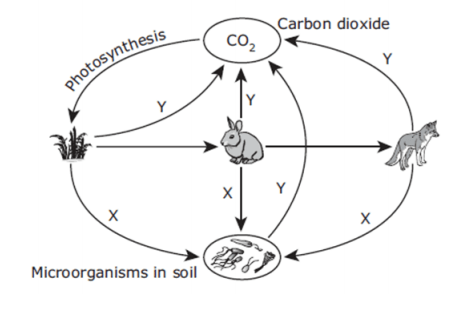
The diagram shows the flow of organic molecules through an ecosystem. What two processes are identified by the labels X and Y?
a)
X : Respiration
Y : Predation
b)
X : Adaptation
Y : Decomposition
c)
X : Fermentation
Y : Nitrogen Fixation
d)
X : Decomposition
Y : Respiration
75.
The average temperature of the surface of Earth has increased approximately 1°C in the past century. Which reason best explains this increase in temperature?
a)
lower levels of ozone in the atmosphere
b)
lower levels of nitrogen in the atmosphere
c)
higher levels of carbon dioxide and other greenhouse gases in the atmosphere
d)
higher levels of oxygen in the atmosphere