
 Worksheets
HOMS Review: Mid-Year Exam
Total questions: 70
Worksheet time: 1hrs 2mins
is a chemical property of a material.
What determines the physical and chemical properties of matter?
The type of reactions the matter is involved in
The type of atoms that make up the matter and their arrangement
The state of matter (solid, liquid, gas, plasma)
The temperature and pressure conditions the matter is exposed to
What is the density of water?
0.5 g/cm³
1 g/cm³
1.5 g/cm³
2 g/cm³
What is the equation to calculate density?
D = volume / mass
D = mass * volume
D = mass / volume
D = mass + volume
If an object has a mass of 200 grams and a volume of 600 cm³, what is the density? g/cm³
0.5 g/cm³
1.5 g/cm³
2 g/cm³

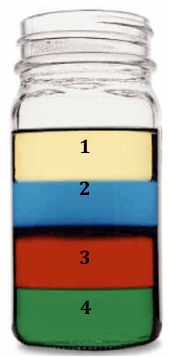

A graduated cylinder is used to measure...
Volume
mass
weight
density

Which box has a higher density?
A
B
They both have the same density.
Light
Matter
Not Matter
Sound
Matter
Not Matter
atoms
matter
not matter

What subatomic particle is the arrow pointing towards?
Proton
Neutron
Electron
The majority of the mass of an atom is found in the
Proton
Neutron
Electron
Nucleus
The smallest unit of matter is a(n)
molecule
element
atom
compound

What subatomic particle is the arrow pointing towards?
Proton
Neutron
Electron
Electrons have a ________ charge.
Positive
Negative
Neutral
What subatomic particle determines the element of the atom?
Proton
Neutron
Electron

What subatomic particle is the arrow pointing towards?
Proton
Neutron
Electron
Atoms are mostly _________ space.
Crowded
Empty
Outer
Filled
The atomic number tells you what?
number of electrons
number of protons
number of neutrons
both electrons and protons in an atom.

The periodic table is organized into columns called _______ and rows called ______.
groups and periods
periods and groups
categories and periods
categories and groups
The chart that shows the arrangement of elements in order by their atomic number
Electron Cloud
Periodic Table
amu
Atomic Mass
The sum of the protons and neutrons in the nucleus of an atom
Atomic Number
Compound
Electrons
Mass Number (also called Atomic Mass)
The part of the atom that determines the identity of the atom is the ____________.
proton
nucleus
electron
neutron

_________are not good conductors of heat or electricity.
Metals
Metalloids
Nonmetals

The blue elements are called
metals
nonmetals
metalloids
noble gases

The elements along the staircase are called
metals
nonmetals
metalloids
noble gases

What does the 1.00794 stand for?
Hydrogen
atomic number
atomic mass
atomic explosion
The total number of protons and neutrons in the nucleus of an atom
Atomic Number
Mass Number
Atomic Theory
Electron Cloud
All matter is made of _________.
energy
atoms
electrons
compounds

What is the atomic number of Boron?
5
11
6

What is the atomic mass of Boron?
5
11
6

How many protons does Boron have?
5
11
6

How many electrons does Boron have?
5
11
6


Allows heat or electricity to go through
insulator
conductor
luster
ductile
Able to be drawn into wire is
malleable
insulator
luster
ductile
Elements in which group almost never react with other elements?
Noble Gases
Metalloids
Nonmetals
Alkali Earth Metals
Where are the least reactive elements on the periodic table located?
The top of the periodic table
The bottom of the periodic table
The far left side of the periodic table
The far right side of the periodic table
An element on the far left side of the periodic table would be
very reactive
not reactive at all
it depends
A formula is used to represent a __________.
element
compound
mixture
H2O
element
compound
mixture
Mud
element
compound
mixture

How would you classify the matter in the picture above?
Element
Compound
Homogeneous Mixture
Heterogeneous Mixture

How would you classify the matter in the picture above?
Element
Compound
Homogeneous Mixture
Heterogeneous Mixture

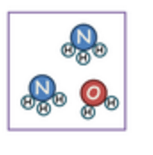

What type of substance is being modeled here?
pure substance of one element
mixture of two elements
mixture of two compounds
pure substance of one compound
Rusting metal is an example of a ____ change.
chemical
phase
state
physical


One of the signs of a chemical reaction taking place is:
Bubbles are produced
Reactants are not combining
Products are not forming
Color is not changing
In NH3, how many Nitrogen's are there?
1
2
3
4
According to the law of conservation of mass, which statement is true?
The atoms of the reactants and products are different
The atoms of the reactants and products are equal
The subscripts must be the same
The compounds must be the same

Does this follow the law of conservation of mass?
Yes, because there are the same number of atoms.
Yes, because there are not the same number of atoms.
No, because there are the same number of atoms.
No, because there are not the same number of atoms.
Which equation follows the law of conservation of mass?
Na + Cl2 --> NaCl
Na + Cl2 --> 2NaCl
2Na + Cl2 --> NaCl
2Na + Cl2 --> 2NaCl
This chemical equation represents what happens when a nail rusts: 4Fe + 3O2 –› 2Fe2O3. The total mass after the reaction is
not considered before the reaction.
5 times less than before the reaction.
exactly the same as before the reaction.
about twice as much as before the reaction.

