wayground logo

Free Printable Worksheets

NEW

Font size

S
M
L
XL
Worksheets

Earth 2 Review

Total questions: 65

Worksheet time: 42mins

Name
Class
Date
1.

Which type of plate boundary would cause mountains to form?

a)

Transform

b)

Convergent

c)

Divergent

d)

Reform

2.
This layer of Earth is solid Iron and Nickel
a)
Outer Core
b)
Mantle
c)
Inner Core
d)
Crust
3.
The Great Rift Valley in Africa and the Mid-Ocean Ridge were all created by this boundary
a)
Divergent
b)
Convergent
c)
Reform
d)
Transform
4.
This layer of Earth is the thickest part
a)
crust
b)
outer core
c)
mantle
d)
inner core
5.
What are the two types of crust
a)
continental and oceanic
b)
ocean and upper
c)
lower and upper
d)
pizza and subway
6.
Which layer has convection currents?
a)
Inner Core
b)
Outer Core
c)
Mantle
d)
Crust
7.
subduction zones in the ocean can create which features?
a)
islands
b)
volcanoes
c)
earthquakes
d)
all of the above
8.
Earthquakes and volcanoes are most likely found in which locations?
a)
At plate boundaries
b)
in oceans
c)
in the middle of continents
d)
in the middle of plates
9.
When one plate sides under neath another, it _________ and the magma _________.
a)
hardens, sinks
b)
melts, sinks
c)
hardens, rises
d)
melts, rises
10.
The Himalayas in Asia are an example of what type of plate boundary?
a)
divergent
b)
continent-to-continent convergent
c)
ocean-to-continent convergent
d)
transform
11.
Transform boundaries are most likely to produce what phenomenon?
a)
volcanoes
b)
deep sea trenches
c)
underwater mountain ranges
d)
earthquakes
12.
When an oceanic plate and a continental plate collide, which one will subduct?
a)
oceanic
b)
continental
c)
neither
13.
Which of the following is NOT a tectonic boundary?
a)
Convergent
b)
Divergent
c)
Sedergent
d)
Transform
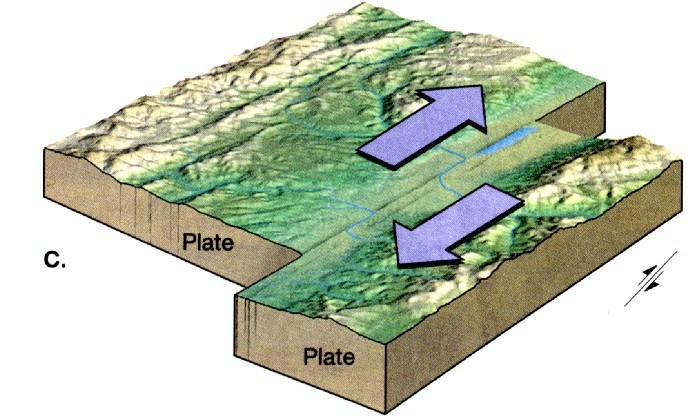
14.
What is this image...
a)
Revolving boundary
b)
San Andreas (Transform)
c)
Convergent
15.
Two tectonic plates collide at a _______ plate boundary.
a)
convergent
b)
divergent
c)
transform
16.
The area where two tectonic plates meet.
a)
mantle
b)
focus
c)
plate boundary
d)
convection
17.
Most volcanoes and earthquakes occur...
a)
along the coast
b)
along tectonic plate boundaries
c)
in the Arctic
d)
in the ocean
18.
This landform can occur at a divergent plate boundary.
a)
ocean trench
b)
mid-ocean ridge
c)
tall mountains
d)
transform fault
19.
A continental rift valley can be formed from stretching continental crust at...
a)
transform plate boundaries
b)
convergent plate boundaries
c)
divergent plate boundaries
d)
all plate boundaries
20.
A mid-ocean ridge occurs at a ________ plate boundary.
a)
transform
b)
convergent
c)
divergent
21.
What type of boundary is the SAN ANDREAS FAULT on?
a)
Covergent
b)
Transformers
c)
Divergent
d)
Transform
22.
What is the name of the plate boundary that slides past each other?
a)
Divergent
b)
Convergent
c)
Transform
d)
Mr. C the Slide Man
23.
Which of these events can ONLY happen on a DIVERGENT BOUNDARY?
a)
Rift Valley
b)
Mountain
c)
A peninsula
d)
An Insanely complex, long answer that you will click out of instinct. 
24.
The type of plate boundary where two plates come together is a .....
a)
Convergent Boundary
b)
Divergent Boundary
c)
Transform Boundary
d)
Plate Boundary
25.
Which of the following causes Earth's tectonic plates to move?
a)
Energy from the Sun
b)
Magnetic Pole Reversal
c)
Convection currents in the mantle
d)
Faults in Mountain Ranges
26.
What type of plate boundary is this?
a)
Plate
b)
Divergent
c)
Convergent
d)
Transform
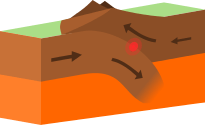
27.
What type of event will occur at this boundary?
a)
Earthquake
b)
Volcano Eruption
c)
Tornado
d)
Mountain Building
28.
A divergent boundary occurs when plates ....
a)
Pull apart
b)
Come together
c)
Slide past each other
d)
subducting
29.
Which of the following is the name of the ancient supercontinent formed 28 Million Years ago.
a)
Pangea
b)
Gondwanda
c)
Laurasia
d)
Neverland
30.
What type of plate boundary is this?
a)
Transform
b)
Convergent
c)
Divergent
d)
Plate
31.
The theory that says Earth's continents once made up an ancient supercontinent, and have been drifting apart ever since, is called the theory of...
a)
Pangea
b)
Plate Tectonics
c)
Natural Selection
d)
Gravity
32.

Oceanic Trenches are formed by _______ plate boundaries

a)

Convergent

b)

Transform

c)

Plate

d)

Divergent

33.
A fault is formed by the movement of a __________ plate boundary
a)
Transform
b)
Convergent
c)
Divergent
34.
Islands can from from magma which is pushed up at a __________ plate boundary
a)
Divergent
b)
Convergent
c)
Transform
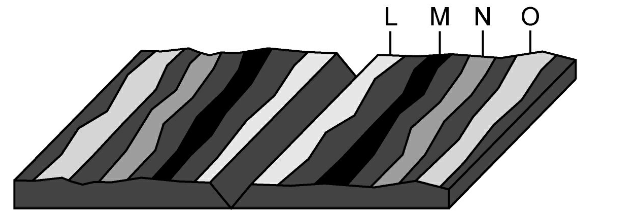
35.
Where would the oldest rock be found?
a)
L
b)
M
c)
N
d)
O
36.
Mountains are created when....
a)
Two continental plates collide
b)
Two oceanic plates pull apart
c)
An Oceanic plate subducts under a Continental Plate
d)
Two continental plates pull apart
37.

_______ are created and found in soil, in rocks, in seashells, or deep in the earth.

a)

Elements

b)

Crystals

c)

Minerals

38.

Particles of __________ make up sediment.

a)

Rock

b)

Sand

c)

Plant and animal remains

d)

All of the above

39.

Minerals can have a metallic or nonmetallic _____________.

a)

Color

b)

Density

c)

Luster

40.

A reliable way to test and identify a mineral is to look at its ___________.

a)

Streak

b)

Size

c)

Hardness

41.

___________ is when a mineral breaks leaving a rounded or irregular surface.

a)

Fracture

b)

Hardness

c)

Cleavage

42.

Galena is almost three times as heavy as quartz, so it is __________.

a)

Softer

b)

Denser

c)

Lighter

43.

Wind and water ____________ sediment on land and on the bottoms of rivers, lakes, and oceans.

a)

Deposit

b)

Particles

c)

Surface

44.

The compacting and cementing of the sediment form _______________ of rock.

a)

Deposits

b)

Surfaces

c)

Layers

45.

Sedimentary rock can be classified based on how it is _________________.

a)

Compacted

b)

Cemented

c)

Formed

46.

There are ________________ types of sedimentary rock.

a)

Five

b)

Three

c)

Seven

47.

__________ are pieces of bones and shells that can be found in sedimentary rock.

a)

Fossils

b)

Chalk

c)

Cement

48.

Heat and pressure melt rocks to form ______________.

a)

Ash

b)

Magma

c)

Lava

49.

Rocks on the surface change with _____________ and erosion.

a)

Weathering

b)

Magma

c)

Forces

50.

If a rock contains many crystals, its texture will be _______________.

a)

Smooth

b)

Coarse

c)

Hard

51.

The lava that forms extrusive igneous rocks cools quickly so _____________ crystals form.

a)

Few to no

b)

Many

c)

None

52.

Plants and animals that were buried by volcanic ash, sand, or sediment on the bottoms of oceans, lakes, and rivers became __________________.

a)

Trilobites

b)

Fossils

c)

Rocks

53.

A mineral's hardness is its ability to resist being ____________.

a)

Scratched

b)

Broken

c)

Wet

54.

_____________ is when a mineral breaks leaving a rounded or irregular surface.

a)

Cleavage

b)

Fracture

c)

Density

55.

Rocks that form when magma _________ and hardens are called igneous rocks.

a)

Heats

b)

Cools

c)

Stays the same temperature

56.

Intrusive rocks form when magma cools ____________ below the earth's surface.

a)

Quickly

b)

Slowly

c)

At a regular pace

57.

Magma reaches the earth's surface becomes _________________.

a)

Gas

b)

Lava

c)

Ash

58.

Extrusive rocks form when magma reaches the earth's surface, becomes lava, and cools _________________.

a)

Quickly

b)

Slowly

c)

At a regular pace

59.

A new island is mainly made of which type of rock?

a)

Igneous

b)

Sedimentary

c)

Metamorphic

d)

None of the Above

60.

What is the name of the tectonic plate labeled at "X"?

a)

North American Plate

b)

South American Plate

c)

African Plate

d)

Indo-Australian Plate

61.

What geologic event will occur at a transform boundary?

a)

Earthquake

b)

Ocean basin

c)

Rift Valley

d)

Mountain building

62.

Which diagram(s) illustrate the type of movement that could result in the formation of continental mountain building?

a)

Diagram 1

b)

Diagram 2

c)

Diagram 3

d)

Diagram 1 & 3

63.

Which diagram(s) illustrate the type of movement that could result in the formation of an ocean basin?

a)

Diagram 1

b)

Diagram 2

c)

Diagram 3

d)

Diagram 1 & 3

64.

Which mineral sample has a hardness less than 2.5?

a)

Sample 1

b)

Sample 2

c)

Sample 3

d)

Sample 4

65.

Which type of rock will have a process of heat and pressure?

a)

Igneous

b)

Metamorphic

c)

Sedmentary

d)

Magma