wayground logo

Free Printable Worksheets

Font size

S
M
L
XL
Worksheets

Hard Core STAAR review Grade 8

Total questions: 177

Worksheet time: 3hrs 2mins

Name
Class
Date
1.
Thomas Jefferson wrote what famous document?
a)
Pennsylvania Gazette
b)
Declaration of Independence
c)
Green Eggs and Ham
d)
Poor Richards Almanac
2.
Who led the army during the American Revolution?
a)
Ben Franklin
b)
Jack Uzzi
c)
George Washington
d)
Donald Trump
3.
This was added to the Constitution and lists our most important rights
a)
Bill of Rights
b)
Bill of Lefts
c)
Bob of Rights
d)
Chicken Nuggets taste delicious
4.

This document states laws and the plan for how the government of our country works

a)

Constitution

b)

Compromise

c)

Congress

d)

Cold

5.

Who was the first president of the United States?

a)

James Madison

b)

George Washington

c)

Abe Lincoln

d)

Thomas Jefferson

6.
What was the name of the Almanac written by Ben Franklin?
a)
The Reading Eagle
b)
Go Math
c)
Poor Frank's Almanac
d)
Poor Richard's Almanac
7.

Paine begins his essay with the phrase “These are the times that try men’s souls” (1) he is suggesting that

a)

, not women, will suffer in the events that are coming

b)

This is a time that forces people to show their true selves

c)

a period of boredom is coming for the colonists

d)

those who fight in the revolution will be saved

8.
What is the main purpose of Paine's essay?
a)
It is a summons for peace and rational thinking.
b)
It is overemotional preaching for equality.
c)
It is a patriotic call to duty and action.
d)
It is a demand for immediate liberty from England.
9.
Harriet Beecher Stowe, Frederick Douglass and William Lloyd Garrison all used which of the following methods to abolish slavery?
a)
boycotts
b)
speeches
c)
written words
d)
all of the above
10.
Which of the following people lead hundreds of enslaved people to freedom on the Underground Railroad and was a spy for the Union Army during the Civil War?
a)
John Brown
b)
Sojourner Truth
c)
Harriet Tubman
d)
Frederick Douglass
11.
I wrote a powerful story about an enslaved family that Southerners called "propaganda" but caused many Northerners to become abolitionists. 
a)
Harriet Tubman
b)
Harriet Beecher Stowe
c)
Sojourner Truth
d)
Frederick Douglass
12.
"As the first runaway slave to speak publicly, I asked for abolition immediately and I called for slaves to lead the fight in this cause." Which of the following people made this statement?
a)
Frederick Douglass
b)
Sojourner Truth
c)
William Lloyd Garrison
d)
Susan B. Anthony
13.
Who was the author of the anti-slavery  newspaper  "The Liberator"? This man also wrote and persuaded President Lincoln to free all slaves during the Civil War.
a)
John Brown
b)
Nat Turner
c)
Frederick Douglass
d)
William Lloyd Garrison
14.
The network of escape routes out of the South for enslaved people was known as the _____.
a)
Freedom Trail
b)
Slave Network
c)
Underground Railroad
d)
Southern Railroad
15.
Which of the following reasons best explains why the number of slaves increased between 1820 and 1860?
a)
The population of free African Americans also rose during this period.
b)
Many people in the South thought slavery was wrong but necessary.
c)
The increasing demand for cotton required more plantation workers.
d)
Stricter slave codes kept slaves from revolting and running away.
16.

______ lived alone for two years at ________.

a)

Emerson; Walden Pond

b)

Correll; Toms River

c)

Clayton; Bamber Lake

d)

Thoreau; Walden Pond

17.

"Civil Disobedience" is an essay by Thoreau that inspired:

a)

passive resistance

b)

Mahatma Gandhi

c)

Martin Luther King Jr.

d)

All three

18.
Columbus started his journey in the year ________.
a)
1592
b)
1492
c)
1892
d)
1992
19.

What company did John Smith join?

a)

Discovery Company

b)

Jamestown Company

c)

Virginia Company

d)

London Company

20.
John Smiths' one rule was the following:
a)
"if you don't work, you will eat."
b)
"if you don't work, you don't eat."
c)
"if you don't eat, you don't work."
21.
Washington's Secretary of the Treasury was:
a)
Benjamin Franklin
b)
Thomas Jefferson
c)
John Adams
d)
Alexander Hamilton
22.
A tax on imports is called a:
a)
whiskey tax
b)
tariff
c)
cabinet
d)
bond
23.
The only President without a political party was:
a)
Washington
b)
Adams
c)
Jefferson
d)
Hamilton
24.
The Neutrality Proclamation stated that:
a)
America would not be involved in foreign affairs
b)
America would not be involved in the war between Britain and France
c)
America would not trade with Britain or France
d)
All of these
25.
Jay's treaty stated that:
a)
Britain was sorry for attacking U.S. ships
b)
Britain would pay for U.S. ships it destroyed
c)
The U.S. would not trade with France
d)
The British would stop attacking U.S. ships
26.
Supporters of Alexander Hamilton created which Political Party?
a)
Federalist
b)
Democratic-Republican
c)
Whig
d)
Tupperware
27.
WASHINGTON'S FIRST SEC. OF STATE WAS _________________.?
a)
CONDOLEESA RICE
b)
JOHN ROBERTS
c)
THOMAS JEFFERSON
d)
BEN FRANKLIN
28.
This battle was considered the turning point of the American Revolution. Because of this important victory, we were able to gain support from France and Spain.
a)
Trenton
b)
Lexington & Concord
c)
Saratoga
d)
Battle of Bull Run
29.
WASHINGTON PUT DOWN THIS UPRISING DURING HIS FIRST TERM.
a)
WHISKEY REBELLION
b)
BOSTON MASSACRE
c)
STAMP ACT
d)
BUNKER HILL
30.
WASHINGTON SET A PRESIDENTIAL TRADITION BY NOT DOING WHAT?
a)
WEARING A WIG
b)
SHAKING HANDS
c)
STANDING DURING HIS INNAUGURATION
d)
NOT SERVING A THIRD TERM
31.
Washington advised against political parties. The New Republic should go in the same direction, political parties would offer differing views and tear the country in half. Which document was this advice given?
a)
Monroe Doctrine
b)
Farewell Address
c)
Missouri Compromise
d)
Democratic-Republican
32.
George Washington was unanimously voted into the role of president. It was because he displayed
a)
civic virtue
b)
civil disobedience
c)
arrogance
d)
confidence
33.

Boston Tea Party, Shay's Rebellion

Whiskey Rebellion are examples of _________

a)

civil disobedience

b)

civic virtue

c)

foreign issues

d)

democracy

34.
This was the last battle and it ended the American Revolution.
a)
Battle of Yorktown
b)
Battle Saratoga
c)
Lexington & Concord
d)
Trenton
35.
According to the Declaration of Independence, what truth was "self-evident"?
a)
All men are created equal
b)
Rights are given by good kings
c)
Government exists to protect us from ourselves
d)
Only a democracy can protect our rights
36.
Who was the main author of the Declaration of Independence?
a)
Benjamin Franklin
b)
Samuel Adams
c)
Thomas Jefferson
d)
Paul Revere
37.
What are our natural rights according to Jefferson?  (He got the idea from John Locke, but he changed the last right.)
a)
Freedom of speech, religion, and press
b)
Life, liberty, and property
c)
Life, liberty, and the pursuit of happiness
d)
Voting, rebelling, and health
38.
According to the Declaration of Independence, where does government get its power?
a)
From the King
b)
From the Supreme Court
c)
From God
d)
From the people
39.
Why was the Declaration of Independence written?
a)
To stop taxes from the British Empire.
b)
To make a United States army.
c)
To gain independence from the British Empire
d)
To install their own king in America
40.
The List of Grievances were the part of the Declaration that
a)
detailed the colonists' complaints with King George.
b)
listed a man's natural rights.
c)
introduced the Declaration.
d)
concluded the Declaration, declaring America a free country.
41.
Why is July 4, 1776 an important date in U.S. history?
a)
Common Sense was published.
b)
The Olive Branch Petition sent to King George III.
c)
The American Revolution ends.
d)
The Declaration of Independence is signed.
42.
To Great Britain, the signing of the Declaration of Independence was
a)
an act of loyalty.
b)
an act of treason.
c)
an act of bravery.
d)
an act of insanity.
43.
Thomas Jefferson was inspired by a famous man of the Enlightenment.  His name was...?
a)
William Penn
b)
Roger Sherman
c)
John Locke
d)
Robert Livingston
44.
When Thomas Jefferson copied John Locke's ideas about the social contract, what did he say the people had the right to do to a government who was not protecting the people's rights?
a)
Write a letter
b)
Suggest how it could be better
c)
Wait until they started to respect the people's rights
d)
Abolish it
45.

What was the purpose of the Olive Branch Petition?

a)

to avoid war with Britain

b)

to spread political ideals throughout the colonies

c)

to boycott British goods

d)

to get approval for the Declaration of Independence

46.
What are unalienable rights?
a)
rights that the king gives you
b)
rights that you have to earn
c)
rights that you are born with and can't be taken away from you
d)
rights that can be taken away if you disobey the laws
47.

The Declaration of Independence was a message to power (King of England). This document was written during the

a)

Second Continental Congress

b)

First Continental Congress

c)

Virginia House of Burgesses

d)

Stamp Act Congress

48.

How did the King respond to the Second Continental Congress's requests?

a)

He sent a representative to negotiate

b)

He hired foreign troops from Germany and prepared for war

c)

He passed a new series of laws to punish the colonists

d)

He invaded Philadelphia

49.

What system of government did the Second Continental Congress establish?

a)

School Systems

b)

Electoral College

c)

Articles of Confederation

d)

Shipping Season

50.
Who said, "don't fire until you see the whites of their eyes?"
a)
Colonel William Prescott
b)
George Washington
c)
Thomas Jefferson
d)
Ben Franklin
51.
Why did Paul Revere ride his horse to Concord at midnight?
a)
To tell the colonist the Queen of England was on the ship
b)
To tell the colonist to pay their taxes quickly
c)
To warn the colonist the British was coming,get ready to fight and to save  a chest of papers
d)
To tell the colonist Ms. Garris was coming
52.
What is militia?
a)
to refuse to buy a product
b)
people who work as soldiers when needed
c)
an event at which people speak out
d)
a person who makes objects out of silver
53.

Valley forge

a)

Very cold winter-Soldiers camped in PA and suffered from lack of food and supplies

b)

Ended the American Revolutionary War

c)

Turning point-French came to aid Patriots

d)

Last battle-The British surrendered the to Continental Army

54.

Treaty of Paris _________ ended the American Revolutionary War

a)

1776

b)

1607

c)

1783

d)

1763

55.
Which colonist were called Patriots?
a)
those who obeyed the laws
b)
those who were willing to fight
c)
those who wanted independence
d)
those who were loyal to the king
56.

After the Battle of Saratoga, which foreign country became and ally to the Continental Army

a)

French

b)

England

c)

Africa

d)

Canada

57.

Military Leader of the continental army?

a)

George Washington

b)

Paul Revere

c)

John Hancock

d)

John Paul Jones

58.

Wife of John Adams who urged him to "remember the ladies"during the creation of the new colonial government during the American Revolution

a)

Abigail Adams

b)

Samuel Adams

c)

John Adams

d)

Thomas Paine

59.

Spanish military General who supplied the Continental Army during the American Revolution.His naval fleet kept the British from gaining control of the Mississippi River.

a)

Bernardo de Galvez

b)

Marquis de Lafayette

c)

Haym Salomon

d)

Mercy Otis Warren

60.

An African American who joined the Continental Army and acted as a spy during the American Revolution

a)

Crispus Attucks

b)

James Armistead

c)

Marquis de Lafayette

d)

Haym Salomon

61.
What kind of congress did the Great Compromise establish?
a)
1 House that controls everything
b)
2 Houses that have no power
c)
2 Houses that both vote on laws
d)
1 House that has no power
62.
For the Great Compromise, how is the number of Senators determined?
a)
based on population of each state
b)
equal number - 1 from each state
c)
equal number - 2 from each state
d)
slaves count as 3/5
63.
Congress is made up of two houses, which one is based on population?
a)
House of Burgesses
b)
Senate
c)
House of Representatives
d)
Continental Congress
64.
What doubled the size of the US?
a)
Mexico
b)
Canada Purchase
c)
Louisiana Purchase
d)
California Purchase
65.
Who sold the Louisiana territory to the US?
a)
Spain
b)
France
c)
Britian
d)
Portugal
66.
How much did the United States pay for the Louisiana Territory?
a)
$100,000
b)
$1 million
c)
$15 million
d)
$100 million
67.
What president arranged the Louisiana Purchase?
a)
Thomas Jefferson
b)
George Washington 
c)
Andrew Jackson
d)
William Henry Harrison
68.
In what year did the Louisiana Purchase take place?
a)
1776
b)
1787
c)
1803
d)
1812
69.
Which port did Jefferson want to control?
a)
Savannah
b)
New Orleans
c)
Mexico
d)
Mississippi
70.
The two people Jefferson sent to explore the Louisiana Territory after it was purchased?
a)
Sacagawea & John Smith
b)
York & Daniel Boone
c)
Franklin & MAason
d)
Lewis & Clark
71.
Andrew Jackson's election victory in 1828 depended on support from
a)
the rich and well-born.
b)
Native Americans.
c)
the common people.
d)
states'  rights supporters.
72.
Jackson's practice of rewarding political supporters with government jobs became known as
a)
the spoils system.
b)
Jacksonian democracy.
c)
mudslinging.
d)
a corrupt bargain.
73.

Jacksonian Democracy

a)

an informal group of trusted advisers who sometimes met in the White House kitchen

b)

The practice of giving government jobs to political backers

c)

The period of expanding democracy that gave voting rights to all white males

d)

The Court ruled that the national bank was constitutional

74.

The Trail of Tears refers to

a)

Jackson’s angry negotiations with the Five Civilized Tribes.

b)

the movement of Seminole Indians from the West to Florida.

c)

government workers who lost their jobs due to Jackson’s spoils system.

d)

the removal of Cherokee Indians from Georgia to Indian Territory in Oklahoma.

75.
Why did Jackson oppose the Bank of the United States?
a)
He thought its president was inexperienced and poorly educated.
b)
He thought it loaned too much money to farmers and workers.
c)
He thought it was unconstitutional and that it favored the rich.
d)
He thought it benefited western business owners over those in the east.
76.
What is Jacksonian Democracy?
a)
the idea that the common people should control their government
b)
the political party that supported Jackson in the election of 1828
c)
the notion that the rich and upper class should have the most power
d)
the nickname Andrew Jackson earned in the War of 1812
77.
The nullification crisis occurred when
a)
the Supreme Court declared the tariff laws null and void.
b)
Congress refused Jackson's request to repeal the tariff laws.
c)
South Carolina threatened to secede if the tariff laws were enforced.
d)
Jackson threatened to make South Carolina leave the Union by force.
78.

Which Supreme Court decision is most closely associated with the Trail of Tears?

a)

McCullough v. Maryland

b)

Gibbons v. Ogden

c)

Worcester v. Georgia

d)

Dred Scott v. Sanford

79.
Many of his opponents would have agreed with the cartoon’s portrayal of Jackson   Because it suggests that ---
a)
he was not really the common man that many people thought him to be
b)
he has used the spoils system to gain wealth and influence in the government
c)
the executive branch of government became too powerful during his presidency
d)
the leaders of other countries had too much influence in the American government
80.

The word abolish means?

a)

to go

b)

to like

c)

to start

d)

to end

81.

Emancipation proclamation...

a)

Guaranteed new states would join the U.S.

b)

Tortured caught slaves

c)

Freed all slaves in states in rebellion against the US

d)

Paid all slaves to serve in the army

82.
Why did slaves want to reach Canada?
a)
The slave catchers were nicer there
b)
Slavery was only in a small part of Canada
c)
The Fugitive Slave Act didn't apply to Canadians
d)
They could make more money
83.
What was The Fugitive Slave Act?
a)
A law that forced slaves to work long hours
b)
A law that forced slave owners to treat slaves nicer
c)
A law that forced you to return a runaway slave to his owner
d)
A law that made slavery illegal 
84.
What geographical feature divided the North and the South?
a)
Ohio River
b)
Lake Erie
c)
Mississippi River
d)
Erie Canal
85.
What year was the Civil War?
a)
1961-1965
b)
1776-1782
c)
1861-1865
d)
1812-1814
86.
Who was the President during the Civil War?
a)
Abraham Lincoln
b)
George Washington
c)
Thomas Jefferson
d)
George Bush
87.
This was the first battle of the Civil War
a)
Yorktown
b)
Bull Run
c)
Appomattox
d)
Gettysburg
88.
This was the president of the Confederate States.
a)
Abraham Lincoln
b)
Ulysses S. Grant
c)
Robert E. Lee
d)
Jefferson Davis
89.
This battle changed the way navy warships were made.
a)
Battle of Bull Run
b)
Battle of the Iron Clads
c)
Battle of For Sumter
d)
Battle of Richmond
90.

This battle was the turning point in the US Civl War.

a)

Battle of Bull Run

b)

Battle of Antietam

c)

Battle of Gettysburg

d)

Battle of Appomattox Courthouse

91.
This was the main economy of the union
a)
Agriculture
b)
Industry
c)
Shipping
d)
Trade
92.
This was the main economy of the Confederacy
a)
Agriculture
b)
Industy
c)
Shipping
d)
Trade
93.
This is where the Civil War Ended
a)
Yorktown
b)
Richmond
c)
Gettysburg
d)
Appomattox Courthouse
94.
This was the bloodiest battle of the Civil War
a)
Battle of Bull Run
b)
Battle of Antietam
c)
Battle of Gettysburg
d)
Battle of Appomattox
95.
Southern General from Virginia who led the South's largest army and lost a major battle at Gettysburg, Pennsylvania.
a)
Jefferson Davis
b)
Robert E. Lee
c)
Abraham Lincoln
d)
Ulysses S. Grant
96.
To break away from a group
a)
state's rights
b)
slavery
c)
Gettysburg
d)
secede
97.
One of General Lee's most important generals who would stand like a "Stonewall" during battles and was accidentally killed by his own men.
a)
Jefferson Davis
b)
Thomas "Stonewall" Jackson
c)
Robert E. Lee
d)
Ulysses S. Grant
98.
Which side felt their states' rights had been violated?
a)
North 
b)
South
99.
An abolitionist that led a raid at Harper's Ferry, Virginia.
a)
Abraham Lincoln
b)
John Brown
c)
Stonewall Jackson
100.
What was the purpose of Uncle Tom's Cabin?
a)
to turn people against slavery
b)
to persuade people to agree with slavery
c)
to persuade the South to favor tariffs 
d)
to end the Civil War
101.
This person was the Commander of the Union Army and took over the Mississippi River.
a)
Ulysses S. Grant
b)
Abraham Lincoln
c)
Robert E. Lee
d)
John Brown
102.

what did General Sherman do?

a)

start a war

b)

destroy most of Georgia

c)

killed people

d)

taught math

103.
Why was it important to destroy  Atlanta?
a)
It was Jefferson Davis' favorite place in the South.
b)
It was the industrial and transportation center of the confederacy.
c)
It was the city with the largest population of slaves to be freed.
d)
It was the city with the highest number of Government buildings.
104.
Andrew Johnson became President after the death of?
a)
Andrew Jackson
b)
Abraham Lincoln
c)
U.S. Grant
d)
William McKinley
105.
Congress held impeachment hearing of Andrew Johnson for the violation of?
a)
Sherman anti-trust Act
b)
Gold Standard
c)
Tenure of office Act
d)
Pendleton Act
106.
Which organization has been referred to as "the Invisible Empire of the South"?
a)
Union League
b)
Ku Klux Klan
c)
Nativists
d)
Freedman's Bureau
107.
The 13th Amendment
a)
defined who a citizen was
b)
gave black males the right to vote
c)
outlawed slavery
108.
The 14th Amendment?
a)
outlawed slavery
b)
defined who a citizen was
c)
gave black males the right to vote
d)
gave women the right to vote
109.
The 15th Amendment?
a)
gave black males the right to vote
b)
defined who a citizen was
c)
abolished slavery
d)
gave D.C. the right to vote
110.

Great Britain impresses American sailors. What does the word "impress" mean?

a)

To give aid to others

b)

To influence or persuade others to do something

c)

To take someone against their will, or kidnap

d)

To lead someone to a safe place

111.

_____________________ save as many important papers as possible by pressing them into trunks and fleeing before the British arrived at the White House.

a)

Dolley Madison

b)

James Madison

c)

Harriet Tubman

d)

Andrew Jackson

112.

At the start of the Revolutionary War, Americans were worried about fighting at sea. Why?

a)

Great Britain had the most powerful navy in the world.

b)

Britain's ships were made from a very strong metal that America did not have.

c)

The War Hawks were excellent fighters by sea.

d)

France had the strongest battle ships in Europe.

113.

What event did Francis Scott Key write the Star-Spangled Banner about?

a)

The night Andrew Jackson attacked the Shawnee village.

b)

The Battle of New Orleans when Andrew Jackson defeated the British.

c)

The Battle of Tippecanoe that cost Tecumseh his life.

d)

The morning after the British attacked Fort McHenry. The American flag was burnt around the edges, but still flying high.

114.
Which treaty ended the War of 1812?
a)
Treaty of Ghent
b)
Treaty of Paris
c)
Treaty of Versailles
d)
Treaty of Guadelupe Hidalgo
115.
Who was Tecumseh?
a)
Cherokee Leader- united Native Americans against the white settlers
b)
Shawnee Leader- united Native Americans against the white settlers
c)
A member of congress who favored war with Britain
d)
A member of Congress who was against the war with Britain
116.
In 1814, the British burned buildings in which city?
a)
Boston
b)
Philadelphia
c)
Washington, D.C.
d)
Chicago
117.
_____________ is when a country stops trade with another country as
a)
impressment
b)
embargo
c)
neutrality
d)
violation
118.
Who was the US President during the War of 1812?
a)
Thomas Jefferson
b)
James Madison
c)
John Adams
d)
George Washington
119.
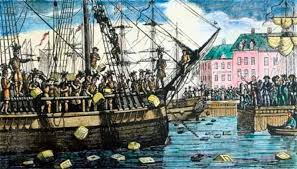
What event is depicted in this image?
a)
Boston Massacre
b)
Boston Tea Party
c)
Battle of Bunker Hill
d)
Lexington and Concord
120.
Samuel Adams and Paul Revere led members of the Sons of Liberty in this protest against taxes.
a)
First Continental Congress
b)
Boston Massacre
c)
Boston Tea Party
d)
Stamp Act Congress
121.
This enslaved person wrote poems and plays supporting American independence.
a)
Harriet Tubman
b)
Benjamin Banneker
c)
Paul Revere
d)
Phillis Wheatley
122.
What was the Boston Massacre?
a)
It was when British soldiers marched to "seize and destroy" the Patriot's military supplies.
b)
It was an area of Boston that was occupied by British soldiers.
c)
It was when British soldiers panicked and fired into a crowd of angry colonists.
d)
It was when Patriots drank tea near Boston Harbor.
123.
What Act placed a tax on printed materials in the colonies?
a)
Stamp Act
b)
Townshend Acts
c)
Tea Act
d)
Intolerable Acts
124.
Who formed the Sons of Liberty and Committee of Correspondence?
a)
George Washington
b)
Samuel Adams
c)
Paul Revere
d)
George III
125.
To nullify a law means …
a)
to agree to the law
b)
to secede.
c)
to void or cancel the law.
d)
to vote on the law.
126.
Which person is known as the "Father of State's Rights" and supported nullification and secession if necessary to protest the "Tariff of Abomination"?
a)
Henry Clay
b)
James Monroe
c)
John C. Calhoun
127.
Which state threatened to nullify the tariffs passed by the Federal Government?
a)
Maine
b)
New York
c)
Maryland
d)
South Carolina
128.

A machine that removes seeds from cotton fiber

a)

Cotton seeder

b)

Cotton gin

c)

Cotton runner

d)

Cotton fiber maker

129.

An artificial waterway connecting the Hudson river with Lake Erie.

a)

Panama Canal

b)

Mississippi River

c)

Ohio River

d)

Erie Canal

130.

A period of rapid growth in the use of machines in manufacturing and production that began in the mid-1700s

a)

American Revolution

b)

Industrial System

c)

Industrial Revolution

d)

American Industrialists

131.

A part of a machine or device that can be replaced by another identical part

a)

Interconnected part

b)

Turnable Part

c)

Interchangeable System

d)

Interchangeable part

132.
America wanted to end slavery in the first 20 years of its existence. What invention caused slavery to stay longer?
a)
Invention of the Cotton Gin
b)
The slaves wanted to stay slaves
c)
The invention of the steam boat
d)
THe invention of moveable parts
133.

This invention increased the speed of communication for personal, business, and government use

a)

Telegraph

b)

Teleprompter

c)

Cotton Gin

d)

Smoke signals

134.

Robert Fulton's invention revolutionized river travel and made shipping quicker by increasing the speed of transportation

a)

Steamboats

b)

Tugboats

c)

Railroads

d)

Canals

135.
The cotton gin and interchangeable parts were inventions of--
a)
Eli Whitney
b)
Robert Fulton
c)
Thomas Edison
d)
Robert Morse
136.
Which invention resulted in an increase in the demand for coal?
a)
Iron plow
b)
Cotton gin
c)
Steam engine
d)
Internal combustion engine
137.
_________________ was an important leader in education reform.
a)
George Whitfield
b)
Dorthea Dix
c)
Horace Mann
d)
Fredrick Douglas
138.
In the 1840s, Seneca Falls, New York, became the scene of an important convention for -
a)
women's rights
b)
labor union organization
c)
temperance reform
d)
prison reforms
139.
Which of the following best describes Elizabeth Cady Stanton?
a)
Leader in the abolitionist movement
b)
First woman doctor in the United States
c)
Leader in improving American schools
d)
Organizer of the Women's Rights Convention
140.
Which Reform movement most closely associates with the term "suffrage?"
a)
Education Reform
b)
Temperance Movement
c)
Women's Rights Movement
141.
Which Reform movement most closely associates with the term "slavery?"
a)
Abolitionist Movement
b)
Prison Reform Movement
c)
Women's Rights
142.
The Mexican General at the Alamo and San Jacinto was
a)
Santa Anna
b)
Urrea
c)
Houston
d)
Travis
143.
What religious movement led to the other reform movements?
a)
The Reformation 
b)
The Second Great Awakening
c)
The Renaissance 
d)
The First Great Awakening 
144.
Former slave, travels the country arguing for women's rights and abolition
a)
William Lloyd Garrison
b)
Sojourner Truth
c)
Harriet Beecher Stowe
d)
Harriet Tubman
145.
What was an important power source used during Industrial Revolution?
a)
Electricity
b)
Whale Oil
c)
Steam
d)
Wind
146.
Which of the following was associated with women's suffrage?
a)
Charles Finney
b)
Horace Mann
c)
Frederick Douglass
d)
Susan B. Anthony
147.
Utopian communities were
a)
places for religious freedom
b)
places for runaway slaves to get a job
c)
supposed to be for women only
d)
an attempt at forming a perfect society
148.
Which colonial grievance is represented by the picture? 
a)
No trial by jury of peers
b)
Illegal Search & Seizure
c)
No Freedom of Speech
d)
Quatering of Troops
149.
Which colonial grievance is represented by the picture? 
a)
Illegal Search & Seizure
b)
No freedom of speech
c)
King has absolute power
d)
No trial by jury of peers
150.
Which colonial grievance is represented by the picture? 
a)
No trial by Jury of peers
b)
No freedom of speech
c)
King has absolute power
d)
Taxation without representation
151.
Which colonial grievance is represented by the picture? 
a)
King has absolute power
b)
No freedom of speech
c)
No trial by jury
d)
Illegal search & seizure
152.
What is republicanism?
a)
There are three branches of government. 
b)
The state and national government share power. 
c)
The people are in charge. 
d)
The people vote for their leaders, who then represent the people. 
153.
What is "checks and balances?"
a)
Each branch of power has the ability to limit the power of the other branches. 
b)
The people elect their leaders. 
c)
The people are in charge. 
d)
The people have rights. (Bill of Rights) 
154.
What is federalism?
a)
The people vote for their leaders who then represent them. 
b)
The people have individual rights. 
c)
There are three branches of government. 
d)
The state and national government share power. 
155.
Which proves that the USA uses separation of powers?
a)
The people vote for their leaders. 
b)
The people are in charge. 
c)
There are three branches of government. 
d)
The people have individual rights. (bill of rights) 
156.
What is popular sovereignty?
a)
"The people rule." 
b)
There are three branches of government. 
c)
There are two houses in the legislature. 
d)
The people vote for their leaders who then represent them. 
157.
The people elect senators to serve in Washington, DC.
a)
Popular Sovereignty
b)
Republicanism
c)
Federalism
d)
Limited Government
158.
The Constitution restricts the powers of the government.
a)
Limited Government
b)
Federalism
c)
Checks and Balances
d)
Individual Rights
159.
"We the people...do ordain and establish this Constitution."
a)
Separation of Powers
b)
Checks and Balances
c)
Federalism
d)
Popular Sovereighty
160.
State governments have the power to pass marriage laws within their state.
a)
Republicanism
b)
Separation of Powers
c)
Federalism
d)
Limited Government
161.
Government is by the consent of the governed.
a)
Popular Sovereighty
b)
Republicanism
c)
Individual Rights
d)
Checks and Balances
162.
Only the federal government can coin money.
a)
Federalism
b)
Limited Government
c)
Checks and Balances
d)
Separation of Powers
163.
Government officials are never above the law.
a)
Individual Rights
b)
Popular Sovereignty 
c)
Federalism
d)
Limited Government
164.
Congress can override a presidential veto by 2/3 vote in each house.
a)
Federalism
b)
Checks and Balances
c)
Popular Sovereignty
d)
Separation of Powers
165.
The Legislative Branch makes the laws
a)
Checks and Balances
b)
Separation of Powers
c)
Federalism
d)
Limited Government
166.
People may peacefully protest actions with which they disagree.
a)
Individual Rights
b)
Limited Government
c)
Checks and Balances
d)
Republicanism
167.
Which of the following rights and freedoms is specifically guaranteed by the first 1st amendment?
a)
Right to an education
b)
Freedom of press
c)
Right to bear arms
d)
Right to privacy 
168.
According to the Fourth Amendment, the police can search and seize a person's property only if
a)
the neighbors sign a petition.
b)
the chief of police gives permission.
c)
a judge issues a warrant.
d)
the have a written note from your mother. 
169.
Why was the Ninth Amendment added to the Constitution?
a)
because the framers worried they might have forgotten an important right
b)
because the framers wanted to make clear that basic rights were guaranteed even if they were not stated specifically
c)
because the Bill of Rights had to have ten parts
d)
because the English Bill of Rights listed nine rights
170.
The Tenth Amendment states that
a)
most powers belong to the national government.
b)
powers not given to the national government or prohibited from the states belong to the states or the people.
c)
the people are the source of all government powers.
d)
the states are the most important part of our government system.
171.
What historic document is the Bill of Rights a part of?
a)
Declaration of Independence
b)
The US Constitution
c)
The Articles of Confederation
d)
The English Bill of Rights
172.
Which amendment gives a "well-regulated militia...the right of the people" to bear arms.
a)
1st Amendment
b)
4th Amendment
c)
5th Amendment
d)
2nd Amendment 
173.
Why was King John forced to sign the Magna Carta?
a)
to increase the power of the monarchy
b)
to end taxation in England
c)
to force the monarchy to give up power
d)
to weaken the power of nobles
174.
 Why did the Pilgrims create the Mayflower Compact?
a)
 to show that they opposed representative government.
b)
to establish an orderly community
c)
 to reinforce the laws of England in the new colony
d)
 to guarantee universal religious tolerance in the colony
175.
When was Mayflower Compact written?
a)
1410
b)
1492
c)
1655
d)
1620
176.
What was stated in the Proclamation of 1763?
a)
Colonists were banned from settling west of the Appalachian Mountains.
b)
Colonists were encouraged to begin settling west of the Appalachian Mountains.
c)
The Proclamation ended the French and Indian War. 
d)
The Proclamation proclaimed independence for the American colonists. 
177.
According to the British what was the reason for the Proclamation of 1763?
a)
The Proclamation of 1763 gave all of the land to the American colonists.
b)
It was a law that allowed colonists the chance to  settle west of the Appalachian Mountains.
c)
The Proclamation was a meeting between Native Americans and the colonists. 
d)
It was attempt to end conflicts between Native Americans and colonists west of the Appalachian Mountains.