wayground logo

Free Printable Worksheets

Font size

S
M
L
XL
Worksheets

Electrostatics and DC Circuits Practice

Total questions: 75

Worksheet time: 57mins

Name
Class
Date
1.
Two like charges
a)
 neutralize each other.
b)
repel each other. 
c)
must be neutrons. 
d)
attract each other.
2.
The charge of an electron is 
a)
positive. 
b)
negative. 
c)
Electrons have no charge
3.
An atom loses an electron.  What type of charge does it have now?
a)
positive
b)
negative
4.
What direction are the electric field lines around an electron?
a)
towards the charge
b)
away from the charge
5.
When a balloon is rubbed on clothes it acquires a charge by ___________
a)
Induction
b)
reduction
c)
friction 
d)
concuction
6.
When a glass rod is rubbed with silk and the glass rod becomes positively charged, what happens to the electrons?
a)
they are removed from the rod
b)
they are added to the rod
7.
What do you call the process of charging a conductor by bringing it near another charged object?
a)
induction
b)
polarization
c)
neutralization
d)
conduction
8.

What direction are the electric field lines around a proton?

a)

towards the charge

b)

away from the charge

9.
Which of the following is not a good conductor of electricity?
a)
copper
b)
silver
c)
Glass
d)
aluminum
10.
Which of the following is not a good insulator?
a)
Copper
b)
Glass
c)
rubber
d)
wool
11.
The law of conservation of charge states that...
a)
all atoms have more protons than electrons
b)
only protons can be rubbed off of an atom
c)
charge cannot be created or destroyed
d)
charge cannot be transferred 
12.
assume a rubber rod is rubbed against a rabbit fur and gains 5 electrons.  which of the following is true?
a)
The fur lost 5 electrons
b)
the fur gained 5 electrons
c)
the fur gained 5 protons
d)
The fur lost 2 electrons
13.
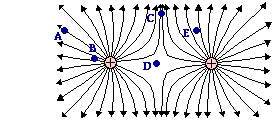
Which of the following labeled points is in the region with the strongest force of electric charge
a)
A
b)
B
c)
C
d)
D
14.
What object allowed John Tra"voltage" to discharge his electrons?
a)
The rug
b)
The wall
c)
The door
d)
The metal doorknob
15.
If two balloons have the same charge, what will happen if you place them close to each other?
a)
Nothing
b)
They will be attracted
c)
They will pop
d)
They will push each other away.
16.
What is the name of this device that is used to detect charges?
a)
beaker
b)
electroscope
c)
van de graff generator
d)
chargometer
17.
During a physics lab, a plastic strip was rubbed with cotton and became positively charged. The correct explanation for why the plastic strip becomes positively charged is that ...
a)
the plastic strip acquired extra protons from the cotton.
b)
the plastic strip acquired extra protons from the charging process 
c)
protons were created as the result of the charging process
d)
the plastic strip lost electrons to the cotton during the charging process 
18.
Insulators are different than conductors in that insulators ____.
a)
do not contain electrons or protons 
b)
 do not contain any charge
c)
have a weaker affinity for electrons 
d)
do not allow charge to freely move 
19.
Consider the conduction charging shown. 
a)
Electrons move from the insulating stand into the sphere.
b)
Protons move from the bar into the sphere.
c)
Electrons move from the charged metal bar into the sphere.
d)
Protons move from the sphere into the negatively charged bar.
20.
A negatively charged plastic comb is brought close to, but does not touch, a small piece of paper. If the comb and the paper are attracted to each other, the charge on the paper
a)
must be positive
b)
must be negative
c)
may be neutral or negative
d)
may be neutral or positive 
21.
Two electrically charged identical-sized metal spheres, A (charge of -4) and B (charge of +8). If the spheres are brought into contact, which sphere will have a net gain of electrons?
a)
both A and B
b)
neither
c)
only A
d)
only B
22.
Two electrically neutral metal spheres, A and B, on insulating stands are placed in contact with each other. A negatively charged rod is brought near, but does not touch the spheres, as shown in the diagram below. How are the spheres now charged?
a)
A is positive and B is positive.
b)
A is negative and B is positive.
c)
A is positive and B is negative.
d)
A is negative and B is negative.
23.
Which net charge could be found on an object?
a)
4.8 x 10⁻¹⁹ C
b)
1.8 x 10⁻¹⁹ C
c)
3.0 x 10⁻¹⁹ C
d)
2.8 x 10⁻¹⁹ C
24.
Metal sphere A has a charge of +12 elementary charges and identical sphere B has a charge of +16 elementary charges. After the two spheres are brought into contact and separated, the charge on sphere A is
a)
+14 elementary charges
b)
+28 elementary charges
c)
+2 elementary charges
d)
-2 elementary charges
25.
Electrostatic force F exists between two point charges. If the both charges are doubled, the force between the charges will be
a)
F
b)
4F
c)
2F
d)
F/4
26.
Which of the following is a false statement about electrostatic force.
a)
Bringing charges closer together strengthen the force.
b)
The electrostatic constant remains the same.
c)
The values of the two charges is always the same.
d)
Electrostatic force can be attractive or repulsive
27.
An electrostatic force of magnitude F exists between two metal spheres having identical charge q. The distance between their centers is r. Which combination of changes would produce no change in the electrostatic force between the spheres?
a)
doubling q on both spheres while halving r
b)
doubling q on one sphere while halving r
c)
doubling q on one sphere while doubling r
d)
doubling q on both spheres while doubling r
28.
Two similar metal spheres, A and B, have charges of +2.0 x 10⁻⁶ coulomb and +1.0 x 10⁻⁶ coulomb, respectively. The magnitude of the electrostatic force on A due to B is 4.0N newtons. What is the magnitude of the electrostatic force on B due to A?
a)
2.0N
b)
4.0N
c)
8.0N
d)
1.0N
29.
Metal sphere A has a charge of -2 units and an identical metal sphere, B, has a charge of -4 units. If the spheres are brought into contact with each other and then separated, B will _____
a)
gain 1 electron
b)
lose 1 electron 
c)
gain 3 electrons
d)
lose 3 electrons
30.
A negatively charged rod touches the knob of a neutral electroscope. Which  best represents the distribution of charge on the electroscope.
a)
both the knob and leaves become positive
b)
both the knob and leaves become negative
c)
the knob becomes negative and the leaves become positive
d)
the knob becomes positive and the leaves become negative
31.
What is it called when an object gains a charge when touched by a charged object?
a)
Induction
b)
ESD
c)
Conduction
d)
Conducting path
32.
What is it called when an object gains a charge without touching a charged object but by being held near the charged object?
a)
Induction
b)
ESD
c)
Conduction
d)
Conducting path
33.
The lightning you observe in a thunderstorm occurs when a bolt of electrons travels down a ______________, and discharges the cloud and the earth. 
a)
Induction
b)
ESD
c)
Conduction
d)
Conducting path
34.
What equation is this:
F= k (q(a) x q(b)) / r^2 
a)
Coulombs law
b)
Ohms law
c)
Newtons law
35.
What is the unit of electric charge?
a)
Volts
b)
Amps
c)
Coulombs
d)
Ohms
36.
How is the electric force between two charges affected when both of the charges are doubled?
a)
four times as much
b)
two times as much
c)
half as much
d)
one quarter as much
37.
The atomic nuclei of almost all elements consists of
a)
protons
b)
protons and electrons
c)
protons and neutrons
d)
only neutrons
38.
When the distance between two charges is halved, the electrical force between the charges
a)
quadruples
b)
reduces to one fourth
c)
halves
d)
doubles
39.
A positive ion has
a)
a 1 + charge
b)
more protons than electrons
c)
one proton
d)
more electrons than protons
40.
A negative ion has
a)
more electrons than protons
b)
a 1 - charge
c)
one proton
d)
more protons than electrons
41.
Two particles opposite in charge are held near each other and released.  As they move the force on each particle
a)
Increases
b)
decreases
c)
stays the same
d)
t
42.
Good insulators
a)
have electrons free to move around
b)
have tightly bound electrons
c)
have electrons do not move at all
43.
Good conductors 
a)
have electrons free to move around
b)
have electrons tightly bound
c)
do not have electrons
44.
A series circuit has ____ path(s) that the electric current can take. 
a)
One
b)
Two 
c)
Three 
d)
Four
45.
Voltage Across 3 KΩ?
a)
6 V
b)
3 V
c)
2 V
d)
1 V
46.
a)
Circuit X is brighter than circuit Y
b)
Circuit Y is brighter than circuit X
c)
Both circuits have the same brightness
d)
Neither circuit will light the bulbs
47.
What happens when you add a second bulb to a series circuit?
a)
The first bulb gets brighter
b)
The second bulb will be as bright as the first because they both get full power
c)
The circuit will no longer work
d)
Both bulbs will be half as bright because the voltage is divided by two now
48.
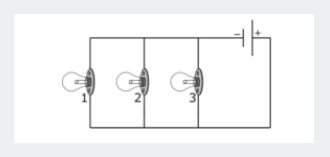
If bulb 1 burns out, what will occur?
a)
bulbs 2 and 3 will go out
b)
bulbs 2 and 3 receive more volts
c)
bulbs 2 and 3 will stay lit
d)
nothing will happen
49.
How does the brightness of each identical lightbulb compare?
a)
A is brightest
b)
B is brightest
c)
C is brightest
d)
they all have equal brightness
50.
What is the total VOLTAGE of the circuit?
a)
10 V
b)
20 V
c)
40 V
d)
4 V
51.
Find Current
a)
50 mA
b)
0.5 mA
c)
5 mA
d)
500 mA
52.
Equivalent Resistance?
a)
11/6 Ω
b)
6/11 Ω
c)
11/3 Ω
d)
3/11 Ω
53.

A circuit contains two un-equal resistances in parallel have

a)

current is same in both.

b)

large current flows in larger resistor.

c)

potential difference across each is same.

d)

smaller resistance has smaller conductivity

54.

Property of a substance which offers opposition to flow of current through it is called

a)

energy.

b)

capacity

c)

resistance

d)

voltage

55.

The total charge, Q flowing the area per unit time is defined as ?

a)

Current

b)

Capacitance

c)

Coulomb

d)

Potential difference

56.

Which one of the following graphs correctly represents Ohm’s law, where V is the voltage and I is the current?

a)
b)
c)
d)
57.

Which of the formula represent effective resistcance in parellel?

a)

1/Reff = 1/R1 + 1/R2 + ...

b)

Reff = R1 + R2 + ...

c)

1/Reff = 1/R1 = 1/R2 = ...

d)

Reff = R1 = R2 = ...

58.
Which quantity should be measured by the voltmeter ?
a)
Current
b)
Voltage
c)
Power
d)
Speed
59.

How do you calculate resistance?

a)

Divide voltage by current

b)

Divide charge by current

c)

Multiply current by voltage

d)

Multiply voltage and current

60.

What are the units for resistance?

a)

Ohms (Ω)

b)

Voltage (V)

c)

Amps (A)

d)

Charge (C)

61.
To complete a circuit the switch must be
a)
unattached
b)
open
c)
closed
62.
Which of these objects is an insulator?
a)
Copper Wire
b)
Paper Clip
c)
Steel Pole
d)
Rubber Gloves
63.
Which of these objects is an insulator?
a)
Copper Wire
b)
Paper Clip
c)
Steel Pole
d)
Rubber Gloves
64.
Which of these objects is an insulator?
a)
Copper Wire
b)
Paper Clip
c)
Steel Pole
d)
Rubber Gloves
65.
Electricity is the flow of _________.
a)
Protons
b)
Neutrons
c)
Electrons
66.

What is this symbol called?

a)

A. Bulb

b)

B. Resistor

c)

C. Battery

d)

D. Voltage

67.

What is this symbol?

a)

A. Ammeter

b)

B. Resistor

c)

C. Battery

d)

D. Voltage

68.

To calculate voltage, multiply _______ and _________

a)

current, resistance

b)

volts, current

c)

volts, ohms

d)

ohms, resistance

69.
The type of current where charges flow in one direction
a)
Direct Current
b)
Alternating Current
c)
Electron Flow
d)
Voltage
70.
A circuit in which the electricity bypasses the resistors and the current increases too much possibly causing the wires to overheat
a)
Closed circuit
b)
Short circuit
c)
Load
d)
Fuses
71.
An ammeter is a device that can be used to measure
a)
Current
b)
Voltage
c)
Resistance
d)
Power
72.
An ohmmeter is a device that can be used to measure
a)
Current
b)
Voltage
c)
Resistance
d)
Power
73.
this is the symbol for a _____?
a)
switch
b)
light 
c)
battery
d)
wires
74.
This is the symbol for a ...
a)
Bulb
b)
Battery
c)
Horn
d)
Fuse
75.
This is the symbol for a ...
a)
Wire
b)
Battery
c)
Buzzer
d)
Fuse