wayground logo

Free Printable Worksheets

NEW

Font size

S
M
L
XL
Worksheets

Weather Review

Total questions: 51

Worksheet time: 35mins

Name
Class
Date
1.
What imaginary line divides our world into the northern and southern hemispheres?
a)
equator
b)
international date line
2.
A severe storm that involves strong winds and forms over warm water is:
a)
tornado
b)
thunderstorm
c)
hurricane
d)
blizzard
3.
A severe storm which involves a funnel cloud forming from a cumulonimbus cloud:
a)
hurricane
b)
tornado
c)
thunderstorm
d)
blizzard
4.
This severe weather involves lightning, rain, and forms from a cumulonimbus cloud.
a)
thunderstorm
b)
tornado
c)
hurricane
d)
blizzard
5.
This weather tool measures wind speed 
a)
thermometer
b)
barometer
c)
anemometer
d)
psychrometer
6.
a)
nimbostratus cloud
b)
cumulonimbus cloud
c)
cirrocumulus cloud
d)
altostratus cloud
7.
What type of cloud looks like cotton and is in the lower altitudes?
a)
Cumulus
b)
Stratus
c)
Cirrus
8.
what type of cloud is shown?
a)
cumulus
b)
cirrus
c)
stratus
9.
what type of cloud is shown?
a)
cumulus
b)
cirrus
c)
stratus
10.
Clouds are made up of tiny drops of ______ or ice. The moisture in the cloud affects the weather.
a)
dust
b)
water
c)
cloud particles
d)
precipitation
11.
This is sometimes called a thunderhead cloud. It looks very tall like mountains and heavy rain comes from it. 
a)
Cumulus
b)
Cirrus
c)
Stratus
d)
Cumulonimbus
12.
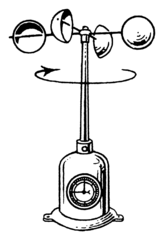
This weather instrument is a...
a)
anemometer
b)
barometer
c)
wind vane
d)
thermometer
13.
This weather instrument is a...
a)
thermometer
b)
anemometer
c)
rain gauge
d)
barometer
14.
This weather instrument is a...
a)
anemometer
b)
Christmas ornament
c)
wind vane
d)
barometer
15.
This weather instrument is an...
a)
wind vane
b)
anemometer
c)
barometer
d)
thermometer
16.
Temperature is measured in...
a)
degrees
b)
inches
c)
centimeters
d)
feet
17.
This tool measures the wind speed.
a)
barometer
b)
anemometer
c)
thermometer
d)
my dog when he sticks his head out the window
18.
Someone who studies the weather.
a)
rain gauge
b)
taxonomists
c)
meterologist
d)
satellites
19.
At which humidity is it more likely to rain?
a)
50%
b)
20%
c)
77%
d)
99%
20.
What type of map is shown?
a)
satelite
b)
radar
c)
isobar
d)
isotherm
21.
What type of map is shown?
a)
satellite
b)
radar
c)
isobar
d)
isotherm
22.
What weather instrument is pictured?
a)
Anemometer
b)
Wind Vane
c)
Barometer
d)
Hygrometer
23.
What weather instrument is pictured?
a)
Anemometer
b)
Thermometer
c)
Barometer
d)
Hygrometer
24.
What weather factor does a wind vane measure?
a)
Air Pressure
b)
Air Temperature
c)
Wind Speed
d)
Wind Direction
25.

Where do warm ocean currents come from

a)

the poles

b)

near the land

c)

the equator

d)

middle of the oceans

26.

What city is most likely going to see temperatures rise?

a)

San Jose

b)

El Paso

c)

Jacksonville

d)

Chicago

27.

What city will experience decreasing temperatures in the next day?

a)

Denver

b)

El Paso

c)

Memphis

d)

Los Angeles

28.

What does this symbol represent?

a)

Cold Front

b)

Warm Front

c)

Stationary Front

d)

Occluded Front

29.

What does this symbol represent?

a)

Cold Front

b)

Warm Front

c)

Stationary Front

d)

Occluded Front

30.

What does this symbol represent?

a)

Cold Front

b)

Warm Front

c)

Stationary Front

d)

Occluded Front

31.

What does this symbol represent?

a)

Cold Front

b)

Warm Front

c)

Stationary Front

d)

Occluded Front

32.

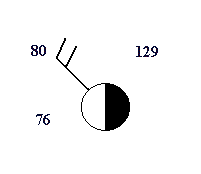
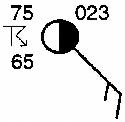
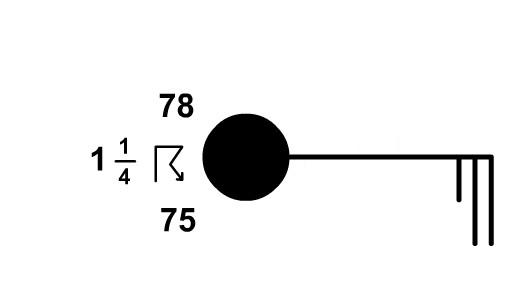
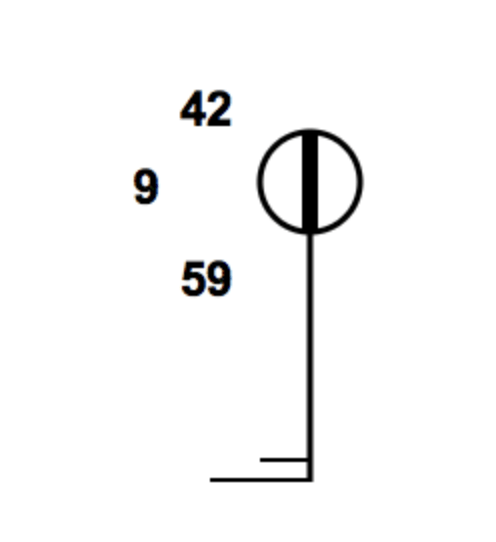
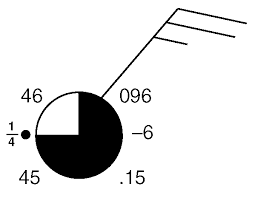
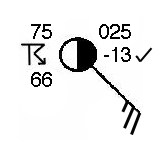
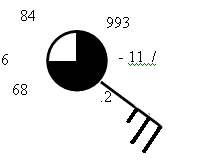
What is the temperature for the following station model?

a)

4 ºF

b)

76 ºF

c)

80 ºF

d)

129 ºF

33.

What is the dewpoint for the following station model?

a)

10 ºF

b)

23 ºF

c)

65 ºF

d)

75 ºF

34.

What is the present weather for the following station model?

a)

rain

b)

thunderstorms

c)

drizzle

d)

fog

35.

What is the visibility for the following station model?

a)

1/2 mi

b)

9 mi

c)

42 mi

d)

59 mi

36.

What is the amount of precipitation for the following station model?

a)

.15 in

b)

1/4 in

c)

6 in

d)

46 in

37.

What is the wind speed for the following station model?

a)

10 knots

b)

15 knots

c)

20 knots

d)

25 knots

38.

What is the amount of cloud cover for the following station model?

a)

25%

b)

50%

c)

75%

d)

100%

39.
Which layers of the atmosphere are the hottest?
a)
troposphere & thermosphere
b)
stratosphere & thermosphere
c)
mesosphere & thermosphere
d)
troposphere & stratosphere
40.
Which layer of the atmosphere do we live in?
a)
troposphere
b)
mesosphere
c)
thermosphere
d)
exosphere
41.
Which layer is known as the weather layer?
a)
stratopshere
b)
thermosphere
c)
mesosphere
d)
troposphere
42.
Which layer of the atmosphere contains both the ionosphere and the exosphere?
a)
troposphere
b)
stratosphere
c)
mesosphere
d)
thermosphere
43.
Which layer of the atmosphere contains a special form of oxygen called the ozone layer?
a)
mesosphere
b)
stratosphere
c)
thermosphere
d)
ionosphere
44.
What are the two most abundant gases in earth's atmosphere?
a)
nitrogen & oxygen
b)
carbon dioxide & water vapor
c)
hydrogen & oxygen
d)
oxygen and ozone
45.
What is the coldest layer of the atmosphere?
a)
troposphere
b)
mesosphere
c)
stratosphere
d)
thermosphere
46.
a)
Low Clouds
b)
Low Temperatures
c)
Light Wind
d)
Low Air Pressure
47.
a)
High Air Pressure
b)
High Temperatures
c)
Heavy Rain
d)
Hail
48.
Low Pressure is associated with this type of weather...
a)
Cloudy/Overcast Weather
b)
Cold Weather
c)
Warm Weather
d)
Fair Weather
49.
High Pressure is associated with this type of weather...
a)
Cloudy/Overcast Weather
b)
Cold Weather
c)
Warm Weather
d)
Fair Weather
50.
A warm front moving into an area can bring this type of weather...
a)
Warmer Temperatures, Clear Skies
b)
Colder Temperatures, Clear Skies
c)
Warmer Temperatures, Clouds, and steady precipitation
d)
Colder Temperatures, Clouds, and Precipitation
51.
A cold front moving into an area can bring this type of weather...
a)
Warmer Temperatures, Clear Skies
b)
Colder Temperatures, Clear Skies
c)
Warmer Temperatures, Clouds
d)
Colder Temperatures, Clouds, and Precipitation