Wayground logo

Free Printable Worksheets

Font size

S
M
L
XL
Worksheets

Physics Review

Total questions: 42

Worksheet time: 38mins

Name
Class
Date
1.

What is the definition of acceleration?

a)

When an object changes its speed, direction, or both

b)

An object's speed in a particular direction

c)

How fast an object traveled in a certain amount of time

2.

What is the definition of velocity?

a)

When an object changes its speed, direction, or both

b)

An object's speed in a particular direction

c)

How fast an object traveled in a certain amount of time

3.

What is the definition of speed?

a)

When an object changes its speed, direction, or both

b)

An object's speed in a particular direction

c)

How fast an object traveled in a certain amount of time

4.

Is this an example of speed or velocity?


55 mph

a)

Speed

b)

Velocity

5.

Is this an example of speed or velocity?


150 m/s West

a)

Speed

b)

Velocity

6.

Which of the graphs shows that one of runners started 10 yards further ahead of the

other?

a)
b)
c)
d)
7.

In which of the following graphs below are both runners moving at the same speed?

a)
b)
c)
d)
8.

Segment O-A The bus is _________________.

a)

at rest

b)

returning (to original position)

c)

moving forward

9.

Segment A-B The bus is _________________.

a)

at rest

b)

returning (to original position)

c)

moving forward

10.
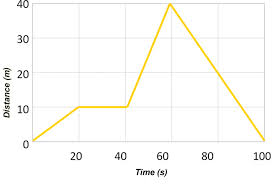
How long did it take this object to travel back to its reference/starting point?
a)
20 s
b)
30 s
c)
60 s
d)
100 s
11.
At 60 seconds, how far had this object traveled? 
a)
0 m
b)
10 m
c)
20 m
d)
40 m
12.
What is happening at C?
a)
Stationary
b)
Accelerating
c)
Fast steady speed; moving away from the starting position
d)
Slower steady speed; moving away from the starting position
13.
What is happening at C?
a)
Stationary
b)
Accelerating
c)
Fast steady speed; moving away from the starting position
d)
Slower steady speed; moving away from the starting position
14.
What is the speed of an object that travels 60 meters in 4 seconds?
a)
240 m/s
b)
15 m/s
c)
0.067 m/s
d)
15 mph
15.
A family left for the museum at 7 in the morning. They arrived at 10 and they traveled at 60 miles per hour. How far away  was the museum?
a)
20 miles
b)
180 miles
c)
180
d)
20
16.
Energy due to motion is ____________ energy. 
a)
Potential 
b)
Energy
c)
Kinetic
d)
Friction
17.
__________ is stored energy. 
a)
Potential
b)
Kinetic
c)
None of the above 
d)
All of the above 
18.
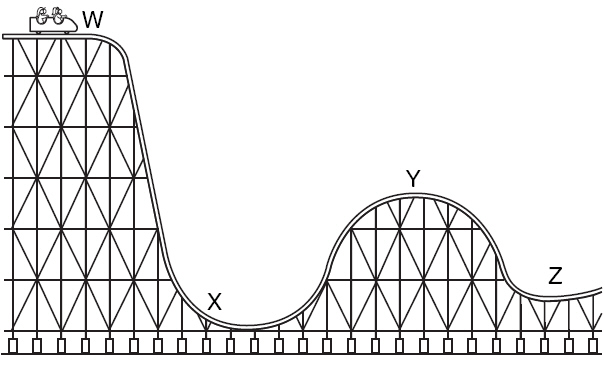
At which point is potential energy greatest?
a)
W
b)
X
c)
Y
d)
Z
19.
At which point is potential energy greatest?
a)
W
b)
X
c)
Y
d)
Z
20.
At which point is kinetic energy greatest? 
a)
W
b)
X
c)
Y
d)
Z
21.
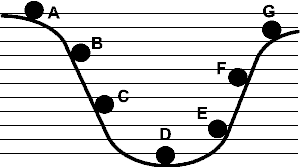
Which point has the most potential energy?
a)
G
b)
f
c)
b
d)
a
22.
Explain what happens to the potential energy of a rock as it falls off the side of a cliff.
a)
The kinetic energy decreases as the potential energy increases.
b)
The kinetic energy decreases as the potential energy decreases.
c)
The potential energy decreases as the kinetic energy increases.
d)
The potential energy decreases as the kinetic energy decreases. 
23.
Which of the following energy transformations occur when a lamp that is plugged into a wall socket is functioning correctly?
a)
Chemical to light
b)
Electrical to chemical
c)
Electrical to light
d)
Chemical to electrical
24.
Which of the following shows an energy transformation from chemical energy to electrical to light energy?
a)
A bolt of lightning lights the night sky.
b)
A candle glows brightly in the dark.
c)
A fire in a fireplace lights up a room.
d)
A battery causes a flashlight to shine.
25.
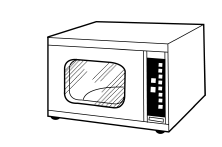
The picture shows a microwave oven. As a microwave oven is operated, electrical energy is transformed into all of the following types of energy EXCEPT —
a)
solar
b)
light
c)
thermal
d)
mechanical
26.
What is Newton's First Law of Motion?
a)
F=m x a
b)
Every action has an equal and opposite reaction
c)
An object at rest stays at rest, an object in motion stays in motion unless acted on by another force. 
d)
Friction 
27.
Which type of force(s) will cause a change in an object's motion?
a)
gravity
b)
zero net force
c)
balanced forces
d)
unbalanced forces
28.
Why does an 18-wheeler have more inertia than a bicycle?
a)
it has more mass
b)
it has more volume
c)
it is not as aerodynamic
29.
A resistance to a change in motion is 
a)
Acceleration
b)
Inertia
c)
Gravity
d)
Velocity
30.
A rock is sitting on the ground.
a)
Balanced
b)
Unbalanced
31.

a push or pull

a)

ACCELERATION

b)

SPEED

c)

VELOCITY

d)

FORCE

32.

What it the equation for the second law of motion

a)

F/m=a

b)

M/FV

c)

F=MA

d)

M=AF

33.

What is force measured in

a)

Newton's

b)

Pounds

c)

Kilograms

d)

Inches

34.
Michael hit the golfball at an acceleration of 31 m/s2.  The force he used was measured to be 15 N.  What mass does the ball have?
a)
0.48 N
b)
48 kg
c)
48 N
d)
0.48 kg
35.
If a 10 kilogram object accelerates suddenly at 15 m/s2, how much force was applied to the object?
a)
150 Newtons
b)
15 Newtons
c)
150 kilograms
d)
100 kilograms
36.
Newton's third law states that any action will have a(n) _______ and ______ reaction
a)
Equal and similar
b)
Equal and opposite
c)
Equal and different
d)
Greater and opposite
37.

What will happen if the Action is greater than the Reaction?

a)

The man will fall

b)

The boat will sink

c)

Nothing will happen

38.

What happens to the balloon if the air is released ?

a)

Balloon goes right

b)

Balloon goes up?

c)

Balloon goes down

d)

Balloon goes left

39.

If a hammer hits a nail with a force of 12 N, the nail exerts a force on the hammer of

a)

2 N

b)

4 N

c)

12 N

d)

24 N

40.
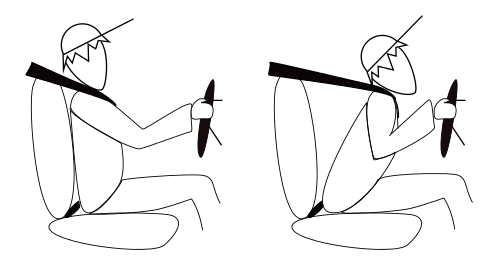
What Newtons law does this picture represent
a)
Newtons 2nd law 
b)
Law of gravity 
c)
Newtons 1st law
d)
Newtons 5th law
41.
What law of motion does this picture represent?
a)
Newtons 3rd law
b)
Newtons 4th law
c)
Newtons 1st law
d)
Newtons 2nd law 
42.
Determine the accelerations that result when a 12-N net force is applied to a 3-kg object. 
a)
3 m/s
b)
4 ft/s 
c)
13 m/s
d)
4 m/s