wayground logo

Free Printable Worksheets

Font size

S
M
L
XL
Worksheets

Blood Characterisitics, blood typing, cardiac cycle, lymphatic system Review

Total questions: 141

Worksheet time: 2hrs 17mins

Name
Class
Date
1.

an essential molecule of the red blood cell that serves as the binding site for oxygen and carbon dioxide.

a)

hemoglobin

b)

fibrin

c)

anemia

d)

platelets

2.

a cancer caused by the production of an extremely high number of immature white blood cells in the bone marrow.

a)

anemia

b)

aplastic anemia

c)

Leukemia

d)

bone cancer

3.

Red blood cells are called:

a)

erythrocytes

b)

leukocytes

c)

melanocytes

d)

thrombocytes

4.

What percentage of blood is plasma?

a)

50

b)

55

c)

30

d)

75

5.

What color is plasma?

a)

red

b)

blue

c)

yellow

d)

white

6.

Formed elements in blood are 45% of blood volume and are made up of all of the following except:

a)

erythrocytes

b)

leukocytes

c)

platelets

d)

water

7.

A genetic bleeding disorder resulting in a bleeding disorder (bleeding that won't stop):

a)

polycythemia

b)

hemophilia

c)

anemia

d)

agglutination

8.

Granulocytes and Agranulocytes are 2 classifications of:

a)

erythrocytes

b)

leukocytes

c)

thrombocytes

d)

platelets

9.

Platelets are

a)

red cells that lack a nucleus.

b)

blue cells that have a nucleus

c)

large cells with a prominent, concave nucleus

d)

cytoplasmic fragments of large cells

10.

The liquid part of blood made of mostly water; nutrients, minerals and oxygen are dissolved

a)

Marrow

b)

Plasma

c)

Proteins

d)

Urea

11.
Blood type is determined by antigens.
a)
True
b)
False
12.
The rH factor determines what part of the blood type?
a)
+ or -
b)
the number of antigens
c)
the number of antibodies
d)
aggulation
13.
What antigens are present in a person with AB- blood?
a)
A, B, and Rh
b)
Rh, only
c)
A and B
d)
No antigens
14.
What blood type has the Rh, A, and B Antigens?
a)
O-
b)
A+
c)
AB- 
d)
AB+
15.
Which part of the blood is responsible for forming blood clots after cut?
a)
Erythrocytes
b)
Leukocytes
c)
Thrombocytes
d)
Plasma
16.
What is the main job of an erythrocyte?
a)
Build Proteins
b)
Clot Blood
c)
Fight Bacteria
d)
Carry oxygen
17.
What does blood consist of?
a)
plasma, red blood cells, white blood cells, platelets
b)
hormones, oxygen, nutrients, water
c)
red blood cells
d)
carbon dioxide and minerals
18.
What part of blood is responsible for carrying wastes, nutrients, and minerals?
a)
Red Blood Cells
b)
White Blood Cells
c)
Platelets
d)
Plasma
19.
What is suspect 3's Blood Type?
a)
AB+
b)
AB-
c)
O+
d)
O-
20.
What is suspect 2's Blood Type?
a)
A-
b)
B-
c)
A+
d)
B+
21.
What is clumping of Red Blood Cells Called?
a)
Agglutination
b)
Antigen
c)
Antibody
d)
Thrombocyte
22.
What part of blood is responsible for fighting infections?
a)
Red Blood Cells
b)
White Blood Cells
c)
Platelets
d)
Plasma
23.
Which blood type has only B antibodies?
a)
A blood
b)
B blood
c)
AB blood
d)
O blood
24.
Which blood type(s) can receive blood from AB- blood type persons?
a)
O- blood types only
b)
AB- blood types only
c)
both AB - and AB + blood types
d)
A-, B-, AB-, & O blood types
25.
Another term for a blood platelet is 
a)
Leukocyte
b)
Erythrocyte
c)
Antigen
d)
Thrombocyte
26.
The lack of sufficient red blood cells in the blood system is called
a)
cyanosis
b)
anemia
c)
hemochromatosis
d)
hypoxia
27.
Blood is classified as ___ tissue.
a)
connective
b)
circulatory
c)
epithelial
d)
muscular
28.
Blood becomes bright red in color because of the
a)
amount of folic acid present
b)
amount of hemoglobin present
c)
amount of oxygen present
d)
amount of iron present
29.
Sickle cell anemia is caused by 
a)
a lack of red blood cells
b)
a genetic abnormality in the amino acids
c)
lack of available oxygen
d)
too much iron in the circulatory system
30.
The shape of the RBC allows for a greater surface area so the cell can
a)
fit through capillaries easily
b)
exchange gasses more quickly
c)
hold additional hemoglobin
d)
reproduce quicker
31.
Where does hematopoiesis take place, producing new RBCs?
a)
red bone marrow
b)
yellow bone marrow
c)
synovial membrane
d)
articular cartilage
32.
The three steps of hemostasis are:
1. vascular spasm
2. ___________
3. coagulation
a)
platelet plug formation
b)
agglutination
c)
dilation
d)
erythropoieten formation
33.
The process of stopping bleeding
a)
homeostasis
b)
hemostasis
c)
phagocytosis
d)
dermatographia
34.

Mackenzie has blood type B+, she can receive blood from which blood donors?

a)

B+, B-, O+, O-

b)

B+, A-, O+, O-

c)

B+

d)

O-

35.

Doctors can say that a patient has an infection, if there are a lot of _________ in his blood.

a)

erythrocytes

b)

leukocytes

c)

thrombocytes

d)

plasma

e)

oxygen

36.

Which cells make blood clotting?

a)

thrombocytes

b)

leukocytes

c)

erythrocytes

d)

clotting cells

37.
How long do erythrocytes live?
a)
forever
b)
100-120 days
c)
2 weeks only
d)
a year
38.
Rh+ blood types are less common than Rh- blood types.
a)
true
b)
false
39.
WBC that serves as an anticoagulant and intensifies inflammatory response
a)
neutrophil
b)
monocyte
c)
eosinophil
d)
basophil
40.
WBC that phagocytizes allergens and parasitic worms.
a)
lymphocyte
b)
eosinophil
c)
monocyte
d)
neutrophil
41.
Most common WBC; serve as phagocytes
a)
neutrophils
b)
monocyte
c)
lymphocyte
d)
basophil
42.
B cells, T cells, and natural killer cells are ______.
a)
monocytes
b)
basophils
c)
eosinophils
d)
lymphocytes
43.
Which blood type is the UNIVERSAL DONOR?
a)
O+
b)
O-
c)
AB+
d)
AB-
44.
Which blood type is the universal recipient?
a)
AB+ 
b)
AB-
c)
O+
d)
O-
45.
important in inflammatory reaction
a)
albumins
b)
globulins
c)
histamines
d)
heparin
46.
blood thinner
a)
histamine
b)
globulin
c)
thrombin
d)
heparin
47.
proportion by volume of the blood
a)
hemostasis
b)
hematopoeisis
c)
hematocrit
d)
hemoglobin
48.
formation of blood cells
a)
hemoglobin
b)
hematocrit
c)
hemostasis
d)
hematopoeisis
49.
hormone that causes production of rbc's
a)
hemoglobin
b)
seratonin
c)
erthryopoietin
d)
fibrinogen
50.
active phagocytes
a)
neutrophils
b)
esonophils
c)
basophils
d)
monocytes
51.
Why are the walls of the left ventricle thicker than that of the right ventricle?
a)
The left ventricle must force blood into all the capillaries of the lungs 
b)
the left ventricle doesn't skip leg day
c)
This is false, the walls of the right ventricle are thicker
d)
Blood from the left ventricle is pumped throught the entire body 
52.
Receives oxygenated blood from the lungs
a)
Right Ventricle
b)
Left Ventricle
c)
Right Atrium
d)
Left Atrium
53.
A flap of tissue that prevents blood from flowing backward
a)
Aorta
b)
Atrium
c)
Septum
d)
Valve
54.
Carries the blood from the ventricle to the body
a)
Aorta
b)
Atrium
c)
Valve
d)
Septum
55.
Pumps the oxygenated blood to all parts of the body
a)
Right Ventricle
b)
Left Ventricle
c)
Right Atrium
d)
Left Atrium
56.
Receives blood from the body that is low in oxygen and high in carbon dioxide
a)
Right Atrium
b)
Right Ventricle
c)
Left Atrium
d)
Left Ventricle
57.
Pumps deoxygenated blood to the lungs
a)
Right Ventricle
b)
Right Atrium
c)
Left Ventricle
d)
Left Atrium
58.
The AV node is located at...
a)
A
b)
B
c)
C
d)
D
59.
An EKG is actually
a)
A ratio
b)
An equation
c)
A time frame
d)
A graph 
60.
An electrocardiogram measures what?
a)
The amount of pressure exerted on blood vessels.
b)
The electrical activity of the heart.
c)
How many times the heart contracts over time.
d)
The body's temperature caused by friction of blood in vessel.
61.
Which of the following is not a direct indicator of a person's cardiac health?
a)
Heart Rate
b)
Blood Pressure
c)
EKG
d)
Temperature 
62.
Circulation involving the lungs is called...
a)
Pulmonary Circulation
b)
Cutaneous Circulation
c)
Systemic Circulation
d)
Cardiac Convendency 
63.
Normal blood pressure is...
a)
120/80 mmHg
b)
80/120 mmHg
c)
140/90 mmHg
d)
80/140 mmHg
64.
For a blood pressure reading, the number on top measures...
a)
Diastolic Pressure
b)
Systolic Pressure
c)
Diastemic Pressure
d)
Systemic Pressure
65.
Which contract in unison??
a)
Top chambers, then bottom chambers.
b)
Right Chambers, then the Left Chambers
c)
All four chambers beat in unison.
66.
The 'Lub' sound of the heart's LUB DUB? are the....
a)
Atrioventricular valves closing
b)
Semilunar Valves closing
c)
Blood flowing through the Pulmonary Trunk and Aorta
d)
Blood Flowing down into the venticles
67.
The 'Dub' sound of the heart's LUB DUB? are the....
a)
Atrioventricular valves closing
b)
Semilunar Valves closing
c)
Blood flowing through the Pulmonary Trunk and Aorta
d)
Blood Flowing down into the venticles
68.

If there is higher pressure in the aorta, there will be no movement of blood out of the ventricle

a)

True

b)

False

69.

The function of the atrium

a)

To collect blood

b)

To pump blood to the lungs

c)

To pump blood into systemic circulation

d)

To pump blood to the heart muscle

70.

The entrance to the ascending aorta is guarded by

a)

an atrioventricular valve

b)

bicuspid valve

c)

semilunar valve

d)

tricuspid valve

71.

The only time when all of the valves in the heart are close is during

a)

ventricular diastole

b)

isovolumetric contraction

c)

artrial systole

d)

isovolumetric diastole

72.

The opening of semilunar valves is due to

a)

increased ventricular pressure

b)

decrease ventricular pressure

c)

increased aortic pressure

d)

increase in artrial volume

73.

If ventricular pressure is low, what will happen to the arterioventricular valves?

a)

close

b)

open

74.

During artrial systole, the ventricles are

a)

in systole

b)

in diastole

c)

contracting

d)

not filling

75.

Aortic pressure at its peak during

a)

arterial systole

b)

isovolumetric contraction

c)

ventricular ejection

d)

isovolumetric relaxation

76.

Which component of ECG cycle shows ventricular depolarisation?

a)

P

b)

QRS

c)

T

d)

U

77.

In the diagram below, which part of the tracing represents the contraction of the atria?

a)

P

b)

T

c)

R

d)

S

78.
The emptying of the atria is controlled by the:
a)
SA node
b)
AV node
c)
Purkinje fibres
d)
Bundle of His
79.
The pacemaker of the heart is also known as the....
a)
AV node
b)
SA node
c)
Purkinje fibres
d)
Bundle of His
80.
What fibres allow the ventricles to contract?
a)
SA
b)
AV
c)
Purkinje
d)
Bundle of His
81.
During the systole phase of the cardiac cycle, the ventricles....
a)
Contract
b)
Relax
82.
The heart muscle that these electrical signals control is known as the myocardium
a)
True
b)
False
83.
Which letter/s of the ECG shows the ventricles contracting.....
a)
P
b)
QRS
c)
ST
84.
Which node delays the ventricles from firing before fully filled?
a)
AV
b)
SA
85.
What is the definition of the Cardiac Cycle?
a)
the contraction of the atria
b)
the sequence of events that occur during one complete heartbeat
c)
the contraction and relaxation of the ventricles
d)
the circulation of blood in the heart
86.
During ventricular ejection
a)
only the AV valves open
b)
the semilunar valves open and the AV valves close
c)
only the semilunar valves close
d)
the semilunar valves close and the AV valves open
87.
The semilunar valves are only open during which phase
a)
atrial contraction and ventricular filling
b)
isovolumetric contraction
c)
ventricular ejection
d)
isovolumetric relaxation
88.
The t-wave correlates with which event?
a)
atrium contraction /signals moving from SA node to AV node
b)
ventricle contraction
c)
ventricle repolarization
d)
both atrial and ventricle contraction
89.
The QRS-wave correlates with which event?
a)
atrium contraction /signals moving from SA node to AV node
b)
ventricle contraction
c)
ventricle repolarization
d)
both atrial and ventricle contraction
90.
What is the sequence of events in the transmission of an impulse through the heart muscle?
 a: AV node
 b: AV bundle
 c: SA node
 d: Through the atria
 e: Through the ventricles
 f: Bundle branches
 g: Purkinje fibers 
a)
d, b, a, c, f, g, e

b)
c, d, a, b, f, g, e

c)
b, a, d, c, f, g, e

d)
f, g, d, c, b, a, e

91.
Order the phases an action potential travels in the conduction system
a)
SA node--> AV bundle branches--> AV node--> Purkinje fibers
b)
SA node--> AV node--> AV bundle branches-->  Purkinje fibers
c)
Av bundle branches--> AV node--> SA node--> Purkinje fibers
d)
Purkinje fibers--> SA node--> AV node--> AV bundle branches
92.
The role of the atrioventricular node (AV node) is to
a)
initiate a sinus rhythm
b)
conduct impulses to the sinoatrial node (SA node)
c)
initiate ventricular depolarization
d)
slow down impulses so that the atria can contract to fill the adjacent ventricles with blood
93.
T/F: Heart murmurs are indicative of the valves of the heart not functioning properly: 
a)
True
b)
False
94.
If the heart is beating too fast, it might be indicative of this condition: 
a)
Brachycardia
b)
Tachycardia
c)
Congestive Heart Failure
d)
Heart Murmurs
95.
All of the following occur when the ventricles contract except
a)
the AV valves close
b)
blood is ejected into the aorta
c)
the semilunar valves open
d)
blood from the pulmonary trunk enters the atria
96.
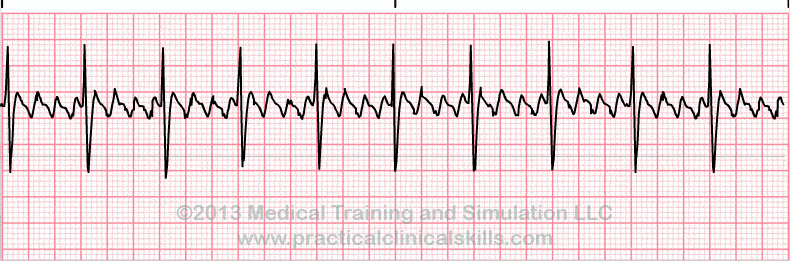
If all therapies are available and ready for use, which would be the priority intervention for this rhythm?
a)
Epinephrine
b)
Vasopressin
c)
Cardioversion
d)
Defibrillation
97.
Valve flaps become stiff from bacterial infection.
a)
Angina pectoris
b)
Valvular stenosis
c)
Incompetent valve
d)
Pericarditis
98.
Heart rate less than 60 beats per min.
a)
Congestive heart failure (CHF)
b)
Heart murmurs
c)
Bradycardia
d)
Tachycardia
99.
Abnormal or unusual heart sounds.
a)
Congestive heart failure (CHF)
b)
Heart murmurs
c)
Bradycardia
d)
Tachycardia
100.

Diastole refers to what action?

a)

Filling

b)

Pumping

101.

During ventricular systole what is happening?

a)

the ventricles are relaxed and the atria contracted

b)

the ventricles and the atria are relaxed

c)

the ventricles and the atria are contracted

d)

the ventricles are contracted and the atria are relaxed

102.

Deoxygenated blood is found on the left side of the heart. True or false?

a)

True

b)

False

103.

Oxygenated blood returns to the heart via the Pulmonary vein to the ...

a)

Left atrium

b)

Right atrium

c)

Left ventricle

d)

Right ventricle

104.
The nurse is helping a patient understand why the heart beat can change in speed. When doing so, what should the nurse explain as being the pacemaker of the heart?
a)
Bundle of His
b)
Sinoatrial node
c)
Purkinje's fibers
d)
Atrioventricular node
105.
The nurse is using a stethoscope to listen to a patient’s heart sounds. The nurse recognizes that the “dupp” of the characteristic “lubb-dupp” heart sound indicates what part of the cardiac cycle?
a)
The closure of the mitral valve
b)
The closure of the tricuspid valve
c)
The closure of the atrioventricular valves
d)
 The closure of the aortic and pulmonary semilunar valves
106.
 A patient asks the nurse to explain what high levels of low-density lipoproteins (LDLs) means. What response by the nurse would be appropriate?
a)
 “Increased blood clotting risk.”
b)
“Increased risk for coronary artery disease.”
c)
“Protection against coronary artery disease.”
d)
 “Decreased risk for atherosclerosis development.”
107.
The nurse is reinforcing instructions provided to a patient to prevent the development of varicose veins. Which patient statement indicates that teaching has been effective?
a)
“Sit with legs crossed.”
b)
“Wear support stockings.”
c)
“Stand for long periods of time.”
d)
“Sleep with the head of the bed elevated.”
108.

The __________ is a wall of muscle that divides/separates the right and left halves of the heart.

a)

Atrioventrucular Valve

b)

Semilunar Valve

c)

Septum

d)

Diaphragm

109.

Identify the circled valve

a)

Tricuspid

b)

Mitral/Bicuspid

c)

Pulmonary

d)

Aortic

110.
Identify the circled valve
a)
Tricuspid
b)
Mitral
c)
Pulmonary
d)
Aortic
111.
Identify the circled valve
a)
Tricuspid
b)
Mitral
c)
Pulmonary
d)
Aortic
112.

The device used to measure the electrical activity of the heart is ________.

a)

EEG

b)

EKG

c)

MRI

d)

EMG

113.

What circulation system carries blood throughout the entire body?

a)

pulmonary circulation

b)

body circulation

c)

heart circulation

d)

systemic circulation

114.
Atherosclerosis impedes coronary blood flow by which of the following mechanisms?
a)
Plaques obstruct the vein
b)
Plaques obstruct the artery
c)
Blood clots form outside the vessel wall
d)
Hardened vessels dilate to allow the blood to flow through
115.
A client is learning about cholesterol. The nurse explains that the “good cholesterol” transports plasma cholesterol away from plaques and to the liver for metabolism. This type of cholesterol is called:
a)
high-density lipoprotein.
b)
low-density lipoprotein.
c)
very-high-density lipoprotein.
d)
very-low-density lipoprotein.
116.

The EKG strip seen above exhibits :

a)

Premature ventricular tachycardia

b)

Normal sinus rhythm

c)

Asystole

d)

Ventricular tachycardia

117.

The following strip is a 6 second strip. What EKG rhythm is displayed here?

a)

Atrial Fibrillation

b)

Asystole

c)

Normal Sinus Rhythm

d)

Sinus Tachycardia

118.

This strip is interpreted as:

a)

Atrial fibrillation

b)

Normal Sinus Rhythm

c)

Atrial Flutter

d)

Ventricular Fibrillation

119.

What does depolarization result in?

a)

relaxation

b)

contraction

c)

repulsion

d)

attraction

120.

What does repolarization result in?

a)

relaxation

b)

contraction

c)

attraction

d)

repulsion

121.

Intrinsic electrical impulses start at which of the following locations?

a)

AV Node

b)

Bundle of His

c)

Purkinje fibers

d)

SA Node

122.

The AV node is located between which two parts of the heart?

a)

right atria, left atria

b)

atria, ventricle

c)

left ventricle, left ventricle

d)

epicardium, pericardium

123.

Which of the following is most likely to occur if there is a blockage to the AV bundle nerve impulse?

a)

the AV Node will not produce electrical impulses

b)

the SA Node will not produce electrical impulses

c)

no effect

d)

the Purkinje fibers will not produce electrical impulses

124.

The last place electrical impulses move through the heart is located where?

a)

the AV Node

b)

the Purkinje fibers

c)

the SA Node

d)

the AV Bundle

125.
What "happens" in the lymph nodes?
a)
Excess glucose in the lymph is stored in the liver
b)
Carbon dioxide is removed from the lymph and passed to the lungs for exhalation
c)
Lymph is oxgenated and pumped through the body
d)
Lymph is cleaned of foreign antigens and debris
126.
Which of the following is true about the lymphatic system?
a)
Lymph flows towards the heart
b)
Lymph flows away from the heart
c)
Lymph is mostly made of plasma
d)
Lymph is only found in lymph nodes
127.
What is the purpose of antibodies?
a)
To pump lymph through the vessels
b)
To create lymph
c)
To fight infection
d)
To remove old red blood cells
128.
Erythro-
a)
Cell
b)
Red
c)
Blue
d)
White
129.
Leuko-
a)
Red
b)
White
c)
Blue
d)
Cell
130.
-pathy
a)
Disease
b)
Infection
c)
Illness
d)
Contagious
131.

What are the formed elements of our blood?

a)

Erythrocytes

b)

Plasma

c)

Leukocytes

d)

Thrombocytes

132.
What structures are foreign substances that invade the body?
a)
neutrophils
b)
lymphocytes
c)
phagocytes
d)
antigens
133.
The lymphatic structure that closely parallell veins are called?
a)
Capillaries
b)
Lymph
c)
Lymph Vessels
134.
The tiny oval shaped lymph structure located throughout the body are known as?
a)
Lymph nodes
b)
Spleen
c)
Lymph fluid
135.
The largest lymphatic structure is?
a)
Lymph
b)
tonsils
c)
Spleen
136.
What is the medical term for watery fluid inside the lympathic vessels?
a)
Plasma
b)
Lymph
c)
Blood
137.
What part of the lymphatic system filters foreign material from blood and destroys old RBCs?
a)
spleen
b)
lymph nodes
c)
thymus 
d)
lymphatic vessels
138.
How is lymph moved through lymphatic vessels?
a)
Contractions of the small intestine
b)
Blood cells carry lymph through the vessels
c)
Contractions of the heart
d)
Contractions of skeletal muscle around the vessels
139.
What is the function of the lymphatic system?
a)
Drains tissue fluids, waste products & flights against infection.
b)
Prevent swelling
c)
Removes toxins & waste 
d)
Fights against infection 
140.
A soft tissue inside the bone that produces blood cells
a)
immune cells
b)
lymph nodes
c)
spleen
d)
bone marrow
141.
If the valves in the lymphatic vessels stopped working, how would this disrupt homeostasis in the body?
a)
Tissue fluid would flow backwards, potentially causing edema, or tissue fluid build-up
b)
It would have no effect, because muscle action would still keep fluid flowing
c)
There are no valves in the lymphatic vessels
d)
Tissue fluid would flow too quickly, causing a heart attack due to the increased fluid flow to the heart