wayground logo

Free Printable Worksheets

Font size

S
M
L
XL
Worksheets

Cell & Molecular Biology Mock Exam

Total questions: 139

Worksheet time: 3hrs 1mins

Name
Class
Date
1.
Which sequence of DNA bases would pair with this partial strand
CAT TCA CTG
a)
ATG TGA CAG
b)
TAC ACT GTC
c)
GTA AGT GAC
d)
CAT TCA CTG
2.
A process in which DNA has the unique ability to make an exact copy of itself.
a)
Replication
b)
Translation
c)
Transcription
3.
Which enzyme is responsible for adding nucleotides?
a)
Topoisomerase
b)
DNA Polymerase
c)
Ligase
d)
Primase
4.
Why does DNA replicate?
a)
To create another copy for the new cell
b)
To create a duplicate copy in case the original gets damaged
c)
To create a new copy to replace the damaged original
5.
What is the purpose of DNA replication?
a)
Cut the DNA 
b)
Make more cells
c)
Apoptosis
d)
Duplicate the DNA
6.
Which enzyme seals okazaki fragments together on the lagging strand?
a)
Topoisomerase
b)
Helicase
c)
Polymerase
d)
Ligase
7.
What is the backbone of DNA made of?
a)
Nitrogen bases
b)
Amino acids
c)
Double H
d)
Sugar & Phosphate
8.

This enzyme synthesizes short RNA sequences to guide DNA Polymerase

a)

Primers

b)

DNA Primase

c)

DNA Polymerase

d)

Topoisomerase

9.

Okazaki fragments are found on the _______________ strand

a)

Leading

b)

Lagging

10.

Which enzyme proofreads and removes RNA Primase

a)

Ligase

b)

Polymerase 1

c)

Polymerase 3

d)

Helicase

11.

Enzyme direction - that DNA is replicated

a)

3' to 5'

b)

5' to 3'

12.

H is the

a)

leading strand

b)

lagging strand

c)

parent strand

d)

none of these

13.

Structure G is

a)

primase

b)

gyrase

c)

DNA polymerase III

d)

DNA polymerase I

14.

This structure is an Okazaki fragment.

a)

A

b)

D

c)

F

d)

G

15.
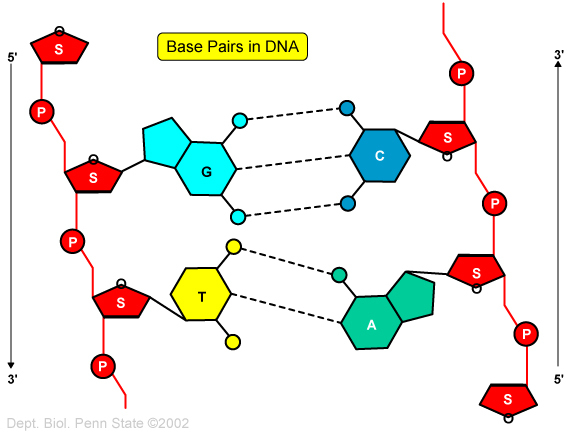
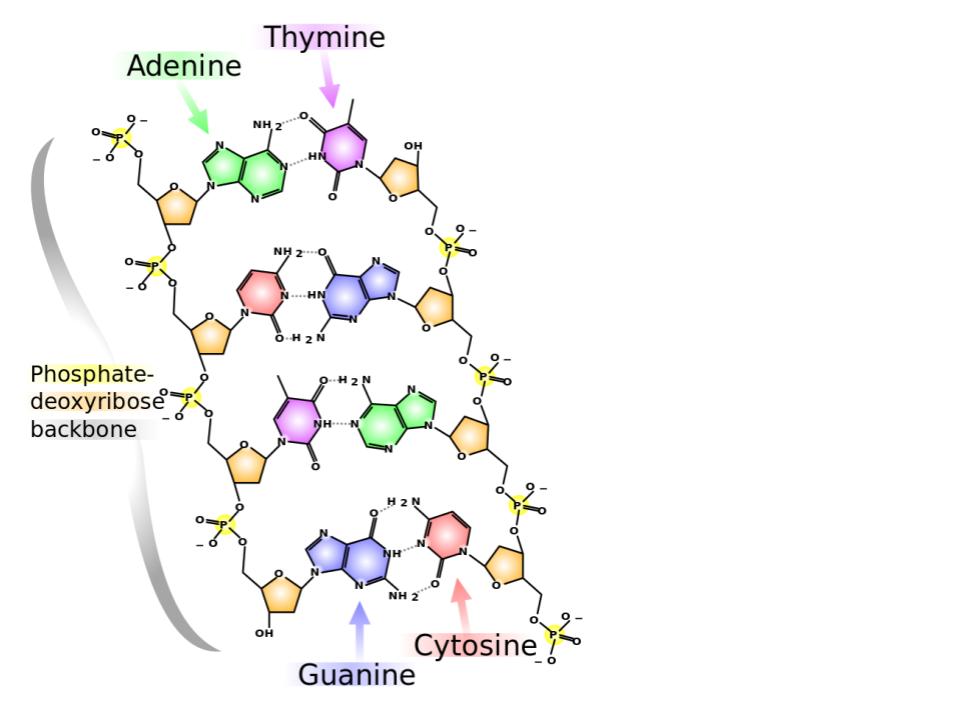
The two strands of a DNA molecule are held together by ________ bonds between their base pairs.
a)
covalent
b)
hydrogen
c)
ionic
d)
peptide
16.
Which of the following is not a base found in DNA?
a)
adenine
b)
thymine
c)
cytosine
d)
uracil
17.
What part of a nucleotide accounts for the genetic variation between individuals?
a)
phosphate
b)
nitrogenous base
c)
deoxyribose
d)
sugar
18.
If one strand of DNA has the sequence TTACCG, the sequence of the other strand of the same molecule will be
a)
AATGGC
b)
TTACCG
c)
AACGGC
d)
AATGGG
19.
Once replication in a DNA molecule is complete, each new DNA molecule contains 
a)
two new strands.
b)
3 exact copies of strands.
c)
one new strand and one old.
d)
two old strands.
20.
The polymerase chain reaction (PCR) is used to
a)
insert DNA from one organism into a new host.
b)
screen for a particular gene.
c)
produce many copies of a selected DNA sequence.
21.
What does mRNA do?
a)
provides information from DNA to ribosomes
b)
transfers amino acids to the ribosomes
c)
makes up ribosomes
d)
builds proteins
22.
What does rRNA do?
a)
provides information from DNA to ribosomes
b)
transfers amino acids to the ribosomes
c)
makes up ribosomes
d)
builds proteins
23.
What does tRNA do?
a)
provides information from DNA to ribosomes
b)
transfers amino acids to the ribosomes
c)
makes up ribosomes
d)
builds proteins
24.
What is the process that copies information from DNA into RNA?
a)
protein synthesis
b)
transcription
c)
translation
d)
DNA Polymerase
25.
What is the process that copies information from DNA into RNA?
a)
protein synthesis
b)
transcription
c)
translation
d)
DNA Polymerase
26.

Where does Transcription take place?

a)

Inside the nucleus

b)

Inside the cytoplasm

c)

Inside the Ribosome

d)

Inside the Rough ER

27.

What happens to the mRNA sequence after it has been synthesized?

a)

stays in the nucleus

b)

leaves the cell

c)

leaves the nucleus

d)

separates into smaller pieces

28.

Select which nitrogenous bases can NOT be found in RNA.

a)

Adenine

b)

Thymine

c)

Uracil

d)

Cytosine

e)

Guanine

29.

Which type of RNA is synthesized during transcription?

a)

messenger RNA (mRNA)

b)

transfer RNA (tRNA)

c)

ribosomal RNA (rRNA)

d)

small nuclear RNA (snRNA)

30.
What will be the resulting mRNA from this DNA sequence:
GAT-TAC-AGA-TTA-CAT?
a)
CTA-ATG-TCT-AAT-GTA
b)
GAU-UAG-UGA-UUA-GUT
c)
CUA-AUG-UCU-AAU-GUA
d)
CAT-ACA-TAC-ATA-TAG
31.
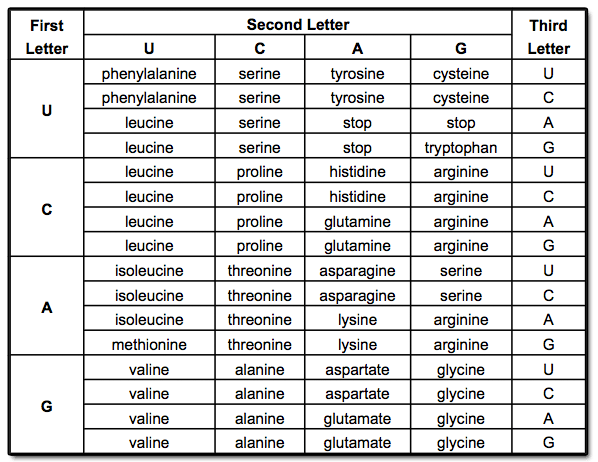
What is the correct amino acid sequence for the mRNA code AUGCCAGUAUGA
a)
Met-Pro-Ala-Val
b)
Met-Pro-Val
c)
Tyr-Gly-His
d)
Tyr-Gly-Arg-His
32.
What is the correct sequence?
a)
RNA --> DNA --> Protein
b)
Protein --> RNA --> DNA
c)
DNA --> RNA --> Protein
d)
DNA --> Protein --> RNA
33.
What process is occurring in this photo?
a)
Transcription
b)
Translation
c)
mRNA is matching with amino acids
d)
tRNA is transcribing the DNA
34.
Which RNA bases would pair with TACGAA in transcription? 
a)
AUGCUU 
b)
ATGCTT
c)
GCATCC
d)
GCAUCC
35.
Where does Translation occur?
a)
Proteins
b)
Mitochondria
c)
Ribosomes
d)
Cytoplasm
36.
DNA codes for...
a)
cholesterol
b)
proteins
c)
fatty acids
d)
a sandwich
37.
Which process is happening in this picture?
a)
Transcription
b)
Translation
c)
Replication
38.
What is the correct amino acid for the following codon:
 GGU
a)
Gly
b)
Met
c)
Ser
d)
Ala
39.
What is the correct amino acid for the following codon:
 UGA
a)
Stop
b)
Met
c)
Asp
d)
Ala
40.
What is the correct amino acid for the following codon:
 UGA
a)
Stop
b)
Met
c)
Asp
d)
Ala
41.

What does "hydrophobic" mean?

a)

water loving, associates with water

b)

water fearing, does not associate with water

c)

a world war II submarine

d)

an example would be solutes like sugar or salt

42.

Which are example is hydrophobic in nature.

a)

Oil

b)

Sugar

c)

Salt

d)

Water

43.
Special proteins help move particles, but NO energy is needed. This is..
a)
facilitated diffusion
b)
exocytosis
c)
active transport
d)
equilibrium
44.
What do the brown structures represent?
a)
Phospholipids
b)
Glycoproteins
c)
Channel Proteins 
d)
Cyctoskeleton Filaments
45.
This process is known as ________ transport.
a)
passive
b)
active
c)
protein
d)
temporary
46.
When looking at the cell membrane, where are the lipid tails located?
a)
Inner part of the bilayer
b)
Outer part of the bilayer
c)
At the end of the bilayer
d)
Goes through each end of the bilayer
47.
How many layers thick is the lipid bilayer?
a)
1
b)
2
c)
3
d)
4
48.

Identify cholesterol molecule

a)

structure a

b)

structure b

c)

structure h

d)

structure i

49.

identify a glycolipid

a)

structure a

b)

structure d

c)

structure e

d)

structure g

50.

Identify a peripheral protein

a)

structure a

b)

strucure b

c)

structure g

d)

structure h

51.

Which of the following substances would have the most trouble crossing the membrane by diffusing through the bilayer?

a)

water

b)

oxygen

c)

carbon dioxide

d)

a sodium ion

52.

Which of the following would likely move through the lipid bilayer most rapidly?

a)

potassium

b)

an amino acid

c)

Carbon dioxide

d)

glucose

53.

Which of the following allows water to move faster across cell membranes?

a)

aquaporins

b)

ATP

c)

peripheral proteins

d)

the sodium-potassium pump

54.
How many different amino acids are there?
a)
15
b)
20
c)
25
d)
30
55.

What type of protein is labeled C?

a)

Peripheral protein

b)

Integral protein

c)

Channel protein

d)

Cholesterol

56.

What type of protein is labeled A & B?

a)

Peripheral proteins

b)

Integral proteins

c)

Glycoprotein

d)

Cholesterol

57.

Which two types of cells were fused together in Figure 5.2 to demonstrate that some proteins can move sideways in the membrane? (Fluid-Mosaic Model)

a)

human and mouse

b)

human and chicken

c)

human and lizard

d)

human and monkey

58.

The glycocalyx or "sugar coat" consist of carbohydrate chains attached to a protein (glycoprotein). Which of the following is not a function or characteristic of the glycocalyx?

a)

Cell-to-cell adhesion

b)

Reception to signaling molecules

c)

Creates a fingerprint for each cell that affects blood type and transplant tissue

d)

synthesizes ATP

59.

Selectively interacts with a specfic molecule or ion so that it can cross the plasma membrane.

a)

Carrier Protein

b)

Junction Protein

c)

Channel Protein

d)

Cell Recognition Protein

60.

Allows molecules to cross the plasma membrane freely.

a)

Channel Protein

b)

Cell Recognition Protein

c)

Enzymatic Protein

d)

Junction Proteins

61.
When particles move out of a cell through facilitated diffusion, the cell ____________.
a)
Gains energy
b)
Uses energy
c)
Releases energy
d)
Does not use energy
62.

F- (small ion) is trying to move with the concentration gradient into the cell. What type of transport should it use?

a)

Protein Pump

b)

Simple Diffusion

c)

Facilitated Diffusion

d)

Osmosis

63.

F- (small ion) is trying to move against the concentration gradient into the cell. What type of transport should it use?

a)

Protein Pump

b)

Simple Diffusion

c)

Facilitated Diffusion

d)

Osmosis

64.

H2O (small ion) is trying to move with the concentration gradient into the cell. What type of transport should it use?

a)

Protein Pump

b)

Simple Diffusion

c)

Facilitated Diffusion

d)

Osmosis

65.

CO2 (small neutral molecule) is trying to move against the concentration gradient into the cell. What type of transport should it use?

a)

Protein Pump

b)

Simple Diffusion

c)

Facilitated Diffusion

d)

Osmosis

66.

CO2 (small neutral molecule) is trying to move with the concentration gradient into the cell. What type of transport should it use?

a)

Protein Pump

b)

Simple Diffusion

c)

Facilitated Diffusion

d)

Osmosis

67.

Which of these are types of active transport

a)

Symport

b)

Osmosis

c)

Antiport

d)

Diffusion

68.

The Na/Glucose pump is an example of a

a)

Uniport

b)

Symport

c)

Antiport

69.

The Na/K pump is an example of a

a)

Uniport

b)

Symport

c)

Antiport

70.

What is one of the functions of a protein?

a)

cell energy

b)

enzymes

c)

long term energy storage

d)

contain genetic information

71.

Proteins that are roughly spherical

a)

globular proteins

b)

fibrous proteins

c)

enzymatic proteins

d)

storage proteins

e)

motor proteins

72.

Proteins that are long and thin

a)

globular proteins

b)

fibrous proteins

c)

enzymatic proteins

d)

storage proteins

e)

motor proteins

73.

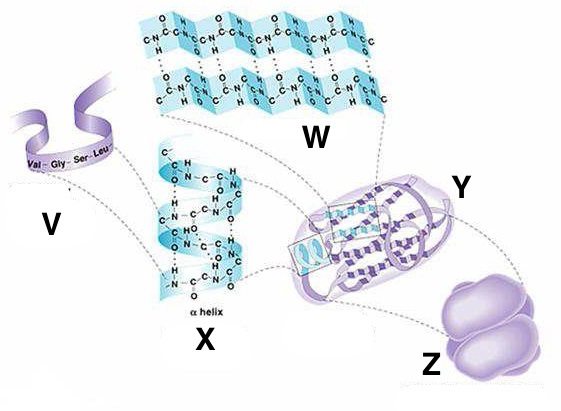
The entire protein forms a three-dimensional structure

a)

primary

b)

secondary

c)

tertiary

d)

quaternary

74.

Which of the following term refers to the order in which amino acids are linked together in a protein.

a)

primary structure

b)

secondary structure

c)

tertiary structure

d)

quaternary structure

75.
makes proteins
a)
nucleus
b)
ribosomes
c)
lysosomes
d)
vacuole
76.
contains enzymes (proteins that speed up digestion and chemical reactions0
a)
lysosome
b)
ribosome
c)
nucleus
d)
golgi body
78.
This structure packages and distributes proteins throughout the cell. 
a)
Golgi Body
b)
Lysosome
c)
Ribosome
d)
Mitochondria
78.
This structure packages and distributes proteins throughout the cell. 
a)
Golgi Body
b)
Lysosome
c)
Ribosome
d)
Mitochondria
79.

Two or more polypeptides attached together and work as one unit

a)

Primary

b)

Secondary

c)

Tertiary

d)

Quaternary

80.

The entire polypeptide forms a three-dimensional structure

a)

Primary

b)

Secondary

c)

Tertiary

d)

Quaternary

81.
The tertiary structure folding in proteins is primary due to the interactions of....
a)
the 'R' groups
b)
the 'P' groups
c)
the 'A' groups
d)
the 'S'
82.

The scientist who took the X-ray crystallogrphy image which enabled the understanding of the DNA double helix was

a)

James Watson

b)

Rosalind Franklin

c)

Francis Crick

d)

Maurice Wilkins

83.

During which phase of the cell cycle is DNA replicated?

a)

G0

b)

Mitosis

c)

Cytokinesis

d)

S

84.

DNA replicates using the _________________ model.

a)

conservative

b)

semi-conservative

c)

photosynthetic

d)

collaborative

85.

The symbol 3' refers to carbon in the sugar to which_______functional group is attached.

a)

PO4

b)

CO

c)

COOH

d)

OH

86.

The symbol 5' refers to carbon in the sugar to which_____ functional group is attached.

a)

PO4

b)

OH

c)

CO

d)

COOH

87.

Which of the following is true of sickle cell disease. In Hemoglobin S (sickle cell hemoglobin)

a)

valine is attracted to other hydrophobic amino acid side chains

b)

valine is repelled by other hydrophobic amino acid side chains

c)

hemoglobin molecules clump together forming long fibers that distort the shape of the red blood cell

d)

hemoglobin molecules are repelled from each other to distort the shape of the red blood cell

88.
In what phase of the cell cycle does DNA replication take place?
a)
G1
b)
S
c)
G2
d)
M
89.
Small segments of DNA made on the lagging strand are called:
a)
Okazaki Fragments
b)
ERVs
c)
Transposable Elements
d)
Telomeres
90.

Contains one new and one old strand

a)

enzymes

b)

helicase

c)

template

d)

semiconservative

91.

keep the strain from super coiling

a)

Single stranded binding protein

b)

topoisomerase

c)

5' to 3'

d)

Okazaki fragment

92.

keep strain separated during replication

a)

Single stranded binding protein

b)

topoisomerase

c)

5' to 3'

d)

Okazaki fragment

93.
The "on/off" switch for an operon is called the
a)
promoter
b)
repressor
c)
operator
d)
gene
94.

What is 4 in the diagram?

a)

RNA polymerase

b)

Inducer

c)

Repressor

d)

Operator

95.

What is 1 in the diagram?

a)

RNA polymerase

b)

Inducer

c)

Repressor

d)

Operator

96.
In the lac operon model the genes within the operon will be expressed if:
a)
lactose is absent in the cell
b)
glucose is present in the cell
c)
lactose is present in the cell
97.
What is the name of the stretch of DNA where RNA polymerase binds?
a)
operator
b)
promoter
c)
enhancer
d)
origin
98.

The lac Z gene codes for:

a)

permease

b)

beta-galactosidase

c)

repressor of lac operon

d)

transacetylase

99.

What is 4 in the diagram?

a)

RNA polymerase

b)

Inducer

c)

Repressor

d)

Operator

100.

What is the name of the stretch of DNA where RNA polymerase binds?

a)

operator

b)

promoter

c)

enhancer

d)

regulatory gene

101.

Virus that infects bacteria

a)

Spirillium

b)

Bacteriophage

c)

Adenovirus

102.

Structure on bacteria used to stick to other bacteria or other surfaces.

a)

cilia

b)

flagellum

c)

Pili

103.
Which 2 molecules form the sides (backbone) of the DNA ladder?
a)
deoxyribose sugar and adenine
b)
deoxyribose sugar and a hydrogen bond
c)
deoxyribose sugar and the nucleus
d)
deoxyribose sugar and phosphate
104.
Nitrogenous bases are joined by which type of bond?
a)
polar bonds
b)
ionic bonds
c)
covalent bonds
d)
hydrogen bonds
105.
The two strands of DNA are held together by:
a)
Hydrogen Bonds
b)
Phosphodiester Bonds
c)
Glycolsyl Bonds
d)
Glycosidic Linkages
106.

what is one purpose of the smooth endoplasmic reticulum?

a)

Modifies protiens

b)

Produces lipids, cholesterol and hormones

c)

Creates ribosomes

d)

Engulfs pathogens

107.
In the order of the lesson what are the three main type of fiber.
a)
microfilaments, microtubuies, and intermediate filaments
b)
intermediate filaments, microfilaments, and microtubuies
c)
microfilaments, intermediate filaments, and microtubuies
d)
microtubules, microfilaments, and intermediate filaments.
108.
What is the Microtubules?
a)
the losses fibers
b)
the thickest fibers
c)
the tightest fibers
d)
the middle fibers
109.
what is the Microfilaments fiber.
a)
the smallest.
b)
the thinnest.
c)
the longest
d)
the thinnest and longest.
110.

Which filaments are built from molecules of protein actin?

a)

Microtubules

b)

Microfilaments

c)

Intermediate filaments

d)

Cilia and flagella

111.

An organelle that transports and packages large molecules like complex carbohydrates, lipids and proteins.

Sometimes called golgi body or golgi complex.

a)

Ribosome

b)

Golgi Reticulum

c)

Endoplasmic Apparatus

d)

Golgi Apparatus

112.
_________ ship and package materials
a)
Golgi bodies
b)
Mitochondria
c)
Rough endoplasmic reticulum
d)
Smooth endoplasmic reticulim
113.

Vesicles from the rough ER are most likely on their way to_____________ .

a)

The peroxisomes

b)

The lysosomes

c)

The Gogi Apparatus

d)

The plant cell vacuoles only.

114.

Which component of the Golgi apparatus is primarily responsible for "receiving" proteins to be packaged and modified?

a)

Cisternae

b)

Vacuoles 

c)

cis Golgi

d)

trans Golgi

115.

Fibers with diameters in a middle range

a)

Microtubules

b)

Microfilaments

c)

Intermediate filaments

116.

Motor proteins (*******. ********) bind to the microtubule and use ATP to transport vesicles around the cell

a)

Nexin, laminin

b)

myosin, actin

c)

dynein, kinesin

d)

desmin, vimentin

117.

A motor protein that moves along microtubules by walking toward the plus end

a)

kinesin

b)

actin

c)

dynein

d)

myosin

118.

A member of the family of motor proteins that move along microtubules by walking toward the minus end.

a)

kinesin

b)

actin

c)

dynein

d)

myosin

119.

A molecule of DNA that is a pattern for synthesis of a new DNA molecule

a)

enzymes

b)

helicase

c)

template

d)

semiconservative

120.

Contains one new and one old strand

a)

enzymes

b)

helicase

c)

template

d)

semiconservative

121.

This carries two different ions or molecules in different directions.

a)

Antiporter

b)

Symporter

c)

Uniporter

d)

Diffusion

122.

These are channel proteins that allow water to pass through the membrane at a very high rate.

a)

Aquaporins

b)

Symporter

c)

Antiporter

d)

Uniporter

123.
During which parts of the cell cycle does the cell grow?
a)
G1 and G2
b)
G1 and S
c)
M phase and cytokinesis
124.
Which phase of mitosis is shown in the picture?
a)
Prophase
b)
Anaphase
c)
Telophase
125.
Which phase of mitosis is shown in the picture?
a)
Interphase
b)
Metaphase
c)
Telophase
126.
Which phase of mitosis is shown in the picture?
a)
Prophase
b)
Metaphase
c)
Anaphase
127.
Which phase of mitosis is shown in the picture?
a)
Prophase
b)
Telophase
c)
Metaphase
128.

Apoptosis means program cell growth.

a)

TRUE

b)

FALSE

129.

To start the process of apoptosis, proteins called ______ are activated.

a)

p53

b)

Ligase

c)

Caspases

130.

How many cell cycle checkpoints are there?

a)

1

b)

2

c)

3

d)

4

131.

Name the 3 checkpoints of the cell cycle

a)

Anaphase checkpoint, mitosis/metaphase checkpoint, and telophase checkpoint

b)

Interphase checkpoint, S phase checkpoint, and M phase checkpoint

c)

G1 checkpoint, G2 checkpoint, and S phase checkpoint

d)

G1 checkpoint, G2 checkpoint, and mitosis/metaphase checkpoint

132.
What is a G protein?
a)
specific type of membrane-receptor protein
b)
protein on the cytoplasmic side of a membrane
c)
membrane-bound enzyme
d)
relay protein
133.
What do second messengers do?
a)
transport a signal through the lipid bilayer
b)
relay a signal from the outside to the inside of the cell
c)
relay message from the inside of the mebrane throughout the cytoplasm
d)
dampen the message
134.
Which of the following is a chemical message that usually travels through the bloodstream to target cells?
a)
hormone
b)
local regulator
c)
endocrine cell
135.
Which of the following is involved in many human medicines for disease?
a)
cAMP
b)
Calcium concentration
c)
G-protein pathways
d)
receptor tyrosine kinases
136.
The 3 steps of signal transduction in order are
a)
reception, transduction, response
b)
response, transduction, reception
c)
reception, response, transduction
d)
transduction, reception, response
137.

Which letter represents the cell surface receptor protein?

a)

A

b)

B

c)

C

d)

D

e)

E

138.
Which of the following correctly describes the reception stage of this signal transduction pathway?
a)
epinephrine binds to a g-protein coupled receptor protein present in the cell membrane
b)
the g protein changes shape, is activated, activates adenyl cyclase, which activates cAMP, which activates protein kinases
c)
protein kinases phosphoylate molecules
d)
glycogen synthesis is inhibited and glycogen breakdown is promoted
139.
Which of the following correctly describes the transduction stage of this signal transduction pathway?
a)
epinephrine binds to a g-protein coupled receptor protein present in the cell membrane
b)
the g protein changes shape, is activated, activates adenyl cyclase, which activates cAMP, which activates protein kinases
c)
cAMP binds to the g-protein coupled receptor protein
d)
glycogen synthesis is inhibited and glycogen breakdown is promoted