wayground logo

Free Printable Worksheets

NEW

Font size

S
M
L
XL
Worksheets

P1-4 AQA GCSE Revision

Total questions: 77

Worksheet time: 1hrs 11mins

Name
Class
Date
1.
What is the equation involving force, distance and work done?
a)
Work = Force x distance
b)
Force = Work x Distance
c)
Distance = Work x Force
2.
W=125 J
d=10 m
F=???
a)
12.5 N
b)
1250 N
c)
0.08 N
d)
135 N
3.
Roger Federer’s tennis ball has a mass of 0.3 kg. If he holds the ball above the ground at a height of 2.0 m to serve, what is its gravitational potential energy (GPE)?
a)
5.88 J
b)
0.6 J
c)
6.67 J
d)
0.15 J
4.
When a pendulum swings, at which point is kinetic energy highest: 
a)
1
b)
2
c)
3
d)
4
5.
When a pendulum swings, at which point is potential energy at its greatest
a)
1
b)
2
c)
3
d)
4
6.
What is the equation involving:
Gravitational potential energy, gravitational field strength, mass and height
a)
Gravitational field strength = mass x gravitaitional potential energy x height
b)
Mass = Gravitational potential energy x gravitational field strength x height
c)
Gravitational Potential Energy = mass x gravtitational field strength x height
7.
You serve a volleyball with a mass of 2 kg. The ball leaves your hand with a speed of 30 m/s. What is the KE of the ball?
a)
900 J
b)
1800 J
c)
60 J
d)
30 J
8.
What is the equation involving kinetic energy, mass and velocity?
a)
Kinetic energy -= mass x velocity
b)
Kinetic energy = 1/2 x mass x velocity2
c)
Kinetic energy = 1/2 x mass x velocity
9.
How much power is needed to do 648 Joules of work in 100 seconds?
a)
64800 Joules
b)
64800 watts
c)
6.48 watts
d)
0.15 watts
10.
A bird used 8 watts of power and flew for 5 seconds.  How much work did the bird do?
a)
40 watts
b)
40 joules
c)
1.6 watts
d)
1.6 joules
11.
If you buy a machine that has an efficiency of 82%, what happened to the other 18%?
a)
Most of the rest of the energy was dissipated to the surroundings as a thermal energy store
b)
There is not enough information given
12.
What is the efficiency of a machine if 55.3 J are put into a machine, but only 14.3 J of energy is useful output?
a)
0.26 Joules
b)
26%
c)
3.86 Joules
d)
386%
13.
What is the equation relating power, work and time?
a)
Power = Work x time
b)
Work = Power x time
c)
Time = Power x work
14.
What is the main problem with some of the renewable energy resources?
a)
Some, like wind and solar, are not reliable
b)
Some, like Biomass, contribute to global warming and acid rain
c)
Some, like Geothermal, will run out in the next 200 years
15.
A resource that can be easily replaced.
a)
renewable
b)
alternative
c)
non renewable
16.
A resource not easily replaced.
a)
non renewable
b)
renewable
c)
alternative
17.
Electric cars are not as good as you would first think because ...
a)
The electricity costs are higher than fuel costs
b)
60% of their energy comes from burning fossil fuels
c)
They create a lot of noise pollution on the roads
18.
Nuclear power is good for making electricity because ...
a)
It doesn't create too much radioactive waste
b)
It doesn't produce greenhouse gases
c)
It is renewable
d)
It is cheap to decommision power plants at the end of their life
19.
The amount of renewable energy is not going up because ...
a)
Fossil fuels are relatively cheap
b)
Fossil fuels are still plentiful and easy to turn into electricity
c)
Renewable energy don't contribute to greenhouse gases
d)
Most renewable energy resources don't produce a lot of electricity and are relatively expensive to build
20.
What is the unit of power?
a)
Newton
b)
Joule
c)
Watt
d)
kilogram
21.
What is the unit of work
a)
Watt
b)
Newton
c)
Joule
22.
What is the unit of Force?
a)
Newtons
b)
Joules
c)
kilograms
d)
Watt
23.
A circuit that has more than one path for electricity to follow is a...
a)
series
b)
static
c)
broken
d)
parallel
24.
Copper is used in wiring because it is an excellent______________ of electricity.
a)
circuit breaker
b)
conductor
c)
insulator
d)
fuse
25.
I am the crackle you hear when you touch a doorknob after rubbing your feet across a carpet.
a)
electric circuit
b)
electric discharge
c)
fuse
d)
conductor
26.
I open overloaded circuits by melting.
a)
circuit
b)
conductor
c)
insulator
d)
fuse
27.
The thin wire inside alight bulb is called the filament.
a)
true
b)
false
28.
If you take one light bulb out of a parallel circuit, all the lights will go out.
a)
true
b)
false
29.
What it the formula to find voltage. 
a)
I= V/R
b)
R=V/I
c)
V= I x R 
30.
In a parallel circuit with 2 lightbulbs, if you take out one lightbulb what will happen to the rest?
a)
They will all go out.
b)
The other one will stay on 
31.
What is the unit of measurement for resistance?
a)
Amperes
b)
Ohm's
c)
Volts
32.
What component is this?
a)
Varibale resistor
b)
fuse
c)
Thermistor 
d)
diode
33.
What component is this?
a)
Varibale resistor
b)
fuse
c)
Thermistor 
d)
diode
34.
What component is this?
a)
LDR
b)
LED
c)
Thermistor 
d)
diode
35.
A Charging system producing 14.5 Volts with a current flow of 43.5 Amps, what is the circuit resistance
a)
58 Amps
b)
0.33 Amps
c)
13 Amps
d)
1 Amp
36.
What is the equation for energy transfer given power and time?
a)
energy transferred = power x time
b)
energy transferred = power/time
c)
energy transferred = time/power
d)
energy transferred = power x time^2
37.
How many Volts would we need to produce a current flow of 8 Amps through a 6 Ohm resistor
a)
12 volts
b)
24 volts
c)
1.3333
d)
48 volts
38.
If the battery produced 12.6 Volts and what would be the current flow be for a 6 Ohm resistor
a)
2.1 Amps
b)
2.4 Amps
c)
1.71 Amps
d)
15 Amps
39.

What size resistor would produce a 3 Amp current flow with a 12 Volt battery

a)

1 Ohm

b)

3 Ohms

c)

4 Ohms

d)

12 Ohms

40.

What device does this graph represent?

a)

Diode

b)

Fixed resistor

c)

Filament lamp

d)

Thermistor

41.

What device does this graph represent?

a)

Diode

b)

Fixed resistor

c)

Filament lamp

d)

Thermistor

42.

What device does this graph represent?

a)

Diode

b)

Fixed resistor

c)

Filament lamp

d)

Thermistor

43.

Which of the following has a resistance that decreases with light intensity.

a)

Filament bulb

b)

thermistor

c)

Light dependent resistor

d)

Diode

44.

Which of the following has a resistance that increases with temperature.

a)

Filament bulb

b)

thermistor

c)

Light dependent resistor

d)

Diode

45.
Which state of matter cannot flow
a)
Solid
b)
Liquid
c)
Gas
46.
What is it called when a substance turns from a liquid into a gas?
a)
Melting
b)
Freezing
c)
Evaporating
d)
Condensing
47.
What is it called when a substance turns from a gas into a liquid?
a)
Melting
b)
Freezing
c)
Evaporating
d)
Condensing
48.
How do you calculate the density of an object?
a)
mass
b)
mass / volume
c)
volume x mass
d)
mass / volume
49.
How do you calculate the volume of a cuboid?
a)
width x length x height
b)
height x length
c)
height x length / width
d)
width / mass x length
50.
What can happen to substances when their internal energy increases?
a)
change state
b)
increase in temperature
c)
decrease in temperature
51.
The energy needed to change 1kg of a solid into a liquid (melt all of it)?
a)
specific latent heat
b)
specific latent heat of vaporisation
c)
specific latent heat of fusion
52.
The energy needed to change 1kg of a liquid into a gas (evaporate all of it)?
a)
specific latent heat
b)
specific latent heat of vaporisation
c)
specific latent heat of fusion
53.
What is happening when a substance is melting?
a)
Bonds are forming
b)
Bonds are breaking
c)
Bonds are weakening
54.
What is happening when a substance is evaporating?
a)
Bonds are forming
b)
Bonds are breaking
c)
Bonds are weakening
55.
How do you calculate the energy needed to melt something?
a)
specific latent heat x mass
b)
specific latent heat / mass
c)
mass / specific latent heat
56.

In which section of the graph is melting happening?

a)

Between A and B

b)

Between B and C

c)

Between D and E

d)

Between E and F

57.
What happens to the number of particles as you cool them down and change its state?
a)
Increases
b)
decreases
c)
doesn’t change
58.
What can happen to substances when their internal energy increases?
a)
change state
b)
increase in temperature
c)
decrease in temperature
59.
The energy needed to change 1kg of a liquid into a gas (evaporate all of it)?
a)
specific latent heat
b)
specific latent heat of vaporisation
c)
specific latent heat of fusion
60.

What state will this substance be between A and B

a)

Solid

b)

Liquid

c)

Gas

61.

What state will this substance be between C and D?

a)

Solid

b)

Liquid

c)

Gas

62.
How many protons does gold atom have?
a)
197
b)
79
c)
118
d)
276
63.
What is the mass of a proton?
a)
1
b)
2
c)
-1
d)
0
64.
What is the charge of an electron?
a)
1
b)
0
c)
-1
d)
4
65.
What is an alpha particle?
a)
1 high speed electron
b)
2 protons
c)
2 neutrons
d)
2 protons + 2 neutrons
66.
What is the definition of an isotope?
a)
An atom with different electron number to proton number
b)
An atom with different proton number from neutron number
c)
An atom with different number of protons from the periodic table
d)
An atom with a different number of neutrons from the periodic table
67.
Which is the most highly ionizing?
a)
Alpha
b)
Beta
c)
Gamma
68.
What is radioactive decay?
a)
The spontaneous breakdown of an atomic nucleus resulting in only energy release
b)
The spontaneous breakdown of an atomic nucleus resulting in only matter release
c)
The spontaneous breakdown of an atomic nucleus resulting in a release of energy and matter
d)
The decay of the use of radios and the increased use of televisions.
69.
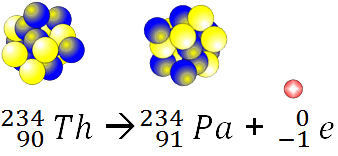
Which type of nuclear radiation is being emitted here?
a)
Alpha
b)
beta
c)
gamma 
d)
none
70.
Takes two small nuclei and combines them into a larger nucleus
a)
fission
b)
fusion
71.
The splitting of a nucleus into smaller nuclei is
a)
fusion
b)
fission
c)
half-life
d)
gamma radiation
72.
How do nuclear power-plants work?
a)
Fusion
b)
Half-life
c)
Fission
d)
Fusion or fission
73.
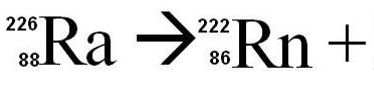
Complete the nuclear equation and determine the type of decay that is occurring in this reaction. 
a)
alpha
b)
beta
c)
gamma
d)
none
74.
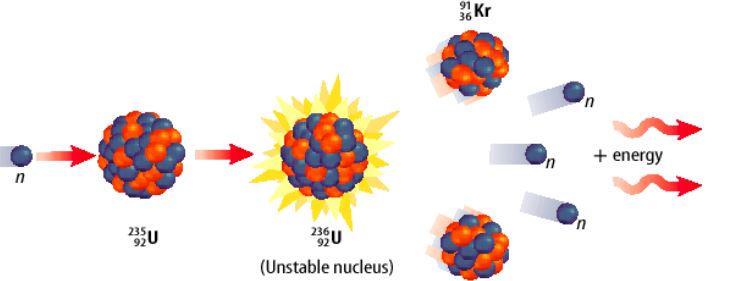
This is an example of...
a)
Fission  reaction
b)
Fusion reaction
c)
Decomposition reaction
d)
Decay
75.
In order of most to least penetrating radiation we have
a)
Alpha , Beta,  Gamma
b)
Beta , Gamma , Alpha
c)
Gamma, Beta, Alpha
d)
Gamma, Alpha, Beta
76.
One advantage of nuclear energy over coal energy is ______.
a)
it is very cheap to build and maintain a nuclear power plant
b)
there is very little dangerous waste with nuclear energy
c)
the nuclear plant emits more greenhouse gases
d)
the nuclear plant does not emit as many greenhouse gases
77.
One disadvantage of nuclear energy is ___.
a)
it is a fossil fuel
b)
it leaves behind radioactive waste
c)
it emits large amounts of pollution into the atmosphere
d)
there are no disadvantages