wayground logo

Free Printable Worksheets

Font size

S
M
L
XL
Worksheets

Biology Review Part 1

Total questions: 55

Worksheet time: 1hrs 1mins
Name
Class
Date
1.
What are the four biological molecules?
a)
proteins, carbohydrates, lipids, nucleic acids
b)
A, T, C, G
c)
water, air, earth, and fire
d)
Joe, Nick, and Kevin Jonas
2.
Which biomolecule is also known as enzymes?
a)
Carbohydrate
b)
Lipid
c)
Nucleic Acid
d)
Protein
3.
Which biomolecule is your main source of quick energy?
a)
Nucleic Acid
b)
Protein
c)
Lipid
d)
Carbohydrate
4.
Which biomolecule is found in fats, oils, and waxes and is a source of long-term energy
a)
Proteins
b)
Nucleic Acid
c)
Lipids
d)
Carbohydrate
5.
What is the function of a nucleic acid?
a)
Stores genetic information
b)
Stores energy
c)
Quick source of energy
d)
Builds structures
6.
Which biomolecule functions include enzymes­ which speeds the rate of chemical reactions, structural components in cells, mechanical functions in muscles and cytoskeleton, cell signaling, and immune response; provides structure and helps with chemical reactions 
a)
Protein
b)
Lipids
c)
Carbohydrate
d)
Nucleic Acid
7.

Which elements are found in Carbohydrates?

a)

C - Carbon

b)

H - Hydrogen

c)

O - Oxygen

d)

N - Nitrogen

e)

P - Phosphorous

8.

Which elements are found in Lipids?

a)

C - Carbon

b)

H - Hydrogen

c)

O - Oxygen

d)

N - Nitrogen

e)

P - Phosphorous

9.

Which elements are found in Proteins?

a)

C - Carbon

b)

H - Hydrogen

c)

O - Oxygen

d)

N - Nitrogen

e)

P - Phosphorous

10.

Which elements are found in Nucleic Acid?

a)

C - Carbon

b)

H - Hydrogen

c)

O - Oxygen

d)

N - Nitrogen

e)

P - Phosphorous

11.
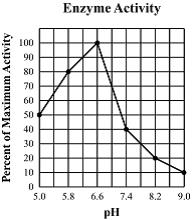
Which of the following conclusions can be drawn from this graph?
a)
The optimum pH of the enzyme is 6.6.
b)
The optimum pH of the enzyme is 5.8
c)
The enzyme’s activity increases as pH increases 5.0 to 9.0
d)
The enzyme’s activity is greater around pH of 8.0 .
12.

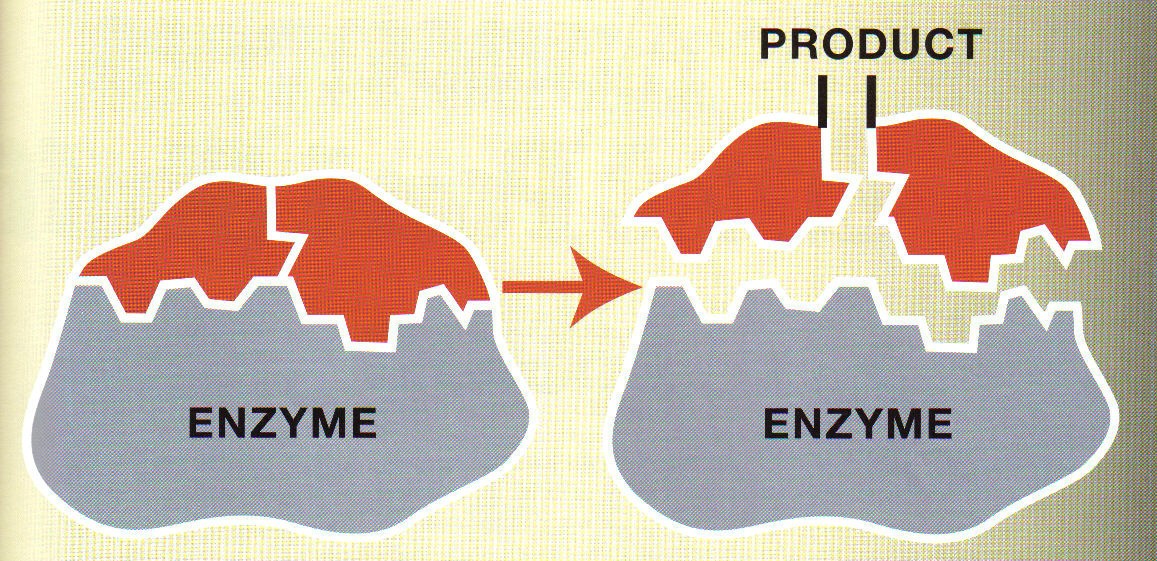
Enzymes speed up reaction rates by changing:

a)

Activation Energy - energy needed to start the reaction

b)

pH - about of Hydrogen concentration

c)

Hydrogen Bonds

d)

Kinetic Energy

13.
Needs host cell to reproduce.
a)
Virus
b)
Bacteria
c)
Fungus
d)
Protozoan
14.
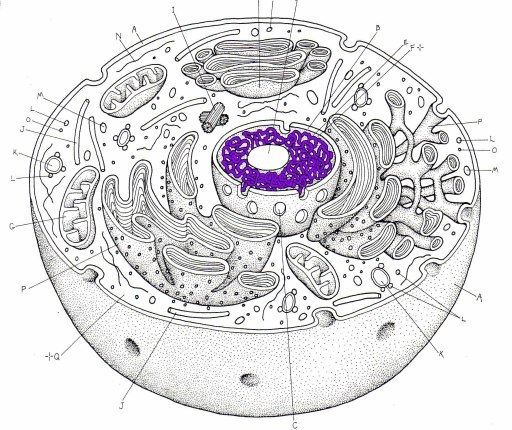
What kind of cell is this?
a)
Eukaryotic
b)
Prokaryotic
15.
What type of cell has a nucleus? 
a)
eukaryotic
b)
prokaryotic 
16.
What type of cell does not have a nucleus?
a)
eukaryotic 
b)
prokaryotic 
17.
Eukarytoes have Many membrane-bound organelles? True or False
a)
True 
b)
False
18.
______ make protein for the cell.  
a)
Nuclei
b)
Ribosomes
c)
Endoplasmic reticulum
d)
Vacuoles 
19.
Which type of cell is bigger?
a)
Prokaryotic
b)
Eukaryotic 
20.
_____ convert light energy into food through photosynthesis.
a)
Vacuoles 
b)
Ribosomes
c)
The Golgi apparatus
d)
Chloroplasts
21.
Which of the following is not a characteristic of a Prokaryotic cell?
a)
unicellular
b)
floating DNA
c)
very small
d)
complex
22.
Which of the following is a characteristic of both Eukaryotic and Prokaryotic cells?
a)
ribosomes
b)
nucleus
c)
membrane bound organelles
d)
simple
23.

Which of the following converts food into energy for the cell? (cellular respiration)

a)

vacuole

b)

mitochondria

c)

cytoplasm

d)

cell membrane

24.
Which cell structure is found in plant and animals cells and controls what can come into or leave a cell?
a)
cell membrane
b)
cytoplasm
c)
nucleus
d)
vacuole
25.
Chloroplasts in plant cells allow the plant to perform a function that animal cells cannot do.  What is the main function of the chloroplasts found in plant cells?
a)
to absorb light energy and manufacture food
b)
to remove waste materials by active transport
c)
to manufacture chemical energy from food
d)
to control the shape of the cell
26.
During which phase of the cell cycle does the cell spend the most time?
a)
Mitosis
b)
Cytokinesis
c)
Interphase
27.
During which part of the cell cycle does the cell divide?
a)
Interphase
b)
Mitosis
c)
S phase
28.

During which part of the cell cycle is DNA replicated?

a)

Mitosis

b)

Cytokinesis

c)

S phase

29.
During which parts of the cell cycle does the cell grow?
a)
G1 and G2
b)
G1 and S
c)
M phase and cytokinesis
30.
Which phase of mitosis is shown in the picture?
a)
Prophase
b)
Anaphase
c)
Telophase
31.
Which phase of mitosis is shown in the picture?
a)
Interphase
b)
Metaphase
c)
Telophase
32.
Which phase of mitosis is shown in the picture?
a)
Prophase
b)
Metaphase
c)
Anaphase
33.
Which phase of mitosis is shown in the picture?
a)
Prophase
b)
Telophase
c)
Metaphase
34.

Uncontrolled cell division which usually leads to tumors and disease is called:

a)

Metaphase

b)

Cytokinesis

c)

Cancer

d)

Diabetes

35.
During what phase of the cell cycle is DNA replicated?
a)
G1 phase
b)
S phase
c)
G2 phase
d)
M phase
36.
Adenine bonds with ______________.
a)
Guanine
b)
Thymine
c)
Cytosine
d)
Adenine
37.
Guanine bonds with ______________.
a)
Adenine
b)
Guanine
c)
Cytosine
d)
Thymine
38.
Why is DNA important?
a)
it is very small and very complicated
b)
it's in everything
c)
it serves as the blueprint for traits of all living things
d)
because we eat it every day for energy
39.
Which sequence of DNA bases would pair with this partial strand
ATG TGA CAG
a)
ATG TGA CAG
b)
TAC ACT GTC
c)
GTA AGT GAC
d)
CAT TCA CTG
40.
What is a gene?
a)
A bundle (like a hot dog bun) that the DNA is packed into
b)
something inside the nucleus
c)
a piece of DNA
d)
all of your DNA
41.
What determines the code, or information, of a DNA molecule?
a)
the shape (structure) of the nitrogen bases
b)
the order (sequence) of the nitrogen bases
c)
the color of the nitrogen bases
d)
the frequency (number) of nitrogen bases
42.
The two strands of nitrogenous bases in DNA are joined by which type of bond?
a)
polar bonds
b)
ionic bonds
c)
covalent bonds
d)
hydrogen bonds
43.
DNA holds the code for
a)
lipids
b)
carbohydrates
c)
protein
d)
sugar
44.
Which component of DNA determines the traits of an organism? 
a)
Nitrogen Bases
b)
Sugar-Phosphate Backbone
c)
Hydrogen bonds
45.
What is another name for a protein?
a)
a chain of amino acids
b)
polypeptide
c)
codon
d)
anticodon
46.
DNA controls traits through the order of its--
a)
phosphates
b)
sugars
c)
carbons
d)
nitrogen bases
47.
How is information for a specific protein carried on the DNA molecule?
a)
As a pattern of phosphate and sugars
b)
In the double helix shape of the condensed chromosome
c)
As a sequence of nucleotides
d)
In the ratio of adenine to guanine
48.

The genetic code is often referred to as blueprint of life. Which is correct about genetic code?

a)

Less complex organisms require additional sets of the genetic code.

b)

The nucleotide sequence of the genetic code is exact same for every organism.

c)

The genetic code for every living organism is made from the same component.

d)

Some simple organiosms do not have genetic code.

49.

All living organisms share the same DNA components. What makes each organism unique?

a)

The sequence of the nucleotides

b)

The double helix

c)

The amount of ATP

d)

The pattern of phosphates and sugars

50.

The sequence of nitrogenous bases in DNA varies widely. All organisms have the same nitrogenous bases. The sequence of bases in DNA is most important for which of the following?

a)

Providing the instructions for the traits of an organism.

b)

Preventing mutations for occurring during DNA replication

c)

Allowing the DNA to have the shape necessary for replication.

d)

Helping from the sugar-phosphate backbone of DNA molecules

51.

What are the products of photosynthesis (what is made)?

a)

Glucose

b)

Oxygen

c)

Water

d)

Carbon dioxide

e)

Light (energy)

52.

What are the reactants of photosynthesis (what does photosynthesis need)?

a)

Glucose

b)

Oxygen

c)

Water

d)

Carbon dioxide

e)

Light (energy)

53.

What are the reactants of Respiration (what does respiration need)?

a)

Glucose

b)

Oxygen

c)

Water

d)

Carbon dioxide

e)

Light (energy)

54.

What are the products of respiration (what is made)?

a)

Glucose

b)

Oxygen

c)

Water

d)

Carbon dioxide

e)

Energy (ATP)

55.

Which statement best describes the relationship between the products of photosynthesis and the reactants of cellular respiration?

a)

The products of photosynthesis serve as the reactants in cellular respiration to provide chemical energy

b)

The products of photosynthesis combine with the reactants in cellular respiration to remove ATP from cells

c)

The products of photosynthesis inhibit the reactants in cellular respiration in the presence of light

d)

The products of photosynthesis change the structure of the reactants in cellular respiration in the presence of light