
 Worksheets
Plant Tissues (9-O)
Total questions: 50
Worksheet time: 50mins
The size of the stem increases in width due to ___________.
primary meristem
apical meristem
intercalary meristem
lateral meristem
Sieve tubes and companion cells are present in _____________.
xylem
phloem
cork
cambium
A twig of white-coloured flowers is placed in a beaker containing coloured water. After some time, the white petals become coloured. Which tissue is responsible for this?
Xylem
Phloem
cork
cambium
Which of the following is not a function of epidermal tissue?
Protection
Absorption of water
Transport of water
Gaseous exchange
The flexibility in plants is due to a tissue called ___________.
chlorenchyma
parenchyma
sclerenchyma
collenchyma
When a grass lawn is mowed, its meristematic tissues get cut off. However, they still regrow. This is due to the presence of
lateral meristem
intercalary meristem
epidermis
apical meristem
It is difficult to pull out the husk of coconut because
sclerenchyma cells are closely packed
collenchyma cells have thickened corners
xylem gives mechanical strength
epidermis has a thick cuticle
Which of the following statements about meristematic tissue is incorrect?
Thin-walled cells with large prominent nuclei
Thick-walled cells with large intercellular spaces
Divide actively leading to growth
Small cells rich in cytoplasm
Find the mismatched pair.
Vascular tissue: Transport
Ground tissue: Storage
Dermal tissue: Reduce transpiration
Permanent tissue: Growth
Which of the following forms the main conducting unit of the xylem?
Tracheids
Vessels
Xylem fibres
Xylem parenchyma
Which of the following statements is true for sieve tubes?
Perforated living cells that conduct food
Perforated dead cells that conduct food
Perforated living cells that conduct water
Perforated dead cells that conduct water
A permanent tissue is described as complex tissue when it has ___________.
one type of cells, performing two or more different functions
more than one type of cells, performing different functions
one type of cells, performing one function
more than one type of cells, performing one common function
Photosynthesis takes place in leaves due to ______________.
chloroplasts present in parenchyma cells
chloroplasts present in complex cells
chloroplasts present in collenchyma cells
chloroplasts present in epidermal cells
A mango tree can grow up to a height of 40 metres. This growth is brought about by
apical meristem
lateral meristem
intercalary meristem
vertical meristem
Permanent tissues are made up of cells that ______________.
have lost the power of division
may be living or dead
both a and b
none of the above
A leaf tendril is flexible and strong due to the presence of _______________.
thickenings at corners of parenchyma tissue
intercellular spaces in parenchyma tissue
intercellular spaces in collenchyma tissue
thickenings at corners of collenchyma tissue
The hard covering of nuts is made of _______________.
parenchyma tissue
collenchyma tissue
sclerenchyma tissue
aerenchyma tissue
Xylem and phloem form a part of _______________.
conducting tissue
vascular tissue
complex tissue
all of the above
Lignin is a substance that thickens the walls of _______________.
parenchyma cells
collenchyma cells
sclerenchyma cells
meristematic cells
Ground tissue is
simple permanent tissue
complex permanent tissue
simple meristematic tissue
complex meristematic tissue
Q1. A group of similar cells to perform a specific function form
organ
organ system
organism
tissue
Q2. Plant tissue that helps in increasing the lenght of the shoot and root.
Intercalary meristem
Apical meristem
lateral meristem
permanent tissues
Q3. type of muscular tissue helps in the movement of organism from one place to another place.
skeletal muscle
smooth muscle
cardiac muscle
Skeletal and smooth muscle
Q4. Xylem is
Simple permanent tissue
Complex permanent tissue
Meristematic tissue
Protective tissue
Q5. Type of parenchyma cells that has chlorophyll in it.
Arenchyma
collenchyma
chlorenchyma
sclerenchyma
Q6. Muscular tissue that is found in the heart
Skeletal
Smooth
Cardiac
Connective
Q7. Meristematic tissue that helps in the increase of the width of the plant(secondary growth)
Apical meristematic tissue
Intercalary meristematic tissue
lateral meristematic tissue
Neural tissue
Q8. Animal tissue that helps in excreting the waste products
connective tissue
epithelial tissue
skeletal muscle
nervous tissue
Q9. Plant tissue that helps in the conduction of food from leaves to all parts of the plant
Xylem
phloem
xylem and phloem
None
Q10. A basic structural and functional unit of all the living organisms
Organ system
organ
tissue
cell
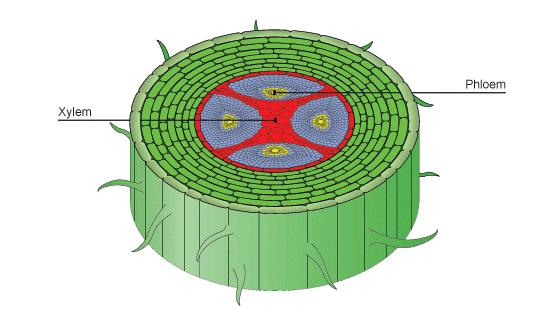
Specific type of plant tissue that transports water and minerals from the roots, through the stems, to leaves
vascular plant
nonvascular plant
xylem
phloem

Specific type of plant tissue that transports food (sugar) made in the leaves to the entire plant
vascular plant
nonvascular plant
xylem
phloem
Other than transporting water, what is a function of xylem?
making food
transporting food
helping support the plant
catching light
The flexibility in plants is due to a tissue called
parenchyma
chlorenchyma
collenchyma
sclerenchyma
Sieve tubes and companion cells are present in
xylem
phloem
cambium
cork
The size of the stem increases in the width due to
apical
intercalary
lateral
vascular bundle
Xylem and phloem are examples of
epidermal tissue
connective tissue
protective tissue
vascular tissue
A tissue whose cells are capable of dividing and re-dividing is called
complex tissue
permanent tissue
connective tissue
meristematic tissue
The only dead cells in phloem
companion
sieve
phloem fibres
phloem parenchyma
Packaging tissue
parenchyma
collenchyma
xylem
phloem
The nuclei of meristematic cells are
small
large
medium sized
no nucleus
Which of the following is an undifferentiated embryonic tissue found in the active growth regions of plants such as tips of roots and stems?
Parenchyma tissue
Collenchyma tissue
Meristematic tissue
Permanent tissue

What type of ground tissue is this?
Parenchyma
Collenchyma
Schlerenchyma


Type of plant that is usually taller (longer) and has vascular tissue (xylem and phloem) that provides support
vascular plant
nonvascular plant
xylem
phloem
This is what almost all non-flowering plants reproduce from (except cone bearing plants)
spores
seeds
monocots
dicot
Examples of these plants include mosses, liverworts, and other plants with no xylem or phloem
dicot
vascular plant
monocot
nonvascular plant

