wayground logo

Free Printable Worksheets

NEW

Font size

S
M
L
XL
Worksheets

Air Test Review #2 Cell Structures & Processes

Total questions: 61

Worksheet time: 3625secs

Name
Class
Date
1.
The powerhouse of the cell is the...It converts energy from food into energy the cell can use
a)
Mitochondrion
b)
Golgi body
c)
Nucleus
d)
Ribosomes
2.
This organelle is in both plants and animals. It is a barrier between the cell and the environment.  It controls what goes in and out of a cell.
a)
cell wall
b)
cell membrane
c)
cell organelles
d)
mitochondria
3.
This cell part is in ALL cells. It is the gel-like substance that provides cell shape.
a)
Chloroplasts
b)
Chromosomes
c)
Cytoplasm
d)
Mitochondria
4.
This structure is only in plant cells. It is outside of the cell membrane and adds more support/structure to the plant.
a)
Cell membrane
b)
Cell Nucleus
c)
Cell Wall
d)
Endoplasmic Reticulum
5.
Tiny cell structures that carry out specific functions within the cell.
a)
membranes
b)
nucleus
c)
organelles
d)
animalicules
6.
This structure is a storage area for the cell. Plants usually have one large one.
a)
Lysosome
b)
Vacuole
c)
Ribosome
d)
Golgi Body
7.
The levels of organization in an organism go in which order: from smallest to largest.
a)
Cell, Tissue, Organ System, Organ
b)
Cell, Organ, Tissue, Organ System
c)
Organ System, Organ, Tissue, Cell
d)
Cell, Tissue, Organ, Organ System
8.
Which organelle acts as the"construction worker" because it assembles amino acids?
a)
Golgi bodies
b)
ribosomes
c)
Chloroplasts
d)
Mitochondria
9.
Where do chloroplasts get energy from to help make food?
a)
Chlorophy
b)
Leaves
c)
Stored Sugar
d)
Sun
10.
Which organelle is like a post office because it receives materials, packages, and distributes them?
a)
Chloroplasts
b)
Ribosomes
c)
Golgi Bodies
d)
Nucleolus
11.
I am the "cleaner" because I break down food. Which organelle am I?
a)
Lysosomes
b)
Mitochondria
c)
Nucleus
d)
Cyto
12.
Plant cells have these but animal cells do not. 
a)
Nucleus and cell mem
b)
cell membrane and cell wa
c)
chloroplast and cell wall
d)
Chloroplasts and mitochondria
13.
Michael looked at a cell through a microscope.  He identified a nucleus, chloroplast, and cytoplasm.  What kind of cell did Michael observe?
a)
animal
b)
plant
c)
vertebrate
d)
bacteria
14.
This cell is simple. Only genetic material, cytoplasm and ribosomes inside.
a)
Eukaryotic
b)
Prokaryotic
c)
Plant
d)
Animal
15.
Complex cell. Can be plant or animal. Contains membrane bound organelles. 
a)
Eukaryotic Cell
b)
Prokaryotic Cell
c)
Bacteria
d)
Blood cell
16.
Organelles inside nucleus function is to make ribosomes
a)
Golgi Body
b)
Lysosome
c)
Rough E.R.
d)
Nucleolus
17.
This organelle makes/transports fats or lipids. 
a)
Rough E.R.
b)
Smooth E.R.
c)
Golgi Bodies
d)
Lysosomes
18.
This function of this organelle is to break down glucose to make cell energy.
a)
Chloroplasts
b)
Mitochondria
c)
Nucleus
d)
ATP
19.
This nucleotide is made in the mitochondria and is fuel for all cells.
a)
Chloroplasts
b)
Glucose
c)
ATP
d)
ADP
20.
This is a green pigment found in plants. 
a)
Chloroplasts
b)
Chlorophyll
c)
Cytoplasm
d)
MItochondria
21.
This specialized cell does not contain a nucleus to allow for transport of oxygen
a)
Nerve Cell
b)
Red Blood Cell
c)
White Blood Cell
d)
Palisade cell
22.
The role of these specialized cells is to help fight off infection and foreign bodies.
a)
Palisade Cells
b)
Nerve Cells
c)
White Blood Cells
d)
Red Blood Cells
23.
This cell sends one way chemical signals throughout the body. 
a)
Nerve Cell
b)
Red Blood Cell
c)
White Blood Cell
d)
Xylem
24.
This specialized cell is loaded with mitochondria so the cells have plenty of ATP to avoid fatigue.
a)
Smooth Muscle
b)
Striated Muscle
c)
Pholem
d)
Cardiac Muscle
25.
The ___________ holds the replicated sister chromatids together.
a)
centriole
b)
chromosomes
c)
centromere
d)
cycles
26.
The cell spends most of it's life in ________________.
a)
mitosis
b)
cytokinesis
c)
Interphase
d)
None of the above
27.
In the S stage of interphase_______________
a)
the cell grows
b)
the nucleus divides
c)
the cell membrane divides
d)
the DNA is replicated
28.
When a plant cell goes through cell division,  _____________.
a)
the 2 new nuclei are separated by the cell membrane pinching off.
b)
4 new cells are formed
c)
a cell plate forms, dividing the 2 new nuclei
d)
None of the above
29.
A human cell has 46 chromosomes before mitotic division.  How many chromosomes will the daughter cells after mitosis.
a)
12
b)
23
c)
46
d)
92
30.
Cells of organism must replicate for ?
a)
growth
b)
repair of damaged cells
c)
replacement of dying cells.
d)
All of the above
31.
Name the phase:
a)
Anaphase
b)
Telophase
c)
Metaphase
d)
Prophase
32.
Name the phase:
a)
Prophase
b)
Metaphase
c)
Anaphase
d)
Telophase
33.
Name the phase:
a)
Prophase
b)
Metaphase
c)
Anaphase
d)
Telophase
34.
Name the phase:
a)
Prophase
b)
Metaphase
c)
Anaphase
d)
Telophase
35.
The structures labeled B are
a)
centrioles
b)
chromatids
c)
centromeres
d)
chromopheres
36.
Interphase contains three stages, including the G1 and G2 stages.  Which of the following occurs during these gap stages? 
a)
separation of chromosomes
b)
cellular growth 
c)
DNA replication
d)
viral transformation 
37.
After meiosis II the daughter cells will contain ____ chromosomes if the original cell contained 78.
a)
78
b)
39
c)
23
d)
46
38.
Which of the following cells is a gamete?
a)
egg
b)
bone
c)
heart
d)
muscle
39.
Identify the phase:
a)
Metaphase I
b)
Metaphase II
c)
Anaphase I
d)
Anaphase II
40.
Identify the phase.
a)
Metaphase I
b)
Metaphase II
c)
Anaphase I
d)
Anaphase II
41.
The fertilized egg is termed a/an _____.
a)
gamete
b)
allele
c)
homolog
d)
zygote
42.

Is the following cell diploid or haploid?

a)

Diploid

b)

Haploid

43.
This type of RNA moves amino acids to the ribosomes.
a)
mRNA
b)
tRNA
c)
rRNA
44.
Meiosis is the _____.
a)
 nuclear division of gametes
b)
nuclear division of body cells
c)
division of body cells
d)
division of sex cells
45.
In sexual reproduction, chromosome reduction is necessary to ___.
a)
ensure that all offspring have the correct diploid number of chromosomes
b)
ensure that all offspring have the correct haploid number of chromosomes
c)
ensure that all daughter cells are identical
46.

Is this a normal human karyotype?

a)

YES

b)

NO

47.

Is this karyotype for a male or female?

a)

MALE

b)

FEMALE

48.

Mitosis makes sure that all daughter cells are _____.

a)

genetically identical, diploid

b)

genetically identical, haploid

c)

genetically diverse, diploid

d)

genetically diverse, haploid

49.
a)

INCREASES GENETIC VARIATION

b)

TAKES PLACE IN PROPHASE I

c)

CROSSING OVER

d)

ALL ARE TRUE

50.

MEIOSIS PRODUCES 4 CELLS-THE CHROMOSOME NUMBER IS ...

a)

DIPLOID

b)

HAPLOID

51.

NORMAL HUMANS HAVE 46 CHROMOSOMES, HOW MANY WILL THE GERM CELLS HAVE AFTER MEIOSIS?

a)

46

b)

23

c)

12

d)

92

52.

CANCER CELLS ARE DIFFERENT BECAUSE THE DON'T ENTER THE G-0 PHASE AND THEY ARE LIKELY TO DO WHICH OF THE FOLLOWING

a)

FAIL TO COMPLETE S PHASE

b)

MUTATE DURING G1 PHASE

c)

REPEAT THE CELL CYCLE CONTINUOUSLY

d)

DIE AFTER COMPLETING MITOSIS

53.
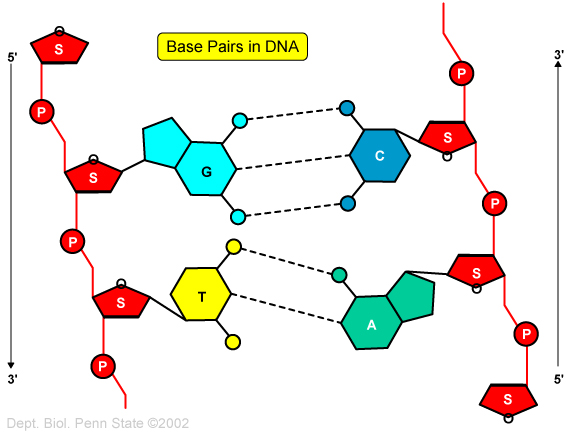
In a molecule of double-stranded DNA, the amount of Adenine present is always equal to the amount of
a)
cytosine
b)
guanine
c)
thymine
d)
uracil
54.
Guanine bonds with ______________.
a)
Adenine
b)
Guanine
c)
Cytosine
d)
Thymine
55.
Which 2 molecules form the sides (backbone) of the DNA ladder?
a)
deoxyribose sugar and adenine
b)
deoxyribose sugar and a hydrogen bond
c)
deoxyribose sugar and the nucleus
d)
deoxyribose sugar and phosphate
56.
Nitrogenous bases are joined by which type of bond?
a)
polar bonds
b)
ionic bonds
c)
covalent bonds
d)
hydrogen bonds
57.
Replicate the following strand of DNA: 
AATCATGGA
a)
AATCATGGA
b)
TTAGTACCT
c)
UUAGUACCU
d)
GGATAUCUA
58.
The enzyme that unzips the DNA to prepare for replication
a)
helicase
b)
replicase
c)
polymerase
d)
synthase
59.
DNA replication results in two DNA molecules,
a)
each one with two original strands
b)
each one with two new strands
c)
each one with one new strand and one original strand
d)
one with two new strands and the other with two original strands
60.
What are the three components of a nucleotide?
a)
sugar, hydrogen, nitrogen base
b)
sugar, oxygen, nitrogen base
c)
sugar, phosphate, nitrogen base
d)
sugar, phosphate, protein
61.
What do we call DNA replication since new DNA has 1 parent strand and 1 new strand?
a)
Conservative 
b)
Semiconservative 
c)
Dispersive