Wayground logo

Free Printable Worksheets

Font size

S
M
L
XL
Worksheets

Chapter 6 - The Environment and Change Over Time

Total questions: 50

Worksheet time: 36mins

Name
Class
Date
1.
What is NOT true about the evidence that fossils provide?
a)
Some fossil organisms are transitional forms between groups of organisms.
b)
Fossil organisms often share physical similarities with living organisms.
c)
All fossils contain intact DNA that can be sequenced
d)
Fossil ages can often be determined by testing nearby rocks.
2.
What is the connection between genetics and natural selection?
a)
Genes vary between individuals and that variation causes mutations
b)
Individuals vary in their appearance and that variation causes mutations.
c)
Mutations can lead to variation that may affect an individual’s survival.
3.
Which rock layer in the diagram seems to be the oldest?
a)
F
b)
E
c)
B
d)
A
4.
According to the law of superposition, which layer is the youngest?
a)
A
b)
B
c)
C
5.
What is the definition of relative age?
a)
the actual age in years of an event or object
b)
a fossil of an organism that was common in a certain span of time. 
c)
the age of an event or object in relation to other events or objects
6.
What is the definition of absolute age?
a)
the actual age in years of an event or object
b)
the age of an event or object in relation to other events or objects
7.
When scientists use logic to determine the age of one fossil compared to another, they use this type of dating.
a)
Relative
b)
Carbon
c)
Absolute
8.
1. What is extinction?
a)
When an organism reproduces
b)
The inside of a nucleus
c)
When an organism dies off from Earth.
9.
2. What is a Mass Extinction?
a)
When an organism dies off from Earth
b)
When multiple species or organisms die off from Earth
c)
A type of trait
10.
What is a major cause of extinctions?
a)
biological evolution
b)
environmental change
c)
carbonization
d)
mineralization
11.
The impression of an organism in a rock
a)
cast
b)
original material fossil
c)
trace fossil
d)
mold
12.
The fossil copy of an organism in a rock
a)
cast
b)
original material fossil
c)
trace fossil
d)
mold
13.
The preserved evidence of the activity of an organism
a)
cast
b)
original material fossil
c)
trace fossil
d)
mold
14.
All the fossils ever discovered on Earth make up
a)
geologic time scale
b)
fossil record
c)
biological evolution
15.
A chart that divides Earth's history into units
a)
geologic time scale
b)
fossil record
c)
biological evolution
d)
ordovician period
16.
The change over time in populations of related organisms
a)
geologic time scale
b)
biological evolution
c)
environmental change
d)
prehistoric time scale
17.
Dead organism is compressed over time
a)
mineralization
b)
trace fossil
c)
carbonization
d)
petrified fossil
18.
A hollow space in rock in the shape of an organism. 
a)
Mold fossil
b)
Cast fossil
c)
Body fossil
d)
Trace fossil
19.
These fossils shows evidence of activity. Scientists use these fossils to study animal behaviors. 
a)
Mold fossil
b)
Trace Fossil
c)
Cast fossil
d)
Body Fossil
20.
The actual plant or animal is in this type of fossil. 
a)
Mold fossil
b)
Cast Fossil
c)
Trace fossil
d)
Original Material Fossil
21.
Which fossil is pictured?
a)
Mold
b)
Cast
c)
Body
d)
Trace
22.
What is hardened tree sap called?
a)
coprolites
b)
index fossils
c)
gastroliths
d)
amber
23.

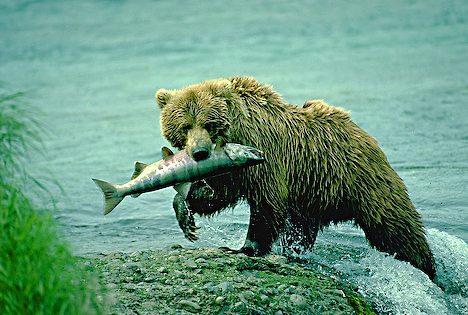
A grizzly bear survives because he is well-adapted to his environment. When he reproduces he passes on those traits to his offspring. this process is called

a)

Natural Selection

b)

Selective Breeding

c)

Random mutations

d)

Variations in a species

24.

Genetic mutations are the direct cause of which of the following?

a)

Aliens

b)

Super heroes

c)

Variations

d)

8th grade behaviors

25.

If Easter eggs were living species of organisms, their different colors would be considered:

a)

Adaptations

b)

Variations

c)

Different species

d)

Extinct species

26.

Where are hereditary traits stored in all organisms?

a)

In the blood

b)

In the brain

c)

In the DNA

d)

In the heart

27.

Why might it be helpful for a species to have a lot of variations?

a)

They can't be seen by predators

b)

If the environment changes, they might be better able to adapt

c)

It is helpful in asexual reproduction

d)

They don't recognize each other

28.

If a sick person takes an antibiotic but it doesn't kill all of the bacteria causing the sickness, what might explain this?

a)

Variations in the bacteria allowed some organisms to be less affected by the antibiotic?

b)

Bacteria cannot be killed by antibiotics

c)

You cannot cure a bacterial infection

d)

Bacteria do not cause sicknesses

29.

Changes in inherited characteristics can cause a species to change into a new one. This change over time is called?

a)

Graduation

b)

Selective Breeding

c)

Revolution

d)

Evolution

30.

On the Galapagos Islands, different finches evolved on different islands to fit their environment. When a species develops unique traits because it is trapped in one area this is called:

a)

Geographic isolation

b)

Geologic separation

c)

General relocation

d)

Genetic differentiation

31.

Heredity is:

a)

Survival of the fittest

b)

The passing of genetic traits from parent to offspring

c)

Believing in false gods

d)

Unexplained

32.

The male and female black widow spider look very different. However, we know they are the same species because:

a)

They reproduce creating fertile offspring

b)

They reproduce creating infertile offspring

c)

They cannot reproduce

d)

They are not the same species

33.

Another term for Natural Selection is:

a)

Breeding

b)

Commensulism

c)

Communism

d)

Survival of the fittest

34.
This image shows a homologous structure. What is the definition for a homologous structure?
a)
Body parts of organisms that are similar in structure and position but different in function.
b)
Body parts that perform a similar function but differ in structure.
c)
The study of similarities and differences among structure of living species.
d)
Body parts that have lost their original function through evolution.
35.
This image shows an analogous structure. What is the definition for an analogous structure?
a)
Body parts of organisms that are similar in structure and position but different in function.
b)
Body parts that perform a similar function but differ in structure.
c)
The study of similarities and differences among structure of living species.
d)
Body parts that have lost their original function through evolution.
36.
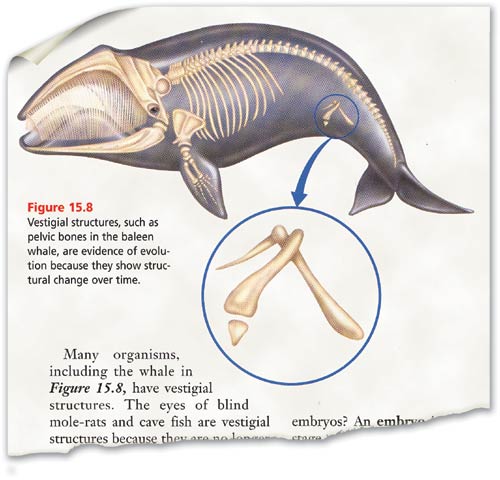
Which one of the options below would we consider to be a vestigial structure in humans?
a)
Eyes
b)
Kidneys
c)
Lungs
d)
Tonsils 
37.
If an organism has a vestigial structure, that structure likely once had a function in a(n)
a)
close relative
b)
early ancestor
c)
unrelated organism
d)
embryological stage
38.
Study of embryos of various organisms to show a common ancestor because of similarities in development
a)
natural selection
b)
embryology
c)
speciation
d)
evolution
39.
Which of the following is an example of a vestigial structure?
a)
the wings of a red-tailed hawk
b)
the hind limbs of a house cat
c)
the fins of sharks
d)
the tailbone of a human
40.
Two organisms that are closely related would have
a)
very similar DNA sequence
b)
exactly the same DNA sequences
c)
no proteins in common
d)
completely different DNA sequence
41.

Homologous structures and similar bones and location of bones of many fossil vertebrates are similar in living organisms. This suggest evidence of

a)

a common ancestor.

b)

the needs of the organisms.

c)

the struggle for existence.

d)

the inheritance of acquired traits.

42.

The long process that occurs over time that results in changes to a living species.

a)

Natural Selection

b)

Biological Evolution

c)

Fossil Record

43.
Humans, birds, whales, and lizards all have similar arm bones. What is the reason for this?
a)
The function of these bones is the same in all animals
b)
They live in similar environments
c)
They have a common ancestor
d)
All organisms resemble humans
44.

A human appendix, a whale's hip bones and a human tail are all:

a)

nonexistent

b)

homologous structures

c)

examples of embryology

d)

vestigial structures

45.
An example of a homologous structure 
a)
human arm and bird wing
b)
rat appendix  and human appendix
c)
wing of butterfly and bird wing
46.
 The best definition for biological evolution is?
a)
A.  When Earth’s processes cause change overtime.
b)
B.  When rock’s change over time.
c)
C.  When a species changes      overtime.
47.
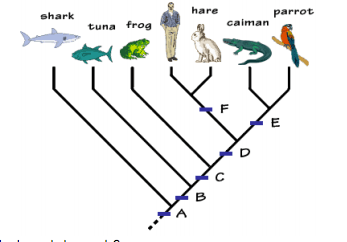
According to this diagram, birds are LEAST closely related to 
a)
Amphibians
b)
Sharks
c)
Ray Finned Fish
d)
Crocodiles
48.
What does Darwin's theory of evolution suggest?
a)
species change over time
b)
extinct species are not related to living species
c)
different species can interbreed
d)
animals that look alike are most closely related
49.
On this diagram, which organism is the closest relative of the human?
a)
Frog
b)
Hare
c)
Caiman
d)
Parrot
50.
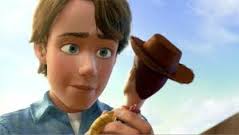
What is the name of Woody's owner in Toy Story?
a)
Andy
b)
Ryan
c)
Mark
d)
Andrew