wayground logo

Free Printable Worksheets

Font size

S
M
L
XL
Worksheets

Q1 Mini 3 Review Weather and Climate 24

Total questions: 49

Worksheet time: 44mins

Name
Class
Date
1.

The __________ is a surface current that flows along the eastern US and brings warm water to Europe.

a)

California Current

b)

Gulf Current

c)

North American Gyre

d)

Arctic Current

2.
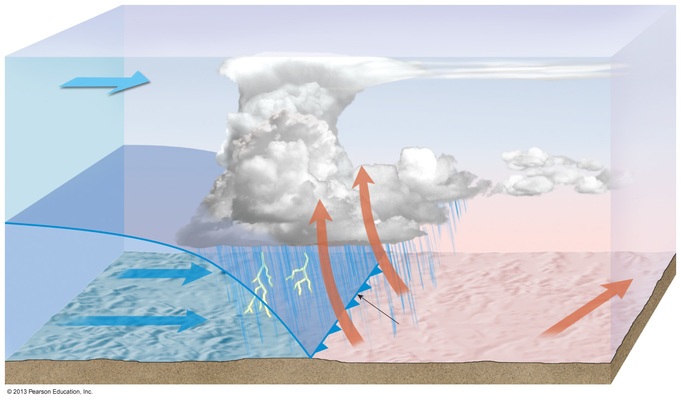
What type of storm front is this? 
a)
warm front
b)
cold front
c)
stationary front
d)
occluded front
3.
A front is
a)
where warm air is cooling at earth's surface
b)
a line where hot and cold air are separating
c)
a line where two different air masses meet
d)
where cold air is rising and forming rain clouds
4.
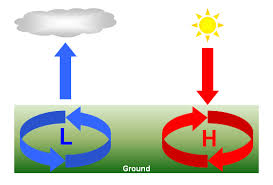
Which most likely produces clear, cool weather?
a)
zero air pressure
b)
stable air pressure
c)
a low pressure system
d)
a high pressure system
5.
_____________ air is more dense and tends to sink
a)
cold
b)
warm
c)
moist
d)
dry
6.
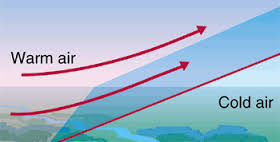
Which type of front is pictured?
a)
Cold front
b)
Warm front
c)
Occluded front
d)
Stationary front
7.
What symbol is this?
a)
warm front
b)
cold front
c)
stationary front
d)
occluded front
8.
Which system results in rainy or stormy weather?
a)
high pressure
b)
low pressure
c)
hurricane
d)
weather system
9.
Which system results in drier, fairer weather?
a)
high pressure
b)
low pressure
c)
hurricane
d)
weather system
10.
When a cold front is approaching, what happens?
a)
warm air is pushing under cold air causing humid weather and lower temperatures
b)
warm air is pushing under cold air causing humid weather and higher temperatures
c)
warm air rises, cools, and causes rain and thunderstorms
d)
cold air is pushed over warm air causing rain and thunderstorms
11.

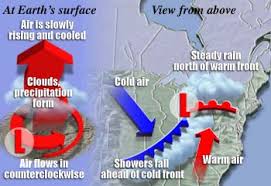
Which one shows a warm front?

a)
b)
c)
d)
12.
What is climate?
a)
What's happening in space at a time and place.
b)
What's happening in our atmosphere at a time and place
c)
The average weather over many years
d)
The average temperature over many years.
13.
What is weather?
a)
What's happening in space at a time and place.
b)
What's happening in our atmosphere at a time and place.
c)
The average weather over many years
d)
The average temperature over many years.
14.
What is the difference between climate and weather?
a)
 Climate averages the weather conditions in a specific place over a long period of time, while weather describes the state of the atmosphere at a specific moment in time.
b)
 Weather averages the weather conditions in a specific place over a long period of time, while Climate describes the state of the atmosphere at a specific moment in time.
c)
Climate describes the weather conditions at night, while weather describes the conditions during the daytime.
d)
 There is not a difference between climate and weather.
15.
Which sentence best describes the relationship between elevation and air temperatures?
a)
 LOWER elevation = COLDER temperatures
b)
HIGHER elevation = COLDER temperatures
c)
HIGHER elevations = WARMER temperatures
d)
There is no relationship
16.
Do sea breezes typically happen during the day or night?
a)
Day
b)
Night
17.

Land breeze and sea breezes are caused by the different _________ between land and water surfaces.

a)

rotations

b)

temperatures

c)

gases

d)

solids

18.

Sea breezes take place during the ________ because the warmer land temperature results in a warmer air mass above the land compared to the cooler air mass over the surface of water.

a)

day

b)

night

19.

What is the main cause of winds?

a)

amount of trees

b)

the moon's gravity

c)

amount of animals

d)

uneven heating of Earth's surface

20.

A cool breeze is blowing from the ocean towards the land during the day. This is called a

a)

land breeze

b)

trade wind

c)

sea breeze

d)

easterly

21.

Air moves from _______ pressure to ________ pressure.

a)

high to low

b)

low to high

c)

high to high

d)

low to low

22.

____ humidity is a measure of the amount of water vapor that air is holding compared to the amount needed for saturation at a specific temperature.

a)

Total

b)

Partial

c)

Relative

d)

none of the above

23.

The boundary between cold and warm air masses is called a ____.

a)

front

b)

storm

c)

climate

d)

flood

24.

SELECT ALL THAT APPLY: Which of the following will produce some type of precipitation?

a)

A High pressure system

b)

A Low pressure system

c)

A cold front

d)

A warm front

25.
The pressure inside a hurricane is _______.
a)
High
b)
Low
26.

A hurricane are low pressure systems and rotates _____.

a)
Clockwise
b)
Counterclockwise 
27.

What is the difference between climate and weather?

a)

climate happens in that moment, weather happens over time

b)

weather happens in that moment, climate happens over time

c)

No difference, they mean the same thing.

28.

Because water ___________, ocean currents have a great effect on climate.

a)

cannot hold heat

b)

hold large amounts of heat

c)

moves more slowly than air

d)

stays colder than air

29.

Latitude strongly influences climate becasue ________ solar energy falls on areas that are closer to the equator than to the poles.

a)

the same amount of

b)

sometimes less

c)

more

d)

less

30.

The sun's rays are least direct near the equator.

a)

True

b)

False - near the poles

c)

False - at high altitudes

d)

False - far from the ocean

31.
As you go to the top of a mountain, what happens to temperature?
a)
Nothing
b)
It increases
c)
It decreases
d)
It goes up and down
32.
Two factors to determine climate are
a)
precipitation and temperature
b)
hurricanes and tornadoes
c)
humidity and pressure
33.

How does the average temperature compare from latitude to latitude?

a)

As latitude increases, the average temperature decreases.

b)

As latitude increases, the average temperature increases.

c)

As latitude increases, the average temperature remains the same. 

d)
Well, it's not this one. 
34.

How does elevation affect the climate of an area?

a)

As elevation increases, air temperature increases.

b)

As elevation increases, air temperature decreases.

c)

As elevation increases, precipitation increases.

d)

As elevation increases, precipitation decreases.

35.

How does distance from a large body of water affect the climate?

a)

Cities near the ocean have less precipitation.

b)

Cities near the ocean have more precipitation.

c)

Cities near the ocean have a smaller temperature range.

d)

Cities near the ocean have a large temperature range.

36.

1. This side of the mountain is dry and desert like because of the rain shadow effect.

a)

Leeward

b)

Sideward

c)

Windward

d)

Land

37.

On the leeward side of a mountain, you might find _____.

a)

Heavy rainfall

b)

Desert

c)

More vegetation

d)

More snow

38.

What landform causes the rain shadow effect?

a)

Mountains

b)

Lakes

c)

Plains

d)

Valleys

39.

Which statement is true about air's capacity to hold water?

a)

As air rises higher up the mountain, its capacity to hold water vapor decreases

b)

As air rises higher up the mountain, its capacity to hold water vapor increases

40.
The ability of the air to hold water depends on its _______________. 
a)
air pressure 
b)
thermometer 
c)
temperature
d)
water vapor
41.
Humidity is a measure of the amount of __________ in the air.   
a)
Rain Drops
b)
Air Pressure 
c)
Temperature
d)
 Water Vapor
42.
Air with a relative humidity of 100 percent is said to be __________________. 
a)
Saturated
b)
Unsaturated 
c)
 Hot 
d)
Muggy 
43.
Dew Point is the
a)
temperature air cools down to reach condensation (or turn into a liquid)
b)
temperature where ice melts to liquid water
c)
temperature where ice turns directly into water vapor
d)
time of day when dew on the ground disappears
44.
As the air temperature increases, the air's capacity for water vapor: 
a)
increases
b)
decreases
c)
remains the same
d)
is unrelated to air temperature and can either increase or decrease
45.

Cold air does not hold a lot of water vapor, so it is generally very....

a)

Dry

b)

Saturated

46.

The location at the yellow star is experiencing ​ ​ (a)   because there is a ​ (b)   heading that way.

Choose from the below words
warmer temperatures
warm front
colder temperatures
cold front
stationary front
strong winds
47.

NAME THE FRONT

48.

NAME THE FRONT

49.
Large body  of air with similar temperature, pressure, and humidity.
a)
Cold front
b)
Warm front
c)
High pressure system
d)
Air mass