wayground logo

Free Printable Worksheets

NEW

Font size

S
M
L
XL
Worksheets

Ecology Review Quiz

Total questions: 57

Worksheet time: 20mins

Name
Class
Date
1.
Which one is NOT an example of a decomposer?
a)
mushroom
b)
leaves
c)
mold
d)
worm
2.
Examples of a producer
a)
frog
b)
algae
c)
worm
d)
mouse
3.
A tree is a ....
a)
composer
b)
decomposer
c)
producer
4.
What is a producer?
a)
an organism that gets energy from eating other organisms
b)
an organisms that uses sunlight to make its own food
c)
an organism that gets energy from eating dead organisms, non-living material or waste
d)
an organism that uses chemical energy to make its own food
5.
What is a herbivore?
a)
an animal that gets energy from eating other animals
b)
an organism that gets energy from eating only plants
c)
an animal that gets energy by eating both plants and other animals
d)
an animal that eats only herbs
6.
What is a carnivore?
a)
an animal that gets energy by eating other animals
b)
An animal that gets energy by eating only plants
c)
an animal that gets energy by eating both plants and animals
d)
an animal that makes its own energy through photosynthesis
7.

An animal that gets energy from eating both plants and animals is a(n)

a)

herbivore

b)

carnivore

c)

omnivore

d)

autotroph

8.
What is this called?
a)
Food Web
b)
Food Chain
c)
Abiotic Factors
9.
What is this called?
a)
Food Web
b)
Food Chain
c)
Abiotic Factors
10.
A producer is a (n) ______________.
a)
heterotroph
b)
omnitroph
c)
autotroph
d)
oscartroph
11.
All food chains begin with a ____________.
a)
primary consumer
b)
secondary consumer
c)
producers
d)
scavengers
12.
Another name for a consumer is a
a)
heterotroph
b)
autotroph
c)
producer
d)
plant
13.
All of the living and nonliving things in an area that interact with each other are called a/an ______.
a)
community
b)
habitat
c)
population
d)
ecosystem
14.
An area where an organism finds food, shelter and water in a specific arrangement
a)
niche
b)
biosphere
c)
biome
d)
habitat
15.
The living part of an ecosystem
a)
Biotic
b)
Abiotic
c)
Mother Earth
d)
Flowers
16.
The non-living part of an ecosystem
a)
Ocean
b)
Lava Flow
c)
Birds
d)
Abiotic
17.
Organisms that look similar and can produce fertile offspring
a)
Species
b)
Fish
c)
Community
d)
Trees
18.
In the energy pyramid here, how much of the energy in the producers gets passed to the herbivores?
a)
10%
b)
20%
c)
80%
d)
90%
19.
Which of the following leads to a decrease in biodiversity?
a)
protection of ecosystems
b)
pollution control
c)
selective cutting
d)
introduction of exotic or invasive species
20.
Nitrogen makes up _____ percent of the atmosphere.
a)
66%
b)
78%
c)
90%
21.
Which biome, because of its climate and amount of rainfall, has the largest number of species of plants and animals?
a)
Tundra
b)
Rainforest
c)
Desert
d)
Pineforest
22.
The diagram below shows the cycling of nutrients in an ecosystem.
The removal of which of the following groups would cause an immediate decrease in the amount of energy flowing through the system?
a)
Producers
b)
Consumers
c)
Decomposers
d)
Inorganic nutrients
23.
which symbiosis is this 
a)
parasitism 
b)
mutualism
c)
commensalism
d)
nonalism 
24.
symbiotic relationship in which both organisms benefit
a)
competition
b)
Mutualism
c)
nitrogen fixation
d)
energy pyramid
25.
What does a food web represent?
a)
All connections of energy flow throughout all organisms in a habitat.
b)
The specific ways that mutualism is carried out.
c)
A single pathway or energy flow between organisms. 
d)
How carnivores get their food. 
26.
Organisms that breaks down and absorbs nutrients from dead organisms 
a)
consumer
b)
trophic level
c)
decomposer
d)
species
27.
relationship in which two species live closely together
a)
resource
b)
mutualism
c)
succession
d)
symbiosis
28.
The amount of energy that usually transfers from one trophic level to the next...
a)
10%
b)
20%
c)
80%
d)
50%
29.
As you move upward, from level to level, in an energy pyramid, energy _____.
a)
increases
b)
decreases
c)
stays the same
d)
increases exponentially
30.
When every organism of a species has died.
a)
Evolution
b)
Natural Selection
c)
Extinction
d)
Artificial Selection
31.
Where the better adapted organisms survive to pass traits along to offspring.
a)
Evolution
b)
Natural Selection
c)
Extinction
d)
Artifical Selection
32.
Why are advantageous traits more likely to be passed onto offspring?
a)
Because they are more likely to survive and reproduce.
b)
Because they come from dominant alleles.
c)
Because they come from recessive alleles.
d)
Because the trait is an acquired phenotype.
33.

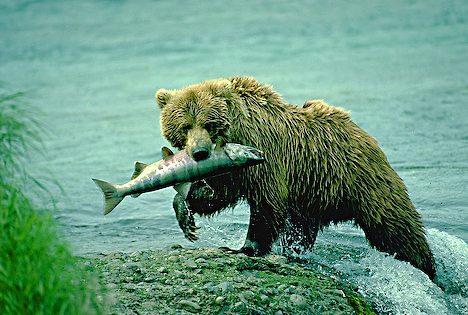
A grizzly bear survives because he is well-adapted to his environment. When he reproduces he passes on those traits to his offspring. this process is called

a)

Natural Selection

b)

Selective Breeding

c)

Random mutations

d)

Variations in a species

34.

The peppered moth's color camouflaged it on the light colored tree bark. It's color was an example of a/n

a)

Variation

b)

Dominant trait

c)

Recessive trait

d)

Adaptation

35.

One female salmon can lay hundreds of eggs. Why doesn't the salmon population increase dramatically?

a)

Salmon reproduce asexually

b)

Most offspring do not grow up to reproduce

c)

Salmon eggs don't hatch

d)

Salmon are extinct

36.
Animals use camoflauge because..
a)
to hunt or hide
b)
for fun
c)
to sleep
37.
Looking like something else is....
a)
Patterns
b)
Mimicry
c)
Color changing
d)
costume
38.
What process occurs when light energy is captured in autotrophs and converted into sugar?
a)
Photosynthesis
b)
Cellular Respiration
39.
Why do plants conduct photosynthesis?
a)
To make light
b)
To make mitochondria
c)
To make glucose
d)
To release carbon dioxide
40.
Which organelle in the plant cell performs photosynthesis?
a)
Chloroplast
b)
Mitochondria
c)
Nucleus
d)
Cytoplasm
41.

What happens if a population grows past its carrying capacity?

a)

The population keeps growing

b)

The population starts to die off

c)

The entire species will go extinct

d)

The carrying capacity just increases

42.

This may cause a population to increase

a)

increase of food supply

b)

removal of predators

c)

removal of disease

d)

all of these

43.

Something that regulates the size of a population is called...

a)

a limiting measure

b)

a limiting factor

c)

carrying capacity

d)

biodiversity

44.

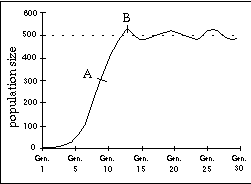
What is the carrying capacity of the graph?

a)

around 500

b)

more than 800

c)

less than 300

d)

around 700

45.

When death rate is equal to birth rate...

a)

population increases

b)

population decreases

c)

population stays the same.

d)

population rapidly increases then becomes stable

46.

Food, water, sunlight, air, soil are resources that are often __________.

a)

limiting factors

b)

wet

c)

carrying capacity

d)

found in rocks

47.
Temperature, light, air, water, and soil are all ___________ parts of the environment.
a)
biotic
b)
abiotic
c)
dead
d)
scavenged
48.
Which of the following describes a biotic factor affecting other parts of an ecosystem?
a)
sunlight increasing the temperature, causing plants to die
b)
a forest fire destroying thousands of acres of trees
c)
a coyote hunting, killing, and eating rabbits
d)
chemical pollution causing the pH of a river to increase
49.
Biodiversity refers to
a)
extinct species
b)
the variety of species on Earth
c)
nonrenewable resources
d)
the rate of species decline
50.
When taken to a new habitat, non-native plants often threaten native plants of the new habitat.  Why do they do this?
a)
Non-native plants are able to mutate rapidly
b)
Non-native  plants cause native animals to relocate
c)
Non-native plants are able to be used for medicine
d)
Non-native plants compete with native plants for resources
51.

What makes a species invasive?

a)

Moving to a new ecosystem and taking resources from natives

b)

Not having papers

c)

Species that can't adapt

d)

Plants that take up too much space

52.
Which of these describes a species that has become extinct?
a)
fewer members of the species are dying than being born
b)
more members of the species are dying than being born
c)
very few members of a species are alive
d)
all members of a species have died
53.
What happens when species produce too many offspring?
a)
Species share the limited resources 
b)
Species eat less so that all can survive
c)
Only those that are least fit can survive
d)
Only those that are best fit can survive
54.

What are renewable resources?

a)

Resources that are used faster than they form

b)

resources that can replenish themselves over time

c)

resources that formed over millions of years

d)

resources that exist only in rural areas

55.

Why has Earth's human carrying capacity increased greatly?

a)

Other organisms have been displaced by agriculture, so there is more space for humans.

b)

Humans have modified their environment due to technological advances.

c)

Humans can live closer together than other animals

d)

Humans are now eating fewer plants than they used to.

56.

Which member of the following food chain is most likely to be affected by mercury, a pollutant? Algae - zooplankton - salmon – bear

a)

algae

b)

salmon

c)

zooplankton

d)

bear

57.

What is one of the greatest threats to biodiversity on Earth?

a)

habitat destruction

b)

loss of drinking water

c)

decrease in food supply

d)

pollution