Wayground logo

Free Printable Worksheets

Font size

S
M
L
XL
Worksheets

unit 4 post assessment review

Total questions: 64

Worksheet time: 5hrs 7mins

Name
Class
Date
1.

Which process transfers heat when particles collide in a solid?

a)

convection

b)

conduction

c)

radiation

d)

evaporation

2.

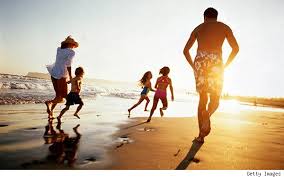
The sun shines down on this family as they play on the beach.

a)

conduction

b)

convection

c)

radiation

3.
A group of friends gather around a fire to stay warm.
a)
conduction
b)
convection
c)
radiation
4.
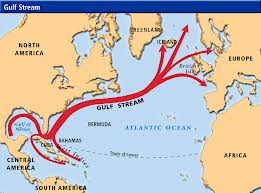
The Gulf Stream is a current that brings warm ocean water from the south to the north.
a)
conduction
b)
convection
c)
radiation
5.
Walking on the warm sand sand with your bare feet.
a)
conduction
b)
convection
c)
radiation
6.
Blow drying your wet hair.
a)
conduction
b)
convection
c)
radiation
7.
Which direction will the heat flow while this person holds a hot cup of tea?
a)
from the cup to her hand
b)
from her hand to the cup
c)
no heat is transferred
8.
Which direction will the heat flow while this ice cap melts?
a)
there is no heat transfer
b)
from the icecap to the water
c)
from the water to the icecap
9.
The man goes to take the hot pot off the stove with his bare hands.
a)
conduction
b)
convection
c)
radiation
10.
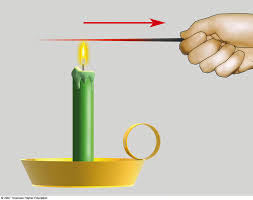
The candle will slowly heat the metal and transfer the heat directly to the mans hand.
a)
conduction
b)
convection
c)
radiation
11.

In what layer of the atmosphere do all weather events occur?

a)

Stratosphere

b)

Exosphere

c)

Mesosphere

d)

Troposphere

12.

In the troposphere, the temperature _____ as altitude increases.

a)

Increases

b)

Decreases

c)

Stays the same

d)

Goes up and down

13.

The ozone layer is a sublayer of the ________ layer.

a)

Troposphere

b)

Stratosphere

c)

Exosphere

d)

Mesosphere

14.

Why is the ozone layer important to life on Earth?

a)

Planes fly in the ozone layer

b)

It is made up of oxygen (O2)

c)

It shields the Earth from ultraviolet (UV) rays from the sun

d)

It causes clouds to be created

15.

In which layer of the atmosphere do meteors burn up?

a)

Troposphere

b)

Mesosphere

c)

Thermosphere

d)

Exosphere

16.

This layer is the outermost layer of the atmosphere. Satellites orbit the atmosphere in this layer.

a)

Exosphere

b)

Mesosphere

c)

Thermosphere

d)

Ozone Layer

17.
Where weather occurs.
a)
stratosphere
b)
thermosphere
c)
troposphere
d)
mesosphere
18.
What does the earth's atmosphere do?
a)
help to regulate the temperature on Earth
b)
Help UV rays to reach the Earth's surface
c)
Creates meteors in the sky
d)
Keep ocean waters cold
19.
What is the energy source for the water cycle?
a)
the sun
b)
the earth
c)
water
d)
the moon
20.
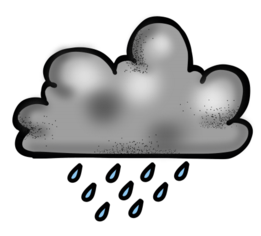
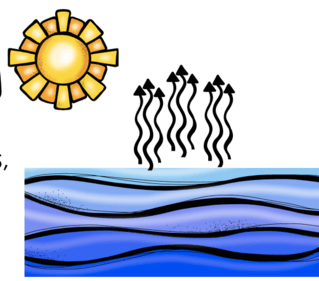
What part of the water cycle does this picture show?
a)
condensation
b)
precipitation
c)
evaporation
21.
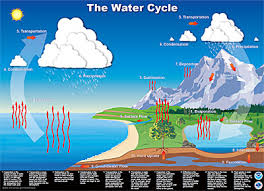
What part of the water cycle does this picture show?
a)
condensation
b)
precipitation
c)
evaporation
22.
When water condenses, the water vapor in the air gets ___________ and changes back into liquid.
a)
cold
b)
hot
c)
warm
d)
solid
23.
Which is the opposite of condensation?
a)
runoff
b)
evaporation
c)
precipitation
d)
transpiration
24.
Which best explains why runoff is important?
a)
It returns water to other locations on Earth
b)
It increases the chance of flooding
c)
It makes evaporation occur faster
d)
It increases condensation
25.
What is it called when plants give off water vapor as a waste product?
a)
condensation
b)
evaporation
c)
sublimation
d)
transpiration
26.
During which stage do clouds form?
a)
condensation
b)
evaporation
c)
precipitation
27.
Which stages does liquid water from the ocean turn into water vapor?
a)
condesantion
b)
evaporation
c)
precipitation
d)
run off
28.
Which stage does ground water try to return to the ocean or soak into the ground?
a)
condensation
b)
evaporation
c)
precipitation
d)
run off
29.
what does this tool measure?
a)
wind direction
b)
wind speed
c)
air temperature
d)
humidity
30.
Air pressure is greater _______.
a)
at the top of the mountain
b)
at the bottom of the mountain
c)
at the center of the mountain
31.
Density of air is greater ________.
a)
at the top of the mountain
b)
at the bottom of the mountain
c)
at the center of the mountain
32.
Which pressure system is characterized by clouds and rain?
a)
Low
b)
High
33.
Which pressure system is characterized by clear skies and dry, sunny weather?
a)
Low
b)
High
34.
What concept describes how warm air and cool air circulate to keep the temperature stable in the atmosphere?
a)
prevailing winds
b)
convection
c)
air pressure
d)
Coriolis effect
35.
When there is an mP air mass moving over an area, the type of weather would most likely be:
a)
hot and dry
b)
warm and humid
c)
cold and rainy or snowy
d)
cold and dry
36.
What type of air mass would typically form here?
a)
mP
b)
mT
c)
cP
d)
cT
37.
How do we characterize an air mass that forms over the ocean?
a)
Dry
b)
Wet
c)
Cold
d)
Warm
38.
How do we characterize an air mass that forms over land?
a)
Dry
b)
Wet
c)
Cold
d)
Warm
39.
How do we characterize an air mass that forms over near the equator?
a)
Dry
b)
Wet
c)
Cold
d)
Warm
40.
How do we characterize an air mass that forms near the poles?
a)
Dry
b)
Wet
c)
Warm
d)
Cold
41.
Describe an arctic air mass.
a)
Dry
b)
Wet
c)
Cold
d)
Warm
42.
Describe a continental air mass.
a)
Dry
b)
Wet
c)
Cold
d)
Warm
43.
Describe a maritime air mass.
a)
Dry
b)
Wet
c)
Cold
d)
Warm
44.
Describe a tropical air mass.
a)
Dry
b)
Wet
c)
Cold
d)
Warm
45.
What types of air masses form over oceans?
a)
Maritime
b)
Continental
c)
Polar
d)
Tropical
46.
What types of air masses would be colder?
a)
Maritime
b)
Continental
c)
Polar
d)
Tropical
47.
What types of air masses would be warmer?
a)
Maritime
b)
Continental
c)
Polar
d)
Tropical
48.
What's the humidity and temperature of a continental tropical air mass?
a)
Wet and cold
b)
Dry and warm
c)
Wet and warm
d)
Dry and cold
49.
What's the humidity and temperature of a maritime tropical air mass?
a)
Wet and cold
b)
Dry and warm
c)
Wet and warm
d)
Dry and cold
50.
What's the humidity and temperature of a continental arctic air mass?
a)
Wet and cold
b)
Dry and warm
c)
Wet and warm
d)
Dry and cold
51.
A wet and cold air mass would be a...
a)
Maritime polar
b)
Continental polar
c)
Maritime tropical
d)
Continental tropical
52.
A dry and cold air mass would be...
a)
Maritime polar
b)
Continental polar
c)
Maritime tropical
d)
Continental tropical
53.
A wet and hot air mass would be a...
a)
Maritime tropical
b)
Maritime polar
c)
Continental polar
d)
Continental tropical
54.
A dry and hot air mass would be...
a)
Maritime arctic
b)
Maritime tropical
c)
Continental tropical
d)
Continental polar
55.
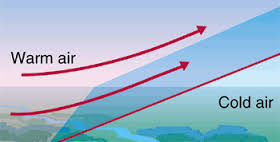
Which type of front is pictured?
a)
Cold front
b)
Warm front
c)
Occluded front
d)
Stationary front
56.
What symbol is this?
a)
warm front
b)
cold front
c)
stationary front
d)
occluded front
57.
Which type of front is associated with purple humps and triangles facing the same direction?
a)
Cold
b)
Warm
c)
Stationary
d)
Occluded
58.

What type of front is shown?

a)

Warm Front

b)

Cold Front

c)

Occluded Front

d)

Stationary Front

59.

This is the symbol for a _____________ weather front.

a)

Cold

b)

Warm

c)

Stationary

d)

Occluded

60.

This is the symbol for a _____________ weather front.

a)

Cold

b)

Warm

c)

Stationary

d)

Occluded

61.
When two air masses meet it is called a
a)
front
b)
gathering
c)
air mass
62.
Identify the type of front that is shown in the image.
a)
Occluded Front
b)
Cold Front
c)
Stationary Front
d)
Warm Front
63.
Identify the type of front that is shown in the image.
a)
Occluded Front 
b)
Cold Front
c)
Stationary Front
d)
Warm Front
64.
Identify the type of front that is shown in the image.
a)
Occluded Front
b)
Cold Front
c)
Stationary Front
d)
Warm Front