
NEW
Font size
S
M
L
XL
 Worksheets
AP Bio Final Exam Review - Part 2
Total questions: 62
Worksheet time: 40mins
Name
Class
Date
1.
The Krebs cycle occurs in:
a)
Mitochondrial Matrix
b)
Cytosol
c)
Inner Mitochondrial Membrane
d)
Outer membrane Space
2.
The part of the brain that operates involuntary control is the:
a)
Hypothalamus
b)
Medulla
c)
Cerebrum
d)
Cerebellum
3.
Which of the following is the correct sequence for embryonic development?
a)
Cleavage, Blastula, Morula, neurula gastrula
b)
cleavage, morula, blastula, gastrula, neurula
c)
Blastula, neurula, morula, cleavage
d)
blastula, neurula, morula, cleavage, cytokinesis
4.
During the period in which life was expected to have begun, the primitive Earth's atmosphere would have had all BUT:
a)
Oxygen
b)
Hydrogen
c)
Ammonia
d)
Methane
5.
An organism that is more complex than a platyhelminthe but more primitive than an arthropod would be a:
a)
An annelid (earthworm)
b)
An echinoderm(star fish)
c)
A chordate
d)
Sponge
6.

Which does not occur in the small intestine?
a)
Pancreatic lipase breaks down fats
b)
Pepsin breaks down proteins to amino acids
c)
Pancreatic amylase breaks down carbohydrates into simple sugars
d)
Bile emulsifies fats into smaller fat particles.
7.
All of the following statements are correct regarding
a)
Alleles are alternative forms of the same gen
b)
Alleles are found on corresponding loci of homologous chromosomes
c)
A gene can have more than two alleles
d)
An individual with two identical alleles is said to be heterozygous for the condition.
8.

Which vessels are responsible for carrying O2 poor blood in the heart
a)
Pulmonary Veins
b)
Pulmonary Arteries
c)
Aortas
d)
Brachiocephalic Artery
9.
Which of the following indicates the correct sequence of reflex arc from the spinal cord in frogs to their effector muscles.
a)
Stimuli, Dendrite, Axon, Effector Cells
b)
Spinal Cord, Dendrite, Axon, Afferent Pathway
c)
Spinal cord, afferent pathway, brain , spinal column
d)
Afferent Pathway, Integration, Sensory Neuron, Ganglia
10.
This type of reaction generally breaks bonds with water
a)
Condensation
b)
Hydrolysis
c)
Condensed Soup
d)
Synthesis
11.
Which macromolecule stores energy, insulates us, and makes up the cell membrane?
a)
lipids
b)
proteins
c)
carbohydrates
d)
nucleic acids
12.
Which of the following is correct about water?
a)
it is a polar molecule and contains polar bonds
b)
it is a polar molecule and contains non-polar bonds
c)
it is a non-polar molecule and contains polar bonds
d)
it is a non-polar molecule and contains non-polar bonds
14.

The process by which glucose is split into pyruvate producing 2 ATP and 2 NADH
a)
Chemiosmosis
b)
Electron Transport Chain
c)
Fermentation
d)
Glycolysis
14.
The process by which glucose is split into pyruvate producing 2 ATP and 2 NADH
a)
Chemiosmosis
b)
Electron Transport Chain
c)
Fermentation
d)
Glycolysis
15.
The process by which glucose is split to produce 2 ATP and lactic acid
a)
Chemiosmosis
b)
Electron Transport Chain
c)
Fermentation
d)
Glycolysis
16.
The process by which a proton gradient (hydrogen ions) is used to produce ATP
a)
Chemiosmosis
b)
Electron Transport Chain
c)
Fermentation
d)
Glycolysis
17.
What is the function of mRNA?
a)
storage of food
b)
prevents mutations
c)
provides energy
d)
carries genetic message
18.
Cytosine makes up 42% of the nucleotides in a sample of DNA from an organism. Approximately what percentage of the nucleotides in this sample will be thymine?
a)
8%
b)
16%
c)
31%
d)
42%
19.
The "on/off" switch for an operon is called the
a)
promoter
b)
repressor
c)
operator
d)
gene
20.
What does a promoter do?
a)
it allows a gene to be transcribed
b)
it creates a DNA segment
c)
it is another word for ribosomes
d)
it is another word for RNA
21.
What type of cells control immunity by making T cells and B cells?
a)
lymphocytes
b)
monocytes
c)
eosinophils
d)
basophils
22.
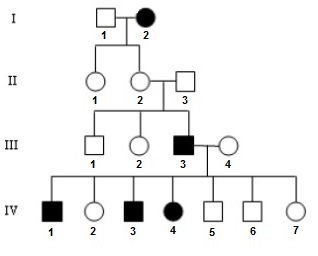
If hemophilia is a sex-linked recessive trait, what genotype would individual IV-2 have?
a)
XBXb
b)
XbXb
c)
XBY
d)
XbY
23.

Why do all the daughters in Generation II carry the colorblind gene?
a)
Because mom passed on the gene.
b)
Because dad passed on the X chromosome.
c)
Because their brother has it.
d)
Because their brother gave it to them.
24.

AB blood type is an example of what type of inheritance?
a)
complete dominance
b)
incomplete dominance
c)
codominance
d)
polygenic inheritance
25.
Where does Photosystem II get its electrons?
a)
photosystem I
b)
splitting of water
c)
ATP
d)
NADPH
26.
Where do the light-dependent reactions occur?
a)
thylakoid membrane
b)
stroma
c)
lumen
d)
mitochondria
27.

What type of transport is shown in the picture?
a)
Osmosis
b)
Diffusion
c)
Endocytosis
d)
Exocytosis
28.

The cell below is in a _________ solution.
a)
Hypotonic
b)
Hypertonic
c)
Isotonic
29.
If a molecule passes through a protein, but goes down a gradient, it is called
a)
active transport
b)
endocytosis
c)
facilitated diffusion
d)
exocytosis
30.
How many ATP molecules are created by fermentation?
a)
0
b)
2
c)
12
d)
36
31.

Identify the functional group:
a)
steroid
b)
phosphate
c)
carbonyl
d)
carboxyl
32.
A sugar, a phosphate group, and a nitrogen base form the building blocks of which organic compound?
a)
carbohydrates
b)
nucleic acids
c)
lipids
d)
proteins
33.
Which of these is NOT a cell junction?
a)
Plasmodesmata
b)
desmosome
c)
tight junction
d)
proteoglycan
34.
ATP synthesis
a)
chloroplast
b)
mitochondria
c)
lysosome
d)
ribosome
35.
All of the following are important characteristics of water in biology EXCEPT which?
a)
cohesion provides surface tension
b)
it is a nonpolar solvent
c)
it is a medium for complex chemical reactions in organisms
d)
it has a high specific heat that stabilizes ambient temperature
36.
Which organelle is the site of protein synthesis?
a)
Ribosome
b)
Lysosome
c)
Vacuole
d)
Mitochondrion
37.
This type of process requires oxygen.
a)
Aerobic
b)
Anaerobic
c)
Cell transport
d)
None of the above
38.
Keeping your internal body temperature the same is called
a)
excretion
b)
homeostasis
c)
respiration
d)
metabolism
39.
Two structures found in plant cells that are not found in animal cells
a)
cytoplasm, cell wall
b)
cytoplasm, cell membrane
c)
chloroplast, cell membrane
d)
chloroplast, cell wall
40.

The part of the neuron that conducts action potentials is the:
a)
Axon
b)
Dendrite
c)
Axon Terminal
d)
Cell Body
41.

The part of the neuron that receives signals is the:
a)
Axon
b)
Dendrite
c)
Axon Terminal
d)
Cell Body
42.

Heartbeat would be accomplished by which branch of the nervous system?
a)
Sensory
b)
Autonomic
c)
Motor
d)
Pineal
43.
Which system controls body movements?
a)
Autonomic Nervous System
b)
Central Nervous System
c)
Peripheral Nervous System
d)
Somatic Nervous System
44.
Which of the following is an example of a second messenger?
a)
cAMP
b)
GTP
c)
insulin
d)
epinephrine
45.
The phase in the cell cycle in which the chromosomes line up across the center of the cell.
a)
metaphase
b)
cytokinesis
c)
prophase
d)
interphase
46.
The step in the cell cycle following mitosis, in which the cytoplasm divides.
a)
cytokinesis
b)
telophase
c)
prophase
d)
metaphase
47.
if a cell has 24 chromosomes at the beginning of meiosis how many chromosomes will it have at the end of meiosis?
a)
6
b)
12
c)
24
d)
the number varies with the species.
48.
Types of lymphocytes
a)
B cells, Cytotoxic T cells, Helper T cells
b)
Macrophages and Neutrophils
c)
erythrocytes and leukocytes
d)
erythrocytes and B cells
49.
What produces the hormones insulin?
a)
Liver
b)
Ovary
c)
Pancreas
d)
Hormones
50.
What produces male hormones?
a)
Ovaries
b)
Sperm
c)
Testis
d)
None of the above
51.
Where is the the Pituitary gland located?
a)
Stomach
b)
Throat
c)
Not this one
d)
Brain
52.
Oxytocin
a)
Hypothalamus
b)
Anterior Pituitary
c)
Adrenal
d)
Thyroid
53.
what hormone is secreted from the ovaries ?
a)
estrogen
b)
testrone
c)
eggstrone
d)
estroganie
54.
What is glucagon's major role in the body?
a)
to raise blood sugar
b)
to lower blood sugar
c)
to receive signals from the pituitary
56.

The pancreas produces _____ when your blood sugar level is high.
a)
GH
b)
ADH
c)
Glucagon
d)
Insulin
56.
The pancreas produces _____ when your blood sugar level is high.
a)
GH
b)
ADH
c)
Glucagon
d)
Insulin
57.
When glucose levels in the blood rise, your brain sends a signal to your pancreas. The pancreas releases insulin, which opens channels in cell membranes to allow glucose to enter the cell, lowering blood sugar levels.
a)
Positive Feedback Response
b)
Negative Feedback Loop
58.
Controls the thyroid gland
a)
TSH
b)
T3
c)
T4
d)
Thyroxine
59.
Causes milk production
a)
oxytocin
b)
progesterone
c)
prolactin
d)
LH
60.
"Programmed cell death."
a)
diffusion
b)
cancer
c)
apoptosis
d)
meiosis
61.

Is this reaction endergonic or exergonic?
a)
Exergonic
b)
Endergonic
62.

Is this reaction endergonic or exergonic?
a)
Exergonic
b)
Endergonic
Reset

