Wayground logo

Free Printable Worksheets

Font size

S
M
L
XL
Worksheets

2021 Honors CFE Rev Cycles, Spheres, Heat and St of Matter

Total questions: 111

Worksheet time: 1hrs 25mins

Name
Class
Date
1.
What does NOT produce carbon dioxide?
a)
Photosynthesis
b)
Burning Fossil Fuels
c)
Animal respiration
d)
Plants decaying
2.
The average temperature of the surface of Earth has increased approximately 1°C in the past century. Which reason best explains this increase in temperature?
a)
lower levels of ozone in the atmosphere
b)
lower levels of nitrogen in the atmosphere
c)
higher levels of carbon dioxide and other greenhouse gases in the atmosphere
d)
higher levels of oxygen in the atmosphere
3.
Respiration is the process by which animals take in _____ and release _____. 
a)
photosynthesis, air
b)
carbon, oxygen
c)
oxygen
d)
oxygen, carbon dioxide
4.
Which of the following removes carbon from the atmosphere?
a)
Combustion
b)
Respiration
c)
Photosynthesis
d)
Death
5.
Carbon can be found in...
a)
The atmosphere
b)
Soil
c)
Fossil fuels
d)
All of the above
6.
Organisms that do not decompose can be buried and become what?
a)
water
b)
nutrients
c)
air
d)
fossil fuels
7.
oxygen is a gas produced by _ and used by  _ 
a)
plants and animals 
b)
photosynthesis and carbon dioxide 
c)
animals and plants 
d)
carbon dioxide and photosynthesis
8.
Which process converts carbon in the form of sugar into carbon dioxide gas?
a)
Bioremediation
b)
Photosynthesis
c)
Respiration
d)
Transpiration
9.
If the plant population decreased, the amount of carbon would _________.
a)
Stay the same
b)
Increase
c)
Decrease
10.

Plants use ____________ to make their own food

a)

Water

b)

Sunlight

c)

Carbon dioxide

d)

All of these

11.

Carbon molecules cannot be created or destroyed

a)

True

b)

False

c)

Not enough information to answer

12.

What is a carbon sink?

a)

Something that adds to the atmosphere.

b)

Something that removes carbon from the atmosphere.

c)

Something that adds carbon to the earth's crust.

d)

Something that removes carbon from the earth's crust.

13.

Which of these historical events led to a major imbalance in the carbon cycle?

a)

The American Civil War

b)

The American Revolution

c)

The Industrial Revolution

d)

The French Revolution

14.

How do carbon emissions lead to global warming?

a)

By trapping the sun's heat in the atmosphere.

b)

By causing very hot volcanic eruptions.

c)

Rocks become richer in carbon as time goes by.

d)

By increasing the amount of carbon in the earth's crust

15.

How do humans affect the carbon cycle?

a)

Inhaling oxygen

b)

Wearing sunscreen

c)

Using pencils to write

d)

Exhaling carbon dioxide

16.
True or false.  The oxygen cycle in interconnected with the carbon cycle.
a)
True
b)
False
17.
The main regulator of CO2 in the atmosphere is..
a)
plants
b)
animals
c)
the ocean
d)
photosynthesis
18.
What can people do to keep the energy budget balanced?
a)
Have controls on factories so that they control their heat and CO2 emissions.
b)
Decrease the amount of heat reflected into the atmosphere by having less pavement and buildings in cities.
c)
Produce and use cars and other means of transportation with less CO2  production.
d)
All of these.
19.
Neither plants nor animals can use the nitrogen in the air, even though it makes up a large part of the atmosphere.  What is the first thing that must happen before nitrogen in the air can be used?
a)
It must be united with oxygen.
b)
It must be exhaled by animals.
c)
It must be fixed into the soil by bacteria.
d)
It must be fixed into the ocean by oxidation.
20.
Why is the CO2 and O2 cycle considered to be a cycle?
a)
there is a exchange of gases
b)
the trees use it and trees are apart of all cycles
c)
there is a continuous exchange of gases
21.
If the removal of many plants and trees increase in a forest, what effect could this have on the carbon dioxide and oxygen cycle?
a)
CO2 levels decrease
b)
CO2 levels increase
c)
Nitrogen levels decrease
d)
Oxygen levels increase
22.

Carbon enters the soil through dead plant or animal matter.

a)

Decomposition

b)

Respiration

c)

Photosynthesis

d)

Diffusion

23.

Which of the following are NOT one of the reservoirs that store Carbon?

a)

Biosphere

b)

Atmosphere

c)

Photosynthesis

d)

Geosphere

24.
What is the energy source for the water cycle?
a)
the sun
b)
the earth
c)
water
d)
the moon
25.
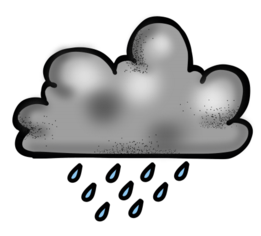
What part of the water cycle does this picture show?
a)
condensation
b)
precipitation
c)
evaporation
26.
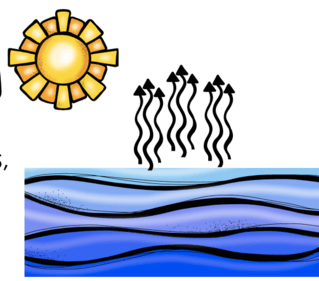
What part of the water cycle does this picture show?
a)
condensation
b)
precipitation
c)
evaporation
27.
What is evaporation?
a)
The part of the water cycle when the sun heats up water, turning it from a liquid into water vapor or steam. It rises from the ground into the air.
b)
The part of the water cycle when the water vapor in the air gets cold. The water turns back into a liquid and forms clouds.
c)
The part of the water cycle when clouds get heavy and can no longer hold the liquid water. This causes the water to fall from the sky to the earth as rain, snow, sleet, or hail.
28.
What is condensation?
a)
The part of the water cycle when the sun heats up water, turning it from a liquid into water vapor or steam. It rises from the ground into the air.
b)
The part of the water cycle when the water vapor in the air gets cold. The water turns back into a liquid and forms clouds.
c)
The part of the water cycle when clouds get heavy and can no longer hold the liquid water. This causes the water to fall from the sky to the earth as rain, snow, sleet, or hail.
29.
What is precipitation?
a)
The part of the water cycle when the sun heats up water, turning it from a liquid into water vapor or steam. It rises from the ground into the air.
b)
The part of the water cycle when the water vapor in the air gets cold. The water turns back into a liquid and forms clouds.
c)
The part of the water cycle when clouds get heavy and can no longer hold the liquid water. This causes the water to fall from the sky to the earth as rain, snow, sleet, or hail.
30.
Which is the opposite of condensation?
a)
runoff
b)
evaporation
c)
precipitation
d)
transpiration
31.
Which best explains why runoff is important?
a)
It returns water to other locations on Earth
b)
It increases the chance of flooding
c)
It makes evaporation occur faster
d)
It increases condensation
32.
What is it called when plants give off water vapor as a waste product?
a)
condensation
b)
evaporation
c)
sublimation
d)
transpiration
33.
When water _________, dew forms.
a)
Melts
b)
Evaporates
c)
Condenses
d)
Precipitates
34.
What is a layer of rock or sediment that holds water?
a)
glacier
b)
well
c)
aquifer
d)
natural spring
35.
How much of our planet is estimated to be covered with water?
a)
68%
b)
50%
c)
97%
d)
75%
36.
How much of our planet's water is saltwater?
a)
75%
b)
1%
c)
99%
d)
97%
37.
What is the primary source of energy for the Earth?
a)
Coal
b)
Wind power
c)
Natural gas
d)
The sun
38.
What is the process called in which gasses in Earth's atmosphere trap heat and send it back down to Earth's surface making it 60 F warmer than it would be?
a)
El nino
b)
Greenhouse effect
c)
Reconvectionation
d)
Global warming
39.
Heat from the sun travels to Earth by _____.
a)
conduction
b)
convection
c)
insulation
d)
radiation
40.
Warm air rises and the cool air sinks demonstrates this type of heat transfer. 
a)
conduction
b)
convection
c)
radiation
d)
Insolation 
41.
Why is the increase of Greenhouse gasses a big issue?
a)
It causes climate change and increase in the global temerature 
b)
It can lead to a major increase in Greenhouses 
c)
It leads to more factories
d)
It causes a major decrease in people
42.
About 30% of the solar energy that reaches the atmosphere is reflected back into space. About 20% is absorbed by the air. What percentage reaches earth's surface?
a)
50%
b)
30%
c)
100%
d)
55%
43.
The balance and distribution of sun's energy on Earth is the
a)
Greenhouse Effect
b)
Earth's energy budget
44.
The ozone layer protects us from
a)
UV rays
b)
CFCs
c)
Increased atmospheric heat
d)
Decreased atmospheric heat
45.
Which of the following is a human impact that contributes to global warming?
a)
Change of the Earth's seasons
b)
El nino
c)
Burning fossil fuels
d)
volcanic eruptions
46.
About 30% of the sun's incoming energy never reaches Earth because it is....
a)
absorbed by the ocean
b)
trapped by the gravitational pull between the moon and the Earth 
c)
reflected back into space
d)
destroyed by the ozone layer
47.

How much of the Sun's Energy is absorbed by land and oceans?

a)

20%

b)

7%

c)

51%

d)

64%

48.

What gas is known for increasing the amount of "trapped" heat in the atmosphere?

a)

Oxygen

b)

Nitrogen

c)

Methane

d)

Carbon Dioxide

49.
About 30% of the solar energy that reaches the atmosphere is reflected back into space. About 20% is absorbed by the air. What percentage reaches earth's surface?
a)
50%
b)
30%
c)
100%
d)
55%
50.
Land heats up and cools down faster than water.
a)
True
b)
False
51.
dark colored surfaces _________ radiation
a)
reflect 
b)
absorb
52.
light colored surfaces ____________ radiation 
a)
absorb
b)
reflect
53.
Some of the sun's energy is absorbed by Earth's surface and released back into the atmosphere as
a)
infrared radiation
b)
greenhouse gases
c)
ultraviolet light
d)
visible light
54.
Water evaporating from the surface of a lake moves from the...
a)
Atmosphere to the geosphere 
b)
Geosphere to the hydrosphere 
c)
Hydrosphere to the atmosphere 
d)
Atmosphere to the hydrosphere 
55.
The rock, dust, soil, and minerals of the Earth's solid crust and outer mantle make up the ____
a)
Biosphere
b)
Geosphere
c)
Cryosphere
d)
Atmosphere
56.
All frozen water on Earth is...
a)
Hydrosphere
b)
Geosphere
c)
Cryosphere
d)
Atmosphere
57.

Which example best describes how human activity can directly impact the biosphere?

a)

Poor farming practices can degrade the soil and cause erosion.

b)

Dumping waste from a factory into a river can pollute the water supply.

c)

Construction activities can release harmful dust and chemicals into the air.

d)

Removing too many fish from the ocean can cause a fish species to go extinct.
58.
This sphere includes the continents, the ocean floor, all the rocks on the surface, and all of the sand in the deserts. 
a)
Hydrosphere 
b)
Biosphere 
c)
Atmosphere 
d)
Geosphere 
59.
Composed of all the water on or near the earth
a)
Hydrosphere 
b)
Biosphere 
c)
Atmosphere 
d)
Geosphere 
60.
This sphere is composed of all the living things 
a)
Hydrosphere 
b)
Biosphere 
c)
Atmosphere 
d)
Geosphere 
61.
Body of air surrounding our planet. 
a)
Hydrosphere 
b)
Biosphere 
c)
Atmosphere 
d)
Geosphere 
62.
When dead plants decompose and nitrogen is returned to the soil, the interaction is between which two spheres? 
a)
The biosphere and atmosphere 
b)
The atmosphere and geosphere 
c)
The geosphere and atmosphere 
d)
The biosphere and geosphere 
63.
When living things breathe, they interact with which of Earth's spheres? 
a)
Geosphere 
b)
Hydrosphere 
c)
Atmosphere 
d)
Biosphere 
64.
Bio = 
a)
Earth
b)
Sphere
c)
Life
d)
Water
65.
Hydro = 
a)
Earth
b)
Sphere
c)
Life
d)
Water
66.
Geo = 
a)
Earth
b)
Sphere
c)
Life
d)
Water
67.
When carbon dioxide dissolves from the air into the ocean- the interaction is between...
a)
The atmosphere and geosphere 
b)
The atmosphere and hydrosphere 
c)
The atmosphere and biosphere 
d)
The atmosphere and atmosphere 
68.
When a plants takes carbon dioxide from the air which two spheres are interacting? 
a)
Biosphere and atmosphere 
b)
Geosphere and atmosphere 
c)
Hydrosphere and atmosphere 
d)
Atmosphere and atmosphere 
69.

Atmo=

a)

Water

b)

Earth

c)

Life

d)

Gases

70.

Cryo=

a)

Gases

b)

Water

c)

Frost/Frozen

d)

Earth

71.

Heavy cloud cover impacted the temperature of the land by making it cooler. What 2 spheres are interacting during this event?

a)

Atmosphere and Hydrosphere

b)

Hydrosphere and Cryosphere

c)

Atmosphere and Geosphere

d)

Geosphere and Hydrosphere

72.

Shifting winds causes major rain storms which floods rivers, lakes and streams. Which 2 spheres are interacting in this event?

a)

hydrosphere and atmosphere

b)

hydrosphere and biosphere

c)

biosphere and atmosphere

d)

geosphere and hydrosphere

73.

Coral reefs protect the coastline by absorbing the energy from the pounding waves. What 2 spheres are interacting in this event?

a)

biosphere and hydrosphere

b)

hydrosphere and geosphere

c)

geosphere and biosphere

d)

geosphere and atmosphere

74.
A metal spoon heating up in a bowl of hot soup
a)
Conduction
b)
Convection
c)
Radiation
75.
Getting a sunburn on while spending the day on the beach
a)
Conduction
b)
Convection
c)
Radiation
76.
Feeling the hot air when opening the oven
a)
Conduction
b)
Convection
c)
Radiation
77.
Burning your tongue on a hot soup
a)
Conduction
b)
Convection
c)
Radiation
78.
The movement of liquid in a lava lamp
a)
Conduction
b)
Convection
c)
Radiation
79.
The sand burning your feet while walking on the beach on a hot day
a)
Conduction
b)
Convection
c)
Radiation
80.
Pancakes cooking on a pan
a)
Conduction
b)
Convection
c)
Radiation
81.
Popcorn cooking in a microwave
a)
Conduction
b)
Convection
c)
Radiation
82.
Water boiling in a pot
a)
Conduction
b)
Convection
c)
Radiation
83.
Magma creating a current in the mantle to move tectonic plates
a)
Conduction
b)
Convection
c)
Radiation
84.

How does heat transfer when you hold an ice cube in your hand?

a)

from the cold ice cube to your warm hand

b)

the cold ice cube makes your hand cold

c)

from your warm hand to the cold ice cube

d)

very carefully

85.

McDonald's keeps my Big Macs warm under a heat lamp which transfers heat through

a)

conduction

b)

convection

c)

radiation

d)

science stuff

86.

Energy that transfers from one substance to another until the temperatures are equal is called...

a)

Joe

b)

temperature

c)

MELTS

d)

heat

87.
_________________________ is a measure of the average kinetic energy of the particles in a material.
a)
thermal
b)
friction
c)
temperature
d)
expansion
88.
The movement of thermal energy from an object at a higher temperature to an object at a lower temperature is called ____________.
a)
thermal
b)
expansion
c)
temperature
d)
heat
89.
Thermal energy always moves from ____________ objects to ______________ objects.
a)
cooler, warmer
b)
warmer, cooler
c)
faster, slower
d)
slower, faster
90.
Thermal energy stops moving when the objects have the same temperature.
a)
True
b)
False
91.
At higher temperatures
a)
particles in an object have less energy
b)
particles in an object move faster
c)
a gas contracts
92.
A gas
a)
has a definite shape but no definite volume
b)
has a definite volume but no definite shape
c)
has fast-moving particles
93.
Freezing
a)
Solid to gas
b)
Liquid to solid
c)
Gas to solid
d)
Liquid to gas
94.
Boiling
a)
liquid to gas
b)
gas to solid
c)
gas to liquid
d)
solid to liquid
95.
Which state of matter has tightly packed molecules?
a)
solid
b)
liquid
c)
gas
96.
Which state of matter has a definite shape?
a)
solid
b)
liquid
c)
gas
97.
Particles (molecules) in a ______________________ have more energy than the other states of matter.
a)
gas
b)
solid
c)
liquid
98.
Particles of a liquid
a)
are tightly packed together and stay in a fixed position.
b)
have no viscosity.
c)
decrease in volume with increasing temperature.
d)
are free to move around one another but still touch.
99.
What term describes a solid changing to a gas?
a)
Deposition
b)
Sublimation
c)
Evaporation
d)
Freezing
100.
The speed of the molecules determines the _____.
a)
volume
b)
density
c)
pressure
d)
temperature
101.
Which has a greater distance between particles?
a)
Solid
b)
Liquid
102.
The slower the particles in a substance move,
a)
the colder it is.
b)
the warmer it is.
c)
the more energy it has.
d)
the less energy it has.
103.
When the temperature of matter decreases the particles ...
a)
speed up and move farther apart
b)
speed up and move closer together
c)
slow down and move farther apart
d)
slow down and move closer together
104.
When the temperature of matter increases the particles...
a)
speed up and move closer
b)
speed up and move farther apart
c)
slow down and move closer together
d)
slow down and move farther apart
105.
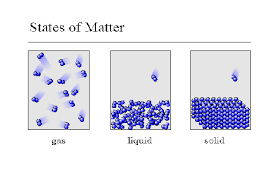
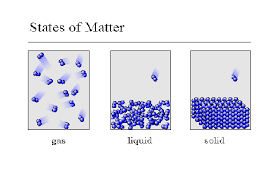
What does this picture represent? 
a)
solid
b)
liquid
c)
gas
d)
plasma
106.
What does this picture represent? 
a)
solid
b)
liquid 
c)
gas
d)
plasma
107.
Which of the following statements is NOT true of all different types of matter?
a)
They are made of atoms and molecules
b)
The particles are always in motion
c)
The particles always move at the same speed
d)
They are made of particles that are too small to see
108.

The negative charge in a plasma is usually due to the

a)

protons

b)

neutrons

c)

electrons

109.

Plasma can be found in which of the following

a)

Auroras

b)

Lightening

c)

LED light bulbs

d)

Stars

e)

Moons

110.

A plasma can be made in a laboratory by

a)

cooling a gas to very low temperatures

b)

cooling a gas and reducing the pressure

c)

heating a gas to extremely hot temperatures

d)

heating a liquid to the point it turns into a gas

111.

In a plasma the electrons are no longer associated with a particular nucleus.

a)

True

b)

False