wayground logo

Free Printable Worksheets

Font size

S
M
L
XL
Worksheets

Plate Tectonics & Paleontology Common Assessment Review

Total questions: 113

Worksheet time: 2hrs 51mins

Name
Class
Date
1.

If we can't travel to the center of the Earth, how do we know so much about it?

a)

Seismic waves, made by earthquakes and man-made explosions

b)

special camera scopes sent through all the layers of the earth

c)

very long thermometers that can reach to the inner core

d)

super powerful x-rays

2.

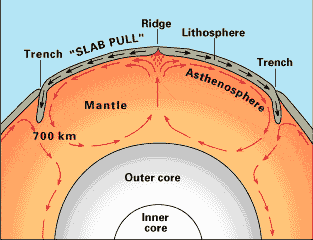
What is the Asthenosphere?

a)

an elastic substance on which the tectonic plates float.

b)

the air that we breathe.

c)

another name for a globe.

d)

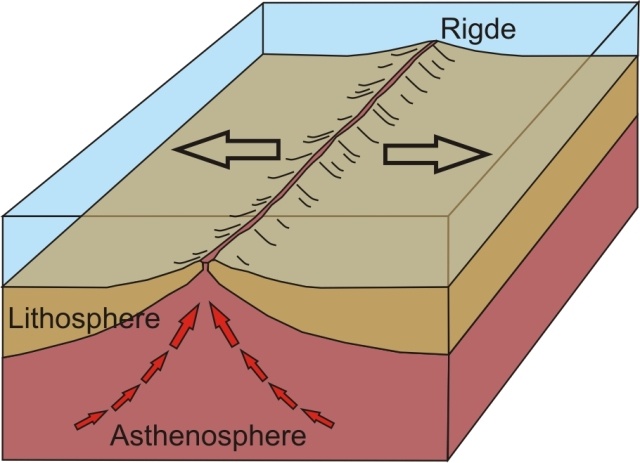
the hard inner core

3.

What are convection currents?

a)

the cycle of heated rock or metal rising, and cooling rock or metal falling.

b)

the cycle of cooling rock or metal rising, and heated rock or metal falling.

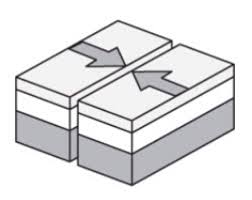
c)

an electric current found in the mantle.

d)

and electric current found in the outer core.

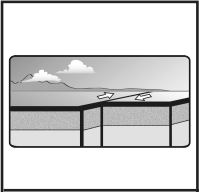
4.

The Lithosphere is made up of the ___________.

a)

Crust and Upper Mantle

b)

Inner and Outer Cores

c)

Outer Core and Lower Mantle

d)

Lower and Middle Mantle

5.

Which layer is made of liquid iron and nickel?

a)

Crust

b)

Mantle

c)

Outer Core

d)

Inner Core

6.

Which layer is made of solid Iron and nickel?

a)

Crust

b)

Mantle

c)

Outer Core

d)

Inner Core

7.

Which layer is the only liquid layer?

a)

Crust

b)

Mantle

c)

Outer Core

d)

Inner Core

8.

What is the densest layer?

a)

Crust

b)

Mantle

c)

Outer Core

d)

Inner Core

9.

What is the hottest layer?

a)

Crust

b)

Mantle

c)

Outer Core

d)

Inner Core

10.

What is the coolest layer?

a)

Crust

b)

Mantle

c)

Outer Core

d)

Inner Core

11.

What is the thickest layer?

a)

Crust

b)

Mantle

c)

Outer Core

d)

Inner Core

12.

What is the thinnest layer?

a)

Crust

b)

Mantle

c)

Outer Core

d)

Inner Core

13.

How many layers does Earth have?

a)

1

b)

2

c)

3

d)

4

14.
Which layer of the earth is in the very center?
a)
Crust
b)
Mantle
c)
Outer Core
d)
Inner Core
15.
Which layer of the earth is between the core and the crust?
a)
Crust
b)
Mantle
c)
Outer Core
d)
Inner Core
16.
Which layer of the earth has the lowest temperature?
a)
Crust
b)
Mantle
c)
Outer Core
d)
Inner Core
17.
Which layer of the earth is under the highest pressure?
a)
Crust
b)
Mantle
c)
Outer Core
d)
Inner Core
18.
What is the name of the layer that contains the uppermost mantle and crust
a)
Asthenosphere
b)
Mesosphere
c)
Lithosphere
d)
Transosphere
19.
What are the two types of crust
a)
continental and oceanic
b)
ocean and upper
c)
lower and upper
d)
pizza and subway
20.
Which crust is thicker
a)
ocean
b)
continental
c)
bread
d)
pizza
21.
Scientists determine what Earth’s interior looks like by using:
a)
Volcanoes
b)
Seismic Waves
c)
Continental Drift
d)
Convection Currents
22.
What observation can we make about Earth’s lithosphere AND asthenosphere?
a)
The asthenosphere floats on top of the lithosphere.
b)
The crust and the core make up the lithosphere.
c)
The crust and mantle make up the asthenosphere. 
d)
The lithosphere floats on top of the asthenosphere
23.
What is the inner core composed of?
a)
Basalt
b)
Granite
c)
Iron and Nickel
d)
Molten (liquid) Metals
24.
If you traveled from the center of Earth to the surface, the pressure would...
a)
increase
b)
decrease
c)
stay the same
d)
unsure
25.
The asthenosphere is part of which layer?
a)
Inner core
b)
Outer Core
c)
Mantle
d)
Crust
26.
What was the name given to all the continents when they were joined as one super continent
a)
Supreme Continent
b)
United States
c)
Eurasia
d)
Pangea
27.
Contains molten (hot liquid) iron and nickel.
a)
outer core
b)
inner core
c)
mantle
d)
crust
28.
This layer is made up of igneous, metamorphic, and sedimentary rock.
a)
outer core
b)
mantle
c)
crust
d)
inner core
29.

The theory that states that pieces of Earth's crust are in constant, slow motion is the theory of...

a)

continental eruption

b)

plate boundaries

c)

plate tectonics

d)

lithospheric drift

30.
All of the continents were once part of one large continent called...
a)
Panacea
b)
Pangea
c)
North America
d)
Gondwana
31.

This man was responsible for creating the idea of continental drift.

a)

Alfred Wegener

b)

Neil Hess

c)

Harry Cooper

d)

Alex Roger

32.
Tectonic plates are made up of continental crust and ________ crust.
a)
continental
b)
oceanic
c)
plates
d)
mantle
33.

What type of plate boundary creates new sea floor?

a)

Divergent

b)

Convergent

c)

Transform

d)

Subduction

34.

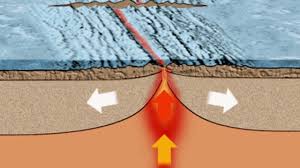
What type of plate boundary is represented in the picture?

a)

Athensphere

b)

Divergent

c)

Transform

d)

Convergent

35.

Which crust subducts because it is denser than other crust?

a)

pizza crust

b)

oceanic crust

c)

continental crust

d)

new crust

36.

What type of plate boundary is represented in the picture?

a)

Transform

b)

Divergent

c)

Convergent

d)

Lithosphere

37.
There are three types of plate boundaries. Which choice is NOT a type of plate boundary?
a)
convergent
b)
thrust
c)
divergent
d)
transform
38.

What is the source of energy that drives plate movement?

a)

the subducton of the sea floor

b)

the different densities of the oceanic and crustal plates

c)

convection currents in the asthenosphere

d)

the friction force between the plates that move past each other

39.
A plate boundary where two plates move away from each other is called
a)
Divergent Boundary
b)
Convergent Boundary
c)
Transform Boundary
d)
Subduction
40.
A Plate Boundary where two plates move toward each other is called
a)
Convergent Boundary
b)
Divergent Boundary
c)
Transform Boundary
d)
Subduction
41.
Convergent Plate Movement can create
a)
Rifts
b)
Mountains
c)
Ocean Ridges
d)
Radiation
42.
During sea floor spreading, molten material rises up from the mantle...
a)
along the continents
b)
at the mid ocean ridges
c)
deep ocean trenches
d)
at north and south poles
43.
Which of the following is where one plate slides under another plate?
a)
submarine zone
b)
divergence zone
c)
subduction zone
d)
lower zone
44.
What kind of plate boundary is shown here?
a)
divergent
b)
convergent
c)
transform
d)
submergent
45.
What kind of plate boundary is shown here?
a)
divergent
b)
convergent
c)
transform
d)
subducting
46.
What kind of plate boundary is shown here?
a)
divergent
b)
convergent
c)
transform
d)
strike slip
47.
What geologic feature/event you be most likely to find at a transform boundary?
a)
Earthquakes
b)
Volcanoes
c)
Mountains
d)
Rift Valleys
48.
What geologic feature/event would you most likely to find at a divergent boundary between two pieces of oceanic crust?
a)
Rift Valley
b)
Mid-Ocean Ridge
c)
Island Arc
d)
Flat land
49.
What geologic feature/event would you most likely to find at a divergent boundary between two pieces of continental crust?
a)
Mid-Ocean Ridge
b)
Mountain
c)
Rift Valley
d)
Island Arc
50.
What geologic feature/event would you most likely to find at a convergent boundary between two pieces of continental crust?
a)
Volcano
b)
Mountain
c)
Rift
d)
Island Arc
51.
A subduction zone is formed...
a)
when one tectonic plate sinks below another
b)
at every type of convergent plate boundary
c)
at every type of divergent plate boundary
d)
at transform boundaries
52.
Name the boundary
a)
convergent boundary
b)
divergent boundary
c)
transform boundary
d)
sergent boundary
53.
In which type of boundary do the plates move away from each other?
a)
convergent
b)
normal
c)
divergent
d)
transform
54.
The area where two or more plates meet is called a __________________.
a)
fault
b)
plate boundary
c)
plate edge
d)
ring of fire
55.

What type of boundary is this?

a)

convergent

b)

divergent

c)

transform

56.

What type of boundary is this?

a)

convergent

b)

divergent

c)

transform

57.

What type of boundary is this?

a)

convergent

b)

divergent

c)

transform

58.

New crust forms along a(n)

a)

subduction zone

b)

divergent boundary

c)

convergent boundary

d)

transform boundary

59.

___________, meaning "all land," is the name of the great landmass that existed millions of years ago.

a)

lithosphere

b)

Pangaea

c)

subduction zone

d)

tectonic

e)

Wegener

60.

A __________ plate is a large slab of crust and upper mantle that moves over the earth's surface.

a)

lithosphere

b)

Pangaea

c)

subduction zone

d)

tectonic

e)

Wegener

61.

Which model is depicting a convergent boundary between two plates?

a)

top

b)

middle

c)

bottom

62.

Which model is depicting a transform boundary between two plates?

a)

top

b)

middle

c)

bottom

63.

Which model is depicting a divergent boundary between two plates?

a)

top

b)

middle

c)

bottom

64.

What occurs between two oceanic plates at a divergent boundary?

a)

rift valley

b)

sea floor spreading

c)

volcanic mountain range

65.
What does the theory of continental drift state?
a)
The continents were once joined in a super-continent and have moved over time
b)
Continents are stationary and do not move
c)
The Earth is broken into lithospheric plates that move due to convection currents
d)
none of the above
66.
What evidence did Wegener use in his theory?
a)
Continents and fossils fitting together/matching-up like puzzle pieces 
b)
glacier scars and evidence from temperature
c)
mountain ranges and coal deposits line up across continents
d)
all of the above
67.
Why did no one believe Wegener's thoery?
a)
He could not explain HOW the continents moved
b)
He didn't have evidence
c)
His data was wrong
d)
He didn't use the right technology to gather data
68.
What two specific continents fit together most noticeably?
a)
Africa and North America
b)
South America and Europe
c)
South America and Africa
d)
Antartica and Africa
69.
How long ago is Pangea believed to have existed?
a)
200-300 million years ago
b)
1000-2000 years ago
c)
10,000-20,000 years ago
d)
20-30 billion years ago
70.
What does the word Pangea mean?
a)
big land mass
b)
old land
c)
all land
71.
How does evidence of glaciation in Africa support the Theory of Continental Drift?
a)
It shows that the continents must have been in a different location.
b)
It doesn't. 
c)
I shows that it was colder at the equator in the past.
d)
It shows that it was warmer at the equator in the past.
72.
What is the force that moves the continents? 
a)
Conduction 
b)
Convection 
c)
Radiation 
d)
Conveyor belts 
73.
What are the two types of crust?
a)
continental and oceanic
b)
ocean and basin
c)
lower and upper
d)
thick and thin
74.
What is Pangaea?
a)
the name of a German scientist
b)
the name of the super-continent that existed millions of years ago
c)
another name for continental drift
d)
the name of an ancient fossil
75.
What type of evidence was NOT used by Alfred Wegener to support his continental drift hypothesis?
a)
evidence from landforms
b)
evidence from fossils
c)
evidence from human remains
d)
evidence from climate
76.
Who is the scientist who proposed Continental Drift Theory?
a)
Albert Einstein
b)
Alfred Wegener
c)
Isaac Newton
d)
John Dalton
77.
What are the remains of organism noticed by Wegener that are found the same in two continents?
a)
Leaves and flowers
b)
Ice and mountains
c)
Plants and animals
d)
Dinosaurs and reptiles
78.

Scientists think that the continents once formed a giant landmass that broke apart, and then slowly drifted apart. What is the name given to this hypothesis?

a)

sea-floor Spreading

b)

plate tectonics

c)

continental drift

d)

Pangaea

79.

Most geologist think that the movement of Earth's tectonic plates is caused by

a)

the rotation of the Earth.

b)

the Earth's magnetic field.

c)

subduction.

d)

convection currents.

80.

Ocean crust is made of _______ and is _______ dense than continental crust.

a)

basalt, less

b)

basalt, more

c)

granite, less

d)

granite, more

81.

Fossils of the Mesosaurus were found on the continents of South America and Africa within the same layers of rock. This provides evidence that the two continents were once

a)

separated by an ocean.

b)

joined as one large land mass.

c)

in different hemispheres.

d)

located near the poles.

82.
What does the theory of continental drift state?
a)
The continents were once joined in a super-continent and have moved over time
b)
Continents are stationary and do not move
c)
The Earth is broken into lithospheric plates that move due to convection currents
d)
none of the above
83.
What two specific continents fit together most noticeably?
a)
Africa and North America
b)
South America and Europe
c)
South America and Africa
d)
Antartica and Africa
84.
Who is the person credited with developing the theory of continental drift?
a)
Harry Hess
b)
Galileo
c)
Alfred Wegener
d)
Newton
85.
Which piece of evidence did Wegener use to prove continental drift?
a)
The shape of the continents
b)
Similar fossils found on separate continents
c)
Tree fossils found in odd places
d)
All of the above
86.

In sea-floor spreading, molten material rises from the mantle and erupts creating new crust.

a)

along the edges of all the continents.

b)

along mid-ocean ridges.

c)

in deep-ocean trenches.

d)

at the north and south poles.

87.

Most geologists think that the movement of Earth’s plates is caused by _______

a)

convection.

b)

continental drift.

c)

subduction.

d)

conduction.

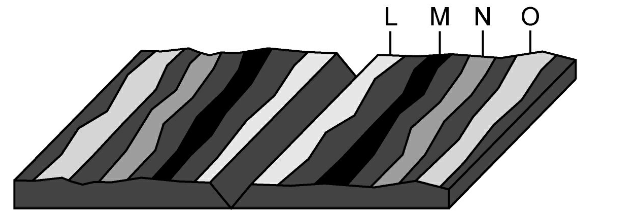
88.
Where would the oldest rock be found?
a)
L
b)
M
c)
N
d)
O
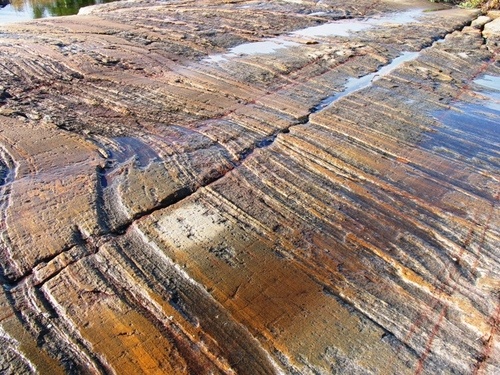
89.
This is a picture of glacier scars found in Africa.  What are these evidence for?
a)
Africa has always been near the equator
b)
Africa was once in an area of the Earth that had a very cold climate
c)
The continents have not moved
d)
sea floor spreading
90.
Where have Glossopteris fossils been found?
a)

India

b)

Australia

c)

Antarctica

d)

All of them

e)

South America

91.
Mesosaurus fossils have been found on what two continents?
a)
India and Africa
b)
Africa and South America
c)
Antartica and Australia
d)
India and Antarctica
92.

What are mid-ocean ridges?

a)

Vast mountain ranges deep below the ocean's surface

b)

Deep underwater troughs on the seafloor

c)

The process by which new oceanic crust is continuously formed and destroyed

d)

molten rock below Earth's surface

93.

The youngest rocks on the ocean floor are located ____.

a)

near continents

b)

at mid-ocean ridges

c)

far from mid-ocean ridges

d)

near Asia

94.

Who first proposed the idea of seafloor spreading?

a)

Alfred Wegener

b)

Harry Hess

c)

James Hutton

d)

Nicolaus Copernicus

95.

Harry Hess discovered....

a)

Submarines

b)

Deserts at the bottom of the ocean

c)

A new fish species

d)

The Mid-Atlantic Ridge

96.

Which layer of Earth flows slowly and causes the crust to move?

a)

Crust

b)

Mantle

c)

Inner Core

d)

Outer core

97.

Define: Pangea

a)

Earth's continental blocks of land to form a single large landmass known as a supercontinent.

b)

The smaller continents at the North and South Pole today.

c)

Australia

98.
According to the law of superposition, the oldest fossils are found 
a)
At the top of the rock layers
b)
Near the bottom of the rock layers
c)
In the middle of the rock layers
d)
Somewhat near the surface
99.
Which rock layer in the diagram seems to be the oldest?
a)
F
b)
E
c)
B
d)
A
100.
According to the law of superposition, which layer is the youngest?
a)
A
b)
B
c)
C
101.
Which of the following orders the rock layers accurately from youngest to oldest?
a)
1, 2, 3, 4, 5
b)
5, 4, 3, 2, 1
c)
2, 3, 4, 5, 1
d)
1, 2, 3, 5, 4
102.
Which fossil is relatively the oldest?
a)
Trilobite
b)
Ammonite
c)
Crinoid
d)
Gastropod
103.
Which animal is the youngest in site 1?
a)
bird
b)
ammonite 
c)
shell
104.

The Law of Superposition states that in horizontal layers of sedimentary rock, each layer is older than the layer above it and younger than the layer below it.

a)

I don't get it.

b)

GOT IT!

105.
Which rock layer in the diagram seems to be the oldest?
a)
F
b)
E
c)
B
d)
A
106.

Which rock layer in the diagram seems to be the youngest?

a)

F

b)

E

c)

B

d)

A

107.

Which of the following rock layers is younger than D?

a)

A

b)

B

c)

C

d)

E

108.

Which of the following rock layers is older than than C?

a)

F

b)

E

c)

D

d)

A

109.

Rock layer D is _______________ than rock layer A.

a)

older

b)

younger

110.

Rock layer B is _______________ than rock layer E.

a)

older

b)

younger

111.

Rock layer C is _______________ than rock layer D but _______________ than rock layer B.

a)

older, younger

b)

younger, older

112.

Rock layer D is _______________ than rock layer C but _______________ than rock layer E.

a)

older, younger

b)

younger, older

113.

Which rock layer most likely contains fossils of the most recently evolved organisms?

a)

F

b)

E

c)

D

d)

C