Wayground logo

Free Printable Worksheets

Font size

S
M
L
XL
Worksheets

EOC FINAL PRACTICE

Total questions: 38

Worksheet time: 51mins
Name
Class
Date
1.
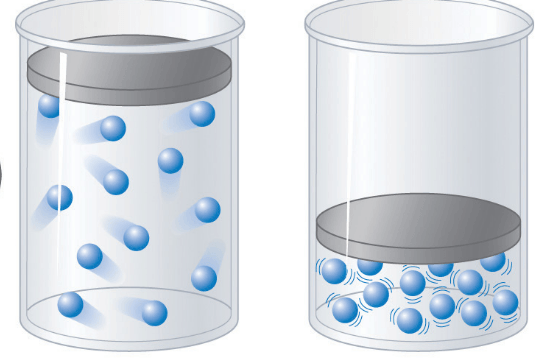
Which container will have a lower pressure?
a)
left
b)
right
c)
they both have the same pressure
d)
I don't know
2.
If a balloon is cooled what will happen to the volume?
a)
Volume will increase
b)
Volume will decrease
c)
Volume will not change
3.
What is the atomic number of Rubidium?
a)
37
b)
44
c)
45
d)
86
4.
What family is Sodium a part of?
a)
Transition Metals
b)
Halogens
c)
Alkali Metals
d)
Alkaline Earth Metals
5.
Use your periodic table to answer the following question.
Which of the following atoms has 14 electrons?
a)
Carbon (C)
b)
Silicon (Si)
c)
Sulfur (S)
d)
Argon (Ar)
6.
Cobalt (Co) has 27 protons in each atom. Based on this information, which of the following also describes an atom of Cobalt?
a)
It has no neutrons.
b)
It has 27 electrons.
c)
It has 13 neutrons and 14 electrons.
d)
It has a total of 86 neutrons and electrons.
7.
A neutral atom of Carbon-13 has ________ electrons and _________ neutrons
a)
13, 13
b)
6, 7
c)
7, 7
d)
6, 6
8.
What is the symbol for an alpha particle?
a)
42He
b)
0-1e
c)
0+1 e
d)
10n
9.
This is an example of ---
a)
Radioactive Decay
b)
Nuclear Fission
c)
Nuclear Fusion
d)
Fossil fuel reaction
10.
What is the missing isotope that will balance the following nuclear equation?
94Be  +  11H →  _____  +  42He
a)
105B
b)
105Ne
c)
63Li
d)
63C
11.

As you move down the periodic table atoms get bigger. This is because ____________. (hint...hint...think about the periods on the periodic table)

a)

The atoms have more mass.

b)

The atoms have more protons.

c)

The atoms have more energy levels

d)

The atoms have more neutrons

12.
What will nitrogen's charge be as an ion (What is the charge of the nitride ion)?
a)
+3
b)
-3
c)
0
d)
-1
13.
The covalent compound N2O5 would be named
a)
nitrogen oxide.
b)
dinitrogen oxide.
c)
nitrogen pentoxide.
d)
dinitrogen pentoxide.
14.
Name this compound: 
NaBr
a)
Bromide sodide
b)
Sodium bromide
c)
Sodium bromate
d)
Sodium bromite
15.
Balance this equation
_N2 + _H2 --> _NH3
a)
1,2,3
b)
1,3,2
c)
1,1,2
d)
2,1,1
16.

2 NaBr + 1 Ca(OH)2 ----> 1 CaBr2 + 2 NaOH

a)

Synthesis (or combination)

b)

Decomposition

c)

Single replacement

d)

Double replacement

17.
Pb + FeSO4 ----> PbSO4 + Fe
a)
Synthesis (or combination)
b)
Decomposition
c)
Single displacement
d)
Double displacement
18.

CaCO3 ----> CaO + CO2

a)

Synthesis (or combination)

b)

Decomposition

c)

Single displacement

d)

Double displacement

19.
P4 +  3 O2 ----> 2 P2O3
a)
Synthesis (or combination)
b)
Decomposition
c)
Single displacement
d)
Double displacement
20.
What happens when thermal energy is taken away from particles?
a)
They move faster and farther apart
b)
They move slower and closer together
21.
What is the difference between an element and a compound?
a)
An element is ONE type of atom; a compound is TWO OR MORE
b)
A compound is one type of atom; an element is TWO OR MORE
22.
What type of radioactive decay is shown here?
a)
Alpha decay
b)
Beta decay
c)
Gamma decay
23.
C-12 and C-14 are known as...
a)
Ions
b)
Isotopes
c)
Protons
d)
explosives 
24.
What is this element?
1s22s22p63s2
a)
Neon
b)
Magnesium
c)
Aluminum
d)
Potassium
25.
Is the combustion of gasoline endothermic or exothermic?
a)
Endothermic
b)
Exothermic
26.
C4H12 + O2 → CO2 + H2O
a)
Synthesis
b)
Combustion
c)
Single Replacement
d)
Double Replacement
27.

The molar mass of CaCl2?

a)

100 grams

b)

111 grams

c)

121 grams

d)

131 grams

28.
As you move across the periodic table from left to right, the atomic radius decreases.  This is because - 
a)
the number of protons increases, so attraction to electrons increases
b)
the number of energy levels increases
c)
the number of electrons increases
d)
the atomic mass increases
29.
Electronegativity __________ from left to right within a period and __________ from top to bottom within a group.
a)
decreases, increases 
b)
increases, increases
c)
increases, decreases 
d)
stays the same, increases
30.
Which of these compounds is ionic? 
a)
Carbon dioxide
b)
Dinitrogen trioxide
c)
Silicon tetrachloride
d)
Lithium bromide
31.

Which of these is covalent?

a)

NaCl

b)

Ag(NO3)2

c)

CO2

d)

AlCl3

32.
In the above picture, a powder is about to be poured into the liquid. Which of the following should be done to make this powder dissolve faster?

a)
stir the powder in the liquid
b)
freeze the mixture
c)
add more powder to the liquid
d)
store the mixture in a dark place
33.

NaOH may be found in drain cleaners and as a component of soaps. Is NaOH an acid or a base?

a)

Acid

b)

Base

c)

Neither (Neutral)

34.

Isotopes differ in the number of:

a)

Protons

b)

Neutrons

c)

Electrons

d)

They do not differ.

35.
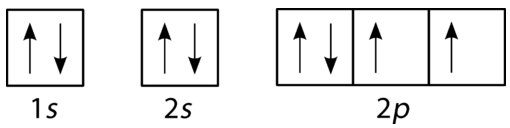
This orbital diagram represents:  
a)
C
b)
B
c)
N
d)
O
36.
Which element is depicted from this atomic orbital diagram?
a)
Carbon
b)
Nitrogen
c)
Oxygen
d)
Phosphorus
37.
What gases are in the unknown mixture?
a)
Gas B & Gas D
b)
Gas C & Gas B
c)
Gas A & Gas D
d)
Gas D & Gas C
38.

Which color has the longest wavelength?

a)

Yellow

b)

Red

c)

Green

d)

Purple