
NEW
Font size
S
M
L
XL
 Worksheets
Heredity EOC Prep
Total questions: 42
Worksheet time: 46mins
Name
Class
Date
1.
What is genetics?
a)
The study of DNA nucleotides
b)
The study of heredity
c)
The study of a cell dividing into 2
d)
The study of eye color
2.

The passing of DNA from parents to offspring
a)
Generation
b)
Heredity
c)
Inheritance
d)
Traits
3.

Chromosomes are found in the ____________ of the cell
a)
Chloroplast
b)
Nucleus
c)
Cytoplasm
d)
Mitochondria
4.
What is a gene?
a)
An entire chromosome that codes for a trait
b)
a piece of clothing
c)
a piece of a DNA on chromosome that codes for a trait
d)
Chemical messengers in your brain that code for a trait
5.
What is a recessive allele?
a)
A trait that is always shown (capital letter)
b)
A trait that can be hidden (lower case letter)
c)
Alleles that are the same
d)
Alleles that are different
6.
What is a dominant allele?
a)
A trait that is always shown (capital letter)
b)
A trait that can be hidden (lower case letter)
c)
Alleles that are the same
d)
Alleles that are different
7.

The physical traits of an organism
a)
Teletype
b)
Genotype
c)
Mesotype
d)
Phenotype
8.

The genes of an organism
a)
Mesotype
b)
Phenotype
c)
Teletype
d)
Genotype
9.

This means Same Gene
a)
Dominant
b)
Recessive
c)
Heterozygous
d)
Homozygous
10.

Genes always appear in pairs. Your parents donate ________ allele for every trait.
a)
1
b)
2
c)
23
d)
46
11.

This means Different Gene
a)
Dominant
b)
Recessive
c)
Homozygous
d)
Heterozygous
12.

What is Bb?
a)
Homozygous
b)
Heterozygous
c)
Recessive
d)
Alleles
13.
What are the two genotypes that show the DOMINANT Phenotype
a)
GG, gg
b)
GG, Gg
c)
Gg, gg
14.
What is the only Genotype that shows the RECESSIVE Phenotype?
a)
GG
b)
Gg
c)
gg
15.
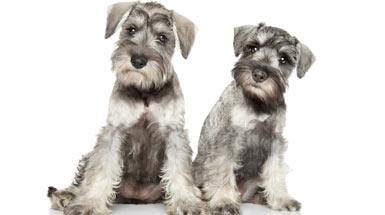
When humans breed purebred dogs to look a certain way and have traits that they like, this is an example of ___________________________
a)
Probably Breeding
b)
Sectional Breeding
c)
Selective Breeding
d)
Suspended Breeding
16.
__________________ is a tool for tracing through generations of family members.
a)
Pedigree
b)
Probability
c)
Purebred
d)
Punnett Square
17.

What are the possible combinations of a pea plant with the alleles PP and a male pea plant with the alleles pp.
P= purple
p= white
P= purple
p= white
a)
all Pp
b)
all PP
c)
Pp,PP,Pp,PP
d)
all pp
18.

A couple has 6 children, all girls. If the mother gives birth to a 7th child, what is the probability that the seventh child will be a girl?
a)
7 out of 7
b)
6 out of 7
c)
1 out of 2
d)
1 out of 7
19.

A heterozygous long-tusked elephant is crossed with a homozygous recessive short-tusked elephant. What is the probability of the offspring having short tusks?
a)
0%
b)
25%
c)
50%
d)
75%
20.

What allele combination should go in the missing box?
a)
AA
b)
Aa
c)
aa
d)
none of these
21.
A homozygous dominant brown mouse is crossed with a heterozygous brown mouse (tan is the recessive color).
a)
100 % tan
b)
100 % brown
c)
50 % brown and 50% tan
d)
75 % brown and 25 % tan
22.
A mutation in which only one nucleotide is altered is called a:
a)
Frameshift Mutation
b)
Deletion Mutation
c)
Point Mutation
d)
Insertion Mutation
23.
Another name for a point mutation is:
a)
Substitution
b)
Frameshift
c)
Insertion
d)
Deletion
24.
ATTTGAGCC- Original
ATTGAGCC - Mutated
The example above is an example of a
a)
Insertion
b)
Point mutation
c)
Deletion
d)
Substitution
25.
In order for offspring to get a genetic mutation, the mutation must occur in what type of cell?
a)
Cells with no nucleus.
b)
Any body cell after birth.
c)
Cells with no cell wall or cell membrane.
d)
Cells like eggs or sperm cells that are undergoing reproduction.
26.
What are the building blocks of proteins called?
a)
DNA
b)
RNA
c)
Ribosomes
d)
Amino Acids
27.
ATTTGAGCC- Original
ATTGAGCC - Mutated
The example above is an example of a
ATTGAGCC - Mutated
The example above is an example of a
a)
Insertion- Frameshift
b)
Deletion- Substitution
c)
Deletion -Frameshift
d)
All of the above
28.

If this pedigree shows an autosomal recessive disorder, what MUST the genotype of individual II-3 be?
a)
HH
b)
Hh
c)
hh
d)
None of the above
29.

How are individuals III-2 and II-4 related?
a)
Cousins
b)
Dad and Daughter
c)
Uncle and Niece
d)
Grandpa and Granddaughter
30.
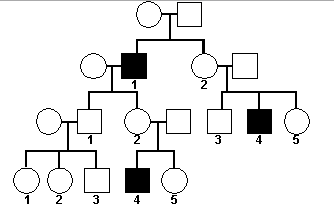
What type of heredity is shown in the pedigree?
(hint: check your notes - "modes of inheritance")
(hint: check your notes - "modes of inheritance")
a)
Sex-Linked Dominant
b)
Sex-Linked Recessive
c)
Autosomal Dominant
d)
Autosomal Recessive
31.

If this pedigree shows a recessive disorder, what MUST the genotype of individual 4 be?
a)
HH
b)
Hh
c)
hh
32.
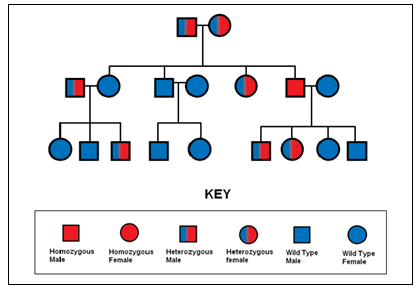
In a pedigree, what shape represents a male?
a)
circle
b)
square
c)
triangle
d)
diamond
33.

How many generations are shown in this pedigree?
a)
1
b)
2
c)
3
d)
4
34.

How many kids did the mother and father from the first generation have?
a)
2
b)
4
c)
5
d)
6
35.
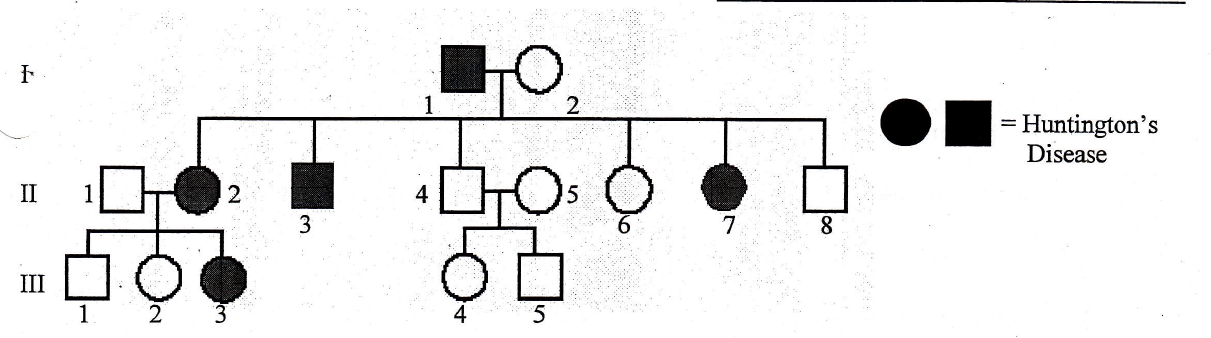
There are no carriers for Huntington's Disease- you either have it or you don't. Is Huntington's disease caused by a dominant or recessive trait?
a)
Dominant
b)
Recessive
36.

How are individuals I-2 and III-5 related?
a)
Grandpa and grandson
b)
Mom and son
c)
Uncle and nephew
d)
Grandma and grandson
37.
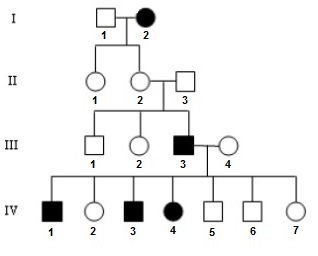
This pedigree represents the inheritance of hemophilia in this family. How many of the females have the hemophilia trait?
a)
8
b)
5
c)
2
d)
3
38.

Huntington's Disease is a dominant trait.
What is the correct genotype for individual I-2?
What is the correct genotype for individual I-2?
a)
HH
b)
Hh
c)
hh
d)
H_
39.

Does this pedigree show a dominant or recessive trait?
a)
Dominant
b)
Recessive
40.
Hemophilia is a recessive sex-linked trait. If H = normal & h = has hemophilia, which genotype represents a male with hemophilia.
a)
XHY
b)
XHXh
c)
XhXh
d)
XhY
41.

a)
Not affected Female
b)
Not affected Male
c)
Affected Male
d)
Affected Female
42.

What do half colored symbols represent?
a)
The individual is a carrier (heterozygous).
b)
The individual expresses the trait.
c)
The individual has both recessive alleles.
d)
The individual has both dominant alleles.
Reset

