wayground logo

Free Printable Worksheets

Font size

S
M
L
XL
Worksheets

Final Review

Total questions: 113

Worksheet time: 1hrs 14mins

Name
Class
Date
1.

An example of an opportunity cost would be

a)

not being able to afford a family trip because the family buys a computer.

b)

buying a movie ticket.

c)

the price of gasoline for a family trip.

d)

buying a computer to help get better grades in school.

2.

How are trade-offs and opportunity costs different?

a)

The opportunity cost is the most desirable trade-off.

b)

A trade-off is the most expensive opportunity cost.

c)

A trade-off can be put on a decision-making grid, but an opportunity cost cannot.

d)

It's more important to be aware of the trade-off when deciding something.

3.

An opportunity cost is

a)

the most desirable alternative given up as the result of a decision.

b)

any good or service we barter for another good or service.

c)

the cost in dollars and time of any decision.

d)

a choice between two equally desirable goods or services.

4.

Factors of production are

a)

all the human-made goods that are used to produce other goods and services; tools and buildings.

b)

land, labor, and capital; the three groups of resources that are used to make all goods and services.

c)

the skills and knowledge gained by a worker through education and experience.

d)

natural resources that are used to make goods and services.

5.
Define Scarcity:
a)
A limited amount of resources
b)
Being afraid of large towns
c)
Limited amount of choices
d)
When you give up one thing to get something else
6.

Which of the following are goods (all that apply)

a)

Cheese

b)

Pizza

c)

Hair cuts

d)

Coaching

7.

Which is not a factor of production

a)

Natural

b)

Money

c)

Entrepreneurial

d)

Human

8.

Who is in charge in a command economy?

a)

The government

b)

Producers

c)

Consumers

d)

Big Business

9.

When demand rises what happens to the price?

a)

It doesn't matter

b)

Remains same

c)

Rises

d)

Falls

10.
What is a need?
a)
Nothing
b)
Something you have to have to live
c)
Something you would like to have
d)
Ice cream
11.
What is a want?
a)
A person
b)
Something you would like to have but don't need to live
c)
Purple
d)
Something you need to live
12.
Things that were not made by humans and are found in nature
a)
natural resources
b)
human resources
c)
capital resources
d)
services
13.
Scarcity arises because all societies have
a)
limited productive resources to satisfy unlimited wants
b)
unlimited productive resources to satisfy limited wants
c)
limited needs and unlimited wants
d)
unlimited needs and limited wants
14.
This part of the market determines DEMAND
a)
buyers
b)
sellers
c)
suppliers
d)
store owners
15.
Which of these is NOT an example of a need?
a)
Water
b)
Food
c)
watch
d)
Shelter
16.
What is it called when you choose between two possible uses for a resource, giving up one alternative for another?
a)
Trade Offs
b)
Real Costs
c)
Building materials
d)
Trading spaces
17.
What does an economist refer to as land? 
a)
Farmland only
b)
Food crops grown on farmland as well as the farmland itself 
c)
Goods and services that are produced from the land 
d)
All natural resources used to produce goods and services
18.
Scarcity is not having enough of something.
a)
True
b)
False
19.
Something you choose to buy is an opportunity cost.
a)
True
b)
False
20.
If you choose an apple instead of a banana, the banana is the opportunity cost.
a)
True
b)
False
21.
Scarcity is NEVER a big problem.
a)
True
b)
False
22.
What will probably happen if something people want to buy is scarce?
a)
The price will go up.
b)
The price will go down.
c)
You will be able to get it for free.
23.
What type of economic system allows the government to decide what to produce, how to produce and for whom to produce?
a)
Market
b)
Mixed
c)
Command
d)
Traditional
24.
What type of economic system is based on customs and beliefs?
a)
Market
b)
Mixed
c)
Traditional
d)
command
25.
The four types of economic systems are: 
a)
Traditional, Command, Mixed, & Market
b)
Traditional, Command, Combined, & Market
c)
Communism, Capitalism, Free Market, and Macroeconomics
d)
Microeconomics, Macroeconomics, Individual, and Traditional.
26.
In the economy of the Bushmen of the Kalahari Desert the people follow the examples of their ancestors.  This is what kind of economy? 
a)
Traditional 
b)
Market 
c)
Command 
d)
Centrally planned 
27.
What are the 3 economic questions?
a)
What to produce? How To Produce? For whom to produce?
b)
Who to produce? Why you produce? Like to produce?
c)
Why to produce? Tell who to produce? Things to produce?
d)
What to produce? How to produce? When to produce?
28.
________ is the most basic or fundamental economic problem.
a)
Scarcity
b)
Labor
c)
Greed
d)
Capital
29.
When someone or a business chooses to specialize or produce certain items.
a)
Entrepreneur
b)
Economics
c)
Voluntary Exchange
d)
Specialization
30.
A person who comes up with a product or service, and finds the money and time to produce this new product.
a)
Entrepreneur
b)
Incentive
c)
Specialization
d)
Barter
31.

Moana's village would be an example of a ___________ economy.

a)

Traditional

b)

Planned/command

c)

Mixed

d)

Free-market

32.

A _____________ economy is driven entirely by voluntary exchange in markets

a)

Traditional

b)

Planned/Command

c)

Mixed

d)

Free Market

33.

A _________ economy is a market-based system in which the government is involved to some extent.

a)

Traditional

b)

Planned/command

c)

Mixed

d)

Free Market

34.
Which of the following is an economic system in which the government and people are used to decide how to use scarce resources?
a)
Market economy
b)
Command economy
c)
Traditional economy
d)
Mixed economy
35.
What are the 3 economic questions?
a)
What to produce? How To Produce? For whom to produce?
b)
Who to produce? Why you produce? Like to produce?
c)
Why to produce? Tell who to produce? Things to produce?
36.
Which economy is dictated by supply and demand and the buyers and sellers?
a)
Market
b)
Socilaism 
c)
Mixed 
d)
Command 
37.
________ is the most basic economic problem.
a)
Scarcity
b)
Labor
c)
Greed
d)
Capital
38.
A person who comes up with a product or service, and finds the money and time to produce this new product.
a)
Entrepreneur
b)
Incentive
c)
Specialization
d)
Barter
39.

In order to be successful, an organization must use its resources in a(n) __________________ way

a)

efficient

b)

opportunity cost

c)

specialization

d)

underutilization

40.

if a country is not using its resources in the best way possible, it is called

a)

efficient

b)

opportunity cost

c)

specialization

d)

underutilization

41.

An example of demand is

a)

building a new house

b)

creating a new app

c)

paying for a bag of Dorritos

d)

reselling a Supreme shirt for $500

42.

In order for something to be in demand, this must exist

a)

desire

b)

options

c)

preparedness

d)

sustainability

43.

In order for something to be in demand a person must be

a)

able to build it

b)

able to pay for it

c)

able to sell it

d)

able to wash it

44.

In order for something to be in demand, there must be a

a)

ability to build it

b)

desire to wear it

c)

willingness to buy it

d)

willingness to wash it

45.

If you demand something, you are

a)

buying it

b)

building it

c)

cleaning it

d)

selling it

46.
The diagram represents a
a)
increase in demand
b)
decrease in demand
47.
Consider the market for cars in Hong Kong. If the price of gasoline increases then the Demand for cars will
a)
increase
b)
decrease
48.
A new study has shown that avocados are extremely healthy. The demand for avocados has increased due to a change in
a)
market size
b)
price of a substitute good
c)
price of a complementary good
d)
tastes and preferences 
49.
The law of demand states that as the price increases then 
a)
quantity demanded increases
b)
quantity demanded decreases
c)
demand increases
d)
demand decreases
50.
The price of petrol/gas is expected to increase next week. Then today the demand for petrol/gas will
a)
increase
b)
decrease
51.
The law of demand refers to how
a)
demand changes when people's incomes change
b)
demand changes when the prices of substitutes and complements change
c)
the quantity demanded changes when the price of the good changes
d)
the price of the good changes when people's demand for the good changes
52.
The graph represents: Demand or Supply?
a)
Demand
b)
Supply
53.
Amount of a product consumers will buy at a given prices is called what?
a)
Substitute
b)
Demand
54.
Law of demand says if the price of pizza falls, the demand for pizza will what?
a)
Increase
b)
Decrease
55.
What kind of graph is this?
a)
Supply
b)
Demand
56.
Drinking tea instead of pop is an example of what?
a)
Substitute
b)
Necessity
57.
The diagram represents a
a)
increase in demand
b)
decrease in demand
58.
“The quantity demanded varies inversely with the price” is known as the law of demand.
a)
True
b)
False
59.
The law of demand refers to the inverse relationship between price and quantity demanded.
a)
true
b)
false
60.
In a market economy, who decides on the prices of goods and services?
a)
government
b)
buyers and sellers
c)
firms
d)
local leaders
61.
A graphic representation of a demand schedule
a)
Demand
b)
Demand Curve
c)
Complement
d)
Substitute
62.
Point at which supply and demand come together
a)
price ceiling
b)
excess demand
c)
equilibrium
d)
disequilibrium
63.
What does this graph show?
a)
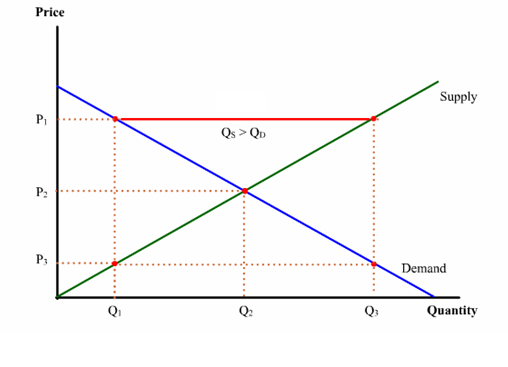
Shortage
b)
Surplus
c)
Supply Table
d)
Equilibrium
64.
The market equilibrium price is the price at which
a)
surpluses depress the number of goods supplied
b)
shortages and surpluses will have no effect on the market
c)
the government will not intervene in the market
d)
the quantity demanded is the same as the quantity supplied
65.
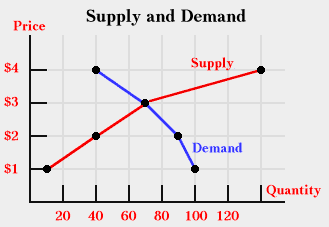
What is the Equilibrium Price?
a)
1
b)
2
c)
3
d)
4
66.
The diagram represents a(n)
a)
increase in supply
b)
decrease in supply
c)
change in quantity supplied
d)
none of the above
67.
What is quantity of a good or service that producers sell at a market price?
a)
supply
b)
demand
68.
The Law of Supply states:
a)
as price increases, supply increases
b)
as prices decrease, supply increases
69.
This part of the market determines SUPPLY
a)
buyers
b)
sellers
c)
consumers
d)
us
70.
For the law of supply, as price rises, what happens to quantity supplied?
a)
it goes up
b)
it goes down
c)
it stays the same
d)
it is not effected
71.
When quantity supplied and quantity demanded is equal
a)
surplus
b)
shortage
c)
equilibrium
d)
law of demand
72.
If a price is above equilibrium price, it creates a...
a)
shortage
b)
surplus
c)
market price
d)
demand
73.
If a price is below the equilibrium price it creates a...
a)
shortage
b)
surplus 
c)
market price 
d)
supply
74.
What does this curve represent?
a)
demand
b)
supply
c)
equilibrium
d)
shortage
75.
If you keep buying despite a price increase, your demand is
a)
elastic.
b)
strong.
c)
normal.
d)
inelastic.
76.
Substitutes are goods
a)
that are bought and used together.
b)
used in place of one another.
c)
that cannot be replaced.
d)
that cause a shift in the demand curve.
77.
A measure of how consumers react to a change in price is known as the
a)
elasticity of demand.
b)
law of demand.
c)
income effect.
d)
demand curve.
78.
For most goods, a rise in people's income means that there will be a(n)
a)
substitution effect.
b)
rise in prices.
c)
increase in demand.
d)
decrease in demand.
79.
Which of the following describes the substitution effect
a)
As the price of a good falls, people will substitute other products.
b)
As the price of a good rises, people will substitute other products.
c)
As demand rises, people will substitute other products.
d)
As demand falls, people will substitute other products.
80.
Which of the following is an example of a good with inelastic demand?
a)
television sets
b)
computers
c)
a particular brand of chewing gum
d)
life-saving medicine
81.
When replacing a certain item with with a less costly item is an example of
a)
the substitution effect 
b)
the income effect 
c)
demand elasticity 
d)
complements 
82.
A complement example would be all except
a)
butter and margarine 
b)
peanut-butter and jelly
c)
flashlight and batteries 
d)
cameras and film 
83.
The desire, ability and willingness to buy a product 
a)
Demand 
b)
Supply 
c)
Consume 
84.
Products that tend to be used together 
a)
complements 
b)
substitutes
c)
goods
d)
needs 
85.
Describes very little a change in demand with a large change in price 
a)
elastic 
b)
inelastic 
c)
demand curve 
d)
price 
86.
A factory closes, laying off hundreds of workers, and consumer spending in the town falls. What factor is affecting demand?
a)
consumer expectation
b)
consumer taste
c)
income effect
d)
substitutes
87.
Demand for a product is said to be _______ when a change in price causes very little change in quantity demanded.
a)
elastic 
b)
inelastic
c)
related
d)
rigid
88.
Insulin for a diabetic has a/an _______ demand.
a)
elastic
b)
inelastic
89.

If a change in the price of an item causes a change in demand, that is called the

a)

absolute advantage effect

b)

comparative advantage effect

c)

income effect

d)

substitution effect

90.

If a change in the price of one item causes a change in demand for a similar item, that is called the

a)

absolute advantage effect

b)

comparative advantage effect

c)

income effect

d)

substitute effect

91.

The price of candy bars has decrease and now you can buy more candy bars with your money. What type of effect is this?

a)

absolute advantage effect

b)

comparative advantage effect

c)

income effect

d)

substitution effect

92.

The cost of Kit Kat candy bars has increased so you buy Snickers instead. What type of effect is this?

a)

absolute advantage effect

b)

comparative advantage effect

c)

income effect

d)

substitution effect

93.

All of the following are causes of a change in the level of demand EXCEPT

a)

change in consumer expectations

b)

change in where you live

c)

change in population

d)

change in taste

e)

change in price of a goods and services

94.

If people begin to buy iPhones because they have all the features that people want now, the cause of a change in the level of demand is a

a)

change in consumer expectations

b)

change in population

c)

change in taste

d)

change in price of goods/services

e)

change in income

95.

If lots of people decide to go to Six Flags this month because it has been announced that ticket prices at Six Flags will go up next month, the cause of a change in the level of demand is a

a)

change in consumer expectations

b)

change in population

c)

change in taste

d)

change in price of goods/services

e)

change in income

96.

If students stop buying hot cheetos because the price has gone up by 25 cents, the cause of a change in the level of demand is a

a)

change in consumer expectations

b)

change in population

c)

change in taste

d)

change in price of goods/services

e)

change in income

97.
Watches made in Norway are worn by people in California.
a)
import 
b)
export
98.
To focus on producing one thing to improve productivity is known as:
a)
Specialization
b)
International trade
c)
Absolute Advantage
d)
Supply and Demand
99.
If I am better at all types of production, I have the ______ in all forms of production.
a)
Comparative advantage
b)
Specialization
c)
Absolute advantage
d)
developed nation
100.
This trade barrier limits the number of products that can be brought into a country.
a)
Tariff
b)
Quota
c)
Embargo
d)
Subsidy
101.
This is a tax on imports that is used to increase price of foreign products and raise government revenue. 
a)
tariff
b)
quota
c)
subsidy
d)
embargo
102.

1.Which of the following is not part of the arguments about trade protection?

a)

The national security

b)

A souree of the government revenue

c)

The potential for corruption

d)

The protection of domestic jobs

103.
The ability to produce more of a given product using a given amount of resources.
a)
comparative advantage
b)
absolute advantage
104.
A tax on imported goods.
a)
import
b)
export
c)
tariff
105.
A limit on the amount of a good that can be imported.
a)
import quota
b)
export quota
106.
The policy of imposing duties or quotas on imports in order to protect home industries from overseas competition.
a)
free trade
b)
protectionism
c)
balance of trade
107.

What argument for protection believes that new or emerging industries should be protected.

a)

National Defense

b)

Protecting domestic jobs

c)

Infant Industry

d)

Keeping money at Home

108.

When the government places a tax on an imported good to protect a domestic good.

a)

Protective tariff

b)

Subsidy

c)

Comparative Advantage

d)

Quota

109.

What is the key to trade?

a)

Self-Sufficiency

b)

Specialization

c)

Technology

d)

Wealth

110.
A situation in which a country specializes in the production of a good or service at which it is relatively more efficient?
a)
Absolute advantage
b)
Concerning advantage
c)
Comparative advantage
d)
Available advantage
111.

If a country refuses to trade with any country that buys oil from Iran, that is an example of

a)

intimidation

b)

quota

c)

requiring a license

d)

tariff

e)

tougher standards for imports

112.

If a country places a 10% tax on imports from another country, that is an example of

a)

intimidation

b)

quota

c)

requiring a license

d)

tariff

e)

tougher standards for imports

113.

If a country limits the importation of products from another country, that is an example of

a)

intimidation

b)

quota

c)

requiring a license

d)

tariff

e)

tougher standards for imports