wayground logo

Free Printable Worksheets

Font size

S
M
L
XL
Worksheets

Semester 2 Review 2019

Total questions: 65

Worksheet time: 35mins

Name
Class
Date
1.

Which of the following is a quantitative observation?

a)

There are two potatoes.

b)

The potato tastes the best.

c)

The potato may cause allergies.

d)

The potato smells funny.

2.
Dominant alleles are represented by a:
a)
Male gene
b)
lowercase letter
c)
recessive trait
d)
capital letter
3.
What are genes?
a)
Something you wear.
b)
Segments of DNA that carry traits for offspring.
c)
The powerhouse of cells.
d)
None of the above.
4.
What is another name for natural selection?
a)
survival of the smartest
b)
survival of the fastest
c)
survival of the biggest
d)
survival of the fittest
5.

What is a change in an organism that allows it to survive in its environment?

a)

homologous

b)

vestigial

c)

variation

d)

adaptation

6.

What are organisms that have similar characteristics and can reproduce?

a)

species

b)

organism

c)

embryology

d)

vestigial

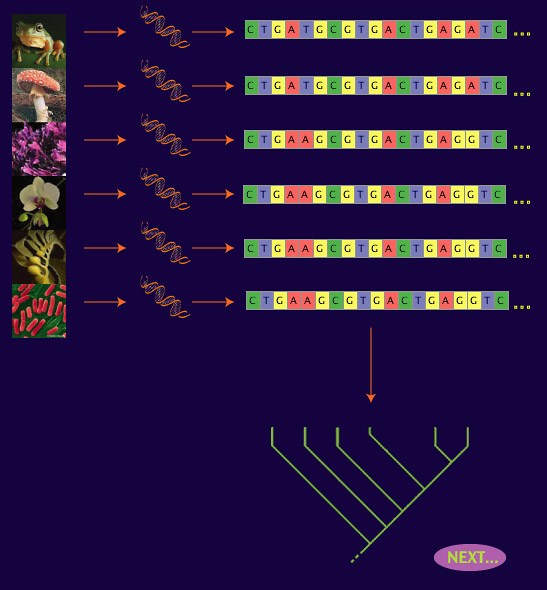
7.
What is this an example of?
a)
diversity of species
b)
variation
c)
vestigial structures
d)
DNA studies
8.

What is it called when the DNA of an organism is altered?

a)

Mutation

b)

Gene Flow

c)

Genetic Drift

d)

Sexual Selection

9.

What is the cause of artificial selection?

a)

The environment

b)

Humans

c)

Mutation

d)

Gene Flow

10.
The environment around Manchester, England, changed during the Industrial Revolution.  How did this change affect peppered moths living in the area?
a)
Natural selection favored moths with dark wings because predators could not see them on the soot-colored trees.
b)
Natural selection favored moths with white wings that were easy for predators to see.
c)
Natural selection favored moths with white wings because predators could not see them on the soot-colored trees.
d)
Natural selection caused moths with white wings to become extinct.
11.

What would two organisms that are closely related have?

a)

very similar DNA sequence

b)

exactly the same DNA sequences

c)

no proteins in common

d)

completely different DNA sequence

12.
The diagram shows fossils in different rock layers. Which of these statements about the age of these fossils is most likely correct?
a)
Fossil A and C are the same age
b)
Fossil B is older than fossil C
c)
Fossils A is older than fossil B
d)
Fossil D is older than fossil C
13.

Why are advantageous traits more likely to be passed onto offspring?

a)

Because the parent(s) are more likely to survive and reproduce.

b)

Because they come from dominant alleles.

c)

Because they come from recessive alleles.

d)

Because the trait is an acquired phenotype.

14.

What are remains of once living organisms found in rock or amber?

a)

fossils

b)

DNA

c)

vestigial structures

d)

rocks

15.
Which of the following is a vestigial structure in humans?
a)
appendix
b)
prehensile tail
c)
opposable thumb
d)
tonsils
16.
What is a group of organisms of the same species that live in a specific geological area?
a)
a population
b)
the Lightning
c)
genus
d)
species
17.
When you start with 1 cell, at the end of mitosis, how many identical cells will you have?
a)
1
b)
2
c)
3
d)
4
18.

The cell spends most of its life in ________________.

a)

mitosis

b)

cytokinesis

c)

Interphase

d)

None of the above

19.
The cells produced via meiosis are called:
a)
sex cells (gametes)
b)
somatic cells
c)
body cells
d)
skin cells
20.
After meiosis is complete how many cells will there be?
a)
1
b)
2
c)
3
d)
4
21.
After meiosis is complete, the new cells:
a)
are all identical
b)
are all different
c)
are half identical and half different
d)
are all stretched out
22.

Which of the following is true for sexual reproduction?

a)

It gives an advantage to organisms to be different than the rest, if the environment changes.

b)

It is better for all organisms to be the same.

c)

It happens faster.

d)

It helps skin cells divide faster to heal wounds.

23.
The process on the left is:
The process on the right is:
a)
Left: meiosis
Right: meiosis
b)
Left: meiosis
Right: cloning
c)
Left: mitosis
Right: meiosis
d)
Left: mitosis
Right: mitosis
24.
Why do we need meiosis?
a)
To double the number of chromosomes going into sex cells
b)
To halve the number of chromosomes going into sex cells
c)
To triple the number of chromosomes going into sex cells
d)
To not change the number of chromosomes going into sex cells
25.
Aa, DD, bB, yy are all examples of
a)
genotypes
b)
phenotypes
26.
Which of the following is a phenotype?
a)
Aa
b)
red hair
c)
heterozygous
d)
DNA
27.
Which of the following genotypes is heterozygous?
a)
Bb
b)
BB
c)
bb
d)
B
28.
This image shows a...
a)
Punnett Square
b)
Phenotype
c)
Genotype
d)
Dominant allele
29.
G = green, g = yellow
The genotype for a yellow plant is...
a)
GG
b)
Gg
c)
gg
d)
all of the choices result in yellow
30.
An organism with two different alleles for a trait is said to be...
a)
recessive
b)
dominant
c)
hybrid
d)
purebred
31.
Which of the following genotypes are purebred?
a)
Pf
b)
Pp
c)
PP
d)
pP
32.

If you cross a black guinea pig with a white guinea pig and the offspring are gray, what type of inheritance would that be?

a)

incomplete dominance

b)

codominance

c)

codependant

d)

cooperative

33.
Black fur is dominant (B) over white fur (b).  Find the probability of heterozygous offspring using the following genotype of these parents.
Bb + bb
a)
0%
b)
25%
c)
50%
d)
100%
34.
What does every food chain start with? (Even if it's not drawn or written there!)
a)
producers
b)
sun
c)
consumer
d)
decomposers
35.
An organism that needs to eat other organisms to obtain energy is known as a:
a)
Autotroph
b)
Producer
c)
Consumer
d)
Mutualist
36.
Consumer that eats plants
a)
heterotroph
b)
herbivore
c)
producer
d)
community
37.
What does a food web represent?
a)
All connections of energy flow throughout all organisms in a habitat.
b)
The specific ways that mutualism is carried out.
c)
A single pathway or energy flow between organisms. 
d)
How carnivores get their food. 
38.
relationship in which two species live closely together
a)
resource
b)
mutualism
c)
succession
d)
symbiosis
39.
The rabbit in this food web would be considered a:
a)
Decomposer
b)
Producer
c)
Secondary Consumer
d)
Primary Consumer
40.
Where an organism lives
a)
habitat
b)
niche 
c)
heterotrogh
d)
biosphere
41.

Which one is not a consumer?

a)

anemone

b)

bear

c)

shark

d)

daisy

42.
The image provided is an example of a(n):
a)
Carnivore
b)
Herbivore
c)
Producer
d)
Autotroph
43.
The nonliving aspects of an ecosystem.
a)
Abiotic factors
b)
Biotic factors
44.
The living portions of the ecosystem.
a)
Biotic factors
b)
Abiotic factors
45.
A collection of organisms that make up a community as well as all of the nonliving aspects of the environment.
a)
Population
b)
Community
c)
Habitat
d)
Ecosystem
46.
As you move upward, from level to level, in an energy pyramid, energy _____.
a)
increases
b)
decreases
c)
stays the same
d)
increases exponentially
47.
 plants that convert energy from the sun
a)
decomposer
b)
primary consumer
c)
secondary consumer
d)
producer
48.
What are the Abiotic factors in this image? 
a)
water, sunlight, dirt, air
b)
birds and plants
c)
birds, water, dirt
d)
plants, water
49.

What is the relationship when both organisms benefit?

a)

commensalism

b)

predation

c)

parasitism

d)

mutualism

50.

Which is not a limiting factor?

a)

Fossils

b)

Food

c)

Water

d)

Sunlight

51.

Which is evidence of evolution?

a)

Genetic mutations over millions of years gave rise to more complex organisms

b)

Mrs. Deschnow loves the Lightning.

c)

Mrs. Deschnow loves her students

d)

Fossils have showed change over time.

52.

Mrs. Deschnow wanted to know if different types of music affected people's heart rates, so she played different music and checked the people's pulses. What is the dependent variable?

a)

type of music

b)

heart rate

c)

how long they listend to music

d)

the musical instrument

53.

Which question can best be investigated by a scientist?

a)

Should I buy a red shirt or a green shirt?

b)

Does chocolate milk or plain milk taste better?

c)

Does a plant need sunlight to grow?

d)

Which feels softer, cat fur or dog fur?

54.

How many independent variables should be tested at a time in a scientific investigation?

a)

none

b)

one

c)

two

d)

three

55.

The variable in the experiment that is the outcome that you measure is called:

a)

Control

b)

Dependent

c)

Independent

d)

Hypothesis

56.

What is an inference?

a)

Just a guess.

b)

A statement based off of your observations.

c)

The same as an observation.

d)

Examples of something.

57.

Which statement is an observation?

a)

That house is empty because there are no lights on.

b)

Her hair is brown.

c)

Her hair is brown because she dyed it.

d)

Her hair has not been cut in two years.

58.

When experimenting with the growth of a plant, a scientist uses twenty plants, two different fertilizers, equal light, and equal water. What type of variable is the water?

a)

Dependent

b)

Independent

c)

Constant

d)

Outcome

59.
Squidward found new reeds to tryout for his clarinet.  He used an APPLAUSOMETER to measure clapping/applause after playing  Under the Sea with each reed.  The results were put in the table.
What was the dependent variable?
a)
The Song
b)
The Reed
c)
The Applause
d)
The clarinet
60.

Why are experiments repeated many times by the same or different scientists?

a)

If the results are the same, replication helps confirm the results.

b)

Competition helps scientists work more quickly.

c)

Many people are interested in the problem.

d)

Different scientists might perform the experiment differently.

61.

If a scientist needs to study a volcano without exposing herself to the dangers of the volcano, what method should she use?

a)

Observation

b)

Field Study

c)

Controlled Experiment

d)

Model

62.

A scientist observes previously unexplained curved lines etched in rocks in the Negev Desert.

Which creative method below would explain how the scientist discovered that snails were carving the lines each night as they feed on lichens that grew on the rocks?

a)

The scientist researched in the library to discover if other rocks had similar lines.

b)

The scientist gathered empirical evidence by recording a video of what happened on the rocks 24 hours a day.

c)

The scientist moved a rock into the laboratory to study its composition.

d)

The scientist found rocks of similar sizes in other locations.

63.

A scientist may choose to use systematic observations rather than an experiment to research the answer to a question. Which of the following statements describes some limitations of investigating using systematic observations?

a)

This method does not usually reveal a pattern.

b)

This method does not allow variables to be changed to test a hypothesis.

c)

This method typically reveals a pattern but it takes too long.

d)

This method cannot be used to answer a research question.

64.

Which of the following scientists study rocks as a part of their work in the study of what the Earth is made of?

a)

Biologist

b)

Botanist

c)

Geologist

d)

Chemist

65.

After meiosis is complete, how many identical cells will there be?

a)

4

b)

0

c)

2

d)

6