wayground logo

Free Printable Worksheets

NEW

Font size

S
M
L
XL
Worksheets

Waves review

Total questions: 78

Worksheet time: 1hrs 6mins

Name
Class
Date
1.
Waves move ___ through vibrations
a)
Energy
b)
Matter
c)
Mass
d)
Weight
2.
Longitudinal waves are ______.
a)
Parallel
b)
Perpendicular
c)
Crazy
3.
Transverse waves are ___.
a)
Parallel
b)
Perpendicular
c)
Weird
4.
What is the wavelength?
a)
Length
b)
Height
c)
# of waves
5.
What is the amplitude?
a)
length
b)
height
c)
# of waves
6.
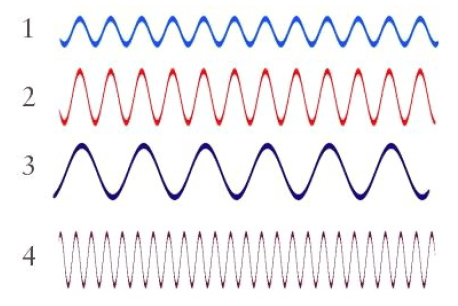
Which is the wavelength?
a)
1
b)
2
c)
3
d)
4
7.
If the frequency gets higher, the wavelength gets 
a)
longer
b)
shorter
8.
If the wavelength gets longer, the frequency gets 
a)
higher
b)
lower
9.
The pitch of the sound depends on
a)
frequency
b)
amplitude
c)
wavelength
10.
Which electromagnetic wave is responsible for cell phones?
a)
gamma
b)
xray
c)
microwaves
d)
radio
11.
Is refracting light bending or bouncing?
a)
bending
b)
bouncing
12.
A blue tshirt looks blue because of ___.
a)
reflection
b)
refraction
c)
diffraction
13.
What happens to frequency when the energy increases?
a)
it increases
b)
it decreases
c)
it stays the same
14.
What part of the wave is shown at letter A?
a)
crest
b)
trough
c)
wavelength
d)
frequency
15.
Which part of the wave is shown at letter C?
a)
crest
b)
wavelength
c)
resting point
d)
amplitude
16.
What does a wave carry?
a)
boats
b)
matter
c)
energy
d)
water
17.
What is the frequency of this wave?
a)
3 Hertz
b)
4 Hertz
c)
5 Hertz
d)
6 Hertz
18.
When wavelength increases, what happens to the frequency?
a)
it increases
b)
it decreases
c)
it stays the same
19.
Which wave has a longer wavelength?
a)
wave C
b)
wave D
20.
Which wave has the most energy?
a)
top wave
b)
bottom wave
21.
Which wave in the diagram has the greatest frequency?
a)
1
b)
2
c)
3
d)
4
22.
What kind of wave is pictured below?
a)
compressional wave
b)
transverse wave
c)
sound wave
d)
mechanical wave
23.
How would a person measure the wavelength on this sound wave?
a)
dense to less dense
b)
trough to crest
c)
compression to compression
d)
beginning of illustration to the end
24.

You can't hear sounds in outer space because there is no

a)

medium

b)

light

c)

energy

d)

heat

25.
The type of waves that require medium to pass:
a)
Mechanical Waves
b)
Electromagnetic Waves
26.
What types of waves carry energy at a right angle or perpendicular to the direction of the energy flow?
a)
Longitudinal waves
b)
Transverse waves
c)
Sound waves
d)
P-waves
27.
What do waves carry from place to place?
a)
Energy, but not matter or particles
b)
Energy and matter or particles
c)
Matter or particles but not energy
d)
Neither energy nor matter or particles
28.
Sound is an example of which type of wave?
a)
Transverse
b)
Longitudinal
c)
Both
d)
Neither
29.
How would you describe the movement of a transverse wave?
a)
Up and down
b)
Back and forth
c)
In zigzags
d)
Linear
30.
Which vocabulary term is used to identify the distance between points C & G?
a)
Amplitude
b)
Crest
c)
Frequency
d)
Wavelength
31.
regular disturbances that carry energy through matter or space
a)
crest
b)
energy
c)
wave
d)
trough
32.
which material does sound travel the fastest?
a)
solid 
b)
liquid 
c)
gases
33.
When a wave strikes and object and bounces off. (example echo)
a)
medium
b)
refraction
c)
reflection
d)
interference
34.
When a wave bends as it passes through at an angle from one medium to another.(example: pencil in a glass of water-)
a)
medium
b)
refraction
c)
reflection
d)
interference
35.

Which particle is a wave of light?

a)

proton

b)

neutron

c)

electron

d)

photon

36.
If all three are waves of light, which wave has the largest speed?
a)
A
b)
B
c)
C
d)
None (same speed)
37.
Which type of light has the lowest energy of this group?
a)
Radio
b)
Microwave
c)
Infrared
d)
Ultraviolet
38.
When an electron absorbs a photon of light, it also...
a)
gains positive charge
b)
gains negative charge
c)
increases energy level
d)
decreases energy level
39.
When an electron emits a photon of light, it also...
a)
gains positive charge
b)
gains negative charge
c)
increases energy level
d)
decreases energy level
40.

Radio waves and _______ are used in communication

a)

Microwaves

b)

Gamma rays

c)

Visible light

d)

Ultraviolet

41.
True/False: The time for a complete back-and-forth swing of a pendulum is its frequency.
a)
True
b)
False
42.
The time that it takes to complete one wave cycle is called the...
a)
frequency
b)
period
c)
amplitude
d)
wavelength
43.
The number of cycles that are completed per second is called the _ and is measured in _.
a)
frequency, Hertz
b)
wavelength, meters
c)
amplitude, meters
d)
period, seconds
44.

What is any motion that repeats itself?

a)

variable

b)

cycle

c)

pendulum

d)

circle

45.

What is a mass that hangs from a fixed point and swings to and fro?

a)

pencil

b)

x axis

c)

pendulum

d)

variable

46.

Which is NOT an example of a pendulum?

a)

yoyo

b)

Foucalt Pendulum

c)

metronome

d)

diving board

47.

Which is NOT one of the variable we tested in the pendulum activities?

a)

length of string

b)

width of string

c)

starting position

d)

mass or number of pennies

48.

Which variable DID affect the out come of the experiment?

a)

starting position

b)

length of string

c)

mass or amount of pennies

49.

Complete- The shorter the string, the _____________ the swings.

a)

greater

b)

less

50.

Anything you can change in an experiment is a/an __________.

a)

system

b)

variable

c)

cycle

d)

average

51.
What is the ONLY thing that changes when one drops a pendulum from 10 degree to 30 degree amplitude? 
a)
The period
b)
The time of the oscillation
c)
The speed the oscillator (same period) back and forth
d)
The equilibrium location
52.
Which of the following is a valid conclusion of the pendulum lab?  
a)
The greater the amplitude, the shorter the period of oscillation
b)
The shorter the string length, the shorter the period of the oscillation
c)
The more massive the plum bob, the shorter the period of oscillation
d)
The greater the amplitude, the smaller the potential energy of the pendulum
53.
Which of the following is FALSE based on the letters in the picture? 
a)
There are 1.5 wavelengths pictured
b)
C-G represents 1 wavelength
c)
B-D represents 1/2 of a wavelength
d)
There are 2 crests and 2 troughs pictured
54.
What is interference?  
a)
occurs when two or more waves overlap and combine 
b)
occurs when two or more waves combine and neutralize each other 
c)
when one waves travels alone
55.
Which of the following is not an example of approximate simple harmonic motion?
a)
a ball bouncing on the floor
b)
a child swinging on a swing
c)
a piano wire that has been struck
d)
a car's radio antenna waving back and forth
56.

Which of the following is/ are characteristics of simple harmonic motion?

I. The acceleration is constant .

II. The restoring force is proportional to the displacement.

III. The frequency is independent of the amplitude.

a)

II only

b)

I and II only

c)

I and III only

d)

II and III only

e)

I, II, and III

57.
the unit for one cycle per second (aka Frequency) is known as ____________.
a)
Hertz
b)
Cycle
c)
Seconds
d)
Period
58.
Is the following an example of harmonic or linear motion?
 
 A bouncing spring.
a)
Harmonic
b)
Linear
59.
In which direction is the pictured spring's restoring force acting?
a)
To the right.
b)
To the left.
c)
There is no restoring force.
d)
Both left and right.
60.
Which of the following is a system where elastic potential energy is being stored?
a)
A bowling ball is left on a trampoline.
b)
A basketball is thrown through the air.
c)
An entire spring is dropped off the top of a building and falls toward the earth.
d)
A frictionless skateboard oscillates back and forth on a frictionless ramp.
61.

........ is the type of motion that repeats itself in equal time intervals.

a)

Period

b)

Oscillations

c)

Frequency

d)

Displacement

62.

.... is the time needed to complete one cycle.

a)

Period

b)

Displacement

c)

Frequency

d)

Amplitude

63.

....... is the distance of the oscillating object from the equilibrium position at a given instant

a)

Frequency

b)

Time

c)

Period

d)

Displacement

64.
Sound travels as
a)
transverse waves
b)
longitudinal waves
c)
seismic waves
d)
air waves
65.
As air particles are pushed together, they create a region of higher density and pressure in a longitudinal wave.  These areas are called:
a)
sound waves
b)
rarefactions
c)
compressions
d)
transverse wave
66.
A sound with a high frequency has a _____ pitch. A sound with a ____ frequency has a low pitch.
a)
high, low
b)
low, high
c)
medium, high
d)
high, medium
67.
A sound that bounces off a surface is called an ________.
a)
loud sound
b)
echo
c)
repeat
d)
quiet sound
68.
Matter that carries sound waves is called a _________
a)
low
b)
high
c)
medium
d)
surface
69.
A back and forth movement of matter
a)
volume
b)
vibration
c)
pitch
d)
frequency
70.
how high or low a sound is
a)
frequency
b)
volume
c)
vibration
d)
pitch
71.
Sound travels FASTEST through which of these materials?
a)
Air
b)
Empty space
c)
Metal
d)
Water
72.
Sound is caused by? 
a)
force
b)
vibrations
c)
instruments
73.
Sound is a form of? 
a)
energy
b)
pitch
c)
volume
74.
Sound does not travel in space because
a)
Space is too far away.
b)
There is no matter in space.
c)
Space is the final frontier
d)
Space has planets.
75.
Why is the school library covered with carpet?
a)
So everyone can make a lot of noise
b)
to help absorb sounds to keep it quiet
c)
because it looks good
d)
to help absorb sounds so it can stay noisy
76.

______________ sounds have a larger amplitude

a)

quiet

b)

loud

77.

______________ sounds have a larger amplitude

a)

quiet

b)

loud

78.

What type of energy does a sound wave have?

a)

Mechanical

b)

Radiant

c)

Electrical

d)

Sound