wayground logo

Free Printable Worksheets

Font size

S
M
L
XL
Worksheets

Earth Science Semester 2 Review

Total questions: 123

Worksheet time: 2hrs 6mins

Name
Class
Date
1.

_____ is a force that acts on rocks to change their shape or volume.

a)

Compression

b)

Shearing

c)

Strain

d)

Stress

2.

_____ pulls on the crust, stretching rock so it becomes thinner in the middle.

a)

Compression

b)

Shearing

c)

Stress

d)

Tension

3.

Pushes a mass of rock in two opposite directions.

a)

compression

b)

shearing

c)

strain

d)

tension

4.

______ faults occur when plates slide horizontally past each other.

a)

Convergent

b)

Divergent

c)

Transform

5.

What factor(s) change a mountain's shape from jagged and high to round and lower over long periods of time?

a)

deposition

b)

weather and erosion

c)

movement of continents

d)

collisions between continental plantes

6.

When matter gains energy (gets hotter), how does that affect the density?

a)

The matter becomes less dense.

b)

The matter becomes more dense.

c)

Density isn't affected.

7.

What is a convection current?

a)

the transfer of energy by direct contact.

b)

the transfer of energy by the movement of matter

c)

the transfer of energy through a solid, such as Earth's crust

d)

the transfer of energy from a region of lower temperature to a region of higher temperature.

8.

Which of the following occurs because of convection current?

a)

Tectonic plates on the crust move.

b)

Pressure in the crust increases.

c)

The mantle increases in size.

d)

Pressure in the crust decreases.

9.
Plates collide on what type of boundary?
a)
convergent
b)
divergent
c)
transform
10.
Plates move away from each other on what type of boundary?
a)
convergent
b)
divergent
c)
transform
11.
When 2 CONTINENTS hit eachother,   This makes...  
a)
a trench
b)
mountains
c)
volcano
d)
mid-ocean ridge 
12.

A tectonic plate is defined as

a)

large, slow moving pieces of Earth's lithosphere.

b)

large, slow moving pieces of Earth's asthenosphere.

c)

large, slow moving pieces of Earth's mesosphere.

d)

large, slow moving pieces of Earth's outer core.

13.

What type of stress is normally associated with transform boundaries?

a)

tension

b)

shear stress

c)

compression

d)

vertical stress

14.
Molten material found inside a volcano is called ___________.
a)
lava
b)
magma
c)
vent
d)
ash
15.
Which statement best describes why the Himalayan Mountain Range continues to grow each year? 
a)
the two continental plates are still colliding and folding
b)
all mountains continue to grow until they explode
c)
the volcanic action beneath the mountains adds to their height 
d)
the moon's gravity pulls at the top of the mountai
16.
The center point on the surface of an earthquake represented by letter R is called what?
a)
Center point
b)
Focus
c)
Epicenter
d)
Seismic waves
17.
What type of boundary is the San Andreas?
a)
Convergent
b)
Transform
c)
Optimus Prime
d)
Divergent
18.
Where is the point at which the first movement occurs during an earthquake? Reperesented by letter S
a)
Epicenter
b)
Focus
c)
Fault
d)
Plate
19.
What is a break in the rock layers called?
a)
Earthquake
b)
Epicenter
c)
Fault
d)
Focus
20.
Which scale measures the intensity of the ground movement?
a)
Mercalli Scale
b)
Richter Scale
c)
Seismogram Scale
d)
Bernoulli Scale
21.
A volcano with a steep slope that has quickly cooling lava and explosive eruptions.
a)
Shield Volcano
b)
Cinder Cone Volcano
c)
Composite Volcano
22.
A volcano with gradual slopes formed by slow cooling lava.
a)
Shield Volcano
b)
Cinder Cone Volcano
c)
Composite Volcano
23.
What types of waves are released from an earthquake?
a)
Energy Waves
b)
Sonic Waves
c)
Seismic Waves
24.
Where do isolated, volcanic islands, such as Hawaii form?
a)
transform boundaries
b)
divergent boundaries
c)
subduction zones
d)
hot spots
25.
What is mostly likely the cause of an earthquake?
a)
stress due to movement in Earth's crust
b)
gravitational variation due to Moon's orbit around Earth
c)
temperature variation due to Earth's orbit around the Sun
d)
rotational imbalance due to changes in Earth's poles
26.
A(n)  _____________ is the result of tectonic plates moving over a hot spot.
a)
plateau
b)
island
c)
canyon
d)
delta
27.
Seismic waves travel _____________. (chose the best answer)
a)
east
b)
north and south
c)
toward the west
d)
in all directions
28.

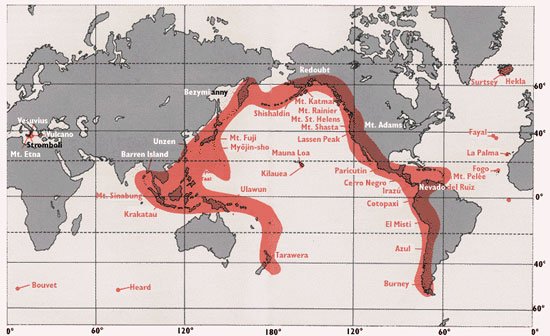
This is the name for the chain of volcanos around the edge of the Pacific Plate.

a)

March Maddness

b)

Earthquake Alley

c)

Ring of Fire

d)

Circle of Death

29.
Volcanoes are found...
a)
on land
b)
under water
c)
on islands
d)
all of the above
30.

Which type of wave is the first to arrive after an earthquake occurs?

a)

P Wave

b)

Rayleigh Wave

c)

S Wave

31.

What is the measure of the amount of energy released in an earthquake?

a)

Earthquake

b)

Epicenter

c)

Magnitude

32.
Which body waves cause particles of rock material to move at right angles to the direction in which the waves are traveling?
a)
Body Waves
b)
P Waves
c)
S Waves
d)
Surface Waves
33.
Which body wave squeezes and stretches rock materials as they pass through the Earth?
a)
Body Waves
b)
P Waves
c)
S Waves
d)
Surface Waves
34.
Seismology
a)
Branch of science that studies earthquakes 
b)
Earthquakes 
c)
The sudden return to elastically deformed rock to its original shape. 
d)
Focus 
35.

In order to determine the location of an earthquake, scientists need seismic data from at least ___ stations.

a)

1

b)

2

c)

3

d)

4

36.
What factor(s) determine(s) whether an eruption will be explosive?
a)
The amount of gases in the magma
b)
The amount of silica in the magma
c)
The amount of gas and silica in the magma
d)
None of these affect the explosiveness of the volcano
37.
What is the definition of dormant?
a)
sleeping
b)
extinct
c)
active
d)
invisible
38.
When an explosive eruption  forms a mixture of hot rock, ash, and gas, this material is called a...?
a)
Land slide
b)
Lava
c)
Eruption trail
d)
Pyroclastic flow
39.
True or False...All living things that die become fossils.
a)
True
b)
False
40.
True or False...Fossils have been found all over Earth.
a)
True
b)
False
41.
_______ are the preserved remains or traces of living things.
a)
bones
b)
fossils
c)
artifacts
d)
organic matter
42.
Fossils can provide evidence of how life has changed over time, how Earth's surface has changed, and clues about what past environments were like.
a)
True
b)
False
43.
Which parts of an organism are more likely to fossilize?
a)
the soft parts - skin, muscle
b)
the hard parts - bones, shells, stems
c)
all parts can become fossilized easily because the organism becomes buried by sediments
44.
All the information that paleontologists have gathered about past life is called the _____
a)
geologic time
b)
geologic eras
c)
fossil eras
d)
fossil record
45.
People who study fossils are called ____.
a)
meterologists
b)
fossilologists
c)
paleontologists
d)
fossil hunters
46.
Where can the oldest layer be found?
a)
The top layer
b)
The middle layer
c)
They are all the same age
d)
The bottom layer
47.
Which layer formed first?
a)
Rock Layer W
b)
Rock Layer X
c)
Rock Layer Y
d)
Rock Layer Z
48.
What is the correct order of the rock layers from oldest to youngest?
a)
F, E, C, B, A, D
b)
A, B, C, D, E, F
c)
F, E, D, C, B, A
d)
D, F, E, C, B, A
49.
The Law of Superposition states that younger rocks lie _________ older ones.
a)
above
b)
below
c)
mixed within
d)
all the time to
50.
Which layer is the oldest ?
a)
A
b)
E
c)
D
d)
F
51.
A is older than layer C
a)
TRUE
b)
FALSE
52.
Relative dating determines the...
a)
precise age of fossils
b)
age of fossils compared to others
c)
climate fossils survived in
d)
movement of continents
53.
According to the law of superposition, which layer is the youngest?
a)
A
b)
B
c)
C
54.
Which of the following correctly lists the layers in order from oldest to youngest?
a)
A, B, C, D, E
b)
E, B, C, D, A
c)
E, D, C, B, A
d)
C, B, A, D, E
55.
The time it takes for 50% of the nuclei in a radioactive sample to decay to its stable isotope is called _____.
a)
the daughter product
b)
geologic time
c)
the half-life
d)
the half-time
56.
You find a rock sample with radioactive atoms present.  If 12.5% of the original radioactive atoms were present, how many half-lives has the rock been around for? (Hint, at Half-Life = 0, you start with 100%)
a)
zero
b)
1
c)
2
d)
3
57.
You find a rock sample with radioactive atoms present.  If 25% of the original radioactive atoms were present, how many half-lives has the rock been around for? (Hint, at Half-Life = 0, you start with 100%)
a)
zero
b)
1
c)
2
d)
3
58.
The graph shows the radioactive decay of a 50-gram sample of a radioactive isotope. 
According to the graph, what is the half-life of this isotope
a)
100 years
b)
150 years
c)
200 years
d)
300 years
59.
What does each layer of rock represent?
a)
a period of time
b)
a different type of stone
c)
an intrusion
d)
a fault
60.
In the history of the earth, when were humans introduced?
a)
at the beginning of the earth
b)
in about the middle of the earth
c)
relatively recently
61.

How old do Paleontologists believe the Earth is?

a)

2019 years old

b)

3.6 billion years old

c)

4.6 billion years old

d)

4.6 million years old

62.

What type of event usually marks the end of an Era

a)

A Mass Extinction

b)

A Quinceanera

c)

An earthquake

d)

A Volcanic Eruption

63.
The Geologic Time Scale is a record of what?
a)
old geologists
b)
sweet geology music
c)
the known history of rocks and fossils
d)
a list of every living thing ever
64.
Eras of the geologic time scale are
divided into ______.
a)
periods
b)
ages
c)
units
d)
epochs
65.

Which of these statements BEST describes (explains) temperature as elevation in the atmosphere increases?

a)

Temperature remains constant with elevation in the thermosphere.

b)

Temperature remains constant with elevation in the mesosphere.

c)

Temperature generally decreases with elevation in the stratosphere.

d)

Temperature generally decreases with elevation in the troposphere.

66.

In which layer of Earth’s atmosphere does weather occur?

a)

mesosphere

b)

stratosphere

c)

thermosphere

d)

troposphere

67.

Atmospheric greenhouse gases help heat the atmosphere by

a)

increasing the amount of solar radiation reaching Earth.

b)

storing energy produced by human activity.

c)

absorbing infrared radiation released by Earth.

d)

increasing the average density of air.

68.
What is the correct order of earth's atmospheric layers from bottom to top?
a)
Stratosphere, Mesosphere, Troposphere, Thermosphere, Exosphere.
b)
Stratosphere, Troposphere, Mesosphere, Thermosphere, Exosphere.
c)
Stratosphere, Troposphere, Thermosphere, Mesosphere, Exosphere.
d)
Troposphere, Stratosphere, Mesosphere, Thermosphere, Exosphere.
69.
What two gases make up the majority of air?
a)
helium & argon
b)
helium & oxygen
c)
ozone & nitrogen
d)
nitrogen & oxygen
70.
What is the initial source for global winds and convection in the atmosphere? 
a)
continental deflection
b)
the rotation of the Earth
c)
Moon's gravity
d)
unequal heating of the Earth by the sun
71.
In which direction do prevailing westerlies flow?
a)
from east to west
b)
from west to east
c)
from north to south
d)
from south to north
72.
Which global winds are found at the poles? 
a)
Polar Westerlies
b)
Prevailing Easterlies
c)
Polar Easterlies
d)
Trade Winds
73.
Which global winds directly effect weather in the U.S.?
a)
Trade Winds
b)
Prevailing Westerlies
c)
Polar Easterlies
d)
Doldrums
74.
The tropical winds running from 0 to 30 degrees latitude are called:
a)
subtropical westerlies
b)
polar westerlies
c)
trade winds
d)
polar winds
75.

The curving of air to the right in the Northern hemisphere is caused by _?_ and is called the _?_ effect.

a)

Earth's rotation...Coriolis

b)

Earth's revolution...Coriolis

c)

Earth's rotation...Doppler

d)

Earth's revolution...Doppler

76.
The ozone layer protects us from
a)
UV rays
b)
CFCs
c)
Increased atmospheric heat
d)
Decreased atmospheric heat
77.
Global warming is due to 
a)
Greenhouse gases
b)
Nitric and sulfuric acids
c)
CFCs
d)
Ozone depletion
78.
Greenhouses gases
a)
Absorb and radiate heat
b)
Destroy the ozone layer
c)
Cause respiratory problems
d)
Create smog
79.
Pollution hanging over urban areas that causes reduced visibility is called
a)
Air pollution
b)
Temperature inversion
c)
Light pollution
d)
Smog
80.
These are two ways people can reduce air pollution.
a)
Drive vehicles that get low gas mileage / Burn trash at home
b)
Burn less fossil fuels / walk and ride bikes
c)
Create major forest fires / Use CFC's
d)
Burn styrofoam at landfills / Use more chlorine
81.
Which term describes when the Earth spins on its axis.
a)
Rotation
b)
Revolution
c)
Kepler's Laws
d)
Precession
82.
Which term describes the time it takes for Earth to complete one circle around the sun.
a)
Rotation
b)
Revolution
c)
Kepler's 1st Law
d)
Barycenter
83.

How long does it take Earth to revolve around the Sun?

a)

Year

b)

Month

c)

Day

d)

6 Months

84.

How long does it take Earth to rotate once on its axis?

a)

365 days

b)

28 days

c)

24 hours

d)

6 Months

85.

When day and night are equal, Earth's axis is not tilted toward nor away from the Sun. What is this called?

a)

solstice

b)

summer

c)

eclipse

d)

equinox

86.

Earth's _____________ is tilted, this is part of the reason we have seasons.

a)

axis

b)

side

c)

oval

d)

pole

87.

Because Earth's surface is round, which part of the planet receives the LEAST light from the Sun?

a)

the north and south poles

b)

the equator

c)

North America

d)

Australia

88.

The moon's gravity is much stronger than Earth's gravity.

a)

True

b)

False

89.
How long does it take the moon to orbit Earth?
a)
about 1 month
b)
about 1 year
c)
about 2 weeks
d)
about 1 day
90.
Why do we see the moon in our sky?
a)
The moon glows at night.
b)
The sun reflects light off the moon.
c)
The moon is a type of star.
d)
The man in the moon turned on the lights.
91.
In order to have an eclipse, the Moon, Sun and Earth have to be?
a)
Below each other
b)
Above each other
c)
In alignment
92.
A lunar eclipse can occur only during the _________________.
a)
Full moon
b)
New moon
c)
Waxing moon
93.
A solar eclipse can occur only during the _________________.
a)
Full moon
b)
New moon
c)
Quarter moon
94.
Tides are caused mainly by what?
a)
Moon’s gravitational pull
b)
Sun’s gravitational pull
c)
Earth’s gravitational pull
95.
Most places on Earth experience about how many high and low tides in 24 hours?
a)
2 high and 2 low tides
b)
4 high and 4 low tides
c)
1 high and 1 low tides
96.

The true brightness of an object in space is called it's:

a)

luminosity

b)

apparent magnitude

c)

light-year

d)

spectroscope

97.

The brightness of an object as seen from Earth is called it's:

a)

luminosity

b)

apparent magnitude

c)

light-year

d)

spectroscope

98.

The distance light travels in a year is called:

a)

a light-year

b)

an earth-year

c)

a spectroscope

d)

an astronomical unit

99.
The color of the star tells us its 
a)
composition
b)
Temperature
c)
Luminosity 
d)
Mass
100.
The only objects in our Universe that produces and emits its own light is
a)
Nebulas
b)
Comets
c)
Planets
d)
Stars
101.

Which best describes the Sun?

a)

small, blue star

b)

large, red star

c)

medium, yellow star

d)

large, yellow star

102.

What is the relationship between the sun and life on earth?

a)

the sun damages life on earth

b)

the sun causes plants to wither and die

c)

the sun powers life on earth

d)

the sun protects life on earth

103.

Where is the energy for the Sun created?

a)

in the Sun's atmosphere

b)

in the convection zone

c)

in the hot zone

d)

in the core

104.

The Earth is 93 million miles from the Sun, the light from the Sun takes about _________________to reach us.

a)

8 hours

b)

8 days

c)

8 minutes

d)

8 seconds

105.

Why do other stars appear so much smaller than the Sun?

a)

they are much smaller

b)

they are so far away

c)

they are not as bright

d)

they are dwarf stars

106.
What happens during nuclear fusion
a)
Hydrogen reacts with Oxygen to create fire.
b)
Hydrogen atoms are forced together to create Helium
c)
Uranium and Plutonium split apart and release radiation.
d)
Helium atoms break down to make hydrogen
107.
What will the Sun become at the end of its lifecycle?
a)
red giant
b)
red dwarf
c)
white dwarf
d)
super nova
108.
The explosion of a massive star is called a
a)
black hole
b)
neutron star
c)
supergiant
d)
supernova
109.
Protostars become stars when
a)
cold, dense nebulae form.
b)
fusion begins in their cores.
c)
they produce thermal energy.
110.
Stars are formed in a large cloud of gas and dust called a
a)
cumulonimbus cloud
b)
nebula
c)
neutron star
d)
black hole
111.
What is the theory that states the universe began with a huge explosion?
a)
Apparent Magnitude
b)
Light year
c)
Big Bang Theory
d)
Galaxy
112.
What is an object that is so massive and dense that even light can not escape its gravity?
a)
Main-sequence
b)
black hole
c)
Apparent Magnitude
d)
Comet
113.
What is a large grouping of stars, dust, and gas bound together by gravity?
a)
Nebula
b)
Galaxy
c)
Cosmology
d)
Gravity
114.
The Milky Way Galaxy is most likely 
a)
an irregular galaxy
b)
a spiral galaxy
c)
an elliptical galaxy
d)
a nebula
115.
Which of the following is not a type of galaxy?
a)
Irregular
b)
Triangular
c)
Spiral
d)
Elliptical 
116.
Place these objects in order from smallest to largest.
a)
Planets, solar system, universe, galaxy
b)
Solar system, planets, galaxy, universe
c)
Planets, solar system, galaxy, universe
d)
Galaxy, solar system, planets, universe
117.
All existing matter and space considered as a whole is called what?
a)
Galaxy
b)
Planet
c)
Universe
d)
Milky Way
118.
The four inner planets are...
a)
Rocky and small
b)
Very large and made of ice
c)
Small and made of ice
d)
Very large and made of gases
119.
The outer planets are...
a)
Rocky and small
b)
Very large and made of ice
c)
Small and made of ice
d)
Very large and made of gases
120.
Which two planets are out of order in this list of our solar system?
Mercury-Earth-Venus-Mars-Jupiter-Saturn-Uranus-Neptune-Pluto.
a)
Mercury and Earth
b)
Earth and Venus
c)
Saturn and Jupiter
d)
Uranus and Neptune
121.
One factor that makes life possible on Earth is
a)
an atmospher
b)
water
c)
greenhouse effect
d)
gravity
122.

These are the 4 planets closest to the sun (Mercury, Venus, Earth, Mars).

a)

inner planets

b)

outer planets

c)

dwarf planets

d)

solar planets

123.

These are the four planets FARTHEST from the Sun; Jupiter, Saturn, Uranus, and Neptune.

a)

inner planets

b)

outer planets

c)

solar planets

d)

the best planets