
 Worksheets
Biology Final Review - No Pictures
Total questions: 60
Worksheet time: 1hrs 26mins
What is the function of ribosomes?
to bond amino acids together to form proteins
to break down biological polymers
to modify lipids
to contain
DNA
What type of cell has a nucleus and membrane bound organelles?
eukaryotic
prokaryotic
In natural selection, the selective agent is the
humans
mutations
breeders
environment
All rabbits living in a particular area would be an example of a(n)
population
species
fossil
individual organism
Two organisms that are closely related would have
very similar DNA sequence
exactly the same DNA sequences
no proteins in common
completely different DNA sequence
Genetic variation can arise from a random change in the DNA of a gene. The change is called a(n)
mutation
gene flow
gene pool
allele
Two species are in different environments and look very similar. However, that are not closely related (analogous). Their resemblance is most likely an example of.
sexual selection
temporal isolation
convergent evolution
divergent evolution
DNA makes an exact copy of itself in a process called ________________________________?
translation
replication
translation
division
What determines the code, or information, of a DNA molecule?
the shape (structure) of the nitrogen bases
the order (sequence) of the nitrogen bases
the color of the nitrogen bases
the frequency (number) of nitrogen bases
Which 2 molecules forms the sides (backbone) of the DNA ladder?
deoxyribose and adenine
deoxyribose and a hydrogen bond
sugar and the nucleus
deoxyribose (sugar) and phosphate
What is the central dogma of molecular biology?
RNA-protein-DNA
RNA-DNA-protein
DNA-protein-RNA
DNA-RNA-protein

Which phase of which process does this picture show?
Transcription
Translation
Replication
What is the relationship between a protein, the cell, and DNA?
DNA is produced by protein which is produced in the cell
Protein is composed of DNA which is produced in the cell
DNA makes RNA which produces protein in the cell
A cell is composed of DNA and protein
Complex cell. Can be plant or animal. Contains membrane bound organelles.
Eukaryotic Cell
Prokaryotic Cell
Bacteria
Blood cell
What organelle is called the "powerhouse" of a cell?
Endoplasmic Reticulum
Nucleus
Mitochondria
Nucleolus
The ability of bacteria to survive and become "stronger" even after antibiotic treatment is called
cellular respiration
endospore formation
electrical resistance
antibiotic resistance
Sexual reproduction is....
Two parents, offspring not identical to parent
two parents, offspring identical to parent
One parent, offspring identical to parent
Asexual reproduction is....
two parents, offspring identical to parent
one parent, offspring identical to parent
one parent, offspring different from parent
Bacteria and Archaebacteria are both prokaryotes. How do they differ to each other?
Bacteria inhabit extreme environment while Archaebacteria inhabit diverse environment.
Bacteria inhabit diverse environment while Archaebacteria inhabit extreme environment.
Both inhabit diverse environment.
Both inhabit extreme environment.
Which type of macromolecule gives you quick energy?
protein
carbohydrate
lipid
nucleic acid
Which type of organism is most likely to develop biological resistance the fastest?
Those that reproduce quickly
Those that reproduce very slowly
The biggest organisms
The smartest organisms
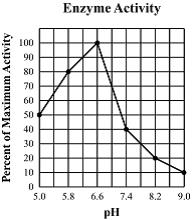

The graph shows how the activity of an enzyme changes over a range of pH values. Which of the following conclusions can be drawn from this graph?
pepsin works best in the stomach at a pH near 2
salivary amylase works best in the mouth at a pH of 9
What is the main function of protein?
For growth, repair, and function of body cells
Acts as an energy giving nutrient
To keep the body warm
Protect internal organs

Which two organisms in the chart below have chromosomes that are most similar in genetic composition?
humans and orangutans
chimpanzees and humans
Which domain is capable of living in extreme environments like hot springs, geysers, or very salty waters?
Bacteria
Archaea
Eukarya
Protista

What is the best explanation for the continual changes in the classification system of organisms?
All organisms struggle for existence and become extinct.
All organisms compete to be at the top of the food chain.
Technological advances like DNA sequencing have allowed scientists to better compare organisms.
More species have been discovered, but scientists have not analyzed all the data.
What is the most accurate way to determine the classification of an organism?
Compare DNA sequences
Examine what the organism eats
Compare fur patterns
Examine migration trends
Because energy flows from organism to organism and is used for metabolism or is converted to heat the next organism in the chain only receives 10% of the energy from the previous level. Therefore, energy ___________.
increases as it flows through an ecosystem
decreases as it flows through an ecosystem
never changes as it flows through an ecosystem
causes explosions as it flows through an ecosystem
If you cross a red poinsettia with a white poinsettia, only red and white variegated poinsettias would be produced. What kind of inheritance pattern does this follow?
Incomplete Dominance
Co-Dominance
Polygenic Trait
Blocked Trait

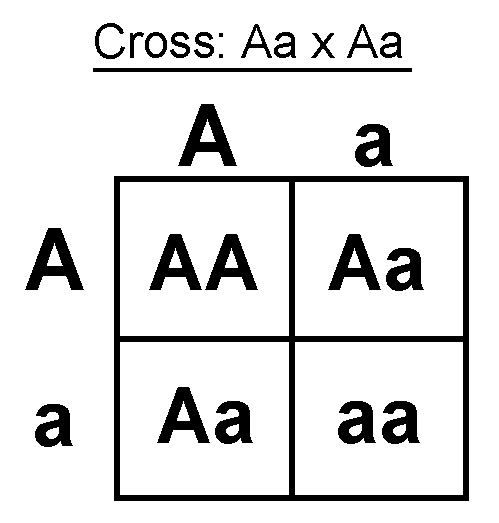
AA and Aa always show up as
dominant traits
recessive traits
What occurs during 'crossing over'?
Chromosomes split
Chromosomes form
Chromosome pieces switch
Chromosomes duplicate
When comparing the offspring of sexually and asexually reproducing organisms, we would expect the genetic material (DNA) of the sexually reproducing organism to -
contain fewer mutations
be lesser in quantity
be simpler overall
show more genetic variation
Mitosis is useful for the creation of new cells which is important for all of the following EXCEPT
organism growth.
repair of damage.
replacement of worn out cells.
generation of gametes, also known as sex cells.
Which of these correctly distinguishes mitosis from meiosis?(DOK3)
Mitosis occurs in sex cells and meiosis occurs in somatic cells.
Crossing over takes place in mitosis and not in meiosis.
Meiosis produces four unique haploid sex cells; mitosis produces two diploid identical body cells.
Mitosis occurs only in animals; meiosis occurs only in plants.
What point mutation adds one base?
Substitution
Deletion
Insertion
What point mutation removes one base?
Deletion
Insertion
Substitution
What are three types of mutations?
Insertion, Deletion, Subsitution
Deletion, Transgression,
Function, Interruption, Insertion
Multiplication, Invasion, Substitution
Which characteristic of bacteria allows them to develop antibiotic resistance more rapidly than other organisms?
they reproduce very quickly
they reproduce asexually
they are single celled
there are no genetic mutations
Why do doctors suggest people get a flu vaccine every year?
Flu viruses replicate more rapidly over time
Flu viruses can mutate from year to year
Vaccines are absorbed by the body after a year
Vaccines get stronger over time
Osmosis is the movement of _____ across a membrane.
food
energy
oxygen
water

A recessive trait ______________________.
can skip a generation if both parents carry the gene (heterozygous) but neither one shows that trait
always shows in the offspring if they are heterozygous
never shows in the offspring
None of the above.
If glaciers melt, _______________
sea levels will rise and flooding could occur.
levels of carbon dioxide in the atmosphere will decrease.
polar bear populations will increase.
ocean salinity will increase.
Why are protista no longer considered a separate kingdom?
Because they are too tiny and they should be called viruses
Because they are prokaryotic and they are actually bacteria
Because they all have chloroplasts so they are actually plants
Because they are so diverse that they should be divided into plants, animals, and fungi
What is Chlorophyll?
the main ingredient in chlorine bleach that whitens clothes
the chemical that you put in a swimming pool to kill germs
a pigment in plants that absorbs sunlight and aids in photosynthesis
the catalyst in mitochondria that fuels cellular respiration
One possible path that shows the flow of energy in an ecosystem is called ______.
a food chain
a food web
a Venn diagram
a food processor
An organism's _________ is defined as the environment in which it lives.
habitat
niche
social structure
ecosystem
Which of the following is the correct order in a food chain?
Sun --> producers --> carnivores --> scavengers --> herbivores
Sun --> producers --> scavengers --> carnivores
Sun --> consumers --> predators --> producers --> hosts
Sun --> producers --> herbivores --> carnivores --> scavengers
__________ is the role an organism plays in the environment.
Habitat
Niche
Primary succession begins with ____________.
Frozen soil
Bare rock, concrete, or cooled volcanic lava
Untouched forest
flooded land


If scientists found the fossils of many sharks buried deep in the earth in many different parts of Hall County, this would indicate:
That the sharks evolved to walk on land and live in the temperate deciduous forest
That this area of North Georgia was once covered by ocean
That local restaurants served shark steaks and buried the bones
that Lake Lanier is actually a salt water sea

