
Font size
 Worksheets
EOC Review
Total questions: 192
Worksheet time: 2hrs 56mins


According to this quotation, Abraham Lincoln believed that


Lincoln's "10 Percent Plan" dealt with
his idea for instituting an income tax.
how to draft more men into the Union Army.
re-admitting Southern states into the Union.
his quest to reconquer only 10% of the South

Presidential Reconstruction following the American Civil War can BEST be described as
a plan to fix the damage to the White House caused by the Civil War.
a desire to rebuild the southern states quickly to help control the economy.
a desire to rebuild the country quickly and without ill feelings following the war.
a desire to punish those southerners responsible for causing and/or prolonging the war.

Which is the BEST description of the southern economy during Reconstruction?
The southern economy was stabilized because of trade relationships with Great Britain and France.
The southern economy was still based on agriculture and cotton, but now depended on sharecropping rather than slave labor
The southern economy was transformed from being based on agriculture to being completely dependent on industry and manufacturing.
The southern economy was completely restored by 1866 and was actually more productive and profitable than the pre- Civil War economy.

Who would have most likely NOT supported the Freedmen's Bureau?
An abolitionist
a carpetbagger
a former slave owner
a northern business owner

Which occurred because more foreigners immigrated to this country in the 19th century?
Crime rates rose
America became the largest populated country
More workers were available to work jobs in cities
Public education became the law

Before the Industrial Revolution, where were most goods manufactured in America?
In homes
In factories
In Britain
They weren't

What would best describe "capital"?
Money, tools, or resources needed to help start or fund a business
Economy that allows no competiton
Charging people to start a business
A tax upon death

What would explain why so many immigrant moved and lived in cities during the Industrial Revolution?
Easy to live off the land
Outstanding health benefits
Jobs, of course
They weren't allowed to move beyond the east coast

Making things, somtimes in large quantities, is called ____________.
Manifolding
Manipulating
Communicating
Manufacturing

What normally happens when the speed of manufacturing something increases?
The cost also gets faster
The costs are lowered to the consumer
Prices are raised
There are fewer options to the consumers

What would explain why urban areas become so over-crowded?
People wanted to be near the harbors
People needed to live near their families
People needed to walk to work, and couldn't live far from their jobs
People just love the smell of urine and poop

The railroad, steamboat and canal system would be improvements in which area?
communication
transportation
urbanization
transformation

This family is moving from home to the city. Which best describes this below?
Urban to Rural
Rural to Rural
Ural to Bering
Rural to Urban
Which best explains why people moved to cities in the 19th century and even today?
To find work opportunities in the city
To escape religious persecution
The find the meaning of life at the bottom of a plate of nachos
To smell the urine and poop of a city instead of the urine and poop on a farm

What impact did factories and faster transportation have on American industries?
It modernized it and gave America's economy a huge boost
It made America's enemies laugh
It produced never before seen levels of poverty and crime
It made people forget that
Select the image that best describes what happened to America's urban centers during the 19th Century.


What is a basic concept of creating identical or nearly identical parts to be mass produced?
electrifixtion
interchangeable parts
mass quantities
interchangeable designs

Which immigrants came to America to escape a shortage of food (famine)?
Chinese
French
Irish
More Chinese

Which people originally came to the West coast of America to seek getting rich in the gold rush?
The Chinese
The Irish
The Orcs
The Polish


What does this political cartoon best represent?
Public opposition to the League of Nations
German Imperial Fleet discussing a blockade of Mexico
The Zimmerman Telegram
Talks of Germany's unrestricted submarine warfare
In January 1918, President Wilson spoke to Congress about the war aims of the nation. His plan ultimately became known as the _______________________ and was designed to create a lasting peace in the world.
Fourteen Points
Treaty of Versailles
Wilson's suggestions
League of Nations
Wilson's idea for a League of Nations was included in the final provisions of the Treaty of Versailles. After most European countries joined the League of Nations, the U.S. soon followed suit and joined in 1920 to become part of the Big 4 (France, Great Britain, Italy, and the U.S.)
True
False
Below is a list of reasons for the United States entering World War I. What would be the third reason?
- German attempts to have Mexico invade the United States
- Acts of sabotage
- ??????????
Sunken American battleships
Destroyed American skyscrapers
Exploded nuclear weapons
Unrestricted submarine warfare
Before the U.S. entered WWI, President Woodrow Wilson declared that the U.S. would provide aid to the allies.
True
False
In 1919, after communist revolutionaries known as Bolsheviks overthrew the czar in Russia, established the Soviet Union, and called for a worldwide revolution to destroy capitalism, people in the United States began to fear communists. This fear of international communism was called __________________.
Socialism
The Red Scare
The Immigrant Scare
The Isolationism Movement
The Judiciary Reorganization Bill of 1937, usually called the _____________________, was a law Roosevelt proposed to give presidents the power to appoint an extra Supreme Court justice for every sitting justice over the age of 70 ½.
court-packing bill
the New Deal
Lend0-Lease Act
14 Points
One of Roosevelt’s major New Deal programs was the Texas Valley Authority (TVA). This was established in 1933 to build dams and power plants along the Rio Grande River and its tributaries.
True
False
Which legislation was passed during the Second New Deal to give federal assistance to the elderly?
the Wagner Act
the Social Security Act
the Fair Labor Standards Act
the Emergency Banking Relief Act
Dirt loosened by the drought and the poor farming practices that had eroded the soil led to this ecological disaster ____________________.
Hoovervilles
the Dirt Bowl
(TVA)
the Dust Bowl

This political cartoon is depicting the U.S. working around what acts?
The Wagner Acts
The Nullification Acts
The Neutrality Acts
Unrestricted Submarine Acts
One way Americans conserved on the home front was through the mandatory government rationing system.
True
False
The project code named the Manhattan Project was hiding what?
The U.S. building Nuclear Weapons
Internment Camps built to hold minorities
Secret plant building new airplanes
New submarine technology


Which of the following is NOT a cause of the Great Depression?
Overproduction and underconsumption
High tariffs restricting trade
buying stocks on the margin
high income taxes
What was President Herbert Hoover's response to the Great Depression?
He believed "rugged individualism" would solve the economy
He created mass welfare
He increased infrastructure to create jobs
He violated his policy of laissez-faire
How did Franklin D. Roosevelt respond to the Great Depression?
He supported the use of private charities to help the poor
He reduced the government's influence over public funding
He created more jobs to give direct employment to the people
He permanently closed the banks in favor of one federal bank
How did FDR plan to change the role of the federal government?
He wanted to increase the role of the executive branch and its power over Congress and the Supreme Court
He wanted to put Congress in charge of the Supreme Court
He wanted to follow the direction of Congress to solve the Great Depression
He wanted to reduce the overall power of the federal government over the states
Which New Deal organization created jobs by encouraging national park projects?
Works Project Administration
Civilian Conservation Corps
Federal Deposit Insurance Corporation
Tennessee Valley Authority
Why did many midwestern farmers migrate from the Great Plains to California?
There was no unemployment on the West Coast
California was experiencing a gold rush
The Dust Bowl pushed farmers out of the Great Plains
The Stock Market crash led farmers to lose their homes on the Great Plains
The purpose of the FDIC was to
provide insurance on bank deposits and restore people's faith in the banking industry
provide increased job opportunities through government jobs
re-open the Stock Market with increased regulations and safety nets
grant tax relief to citizens who deposit money in the bank
How did Americans feel about Hoover's approach to the Great Depression?
They accepted his "hands-off" approach and policy of "rugged individualism"
They were glad that Hoover did not increase federal programs and therefore increase taxes
They expected Hoover and the federal government to help them, and nicknamed shantytowns "Hoovervilles" in anger
They began promoting radical communism in an attempt to overthrow Hoover's capitalist policies
Which of the following is NOT a long-term impact of FDR's New Deal?
Reformed the economy with a "safety net" for economic crises
Recovered the economy with employment through public projects
Provided relief to Americans and increased political participation from the working classes
Removed private ownership of major industries in favor of state ownership
What was the impact of the New Deal on unemployment in the U.S.?
Unemployment still remained high throughout the 1930s
Unemployment came to be the lowest in American history
Unemployment increased with New Deal policies
Unemployment reduced back to its rate in the early 1920s
What philosophy did the New Deal follow?
Laissez-Faire policies should guide our economy
"rugged individualism" will get us through the Great Depression
the federal government should work to help Americans in poverty
capitalism is a natural cure for economic crisis
Which of the following did NOT contribute to the Great Depression crisis?
The Dust Bowl
Bank Failures
Black Tuesday
National government debt
Which of the following is the most likely reason why FDR was re-elected so many times?
Americans knew Congress had control over FDR
Americans and Congress trusted FDR to lead the nation
FDR's wealth allowed him to bribe voters
Americans feared another republican presidency


During the Cold War, what bill did the U.S. Congress pass to provide financial assistance to western European countries?
Truman Doctrine
Open Door Policy
Marshall Plan
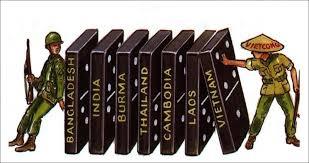
Domino Theory

What policy implemented in the Cold War said the U.S. would give military aid to a country that needed to resist communism?
Marshall Plan
Truman Doctrine
Domino Theory
Open Door Policy
During the Cold War, what policy did the U.S. follow to stop the spread of communism?
Open Door Policy
Big Stick Policy
Containment Policy
Dollar Diplomacy
Which individual/group contributed to the Red Scare by accusing American citizens of being communist spies?
McCarthy/HUAC
NAACP/Farm Workers Union
Nativists/Muckrakers
Philanthropists/Entrepreneurs

In what year did the Russians launch the satellite Sputnik?
1941
1957
1969
1991

What happened as a result of the launch of Sputnik in 1957?
It started the space race between the USSR and U.S.
The U.S. government started NASA.
U.S. began to spend more money on math and science to maintain national security.
All of the above

During what Cold War event did the U.S. bypass a Soviet blockade in Germany without provoking a military conflict?
Berlin Airlift
Vietnam War
Watergate Scandal
Bataan Death March

During the Cuban Missile Crisis, what did President J.F. Kennedy do when he heard that the Soviet Union was constructing nuclear missile sites in Cuba.
He launched a nuclear missile at the Kremlin in Moscow.
He gave into the demands of the Soviet & Cuban government.
He ordered a naval blockade around Cuba to prevent Soviet ships from bringing the necessary materials.
He declared war on the Soviet Union & Cuba.

What legislation helped American soldiers get an education and buy homes in the suburbs during the Cold War?
Interstate Commerce Act
Federal Housing Authority Act
Social Security Act
GI BIll
What was the name of the rapid increase of population following the end of WWII called?
Baby Boom
Columbian Exchange
Great Migration
Demographic Shift

How did the Counter-culture movement of the 1960s impact the Vietnam War?
The hippies protested and organized mass demonstrations.
They helped turn public opinion against the war.
They helped get the 26th amendment passed.
All of the above
What theory caused the U.S. to enter the Vietnam War in order to stop the expansion of communism across Southeast Asia?
Marshall Plan
Domino Theory
Open Door Policy
Dollar Diplomacy

What amendment was passed to lower the voting age because it was unfair that 18-20 year olds could be drafted into the army but not vote?
17th amendment
21st amendment
22nd amendment
26th amendment
What words should you immediately associate with the Cold War?
Hitler & the Nazis
Economic recession
Containment of Communism
Corruption & Industrialization
Before World War II, Korea was ruled by
Russia
China
Japan
USA
Korea was divided along the __________ Parallel after World War II.
35th
36th
37th
38th



Nixon was impeached from presedency.

•Freedom Summer
•Greensboro sit-ins
•U-2 incident
•Détente
•NAFTA
•Bosnia & Serbia airstrikes
•“don’t ask don’t tell” policy
•End of “don’t ask, don’t tell”
•SOPA Internet Protest
•Benghazi Embassy attacked
•Sharecropping
•Tenure of Office Act
•Scalawags
•Redeemers
Mayflower Compact
Roger Williams
House of Burgesses
Cash and Carry
Sit-Down Strike
John Steinbeck- Grapes of Wrath
Social Security Act
Pullman Strike
JP Morgan
Cross of Gold Speech
Plessy v. Ferguson
Independent Treasury System
Specie Circular
Equal Rights Amendment
OPEC
Kent State
Helsinki Accords
Woodrow Wilson
Fourteen Points
Underwood Simmons Tariff
Bull Moose Party
Federal Reserve Act
"he kept us out of war"
Triangle Shirtwaist Fire
1900s
1910s
1880s
1890s
Hartford Convention
Adams-Onis Treaty
War Hawks
American System
Dorthea Dix
Nullification
William Lloyd Garrison
Worcester v. Georgia
Bacon's Rebellion
King Philip's War
Salutary Neglect
Halfway Covenant
Credit Mobilier Scandal
Cattle drives
Horatio Alger
Chief Joseph and the Nez Perce
Boston Massacre
Gaspee Affair
First and Second Continental Congress
Sons of Liberty
Non-importation agreements
Pontiac's Rebellion
Townshend Acts
Booker T Washington
Gospel of Wealth
Yellow Journalism
Knights of Labor
Jim Crow Laws
Social Darwinism
Helen Hunt Jackson- A Century of Dishonor
Northwest Ordinance
Three-fifths Compromise
Articles of Confederation
Annapolis Convention
Treaty of Guadalupe Hidalgo
Wilmot Proviso
Irish Immigration
Pinckney Treaty
Full Funding/Assumption of State Debts
Federalist Party
Anne Hutchinson
Headright System
City on a Hill
Roger Williams
Stamp Act
Paxton Boys
Sugar Act
"No Taxation Without Representation"
Betty Friedan- The Feminine Mystique
Gulf of Tonkin Resolution
Stokely Carmichael (Black Power)
Great Society

