wayground logo

Free Printable Worksheets

NEW

Font size

S
M
L
XL
Worksheets

Light and Electricity

Total questions: 64

Worksheet time: 46mins

Name
Class
Date
1.
If you replace the paper clip with a plastic spoon, what happens?
a)
The bulb doesn't light
b)
The bulb is dimmer
c)
The wires get hot
d)
There is no change
2.
A series circuit has ____ path(s) that the electric current can take. 
a)
One
b)
Two 
c)
Three 
d)
Four
3.
In a parallel circuit, if one connection is broken, all of the connections stop working.
a)
True
b)
False
4.
An object through which electrons can easily flow is called a(n) ___________.
a)
Conductor
b)
Insulator
5.
What kind of circuit is this?
a)
series
b)
parallel
6.
What kind of circuit is this?
a)
Series
b)
Consecutive
c)
Parallel
d)
Training
7.
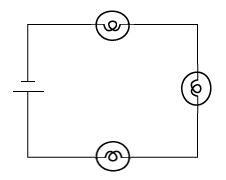
The picture shows an electrical circuit. This circuit is a series circuit because: 
a)
It has 3 light bulbs.
b)
The same current flows through all three light bulbs.
c)
It uses a single battery.
d)
The electrical current has more than one path to flow through
8.
What is a Parallel circuit? 
a)
Has only one path 
b)
Has more than one path 
c)
Allows energy to travel through easily 
d)
Has only one light bulb
9.
What is a switch's function in a circuit?
a)
to make the current hotter or colder
b)
turn on and off the flow of current
c)
the pathway that current flows
d)
to add more power to the circuit
10.
What type of circuit is show in the image?
a)
Series Circuit
b)
Parallel Circuit
11.
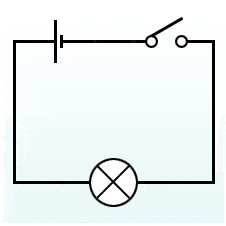
this circuit is .....?
a)
open
b)
parallel
c)
closed
d)
The cutest little circuit evah!
12.
If the electric circuit is CLOSED, the switch is _______. 
a)
ON
b)
OFF
13.
If the electric circuit is OPEN, the switch is ____.
a)
ON
b)
OFF
14.

Why electrical wiring usually are covered with a layer of plastic?

a)

To make it look pretty

b)

To help electricity flow along the wire

c)

To make it safe

d)

To add more energy

15.

Why is electrical wiring usually made from copper?

a)

Because copper is shiny

b)

Because copper conducts electricity

c)

Because copper is not magnetic

d)

Because copper insulate electricity

16.

1. Which switch or switches must be closed to make the lamps light?

a)

Only switch 1

b)

Only switch 1

c)

Switches 1 and 2

d)

Switches 1 , 2 and 3

17.

If lamp 2 is unscrewed from its holder, what will happen to lamp1?

a)

It will stay lit

b)

It will go out

c)

It will get dimmer

d)

It will dissapear

18.
______________ are materials such as rubber that do not allow charges to flow.
a)
conductors
b)
circuits
c)
insulators
d)
amps
19.
A complete, unbroken path that charges can flow through is called an __________________.
a)
conductor
b)
electric circuit
c)
electric current
d)
insulator
20.
The unit for the rate of current is the ______________.
a)
ampere
b)
volt
c)
ohm
d)
joule
21.
All electrical devices contain electric ________________.
a)
acid
b)
gears
c)
circuits
d)
motors
22.
Metals such as copper and aluminum are good ______________. 
a)
insulators
b)
conductors
c)
circuits
d)
charges
23.
A circuit with only one path for the current to flow is a __________________.
a)
parallel circuit
b)
series circuit
c)
mini circuit
d)
device
24.
Resistance in a circuit is equal to voltage divided by ____________.
a)
joules
b)
current
c)
power 
d)
amperage
25.
__________________ is the continuous flow of electric charges through a material.
a)
Electric current
b)
Resistance
c)
Voltage
d)
Static Discharge
26.

Light acts like

a)

a wave.

b)

a particle.

c)

Both a wave and a particle

d)

neither a wave nor a particle.

27.

The full range of frequencies of electromagnetic radiation is called

a)

visible light.

b)

radio waves.

c)

the electromagnetic spectrum.

d)

invisible radiation.

28.

Which of the following occurs as a light wave bends when it passes from one medium into another?

a)

constructive interference

b)

refraction

c)

destructive interference

d)

reflection

29.

Newton’s prism experiments showed that white sunlight is made up of

a)

the full electromagnetic spectrum.

b)

only blue light.

c)

all the colors of the visible spectrum.

d)

only the longest wavelengths.

30.

When the absorption lines of a galaxy shift toward the blue end of the spectrum, it means that the galaxy is

a)

moving away from Earth

b)

small and young

c)

moving closer to Earth

d)

large and old

31.

Light in the form of a particle that has discrete amount of energy is called a

a)

Charm

b)

Photon

c)

Exciton

d)

Muon

32.
The shortest wavelength in visible light is______.
a)
violet
b)
red
c)
blue
d)
yellow
33.
This wave has the second highest frequency on the spectrum. 
a)
microwaves
b)
visible light
c)
x-rays
d)
gamma ray
34.
The higher the frequency the ______ the energy. 
a)
higher
b)
lower
c)
neither, stays the same
35.

The lower the frequency the ______ the energy.

a)

higher

b)

lower

c)

neither, stays the same

36.
A wave with a large wavelength will have a ______ frequency and _____ energy
a)
high, low
b)
high, high
c)
low, high
d)
low, low
37.
Select the correct order of waves on the EMS from the longest wavelength to the shortest wavelength
a)
Radio, Micro, Infra, Visible, Ultra, X-ray, Gamma
b)
Gamma, X-ray, Ultra, Vis, Infra, Micro, Radio
c)
Vis, Micro, Infra, Ultra, X-ray, Gamma, Radio
d)
Micro, Radio, Vis, Infra, Ultra, X-ray, Gamma
38.
Which has the LONGEST wavelength and, therefore, the lowest frequency/energy
a)
Gamma Rays
b)
Radio Waves
c)
Visible Light
d)
Infrared rays
39.
Which has the SHORTEST wavelength and, therefore, the highest frequency/most energy
a)
Radio waves
b)
Ultraviolet Rays
c)
Gamma Rays
d)
X-rays
40.
Which section of the spectrum is the ONLY one we can see?
a)
X-rays
b)
Visible Light
c)
Gamma Rays
d)
Ultraviolet Rays
41.
How are electromagnetic waves different from other waves? 
a)
They have very short wavelengths 
b)
They transmit energy instead of matter 
c)
They can travel through empty space
d)
They can change direction by reflection 
42.
What are electromagnetic waves?
a)
sound waves
b)
electric & magnetic fields (energy) that travel through empty space very quickly
c)
Someone's name
d)
things like longitudinal waves
43.
What does refract mean?
a)
To shrink
b)
To bend
c)
To widen
d)
To enlarge
44.

The bending of waves around a barrier.

a)

refraction

b)

diffraction

c)

resonance

45.
When light strikes an object, it can do all of the following, except...
a)
Be reflected
b)
Be refracted
c)
Be produced
d)
Be absorbed 
46.
What does the word "converging" mean?
a)
to separate
b)
to come together
c)
parallel 
d)
perpendicular
47.
A converging lens is also known as a ____ lens.
a)
convex
b)
concave
c)
double
d)
refracted
48.
What does the word "diverging" mean?
a)
to spread apart
b)
to come together
c)
parallel
d)
perpendicular
49.
A diverging lens is also known as a ____lens.
a)
refracted
b)
diffracted
c)
convex
d)
concave
50.
The point where the rays meet is known as....
a)
Fire
b)
the focal point
c)
refraction
d)
Plane of the lens
51.
Which describes a convex lens?
a)
triangular in shape
b)
more transparent in the middle
c)
thicker on the edges than in the middle
d)
thicker in the middle than on the edges
52.
Is a convex lens thicker or thinner in the middle?
a)
Thicker 
b)
Thinner 
53.

Light is made up of...

a)

electricity and waves

b)

magnetism and waves

c)

electricity and magnetism

d)

electricity and energy

54.

The color with the longest wavelength is...

a)

Blue

b)

Red

c)

Green

d)

Yellow

55.

If you see a green leaf on a tree, that means...

a)

Green is the color being reflected off the leaf.

b)

Green is the color being absorbed by the leaf.

c)

All the colors are being reflected off the leaf.

d)

All the colors are being absorbed by the leaf.

56.

The sky is blue because...

a)

blue is the color most scattered or reflected by our atmosphere.

b)

red is the color most scattered or reflected by our atmosphere.

c)

blue is the color most absorbed by our atmosphere.

d)

blue is complimentary to orange.

57.

Why does a banana look yellow?

a)

it reflects yellow wavelengths of light and absorbs most other wavelengths

b)

it absorbs yellow wavelengths of light and reflects most other wavelengths

58.

what is the correct order of the visible light spectrum?

a)

red, yellow, green, orange, blue, violet and indigo

b)

indigo, blue, violet, orange, yellow, green and red

c)

violet, blue, indigo, green, yellow, orange and red

d)

red, orange, yellow, green, blue, indigo and violet

59.

When you see the color black...

a)

All colors are reflecting

b)

All colors are absorbed

c)

The color blacl is reflecting

d)

the color black is absorbed

60.

White when

a)

the color white reflects

b)

the color black is absorbed

c)

all colors are reflected

d)

no colors are reflected

61.

What does the pencil in this picture show about light?

a)

Light is refracted when it hits a curved object.

b)

Light is reflected when it hits a curved object.

c)

Light is refracted when it passes from air into water.

d)

Light is reflected when it passes from air into water.

62.
What kind of path does light take?
a)
It travels in a straight line until it hits something or goes through it.
b)
It bounces off all objects.
c)
It curves around all objects.
d)
It goes through all objects.
63.
What happens to light passing through a prism?
a)
It goes right through it.
b)
It bends and the light separates.
c)
It bounces off it
d)
It goes around it.
64.
Which of the following is not a primary color of light?
a)
Blue
b)
Red
c)
Yellow
d)
Green