wayground logo

Free Printable Worksheets

Font size

S
M
L
XL
Worksheets

Chemistry Review 1

Total questions: 99

Worksheet time: 1hrs 24mins

Name
Class
Date
1.
all matter is made of what 
a)
energy 
b)
atoms 
c)
electrons 
d)
compounds 
2.
The positive particles of an atom are 
a)
electrons 
b)
positrons 
c)
neutrons 
d)
protons 
3.
the central region of an atom where its neutrons and protons are is its 
a)
nucleus 
b)
electron cloud
c)
core 
d)
center 
4.
an atom with atomic number 6 would have how many protons 
a)
6
b)
12
c)
3
d)
cannot be determined 
5.
Particles in an atom that are neutral and have no charge are 
a)
negatrons 
b)
electrons 
c)
neutrons 
d)
protons 
6.
A particle that moves around the nucleus is a(n)...
a)
Proton
b)
Neutron
c)
Electron
d)
Quark
7.

What does the 1.00794 stand for?

a)

mass number

b)

atomic number

c)

average atomic mass

d)

number of protons

8.
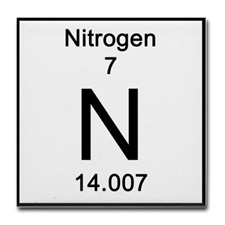
What is the number of protons that the element in this image contain?
a)
14
b)
7
c)
15
d)
18
9.

If an atom has 12 protons, which of the following must it also have to be considered a neutral atom?

a)

12 neutrons

b)

12 electrons

c)

12 protons

d)

24 protons and neutrons

10.
If an atom has 10 protons, 10 neutrons, and 10 electrons, what is the mass of the atom?
a)
10
b)
20
c)
30
11.

What charge does an atom have when it GAINS electrons?

a)

Positive

b)

Negative

c)

Neutral

12.

What two particles determine the mass number?

a)

Protons and electrons

b)

Electrons and neutrons

c)

Protons and neutrons

13.

When an atom loses an electron, it becomes a(n) _____________ ion.

a)

positive

b)

negative

c)

neutral

d)

polyatomic

14.

If the mass number of this chlorine atom is 36, how many neutrons does it have?

a)

17

b)

18

c)

19

d)

can't be determined

15.

What is the atomic number of this atom shown in the Bohr model?

a)

11

b)

12

c)

13

d)

can't be determined

16.

What is the mass number of the atom shown in the Bohr model?

a)

11

b)

12

c)

23

d)

Can't be determined

17.

Is this atom an ion? If so what would it's charge be?

a)

Yes, 1-

b)

No it is neutral

c)

Yes, 1+

d)

Can't be determined

18.

Most of the mass of an atom is found in the ______.

a)

nucleus

b)

proton

c)

electron cloud

d)

isotope

19.
An atom with an unequal number of protons and electrons is said to have (a) ___.
a)
no charge
b)
balance
c)
charge
d)
unbalance
20.
Two atoms of the same element but with different mass numbers are called________
a)
electrons
b)
isotopes
c)
variables
d)
electron cloud
21.
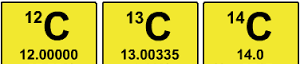
What do these isotopes of carbon all have in common?
a)
neutrons & mass number
b)
atomic number and neutrons
c)
atomic number and electrons
d)
protons, atomic number, and mass number
22.
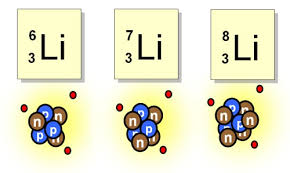
How many neutrons does the isotope of lithium have?
a)
8
b)
3
c)
4
d)
5
23.
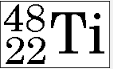
How many protons does this isotope of titanium have?
a)
48
b)
22
c)
26
d)
70
24.
In a correctly written symbol what would be located in the "A" position?
a)
number of neutrons
b)
atomic number
c)
number of electrons 
d)
mass number
25.
What quantities vary between isotopes of an element?
a)
protons, electrons, and atomic mass
b)
protons, electrons, and atomic number
c)
neutrons and electrons
d)
neutrons and atomic mass
26.
which atom has  4 neutrons?
a)
Li-6
b)
Li-7
c)
Li-8
d)
they have the same # of neutrons
27.
How many neutrons in C-14?
a)
6
b)
7
c)
14
d)
8
28.
Isotopes are atoms of the same element with different #’s of __________ & therefore different __________.
a)
n0 ;  atomic #’s
b)
p+ ; atomic #’s
c)
e- ; atomic masses
d)
n0 ; atomic masses
29.
How many neutrons does the isotope below have?     89 36Kr
a)
53
b)
36
c)
89
d)
125
30.
If X is the symbol for an element, which of the following two symbols represent    isotopes of the same element?     I. 7735X  II. 7733X  III. 8137X  IV. 8135 X
a)
I and II
b)
III and IV
c)
I and IV
d)
I and III
31.
How many neutrons does an atom of the isotope Neon-22 have?
a)
12
b)
10
c)
22
d)
20
32.
Four isotopes of lead include lead-204, lead-206, lead-207, and lead-208.  The average atomic mass of lead is 207.2.  Which isotope of lead is likely to be the most abundant.
a)
204
b)
206
c)
207
d)
208
33.
subatomic particles found on the outermost shell & responsible for the atom's reactivity
a)
neutrons
b)
valence electrons
c)
isotopes
d)
ions
34.
Measure mainly of the nuclear particles: protons + neutrons
a)
Subatomic Particles
b)
Atomic Number
c)
Atomic Mass
d)
Gluons
35.
The smallest particle of an element that shows all the properties of that element.
a)
Subatomic Particles
b)
Atom
c)
Quarks
d)
Gluons
36.
Where electrons are likely to be found as they travel around the nucleus
a)
Nucleus
b)
Electron Cloud
c)
Within a Proton
d)
Within a Neutron
37.
Arrangement of elements organized by atomic number
a)
Electron Cloud 
b)
Periodic Table 
c)
Electron Configuration
d)
None of these
38.
Discovered the nucleus of the atom through the Gold Foil Experiment
a)
Rutherford
b)
Chadwick
c)
Thomson
d)
Dalton
39.
Proposed the Modern Electron Cloud Model of the atom
a)
Schrodinger & Heisenberg
b)
Dalton
c)
Chadwick
d)
Rutherford
40.
Discovered the electron within the atom
a)
Thomson
b)
Chadwick 
c)
Schrodinger & Heisenberg
d)
Dalton
41.
Created the Planetary Model of the atom
a)
Bohr
b)
Dalton
c)
Rutherford
d)
Chadwick
42.
Discovered the neutron within the atom
a)
Democritus
b)
Thomson
c)
Rutherford
d)
Chadwick
43.
Believed that atoms of the same element are identical to each other
a)
Bohr
b)
Rutherford
c)
Dalton
d)
Thomson
44.
Calculation used to find the number of neutrons in an atom
a)
Atomic Mass - Atomic Number
b)
Atomic Number - Atomic Mass
c)
Atomic Mass - Electrons
d)
none of these
45.
The only element with no neutrons in its nucleus.
a)
Oxygen
b)
Helium 
c)
Hydrogen
d)
Lithium
46.
"Everything is composed of atoms" was stated by:
a)
Democritis
b)
Dalton
c)
Moseley
d)
Einstein
47.
John Dalton stated:
a)
elements are made of atoms
b)
atoms of a given element are identical
c)
atoms cannot be subdivided, created, nor destroyed
d)
all of the above
48.
The scientist responsible for "discovering" the nucleus is:
a)
Bohr
b)
Rutherford
c)
Schroedinger
d)
Einstein
49.
Electrons are not factored into atomic mass because:
a)
They are so small their mass is negligible
b)
They're not in the nucleus
c)
They're too big
d)
They move so quickly their mass is zero
50.
How did Rutherford discover the proton?
a)
Cathode tube ray experiment
b)
Gold Foil Experiment
c)
Planetary Model
d)
Plum Pudding Model
51.
The word "atom" comes from a Greek word that means
a)
Invisible
b)
Indivisible
c)
Undivided
52.

A wave with a large wavelength will have a ______ frequency and _____ energy

a)

high, low

b)

high, high

c)

low, high

d)

low, low

53.

The frequency of violet light is 7.5x10¹⁴ Hz. What is its wavelength?

a)

4.0x10⁻⁷ m

b)

4.0x10⁷ m

c)

2.25x10²³m

d)

2.25x10²³ Hz

54.

Red light has a wavelength of 675 x 10-9 m. What is its frequency?

a)

2.03x10¹¹ m

b)

4.44x10¹⁴ Hz

c)

4.44x10¹⁴ nm

d)

2.03x10¹¹ Hz

55.

What is the speed of light?

a)

3.0x10⁸ ms

b)

3.0x10⁸ m/s

c)

6.626x10⁻³⁴ Js

d)

6.626x10⁻³⁴ J/s

56.

What is Planck's Constant?

a)

6.63x10⁻³⁴ Js

b)

6.63x10⁻³⁴ J/s

c)

3.0x10⁸ ms

d)

3.0x10⁸ m/s

57.

Ground state means that an electron is...

a)

at its lowest possible potential energy

b)

in the first shell of an atom

c)

laying low for the weekend

d)

removed from an atom

58.

In order to go from ground state to an excited state, an electron must

a)

emit energy

b)

absorb energy

c)

rotate

d)

wiggle

59.

When an electron returns to ground state from an excited state, the atom will

a)

emit energy

b)

absorb energy

c)

rotate

d)

wiggle

60.
Which is the electron configuration for an oxygen atom?
a)
1s22s22p63s23p64s2
b)
1s22s22p4
c)
1s22s22p6
d)
1s22s22p63s23p6
61.
What atom matches this electron configuration?
1s2s2p3s2
a)
Neon
b)
Magnesium
c)
Aluminum
d)
Potassium
62.
How many d orbitals are there in a given sublevel?
a)
1
b)
3
c)
5
d)
7
63.
How many p orbitals are there in a sublevel?
a)
2
b)
1
c)
4
d)
3
64.
What is this element? 
1s22s22p63s23p6
4s23d104p6
a)
Argon
b)
Krypton
c)
Selenium
d)
Bromide
65.
What is the shorthand electron configuration for Sulfur atom?
a)
[Ar] 3p4
b)
[He] 3s23p4
c)
[Ne] 3s23p4
d)
[Na] 3s23p3
66.
How many electrons can the first energy level hold?
a)
1
b)
2
c)
8
d)
0
67.
How many valence electrons does Chlorine have?
a)
5
b)
2
c)
7
d)
5
68.
What element has the valence shell configuration
3s2 3p2
a)
Al
b)
B
c)
Si
d)
Ga
69.
Which element is pictured?
a)
neon
b)
fluorine
c)
magnesium
d)
argon
70.
Identify the element in Period 5 that has 1 valence electron?
a)
Rb
b)
Nb
c)
Ag
d)
Sb
71.
What atom matches this electron configuration?
1s2s2p3s2
a)
Neon
b)
Magnesium
c)
Aluminum
d)
Potassium
72.
Which would describe an electron that has gained energy and jumped to another shell?
a)
ground state
b)
excited state
c)
valence
d)
core
73.
What is the shape of a p orbital?
a)
sphere
b)
it's just too complex to thing about it
c)
dumbbell
d)
I don't know this stuff.
74.
1.  What is the shape of an s orbital?
a)
sphere
b)
dumbbell
c)
double dumbbell
d)
TOO COMPLEX TO KNOW IT.
75.
What is the total number of energy levels used by an atom of aluminum
(Al, atomic #13) in the ground state?
a)
3
b)
7
c)
13
d)
0
76.
How many orbitals are available to hold electrons in the 4th energy level (n=4)?
a)
4
b)
8
c)
16
d)
32
77.
This "rule" of Quantum Chemistry states that it is impossible to know both the position and velocity of an electron at the same time.
a)
Hund's Rule
b)
Heisenberg Uncertainty Principle
c)
Aufbau Principle
d)
Pauli Exclusion Principle
78.
According to the Aufbau Principle, which sublevel should starting filling with electrons after 5s?
a)
6s
b)
5p
c)
4d
d)
3f
79.
Identify the following element:
1s22s22p63s23p64s23d10
a)
nickel
b)
copper
c)
zinc
d)
gallium
80.
The second energy level (n=2) contains a total of 5 electrons...how many more electrons can fit in the 2nd energy level?
a)
0
b)
3
c)
5
d)
7
81.
The second energy level (n=2) contains a total of 5 electrons...how many more electrons can fit in the 2nd energy level?
a)
0
b)
3
c)
5
d)
7
82.
Identify the element whose electron configurations ends with 5p3
a)
As
b)
Te
c)
Sb
d)
Sn
83.
Which of the following statements is true about the 3s and the 4s sublevels?
a)
These sublevels have the same energy
b)
These sublevels are the same distance from the nucleus
c)
These sublevels hold different amounts of electrons
d)
These sublevels have the same shape
84.
Which of the following quantum number sets is not allowed?
a)
{ 3, 2, +1, -1/2 }
b)
{ 5, 3, -1, +1/2 }
c)
{ 12, 1, +2, +1/2 }
d)
{ 7, 6, -5, -1/2 }
85.
Carbon dioxide
a)
C2O2
b)
C20
c)
CO
d)
CO2
86.
Phosphorous trichloride
a)
PCl3
b)
P3Cl
c)
P3Cl3
d)
PCL
87.
Bromine monoflouride
a)
Br1F1
b)
BrF
c)
Br2F
d)
BrF2
88.
Disulfur trioxide
a)
S3O2
b)
SO
c)
S2O3
d)
S2O
89.
Name the following compound:
  BF3
a)
boron fluoride
b)
boron difluoride
c)
monoboron trifluoride
d)
boron trifluoride
90.
Which of these is covalent?
a)
NaCl
b)
Pb(NO3)2
c)
CO2
d)
AlCl3
91.
Covalent compounds
a)
Share electrons
b)
transfer electrons
c)
contain a sea of electrons
d)
conduct electricity
92.
Mono means
a)
7
b)
45
c)
plenty
d)
1
93.
Three pairs of electrons are shaired
a)
Single bond
b)
Double bond
c)
Triple bond
94.
Covalent bond is
a)
a bond that shares electrons metallicaly
b)
A bond that shares electrons with non metals
c)
Metalloids bonding
d)
metals and nonmetals bonding
95.
What molecule could this be? 
a)
BF3
b)
CH4
c)
H2O
d)
CO2
96.
Which of the following shapes describes water?
a)
tetrahedral structure
b)
linear structure
c)
trigonal planar structure
d)
bent structure
97.
How many are shared in a single bond?
a)
2 pairs
b)
4
c)
2
d)
1
98.
How many are shared in a double bond?
a)
2
b)
4 pairs
c)
6
d)
4
99.
The electrons involved in the formation of a covalent bond are
a)
transferred
b)
valance e-
c)
in filled orbitals
d)
only found in the s-orbital