wayground logo

Free Printable Worksheets

Font size

S
M
L
XL
Worksheets

Biology Final Exam REVIEW 2019

Total questions: 183

Worksheet time: 3hrs 14mins
Name
Class
Date
1.
The enzyme known as ‘catalase’ is involved in the breakdown of hydrogen peroxide molecules into separate water and oxygen molecules. During this reaction, what happens to the ‘catalase’?
a)
The enzyme would become products: O2 and H20
b)
The enzyme would be fully used up and discarded.
c)
The enzyme would remain unchanged in any way.
d)
The enzyme would become a new type of enzyme.
2.
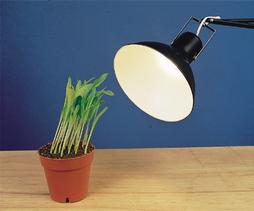
A plant growing towards the light is an example of 
a)
reproduction.
b)
responding to a stimuli.
c)
metabolism.
d)
homeostasis.
3.
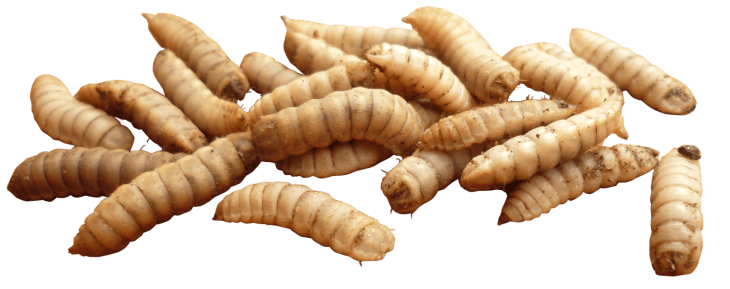
A maggot changing into a fly is an example of 
a)
reproduction.
b)
growth and development.
c)
homeostasis.
d)
evolution.
4.
Put the following terms in order from smallest to largest: organs, cells, organism, organelles, tissues, organ systems
a)
Organelles - cells - tissues - organs - organ systems - organism
b)
cells - organs - tissues - organ systems - organelles - organism - organ systems - tissues
c)
organs - tissues- organism - organelles - cells - organ systems
d)
organism - organ systems - organs - tissues - cells - organelles
5.
The coordination of activities in an organism that maintain homeostasis in a constantly changing environment is called:
a)
regulation 
b)
digestion
c)
synthesis
d)
respiration
6.
In asexual reproduction, all of the offspring are:
a)
Physically Identical
b)
Genetically Identical
c)
Physically and Genetically Identical
d)
Not Identical
7.
What parts of the chromosomes code for traits?
a)
Genes
b)
Deoxyribonucleic Acid
c)
Chromosomes
d)
Nucleus
8.
Daffodils are plants that can perform both asexual and sexual reproduction. How does a daffodil population benefit more by reproducing sexually? 
a)
It can reproduce more rapidly. 
b)
It can adapt faster to its environment. 
c)
It can increase the diversity of inherited traits. 
d)
It can eliminate unfavorable traits from the gene pool. 
9.
Which of the following characteristics of living things best explains why humans sweat when they get hot?
a)
maintaining a stable internal enviornment
b)
growth and development
c)
using energy
d)
ability to reproduce
10.

AIDS, influenza, and Ebola are examples of diseases caused by microbes called–

a)

viruses

b)

parasites

c)

bacteria

d)

fungi

11.

Which statement is true about viruses?

a)

Viruses can eat and metabolize food.

b)

Viruses can reproduce only using a host cell.

c)

Viruses can reproduce on their own at any time.

d)

Viruses contain DNA, so they are alive.

12.

As you add drops of water to the surface of a coin, each drop sticks to the other water droplet because of ________________, and sticks to the penny because of ______________.

a)

adhesion, cohesion

b)

cohesion, adhesion

c)

capillary action, specific heat

d)

specific heat, capillary action

13.
Large bodies of water, such as lakes and oceans, do not quickly fluctuate in temperature. What is the reason for this phenomenon?
a)
Water is an acid.
b)
Water is a versatile solvent.
c)
Water has a high heat capacity.
d)
 Water acts as a buffer.
14.
Carbon, Hydrogen, Oxygen and Nitrogen are elements in what biomolecule?
a)
Carbohydrate
b)
Lipid
c)
Protein
d)
Nucleic acid
15.
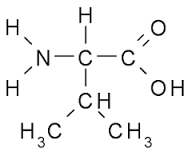
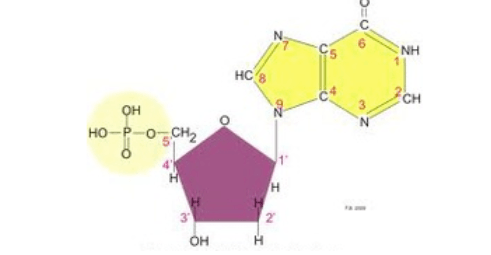
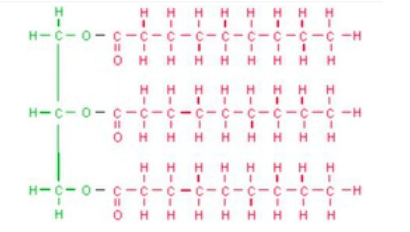
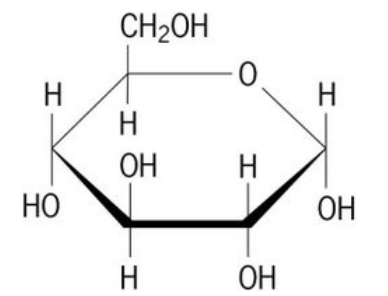
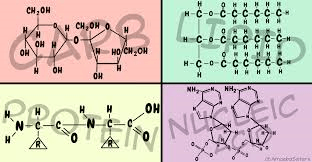
Which biomolecule is this a picture of?
a)
Protein
b)
Nucleic Acid
c)
Lipid
d)
Carbohydrate
16.
Which biomolecule is this a picture of?
a)
Protein
b)
Nucleic Acid
c)
Lipid
d)
Carbohydrate
17.
Which biomolecule is this a picture of?
a)
Protein
b)
Nucleic Acid
c)
Lipid
d)
Carbohydrate
18.
What elements are common to all 4 biomolecules?
a)
Carbon, hydrogen, nitrogen
b)
Carbon, Nitrogen, Phosphorus
c)
Carbon, Hydrogen, Oxygen
d)
Carbon, Hydrogen, Phosphorus
19.
What are the four macromolecules?
a)
proteins, nucleic acids, carbohydrates, and lipids
b)
monosaccharides, lipids, polysaccaharides, and proteins
c)
RNA, DNA, proteins, and carbohydrates
d)
proteins, DNA, RNA, and steroids
20.
Is found in the cell membrane as a bilayer. 
a)
lipids
b)
protein
c)
nucleic acid
d)
carbohydrate
21.
Proteins are made of monomers called ___________
a)
Nucleotides
b)
Monosaccharides
c)
Amino Acids
d)
Glycerol and fatty acids
22.
Monosaccharides are monomers of
a)
Carbohydrates
b)
Lipids
c)
Proteins
d)
Nucleic Acids
23.

Has cell membrane

a)

Prokaryote

b)

Eukaryote

c)

both

24.
Has cytoplasm
a)
Prokaryote
b)
Eukaryote
c)
both
25.
Which type of cell?
a)
Prokaryote
b)
Eukaryote
26.
Which type of cell?
a)
Prokaryote
b)
Eukaryote
27.
A single-celled organism that lacks a membrane-bound nucleus, mitochondria, or any other membrane -bound organelle .
a)
Prokaryote
b)
Eukaryote
c)
Nucleus
d)
Single-celled organism
28.
Where is the DNA found in a prokaryotic cell? 
a)
floating around in the cytoplasm 
b)
in the nucleus 
29.

Which has ribosomes?

a)

Prokaryote

b)

Eukaryote

c)

both

30.

Which type of animal cells would have more mitochondria than others?

a)

Blood cells

b)

Brain cells

c)

Skin cells

d)

Muscle cells

31.

Which type of plant cell would have more chloroplasts than others?

a)

Leaf cell

b)

Root cell

c)

Stem cell

d)

Root epidermal cell

32.

These cells are...

a)

prokaryotes

b)

eukaryotes

33.
Animal, fungi, plant, and protista cells are all examples of which type of cell?
a)
Eukaryotic
b)
Prokaryotic
c)
Both prokaryotic and eukaryotic
34.
Which cell is a prokaryote?
a)
A
b)
B
c)
C
d)
D
35.
Which cell is a Eukaryote? 
a)
A
b)
B
c)
C
d)
D
36.

What forms the channels and pumps in the phospholipid bilayer?

a)

carbohydrates

b)

proteins

c)

hydrophilic heads

d)

lipids

37.
Protein...
a)
A
b)
B
c)
C
d)
D
38.
The function of the plasma membrane is....
a)
to regulate what enters and leaves the cell.
b)
fight bacteria and viruses that enter the cell.
c)
provide rigid support and protection to the cell.
d)
make sure each cell can move
39.
Hydrophilic portion of cell membrane?
a)
A
b)
C
c)
D
d)
40.
Hydrophobic region of the cell membrane?
a)
E
b)
B
c)
C
d)
41.
This experiment illustrates which property of the cell membrane?
a)
impermeability
b)
selective permeability
c)
insolubility
d)
complete permeability
42.
Describes the arrangement of the cell membrane as bendable and made of many parts. 
a)
The Fluid Mosaic Model 
b)
The Major Mobility Model 
c)
The Crazy Cell Model
d)
The Maze Model
43.
Osmosis occurs when there is a different concentration of solute molecules on each side of the membrane. The drawing below shows a beaker containing a 30% salt solution and a suspended cell containing a 10% salt solution. What statement best describes the cell after 20 minutes?
a)
Water will move from the cell into the beaker, resulting in a smaller cell.
b)
Water will move from the beaker into the cell, resulting in a larger cell.
c)
Salt will move from the cell into the beaker, resulting in a smaller cell.
d)
Salt will move from the beaker into the cell, resulting in a larger cell.
44.
A beaker is divided into two halves, A & B, by a membrane that is freely permeable to the water and NaCl but not to protein. Side A is half-filled with a solution of 8% protein, while side B is half filled with a 2% protein solution. Predict what would happen to side A after a few hours. 
a)
The number of protein molecules has increased.
b)
The number of water molecules has decreased.
c)
The number of water molecules has increased.
d)
The percentage of water has decreased. 
45.
In an emergency trauma room, a doctor accidentally gives a patient a large transfusion of distilled water directly into one of his veins instead of blood. Predict what might happen if distilled water was given to the patient instead of blood. 
a)
have no unfavorable effect as long as the water was sterile
b)
have serious, perhaps fatal effects because there would be too much fluid for the heart to pump.
c)
have serious, perhaps fatal effects because the red blood cells would tend to shrivel
d)
have serious, perhaps fatal effects because the red blood cells would tend to burst
46.
Carrot sticks that are left in a dish of freshwater for several hours become stiff and hard. Similar sticks left in a saltwater solution become limp and soft. From this we can deduce that the freshwater is ______ and the saltwater is ________ to the cells of the carrot sticks.
a)
hypotonic, hypertonic
b)
hypotonic, hypotonic
c)
hypertonic, hypertonic
d)
hypertonic, hypertonic
47.
In pure water, a red blood cell from an animal will swell and burst, but a leaf cell from a plant will not. Which structure in the leaf cell is responsible for this difference?
a)
cell membrane
b)
cell wall
c)
mitochondrion
d)
nucleus
48.
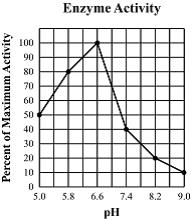
Which of the following conclusions can be drawn from this graph?
a)
The optimum pH of the enzyme is 6.6.
b)
The optimum pH of the enzyme is 5.8
c)
The enzyme’s activity increases as pH increases 5.0 to 9.0
d)
The enzyme’s activity is greater around pH of 8.0 .
49.

What is the function of an enzyme?

a)

enzymes speed up chemical reactions, by increasing activation energy

b)

enzymes slow down chemical reactions, by lowering activation energy

c)

enzymes speed up chemical reactions, by lowering activation energy

d)

enzymes combine products to form reactants

50.

What happens when enzymes are heated to a high temperature?

a)

The enzymes die.

b)

The shapes of the enzyme are altered (denatured)

c)

The enzymes' amino acid sequence changes (mutation)

d)

The enzymes get used up

51.

Which of these is NOT true?

a)

Enzymes can denature when the temperature gets too high.

b)

Enzymes can only be used once in a chemical reaction.

c)

Extreme pH can denature enzymes.

d)

Enzymes speed up chemical reactions.
52.
Which of these is most likely an enzyme?  
a)
Sucrose
b)
Galactose
c)
Fructose
d)
Amylase
53.
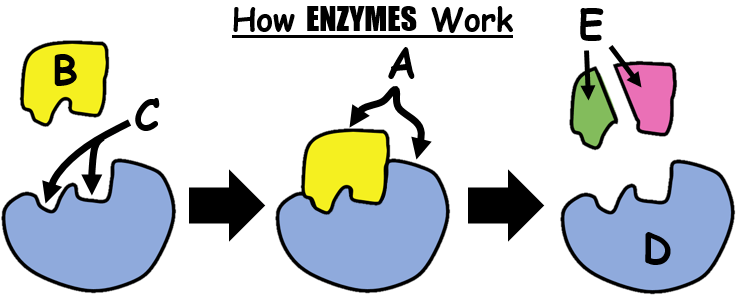
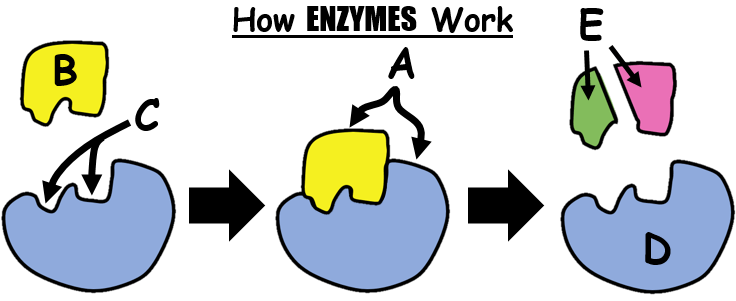
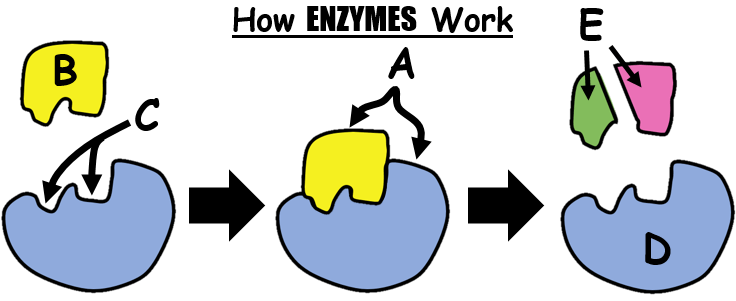
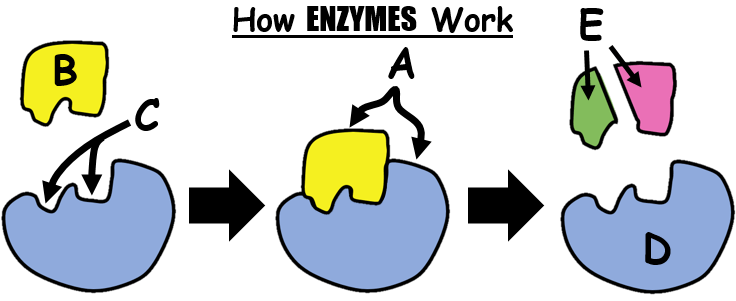
Letter D...
a)
active site
b)
enzyme
c)
substrate
d)
products
54.
Letter B...
a)
active site
b)
enzyme
c)
substrate
d)
products
55.
Letter C...
a)
active site
b)
enzymes
c)
substrate
d)
products
56.
Letter E...
a)
active site
b)
enzyme
c)
substrate
d)
products
57.

Enzyme that breaks down cellulose

a)

Proteinase

b)

Cellulise

c)

Cellulase

d)

Amylase

58.

Indicator used in during amylase demonstration.

a)

Amylase solution

b)

Iodine solution

c)

NaCl solution

d)

Starch solution

59.

Enzyme found in pineapple

a)

Amylase

b)

Lactase

c)

Bromelain

d)

Catalase

60.

The substrate in the Jell-O lab was

a)

bromelain in the canned pineapple

b)

Collagen in the starch

c)

Collagen in the gelatin

d)

bromelain in the fresh pineapple

61.
___________ have 2 functions in the cell membrane.
1.) They act like gatekeepers, only let certain things in. 
2.) Enzyme receptors embedded in the membrane.
a)
Carbohydrates 
b)
Proteins 
c)
Phospholipids 
d)
Cholesterol
62.
This picture represents what type of cell transport?
a)
endocytosis
b)
exocytosis
c)
osmosis
d)
passive transport
63.
This picture represents which type of cellular transport?
a)
passive transport
b)
endocytosis
c)
exocytosis
d)
osmosis
64.
Molecules diffusing with the concentration gradient through a protein channel is...
a)
Facilitated Diffusion
b)
Simple Diffusion
c)
Active Transport
d)
Osmosis
65.
Due to the higher concentration of oxygen in the air than your blood, oxygen goes from the lungs into the red blood cells by....
a)
Facilitated Diffusion
b)
Simple Diffusion
c)
Active Transport
d)
Osmosis
66.
In a nerve cell, ATP energy is used to pump sodium (Na) out of the cell and potassium (K) into the cell. This is an example of...
a)
Facilitated Diffusion
b)
Simple Diffusion
c)
Active Transport
d)
Osmosis
67.
The dispersal of ink in a breaker of water is an example of 
a)
osmosis
b)
diffusion
c)
active transport
68.
The cell below is in a _________ solution.
a)
Hypotonic
b)
Hypertonic
c)
Isotonic
69.
The cell below is in a _____________ solution.
a)
Hypertonic
b)
Hypotonic
c)
Isotonic
70.
A cell in an isotonic solution will
a)
swell
b)
shrink
c)
stay the same size
d)
impossible to tell
71.

What type of transport is this?

a)

facilitated diffusion

b)

active transport

c)

simple diffusion

d)

osmosis

72.

Which substance will move in the following scenario?

a)

NaCl

b)

H20

73.

What type of transport is shown?

a)

Facilitated diffusion

b)

Simple diffusion

c)

Ion channels

d)

Sodium Potassium Pump

74.

What type of transport is shown?

a)

Passive

b)

Active

75.

What is the main purpose of the light dependent reactions?

a)

To provide the energy and electrons for the calvin cycle

b)

To capture energy and make sugar

c)

To reflect green light

d)

To make sugars

76.
Where do the light-independent reactions occur?
a)
thylakoid
b)
stroma
c)
lumen
d)
mitochondria
77.

Where do the light dependent reactions take place?

a)

thylakoid membrane

b)

stroma

c)

lumen

78.

Which of the following is NOT produced in the light dependent reactions?

a)

NADPH

b)

ATP

c)

Oxygen

d)

Glucose

79.
Where does Photosystem II get its electrons?
a)
photosystem I
b)
splitting of water
c)
ATP
d)
NADPH
80.
What is represented by the number 16?
a)
thylakoid
b)
stroma
c)
lumen
d)
inner membrane
81.

Which of the following are products of the light dependent reactions that are utilized in the Calvin cycle?

a)

CO2 and glucose

b)

H2O and O2

c)

ADP and ATP

d)

ATP and NADPH

82.
In green plants, the primary function of the Calvin cycle is to
a)
Use ATP to release carbon
b)
Split water to release oxygen.
c)
Construct simple sugars from carbon dioxide.
d)
Use NADPH to release carbon
83.
Which of the reactions below represents the BALANCED photosynthesis equation?
a)
C6H12O6 + O2 --> H2O + CO2
b)
C6H12O6 + 6 O2 --> 6 H2O + 6 CO2
c)
6 H2O + 6 CO2  -> C6H12O6 + 6 O2
d)
H2O + CO--> C6H12O6 + O2
84.
Use the diagram to answer the question. Between which parts of the molecule must the bonds be broken to form an ADP molecule?
a)
A and B
b)
A and C
c)
B and C
d)
C and D
85.
How many sugar molecules are produced from every six molecules of carbon dioxide that enter the Calvin cycle?
a)
1
b)
3
c)
6
d)
12
86.
Is ADP or ATP more like a fully charged battery, and why?
a)
ADP, because it has three phosphate groups; breaking and reforming the bonds among them releases energy.
b)
ATP, because it has three phosphate groups; breaking and reforming the bonds among them releases energy.
c)
ADP, because it has two phosphate groups; breaking and reforming the bonds among them releases energy.
d)
ATP, because it has two phosphate groups; breaking and reforming the bonds among them releases energy.
87.
Which of the following is considered a waste product of photosynthesis?
a)
glucose
b)
oxygen
c)
carbon dioxide
d)
sunlight
88.
How many ATP can be created from one glucose molecule in aerobic respiration (maximum)?
a)
2
b)
34
c)
36
d)
38
89.
How many ATP molecules are created by fermentation?
a)
0
b)
2
c)
12
d)
36
90.
Which of the following best represents the waste products of cellular respiration?
a)
carbon dioxide and water
b)
carbon dioxide
c)
water
d)
carbon dioxide and oxygen
91.
If your body runs out of oxygen, it will begin to perform ______.
a)
alcohol fermentation
b)
photosynthesis
c)
cellular respiratio
d)
lactic acid fermentation
92.
Where does the Krebs' Cycle occur? 
a)
mitochondrial matrix
b)
outer membrane
c)
chloroplast
d)
cytoplasm
93.

During which step of cellular respiration is the majority of the ATP created?

a)

fermentation

b)

glycolysis

c)

Krebs Cycle

d)

ETC

94.
What is the correct equation for cellular respiration?
a)
6O2 + C6H12O6 -> 6CO2 + 6H2O + Energy
b)
6O2 + C6H12O6 + Energy -> 6CO2 + 6H2O
c)
6CO2 + 6H2O -> 6O2 + C6H12O6 + Energy
d)
6CO2 + 6H2O + Energy -> 6O2 + C6H12O6
95.
The process carried out by yeast that causes bread dough to rise is
a)
alcoholic fermentation
b)
cellular respiration
c)
lactic acid fermentation
d)
mitosis
96.
The first step in getting energy in the cell by breaking down glucose is known as
a)
the Krebs cycle
b)
electron transport
c)
fermentation
d)
glycolysis
97.
What is the difference between respiration and cellular respiration? 
a)
Respiration produces ATP while cellular respiration is gas exchange
b)
Respiration uses glucose while cellular respiration produces glucose
c)
Respiration is gas exchange while cellular respiration produces ATP
d)
respiration produces glucose while cellular respiration produces oxygen
98.
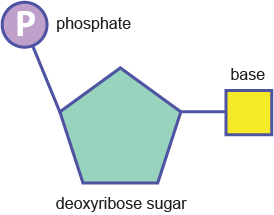
Nucleotides are made up of a sugar, phosphate, and..?
a)
nitrogenous base
b)
nucleic acid
c)
cholesterol
d)
fatty acid
99.
What does DNA stand for?
a)
Deoxyribonucleic acid
b)
Denitrogenous acid
c)
Deribonucleic acid
d)
Diribonucleic acid
100.
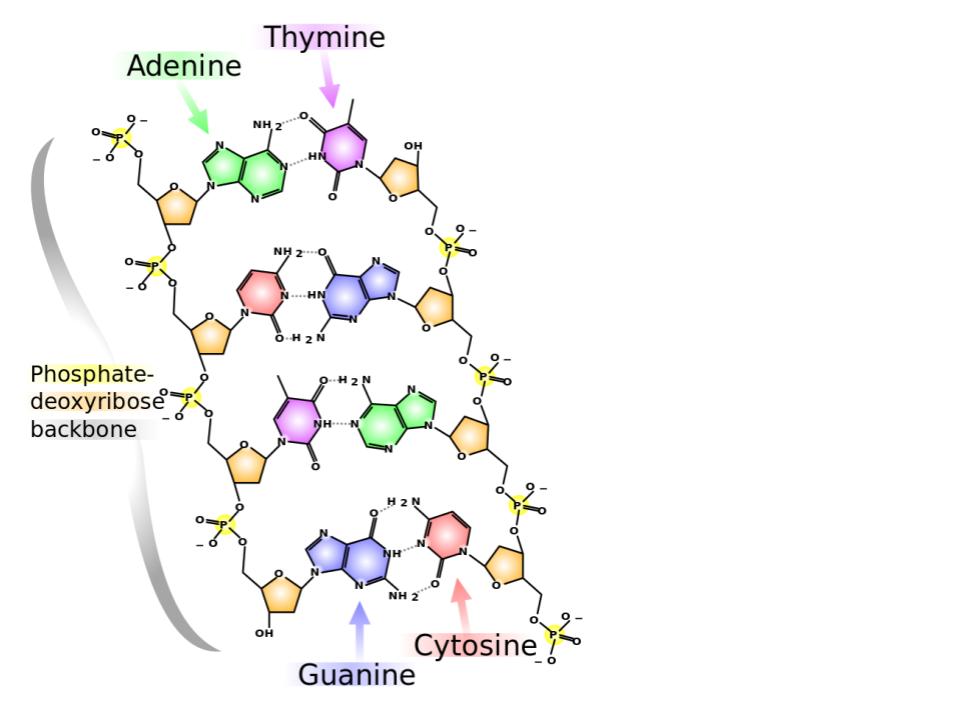
Guanine bonds with ______________.
a)
Adenine
b)
Guanine
c)
Cytosine
d)
Thymine
101.
What determines the code, or information, of a DNA molecule?
a)
the shape (structure) of the nitrogen bases
b)
the order (sequence) of the nitrogen bases
c)
the color of the nitrogen bases
d)
the frequency (number) of nitrogen bases
102.
Which 2 molecules form the sides (backbone) of the DNA ladder?
a)
deoxyribose sugar and adenine
b)
deoxyribose sugar and a hydrogen bond
c)
deoxyribose sugar and the nucleus
d)
deoxyribose sugar and phosphate
103.
The two strands of DNA are held together by:
a)
Hydrogen Bonds
b)
Phosphodiester Bonds
c)
Glycolsyl Bonds
d)
Glycosidic Linkages
104.
Which sequence of DNA bases would pair with this partial strand
ATG TGA CAG
a)
ATG TGA CAG
b)
TAC ACT GTC
c)
GTA AGT GAC
d)
CAT TCA CTG
105.
If the percentage of DNA is made of 30% Thymine, what is the correct percentage of Guanine?
a)
30
b)
15
c)
20
d)
60
106.
The enzyme that unzips the DNA to prepare for replication
a)
helicase
b)
replicase
c)
polymerase
d)
synthase
107.
DNA replication results in two DNA molecules,
a)
each one with two original strands
b)
each one with two new strands
c)
each one with one new strand and one original strand
d)
one with two new strands and the other with two original strands
108.
Fill in the complementary bases according to the base-pair rule in DNA: A T C C A G
a)
T U G G T C
b)
T A G G T C
c)
T A C G T G
d)
T A C C A C
109.
The method of DNA replication is known as:
a)
Semi-conservative
b)
Conservative
c)
Dispersive
d)
Complementary
110.
order of replication
a)
3, 2, 1, 4
b)
2, 1, 4, 3
c)
2, 3, 1, 4
d)
3, 4, 1, 2
111.
Which enzyme is responsible for adding nucleotides ("The Builder")?
a)
Topoisomerase
b)
DNA Polymerase
c)
Ligase
d)
Primase
112.
Which enzyme is responsible for gluing and connecting parts of newly created DNA fragments together ("The Gluer")? 
a)
Topoisomerase
b)
DNA Polymerase
c)
Ligase
d)
Primase
113.
This picture is illustrating the ____ nature of DNA.
a)
anti-parallel
b)
deoxyribosic
c)
helical
d)
radioactive
114.

What small pieces of newly synthesized DNA on the lagging strand called?

a)

Okazaki fragments

b)

Polymer gaps

c)

Helicase fragments

d)

Acidic gaps

115.
What does mRNA do?
a)
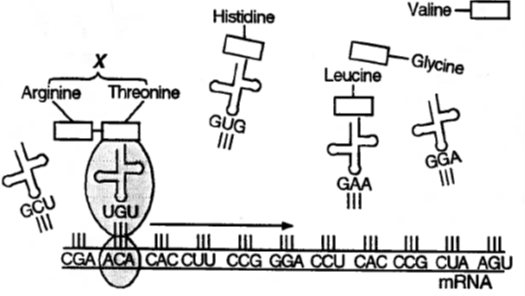
provides information from DNA to ribosomes
b)
transfers amino acids to the ribosomes
c)
makes up ribosomes
d)
builds proteins
116.
What does rRNA do?
a)
provides information from DNA to ribosomes
b)
transfers amino acids to the ribosomes
c)
makes up ribosomes
d)
builds proteins
117.
What does tRNA do?
a)
provides information from DNA to ribosomes
b)
transfers amino acids to the ribosomes
c)
makes up ribosomes
d)
builds proteins
118.
which process is shown?
a)
diffusion
b)
repiration
c)
recombination
d)
translation
119.
When an extra base is inserted into the DNA sequence of a gene, the protein doesn't work. Which explains why?
a)
the base increases rate of translation
b)
the base causes DNA to be transcribed in opposite direction
c)
the inserted base causes the codons in the sequence to be incorrect for the desired protein
d)
the base signals enzymes to translate DNA rather than RNA
120.
The DNA sequence ATCAGCGCTGGC is part of a gene. how many amino acids are coded for by this message?
a)
4
b)
8
c)
12
d)
20
121.
A scientist puts nucleotide chains of UUUUUU in a test tube under conditions allowing protein synthesis. Soon they are only amino acids chains of phenylalinine. What does the experiment indicate?
a)
phenylalanine is composed of uracil
b)
UUU codes for phenylalanine
c)
protein synthesis malfunctions in test tubes
d)
proteins contain one kind of amino acids
122.
DNA sequence is ACAGTGC. How would this be coded on mRNA?
a)
TGTCACG
b)
UGUCACG
c)
GUGACAU
d)
CACUGUA
123.
What is the relationship between a protein, the cell, and DNA?
a)
DNA is produced by protein which is produced in the cell
b)
Protein is composed of DNA which is produced in the cell
c)
DNA controls the production of protein in the cell
d)
A cell is composed of DNA and protein
124.
Genetic info flows in one direction. Which best represents this flow?
a)
DNA-protein-RNA
b)
Protein-RNA-DNA
c)
RNA-protein-DNA
d)
DNA-RNA-protein
125.
Which process?
a)
mutation
b)
transcription
c)
respiration
d)
translation
126.
What process is going on in this photo? 
a)
Transcription 
b)
Translation 
c)
Replication 
d)
All the above 
127.

What is the location in the cell for translation?

a)

nucleus

b)

mitochondria in cytoplasm

c)

ribosome in cytoplasm

d)

chloroplast in cytoplasm

128.
What is the location in the cell for transcription?
a)
nucleus
b)
cytoplasm
c)
ribosome
d)
mitochondria
129.
Diploid Cells are represented by
a)
2n
b)
n
c)
4n
d)
1/2 n
130.
What would indicate a human female?
a)
XX
b)
XYY
c)
XY
d)
XXY
131.
What is the haploid number for this Karyotype?
a)
54
b)
27
c)
13
132.
What is the diploid number for this Karyotype?
a)
54
b)
27
c)
13
133.
The biological gender of a person with the notation 47 XXY is...
a)
female
b)
male
c)
both 
d)
neither
134.
There are 18 chromosomes in the root cell of a carrot, How many chromosomes are found in the pollen cells of the carrot?
a)
18
b)
9
c)
27
d)
36
135.
Which is the correct sequence? 
a)
mitosis - gametes - zygote - meiosis - fertilization - embryo
b)
Fertilization-mitosis-zygote-gametes-meiosis-embryo
c)
meiosis-zygote-gametes-mitosis-fertilization-embryo
d)
meiosis-gametes-fertilization-zygote-mitosis-embryo
136.
If a wing cell of a beetle has 10 chromosomes, how many chromosomes will be in one stomach cell from this beetle?
a)
2
b)
5
c)
10
d)
20
137.
In what organism will the chromosome number  in gametes vary and make the gametes unusable?
a)
Horse
b)
Donkey 
c)
Mule
138.
Crossing over and random assortment lead to _____________
a)
reduced chromosome number
b)
specialized sex cells
c)
genetic variation
d)
Homozygous alleles
139.

Hydra produce offspring by growing the new individual on the body of the parent. This is an example of...

a)

budding.

b)

fission.

c)

regeneration.

d)

tubers.

140.

Which statement describes why genetic variation is beneficial to populations of organisms?

a)

individuals look different from one another

b)

only one parent is needed to produce offspring

c)

populations of the organism increase more rapidly

d)

species can better survive environmental changes

141.

Amoeba use mitosis and produce two offspring that are identical to the parent. This is an example of...

a)

budding.

b)

binary fission.

c)

regeneration.

d)

parthenogenesis.

142.

Which of the following types of reproduction would result in the greatest genetic diversity in the offspring?

a)
b)
c)
d)
143.

Which of the following are advantages of asexual reproduction? Select all that apply.

a)

Overcrowding possible

b)

Inability to adapt to new environments

c)

Quicker process

d)

Produces more offspring

144.
What is the central dogma of biology?
a)
Proteins are made from RNA that assembles amino acids through DNA ribosomes.
b)
RNA copies all information for an organism onto DNA which assembles ribosomes, and creates amino acids from proteins
c)
DNA is the blueprint for an organism. RNA copies specific sections that need to be built and transfers that information to a ribosome which assembles proteins out of amino acids.
d)
RNA is the blueprint for an organism. It copies its information onto DNA, which takes amino acids (like lego building blocks) and assembles those acids into proteins.
145.
ATTTGAGCC- Original
ATTGAGCC - Mutated
The example above is an example of a 
a)
Insertion- Frameshift
b)
Deletion- Substitution
c)
Deletion -Frameshift
d)
All of the above
146.
Would a mutation in the DNA of a skin cell be passed on to an organism's offspring?
a)
Yes, because any change to the DNA is passed on to the offspring
b)
Maybe. Sex cells only use half of the body's genetic code. It might get the copy of a gene that wasn't mutated.
c)
No. Only mutations that occur in the gametes (sex cells) are passed on to the offspring
d)
Without knowing the animal, it would be hard to tell whether or not the mutation would be passed on.
147.
A type mutation in which the sequence of   amino acids does not change is called 
a)
Missense
b)
Nonsense
c)
Silent
d)
Deletion
148.
Which process and type of resulting cells are represented?
a)
mitosis, gametes
b)
mitosis, body cells
c)
meiosis, gametes
d)
meiosis, body cells
149.
Why do we need meiosis?
a)
To double the number of chromosomes going into sex cells
b)
To reduce the number of chromosomes going into sex cells
c)
To triple the number of chromosomes going into sex cells
d)
To not change the number of chromosomes going into sex cells
150.
The structure labeled A is a(n)
a)
chromatid
b)
centriole
c)
centromere
d)
chromophere
151.
The structures labeled B are
a)
centrioles
b)
chromatids
c)
centromeres
d)
chromopheres
152.
What phase is represented?
a)
metaphase 1
b)
metaphase 2
c)
anaphase 1
d)
anaphase 2
153.
What phase is represented?
a)
metaphase 1
b)
metaphase 2
c)
anaphase 1
d)
anaphase 2
154.
This picture shows which process? 
a)
mitosis
b)
meiosis
c)
the cell cycle
155.
In mitosis, the two resulting cells are
a)
different from the starting cell and identical to each other.
b)
different from the starting cell and different from each other.
c)
identical to the starting cell and different from each other.
d)
identical to the starting cell and identical to each other.
156.
In meiosis, the four resulting cells are 
a)
identical to the starting cell and different from each other.
b)
different from the starting cell and different from each other. 
c)
identical to the starting cell and identical to each other.
d)
different from the starting cell and identical to each other.
157.
If a gene is found only on the X chromosome and not the Y chromosome, it is said to be what?
a)
sex-linked trait
b)
polygenic trait
c)
codominant trait
d)
incomplete dominance trait
158.

What is the genotype of a person with type A blood, who had a father with type O blood?

a)

AB

b)

AO

c)

AA

d)

OO

159.

This is an example of ___________?

a)

Incomplete dominance

b)

Codominance

c)

Multiple Alleles

d)

Polygenic Inheritance

160.

This is an example of ___________.

a)

Incomplete Dominance

b)

Codominance

c)

Multiple Alleles

d)

Polygenic Inheritance

161.

What type of inheritance do two alleles have if their traits blend together?

a)

Incomplete Dominance

b)

Codominance

c)

Complete dominance

d)

Sex-Linked

162.

Many genes determine 1 trait (ex: skin color)

a)

Incomplete Dominance

b)

Polygenic

c)

Codominance

d)

Multiple alleles

163.

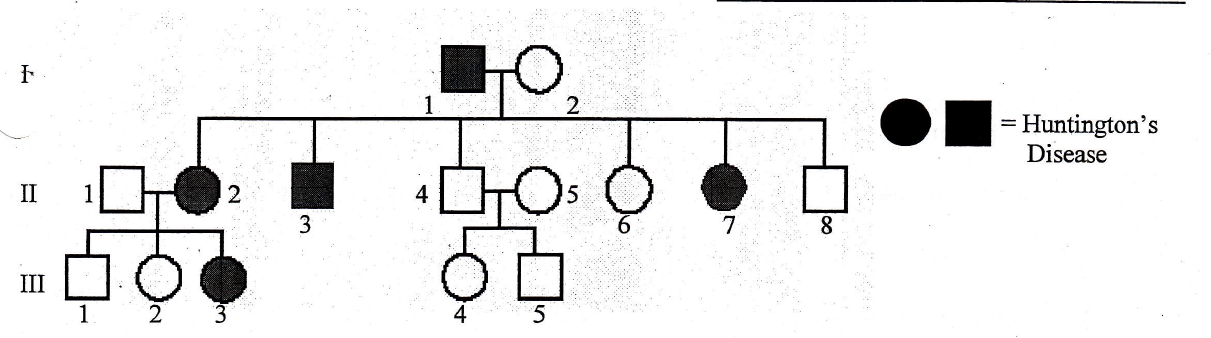
There are no carriers for Huntington's Disease- you either have it or you don't. Is Huntington's disease autosomal dominant or autosomal recessive?

a)

Dominant

b)

Recessive

164.
If this pedigree shows an autosomal recessive disorder, what MUST the genotype of individual II-3 be?
a)
HH
b)
Hh
c)
hh
d)
None of the above
165.

Hemophilia is a recessive sex-linked trait. If H = normal & h = has hemophilia, which genotype represents a male with hemophilia.

a)

XHY

b)

XHXh

c)

XhXh

d)

XhY

166.
Imagine the shaded individuals are those WITH a "hitchhikers thumb." What must be the genotype of individual II-1?
a)
TT
b)
tt
c)
Tt
d)
Impossible to tell
167.
Why do all the daughters in Generation II carry the colorblind gene?
a)
Because mom passed on the gene.
b)
Because dad passed on the X chromosome.
c)
Because their brother has it.
d)
Because their brother gave it to them.
168.
Genotype refers to the ...
a)
physical expression of the genes
b)
the possible combination of alleles in a gene
c)
whether an allele is dominant or recessive
d)
how an organism will appear
169.
having two of the same genes for the trait (sometimes called purebred).
a)
homozygous
b)
hetrozygous
c)
protein
d)
chromosome
170.
having two different genes for a trait (sometimes called hybrid).
a)
protein
b)
homozygous
c)
heterozygous
d)
genotype
171.
G = green, g = yellow
The genotype for a yellow plant is...
a)
GG
b)
Gg
c)
gg
d)
all of the choices result in yellow
172.
What does heterozygous mean?
a)
An organism that has the same genes for a trait (TT or tt)
b)
An organism that has different genes for a trait (Tt)
c)
When neither gene is fully dominant; offspring is a mixture of both
d)
the different forms of a trait (hair color--> brown, blonde, red
173.
A GMO is
a)
A mutant animal
b)
An organism that is made up of lots of different organisms
c)
a genetically mutated option of the human genome
d)
an organism whose DNA has been purposely altered by human intervention
174.
The mathematical chance that something will happen is known as...
a)
chance
b)
luck
c)
probability
175.
What would the ratio for genotypes be for this Punnett Square?
a)
2Bb:2bb
b)
2BB:2Bb
c)
1BB:2Bb:1bb
d)
4Bb
176.
Blood types are an example of co dominance and
a)
incomplete dominance
b)
sex linked traits
c)
multiple alleles
d)
polygenics
177.
In a certain breed of dog, black fur (B) is dominant to brown fur (b). However, a second gene is epistatic to the color locus (center) and can inhibit pigment formation resulting in yellow fur (I). The recessive allele (i) on the other hand permits pigment deposition in the fur. What would be the phenotypes of parents with the following genotypes? bbii x BbIi
a)
brown and black
b)
brown and yellow
c)
yellow and yellow
d)
yellow and black
178.
Which of the following would be an example of gene therapy technology?
a)
development of a nasal spray that contains copies of the normal gene that is defective in person with cystic fibrosis
b)
cutting DNA into fragments with restriction enzymes
c)
modifying E. coli to produce indigo dye for coloring denim blue jeans
d)
separation DNA fragments using gel electrophoresis
179.
____ are produced when DNA from another species is inserted into the genome of an organism, which then begins to produce the protein encoded on the recombinant DNA.
a)
vectors
b)
plasmids
c)
transgenic organisms
d)
gene guns
180.
Genetic engineering has produced goats whose milk contains proteins that can be used as medicines. This effect was produced by
a)
mixing genes into the milk
b)
injecting genes into the goats udders
c)
inserting foreign genes into fertilized goat eggs
d)
genetically modifying the nutritional needs of the goats offspring 
181.
When a virus invades a living cell, its _______
takes over the cell's functions.
a)
outer coat
b)
genetic material
c)
core
d)
cytoplasm
182.
What provides direct energy for the virus?
a)
food
b)
its host
c)
the sun
d)
a parasite
183.
Which of the following is one important difference between a virus and a bacterial cell?
a)
a virus is much larger in size than a bacterial cell
b)
a virus always causes more severe disease than a bacterial cell
c)
a virus can never reproduce on its own, but a bacterial cell can
d)
a virus does not contain genetic material, but a bacterial cell does