Wayground logo

Free Printable Worksheets

Font size

S
M
L
XL
Worksheets

MR M - BTEC SPORT L3 - Revision Quiz

Total questions: 85

Worksheet time: 18mins

Name
Class
Date
1.
What is the biggest bone in your body?
a)
fibula
b)
humerus
c)
pelvis
d)
femur
2.
What is another name for your collar bone?
a)
scapula
b)
clavicle
c)
patella
d)
sternum
3.
What is another name for your shin bone?
a)
fibula
b)
tibia
c)
thigh bone
d)
femur
4.
What do your bones protect?
a)
organs
b)
skin
c)
muscles
d)
feelings
5.
What bones protect your heart and lungs?
a)
pelvis and spine
b)
brain and spine
c)
ribs and sternum
d)
ribs and pelvis
6.
What are the three jobs of your bones?
a)
movement, structure, joints
b)
movement, structure, protection
c)
structure, digestion and breathing
d)
movement, digestion and breathing
7.
What does your bone marrow make?
a)
muscles
b)
cartilage
c)
blood cells
d)
germs
8.
Where are three places you can find cartilage?
a)
nose, tongue and eyes
b)
nose, ears and joints
c)
fingernails, lips and eyes
d)
skin, eyes and lungs
9.
What do we call the place where two or more bones meet?
a)
head
b)
cranium
c)
joints
d)
feet
10.

In this picture, what bone(s) are highlighted in red?

a)

Humerus

b)

Radius

c)

Ulna

d)

Mandible

11.

In this picture, what is represented in multi-colors?

a)

Carpals

b)

Tarsals

c)

Phalanges

d)

Radius

12.

What is the section of the hand highlighted in red?

a)

Phalanges

b)

Meta-Tarsals

c)

Meta-Carpals

d)

Cranium

13.

What is the name of the bone(s) highlighted in red?

a)

Humerus

b)

Carpals

c)

Ulna

d)

Radius

14.
Carpals and tarsals (flat bones) are examples of this type of joint
a)
condyloid
b)
gliding
c)
hinge
d)
saddle
15.
Which of the following is a joint that can freely move?
a)
fibrous
b)
cartilaginous
c)
synovial
16.
Hip and shoulder have examples of this type of joint
a)
ball and socket
b)
condyloid
c)
hinge
d)
gliding
17.
The elbows, knees and phalanges are examples of this type of joint
a)
ball and socket
b)
condyloid
c)
gliding
d)
hinge
18.
Movement away from the mid-line is called _____________.
a)
abduction
b)
adduction
c)
internal rotation
d)
external rotation
19.
Moving a part so that its end follows a circular path (moving a finger in a circular motion without the the hand).
a)
circumduction
b)
rotation
c)
opposition
d)
retraction
20.

What Bone Type is for weight bearing activities?

a)

Long

b)

Short

c)

Flat

d)

Irregular

21.

What is the Agonist also known as?

a)

Prime Mover

b)

Secondary Contractor

c)

Primary Contractor

d)

Concentric Mover

22.

Pick The Skeletal Additional Factor

a)

Osteoporosis

b)

Cramp

c)

Osteoblasts

d)

Osteoclasts

23.

During _______ Gaseous Exchange occurs

a)

Capillarisation

b)

Diffusion

c)

Alveoisation

d)

Bone Growth

24.

During Expiration what do the Intercostal Muscles do?

a)

Contract

b)

Lengthens

c)

Relax

d)

Contract

25.

What is the function of the Bicuspid Valve?

a)

Prevents Back-flow from the left atrium to the left ventricle

b)

Carries oxygenated blood away from the heart

c)

Prevents Back-flow from the right atrium to the right ventricle

d)

Allows de-oxygenated blood to flow to the heart

26.

This is at the end of a bone, cushions/tough

a)

cartilage

b)

tendon

c)

ligament

27.

This attaches bone to muscle.

a)

cartilage

b)

tendon

c)

ligament

28.

Definition: "The volume of air

breathed in and out

with each breath"

a)

Breathing rate

b)

Tidal Volume

c)

Inspiratory Reserve Volume

d)

Vital Capacity

29.

Definition: "The amount of air that can be forced out of the lungs after maximal inspiration."

a)

Tidal Volume

b)

Breathing Rate

c)

Vital Capacity

d)

Inspiratory Reserve Volume

30.

Select the acute adaptations of the respiratory system

a)

Increased breathing rate

b)

Increased strength of respiratory muscles

c)

Increased size of thoracic cavity

d)

Increased tidal volume

31.
a)
Quadriceps
b)
Satorius
c)
Hamstring
d)
Gastronecmius
32.
a)
Latissmius Dorise
b)
Erectors
c)
Deltoids
d)
Abdominal
33.
a)
Tricep
b)
Deltoid
c)
Hamstring
d)
Bicep
34.
a)
Trapezius
b)
Gluteals
c)
Deltoid
d)
Hamstring
35.
a)
Hamstrin
b)
Quadricep
c)
Tibialis Anterior
d)
Gastrocenmius
36.
a)
Glutueal
b)
Hamstring
c)
Quadricep
d)
External Oblique
37.
a)
Pectoral
b)
Tricep
c)
Bicep
d)
Deltoid
38.
a)
Hamstring
b)
Quadriceps
c)
Gastronecmius
d)
Satorius
39.
a)
Latissimius Dorsi
b)
Trapezius
c)
Triceps
d)
Erectors
40.

Which of the following are adaptations to endurance training?

a)

greater cardiac output

b)

horizontal running

c)

increased VO2 max

d)

higher anaerobic threshold

41.

Select the correct adaptations to plyometric training.

a)

increased speed

b)

increased power

c)

decreased speed

d)

improved neuromuscular

42.

Contractions that cause the muscle shortens and does work to cause movement

a)

concentric contractions

b)

eccentric contractions

c)

isometric contractions

d)

isokinetic contractions

43.

During exercise, your breathing rate increased in order to accommodate:

a)

Increased carbon dioxide needs of your muscles

b)

Increased oxygen needs of your stomach

c)

Increased oxygen needs of your muscles

d)

Increased carbon dioxide needs of your stomach

44.
Micro tears usually occur due to what type of exercise?
a)
Low intensity aerobic
b)
Resistance
c)
Flexibility
d)
Motor skills
45.
DOMS is TYPICALLY felt in muscles after how long of exercise ending?
a)
0-12
b)
12-24
c)
24-48
d)
48-36
46.
DOMS occur most when carrying out which type of muscle contraction?
a)
Concentric
b)
Eccentric
c)
Isometric
47.
If we train at a high intensity, which fibres will experience hypertrophy?
a)
Fast Twitch
b)
Slow Twitch
48.
An increase in levels of ATP and PC means we can......
a)
sprint quicker
b)
Lift a heavier weight
c)
Maintain a maximal sprint for longer
d)
Work for a longer period of time.
49.
What does glycolytic capacity mean?
a)
The maximum amount of glycogen you can have in your muscles. 
b)
How much glycogen we have in our muscles
c)
The ability of our muscles to break down glycogen.
50.
Which of these statements is true?
a)
Training aerobically will decrease your speed.
b)
Training anaerobically will descrease your cardiovascular endurance.
c)
Training aerobically means that you can work at a higher intensity for longer.
d)
Training anaerbically means that you can work at a high intensity for longer
51.
Aerobic exercise increases the size and number of what?
a)
Our biceps
b)
Our mitchochondria
c)
Our cells
d)
Our height
52.
Myoglobin is what?
a)
The substance used to carry Oxygen
b)
A type of cell
c)
A part of a cell
d)
A substance that is broken down from glucose. 
53.
Movements that you cannot control
a)
Strain
b)
Sprain
c)
Voluntary
d)
Involuntary
54.
These muscles are found in your organs
a)
Skeletal
b)
Smooth
c)
Rough
d)
Cardiac
55.
Food that are good for the muscular system have
a)
Calcium and Phosphorus
b)
Vitamin A and Vitamin B
c)
Protein and Vitamin C
d)
Protein and Carbohydrates
56.
What are the characteristics of fast twitch muscle fibres?
a)
Explosive activities, fatigue slowly
b)
Endurance activities, fatigue slowly
c)
Explosive activities, fatigue quickly
d)
Endurance activities, fatigue quickly
57.

What would the predominant muscle fibre type be for this athlete?

a)

Slow Twitch

b)

Fast Twitch A

c)

Fast Twitch B/X

d)

Combination of Slow and Fast

58.
Which one of the following is a key characteristic of slow twitch muscle fibers? 
a)
They contain large amounts of Mitochondria
b)
They are fast to fatigue
c)
They are recruited last
d)
They contain low numbers of Mitochondria
59.
Muscle fatigue sets in due to the non-availability of 
a)
calcium
b)
ATP
c)
actin binding sites
d)
sodium
60.
Muscle remains contracted due to overuse, lack of water, or lack of oxygen
a)
Strain
b)
Sprain
c)
Cramp
d)
Pulled Muscle
61.
Given the following structures:
1. larynx
2. nasal cavity
3. pharynx
4. trachea
Which of the following is the correct order that air would flow during inhalation. 
a)
1,2,3,4
b)
2,3,1,4
c)
2,1,3,4
d)
4,2,3,1 
62.
Given the following structures:
1. alveoli
2. bronchi
3. bronchioles
Which of the following is the correct order in which air would flow after inhalation? 
a)
1,2,3
b)
2,1,3
c)
2,3,1
d)
3,2,1
63.
The actual gas exchange with the blood occurs in the 
a)
bronchi
b)
bronchioles
c)
alveoli
d)
ventricles
64.
The energy used to make ATP comes from...
a)
oxygen
b)
carbon dioxide
c)
glucose
d)
water
65.
The movement of oxygen from the alveoli to the blood and from the blood to the tissues is due to the process of... 
a)
osmosis
b)
diffusion
c)
cytokinesis
d)
phagocytosis
66.
The job of the red blood cell is to
a)
fight infection
b)
deliver oxygen and discard carbon dioxide
c)
form scabs
67.
The four parts of the blood are
a)
plasma, platelets, red blood cells, white blood cells
b)
plasma, blue blood cells, white blood cells, red blood cells
c)
ventricle, atrium, vein, artery
68.
ATP stands for?
a)
adenosine thephate
b)
adenosine triphosphate 
c)
alright triphosphate
d)
phosphocreatine
69.
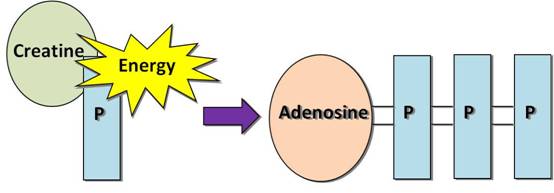
What is the fuel for ATP-PC
a)
glucose
b)
phosphocreatine
c)
fatty acids
d)
fats
70.
What is the by-product of anaerobic glycolosis?
a)
Carbon Dioxide
b)
Water
c)
Lactic Acid
d)
Urine
71.
How long will the Aerobic energy system last?
a)
3mins
b)
2 hours
c)
3 hours
d)
3mins + until stores run out
72.
What energy system will this athlete use?
a)
ATP-PC System
b)
Lactic Acid System
c)
Aerobic System
d)
All three
73.
What will ATP become when it loses a phosphate?
a)
Adenosine  Monophosphate 
b)
Adenosine Triphosphate
c)
Adenine
d)
Adenosine Diphosphate 
74.

Why does the body require the three different energy systems?

a)

It doesn't require three different systems

b)

Different sports have different demands

c)

Intensity and duration of different activities and the availability of oxygen

d)

Physical exercise usually takes longer than a few minutes

75.

What is the main function of the Anaerobic Glycolysis System during performance?

a)

To contribute additional energy for a burst of higher intensity work

b)

To assist in recovery

c)

To meet any energy demands

d)

To produce energy quickly

76.

The Anaerobic Glycolysis System usually lasts for how long?

a)

0-10 seconds

b)

10 seconds - 2 minutes

c)

2 + minutes

d)

1 hour +

77.

The ATP - PC System usually lasts for how long?

a)

0-10 seconds

b)

10 seconds - 2 minutes

c)

2 + minutes

d)

1 hour +

78.

The ATP - PC System usually takes how long to replenish?

a)

10-14 seconds

b)

1-2 minutes

c)

30+ minutes

d)

12+ hours

79.

The sport of Shot Put relies primarily on what Energy System?

a)

ATP-CP System

b)

Anaerobic System

c)

Aerobic System

80.

ADP is...

a)

A precursor to the formation of Lactic Acid.

b)

The by-product of the Anaerobic Energy System.

c)

What ATP becomes after releasing a Phosphate.

81.
The number of ATP molecules produced out of Krebs Cycle is:
a)
2
b)
3
c)
4
d)
0
82.
In glycolysis, glucose is converted into two molecules of _____. 
a)
citric acid
b)
oxaloacetic acid
c)
pyruvic acid
d)
Acetyl CoA
83.
How many ATP are produced in the Electron Transport Chain?
a)
2
b)
30
c)
34
d)
38
84.
What is a product of the Electron Transport Chain?
a)
CO2
b)
O2
c)
C6H1206
d)
H2O
85.

What might happen if your body couldn't process glucose?

a)

You wouldn't be able to digest food

b)

You wouldn't have the energy to function

c)

You would become more likely to catch diseases

d)

You would constantly be thirsty for water