wayground logo

Free Printable Worksheets

Font size

S
M
L
XL
Worksheets

Epistemology Cup Championship

Total questions: 127

Worksheet time: 2hrs 3mins

Name
Class
Date
1.
Building dams, channels, canals, and ditches to bring water to crops 
a)
irrigation
b)
nomads
c)
ziggurat
d)
scribes
2.
"the land between the rivers"; an early civilization between the Tigris and Euphrates Rivers
a)
China
b)
India
c)
Egypt
d)
Mesopotamia
3.
A form of writing that uses groups of wedges and lines. It originated in Mesopotamia.
a)
Heiroglyphics
b)
Cuneiform
c)
Sumerian
d)
Sanskrit
4.
Besides providing a stable food diet, what other advantage did Egypt's location provide for early Egyptians?
a)
Temples to worship in
b)
Sumerian artwork
c)
Natural barriers to protect them
d)
2 dynasties to celebrate religious tradtion
5.
Which statement can best be supported by the information shown on this map?
a)
By 260 B.C., the Mauryan Empire extended north into Central China.
b)
The Mauryan Empire controlled more of the Indian subcontinent than the Gupta Empire did.
c)
Most of the Gupta Empire was located on the Deccan Plateau.
d)
The economies of India's early empires were based on trade.
6.

Where did all of these civilizations develop?

● Mesopotamia

● Egypt

● China

● India

a)

in river valleys

b)

in the mountian range

c)

in the coastal region

d)

in the rain forest region

7.
Legal codes which were the basis of Roman Law
a)
Twelve Tables 
b)
Caesars Code
c)
Romulus reforms
d)
Roman Tablets of Truths
8.
During the Roman Republic, the senate was a select group of
a)
Patricians
b)
Plebeians
c)
Consuls
d)
Both Patricians & Plebeians
9.
200 years of Roman Peace
a)
Pax Sinica
b)
Pax Romana
c)
Golden Horde
d)
Roman Republic
10.
Which emperor made Christianity a legal religion in the empire?
a)
Constantine
b)
Diocletian
c)
Caesar
d)
Nero
11.
Romans were the first to use which building material?
a)
bricks
b)
concrete
c)
stones
d)
wood
12.
During the 1st Century, Christians in the Roman Empire were:
a)
all enslaved
b)
ignored as unimportant
c)
persecuted by the government
d)
welcomed and the religion quickly spread
13.
Where did the Greeks establish city-states and colonies?
a)
Along the Atlantic Coast
b)
Along the Mediterranean Sea
c)
Along the Arabian Sea
d)
Along the Red Sea
14.
What did the Greeks call other peoples?
a)
Traitors
b)
Barbarians
c)
Huns
d)
Northerners
15.
How did Greece and Rome relate to one another?
a)
The Greeks copied the earlier Roman civilization
b)
The Romans copied the earlier Greek civilization
c)
The Greeks conquered the earlier Roman 
d)
The Greeks and Romans are very different
16.
Why did the Geography of Greece prevent unification of the Balkan peninsula?
a)
There was not enough sea going trade
b)
The peninsula was divided by mountains so that the city-state predominated Greek Politics
c)
There was too much sea going trade
d)
Slavery had not developed yet
17.
What were the two leading city-states of Greece?
a)
Olympus and Athens
b)
Sparta and Athens
c)
Sparta and Corinth
d)
Athens and Thebes
18.
How did this Greek architecture get to modern TURKEY?
a)
The Hellenic Period
b)
The Hellenistic Period
c)
The Trojan Wars
d)
The Peleponnesian Wars
19.
Who were the three great philosophers of Athens?
a)
Huey, Dewey, Louie
b)
Donatello, Leonardo, Michaelangelo
c)
Nietzche, Locke, Hobbes
d)
Socrates, Plato, Aristotle
20.
At the heart of the Hellenistic world stood the city of _______________________ located in Egypt
a)
Cairo
b)
Alexandria
c)
Giza
d)
Aswan
21.

The Byzantines came from the Eastern part of the Roman empire. The Western half fell in?

a)

422 AD

b)

500 BC

c)

476 AD

d)

527 AD

22.
Which groups had the most influence on the government, culture and beliefs of the Byzantine Empire? 
a)
Arians, Huns and Vandals 
b)
Muslims and Persians 
c)
Jews and Visigoths 
d)
Romans, Greeks and Christians 
23.
Why was Constantinople such a prosperous city?
a)
Trade hub for Europe, Asia, and Africa
b)
Great architecture 
c)
Autocratic rulers 
d)
The pope lives there
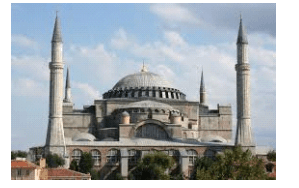
24.
Identify this Byzantine Church that was commissioned by Justinian.
a)
Hagia Sophia
b)
National Cathedral
c)
Notre Dame
d)
Taj Mahal
25.
In 726 AD, Byzantine emperor LeoIII banned the use of icons, or religious images.  This became a controversial issue because not all Byzantines agreed with the ban.  This was one of several controversies that contributed to the 
a)
banning of the practice of any religion other than Christianity in the empire
b)
Byzantine Empire's creation of the separation of church and state
c)
split between the Roman Catholic Church and the Eastern Orthodox Church
d)
weakening of the Church and the rise of Islam within the Byzantine Empire
26.
In 1054, differences between the  Eastern and Western churches grew, causing a split known as 
a)
The Great Scism
b)
The Great Seperation 
c)
The Great Schism
d)
The Great divide
27.
What is iconoclasm?
a)
Icon worship
b)
Icon making
c)
Icon smashing
d)
Icon selling
28.
Based on the map, at which point did Islam Expand into Western Europe?
a)
622-632 CE
b)
632-661 CE
c)
661-750 CE
d)
Islam was never able to make a foothold in W. Europe
29.
Which of the following is not a Holy City to Muslims?
a)
Damascus
b)
Jerusalem
c)
Mecca
d)
Medina
30.
When comparing women in the pre Islamic era to that of Byzantium and Persia, which is true?
a)
Women had less rights in pre Islam Arabia.
b)
Most women held positions of political power in the  Arabian Peninsula.
c)
Women had far more rights in pre Islamic Arabia compared to surrounding areas.
d)
The roles of women in pre Islamic Arabia was about equal to that of other areas.
31.
THIS group led the Muslim Empire to it's Golden Age of learning and culture.
a)
Seljuk Turks
b)
Umayyads
c)
Abassids
d)
Rightly Guided
32.
What is a bazaar?
a)
A covered marketplace where goods from all over the known world were sold
b)
A palace for caliphs or other important officials
c)
A trade center for wealthy merchants and exclusive clientele.
d)
A type of art work used to decorate Arabic letters.
33.
Medieval Muslim scholars preserved Greek and Roman texts as well as discovered many innovations that we still use today including
a)
Alchemy
b)
Iron and metalworking
c)
Concept of Zero
d)
Algebra
34.
Why were the Islamic Caliphates tolerant of Christians and Jews?
a)
They needed help fighting Hindus in India
b)
They were not controlled by the Caliphates
c)
Islam recognized them as true because of their belief in God
d)
They also believed that Jesus was the son of God
35.
In the Empire of Mali, who was Mali's greatest leader?
a)
Mufusa
b)
Mansa Musa
c)
King Kong
d)
Nelson Mandela
36.
How did Ghana become so wealthy?
a)
big business
b)
center of trade route
c)
colonies
d)
television
37.
What is the most important crop of the Incas?
a)
Chocolate
b)
Corn
c)
Squash
d)
Potatoes
38.
What animal was the most useful in the exchange of gold, silk, and salt?
a)
Camel
b)
Horse
c)
Elephant
d)
Alpaca
39.
What were the 3 largest West African Empires?
a)
Songhai, Mali, and Nigeria
b)
Mali, Songhai, and Ghana
c)
Ghana, Songhai, and Bachwezi
d)
Aksum, Ghana, Mali
40.
Floating gardens that were used to grow food crops in swampy conditions were known as
a)
hieroglyphics
b)
chinampas
c)
mesoamerica
d)
terraces
41.
How did the spread of Islam in the 600s contribute to the growth of trade? 
a)
The hajj promoted international travel
b)
Arabs conquered the kingdom of Ghana.
c)
Muslims became merchants in West African towns
d)
North African nomads refused to conver
42.
What was the staple crop (most important food source) for the Maya people?
a)
Avocados
b)
Rubber
c)
Maize (corn)
d)
Bananas
43.
Large agricultural estates run by an owner or an owner's overseer and worked by slaves.
a)
Plantations
b)
Commune
c)
Farmstead
d)
Estate
44.
Why did China return to isolationism even though they had successful voyages?
a)
All their ships sunk 
b)
believed they didn't have anything to gain and it was too expensive
c)
They wanted to spread their religion and culture but no one excepted it
d)
believed they were too important to be traveling to other far off places
45.
What would have been the MOST common European language found in the area in red?
a)
Spainish
b)
English
c)
Dutch
d)
French
46.
·  Trade was operated through private ownership by merchants and ship owners
·  Export more goods than your country imports to create a favorable balance of trade
·  Colonies can only trade with their mother country
·  Build colonies to supply raw materials or resources, and to provide markets to sell goods
·  Place tariffs on goods imported from other countries
a)
Mercantilism
b)
Capitalism 
47.
What was the purpose of Zheng He's explorations? 
a)
Establish diplomatic relations & promote Chinese superiority 
b)
To establish a new colony for China
c)
To establish new trading partners with the Western world 
d)
To gain allies for a future war
48.

Which statement does NOT describe the Middle Passage

a)

Suicide, starvation, and disease are primary causes of death

b)

Journey of slaves from Africa to Europe

c)

Traveled across the Atlantic Ocean

d)

Crammed into tight fitting spaces

49.
How did the discovery and colonization of the New World lead to international trade?
a)
It strengthened the Feudal system.
b)
Colonies provided raw materials and markets to sell to.
c)
Colonies discouraged international trade.
d)
It strengthened relations with Native Americans.
50.
What are joint-stock companies?
a)
Business structures that have certain rights, privileges, and liabilities beyond those of an individual.
b)
Legal relationships in which one person, called the trustee, holds property for the benefit of another person, called the beneficiary.
c)
Partnerships of investors who buy shares of stock in the company.
d)
Organized groups of people who share a common interest, activity, or purpose
51.

In colonial Latin America, the main purpose of the encomienda system was to

a)

insure that the Indians were humanely treated

b)

provide a steady labor supply for early colonists

c)

prevent slaver in Spain’s New World colonies

d)

build and maintain forts to repel foreign invaders

52.
The Japanese used which of the following techniques to signal to Christian missionaries that Christianity was not welcome in Japan
a)
Mean notes
b)
Shooting at Christian Ships
c)
Chuck Norris
d)
Cruxifiction
53.
The period of 1450- 1650 is often referred to by historians as the
a)
"age of gunpowder empires"
b)
"age of Christ"
c)
"age of tolerance"
d)
"the age of agriculture"
54.
Ruler of the Ottoman Empire known for strengthening the government and an improved justice system.  His rule is considered the golden age of the Ottoman Empire. 
a)
Suleiman the Magnificent 
b)
Peter the Great 
c)
Edo
d)
Louis XIV
55.
All of the following are examples of Akbar's policies which led to cultural diffusion due to his religious tolerance EXCEPT:
a)
He married Hindi princesses and allowed them to practice Hindu rituals.
b)
He appointed a Christian monk to tutor his son.
c)
In his government, foreigners could rise to a high office.
d)
He required all of his subjects to convert to Islam.
56.
According to Copernicus, the sun  
a)
Revolved around the earth
b)
Was the center of the Universe
c)
Was the biggest star
d)
 Had many moons
57.
Scientist began using _____________ and _______________ instead of placing their beliefs in faith.
a)
History and faith
b)
Math and Science
c)
Math and History
d)
reason and logic
58.

Believed that scientific theories could be only be developed through observation

a)

Andreas Vesalius

b)

William Harvey

c)

Rene Descartes

d)

Francis Bacon

59.
John Locke argued that all people had the right to ________________. 
a)
Own slaves
b)
Choose their religious beliefs
c)
Pursuit of happiness
d)
Life, liberty, and property
60.
Enlightenment philosopher who believed people were born good, but society corrupted them.  
a)
John Locke
b)
Montesquieu
c)
Rousseau
d)
Voltaire
61.
According to John Locke, why are governments created?
a)
God gives monarchs a divine right to rule over their people
b)
People are naturally selfish and need a strong ruler to create order
c)
People set up governments to protect their lives and property
d)
Civil government must be established to offset the power of the church
62.
An agreement between people and the government to give up some rights for safety and protection
a)
Philosophers
b)
Democracy
c)
Social Contract
d)
Divine Right of Kings
63.
A common theme among Enlightenment thinkers was
a)
A) a desire to improve society
b)
B) faith in traditional religious beliefs
c)
C) support for democratic forms of government
d)
D) a belief in the inherent goodness of humanity
64.

Idea that government should play as small a role as possible in economic affairs.

a)

Constitutional Monarchy

b)

philosopher

c)

Laissez-faire

d)

Natural Rights

65.

What Enlightenment thinker stressed religious freedoms as well as freedom of speech?

a)

Voltaire

b)

Hobbes

c)

Montesquieu

d)

Wollstonecraft

66.
How did absolute monarchs maintain their authority?
a)
By controlling a centralized bureaucracy, standing army & economic policies designed to maximize the wealth of the state.
b)
Through implementation of a strict policy of consulting with a parliamentary body as designated by the voting districts.
c)
Through maintaining a strong military as to create a balance of power withing a particular geographic region.
d)
Developing an economic policy focused on expansion within one's state as well as overseas expansion.
67.

Peter the Great's main reason for visiting the West was to:

a)

gain allies for Russia

b)

gain a warm-water seaport for Russia

c)

learn about Western customs and technology

d)

impress the West with Russian technology

68.
Who was the English Civil war a struggle between?
a)
England and France
b)
Parliament (power of the people) and the monarch
c)
English citizens and Louis XIV
d)
Parliament and France
69.
What name did Louis XVI give himself?
a)
The Sun King
b)
The Son King
c)
The Most Catholic King
d)
The Lord Protectorate
70.
Only this group paid taxes in pre-revolutionary France.
a)
1st Estate
b)
2nd Estate
c)
3rd Estate
d)
1st and 3rd Estates
71.
The motto of the French Republic was:
a)
life, liberty, pursuit of happiness
b)
life, equity, equality
c)
liberty, equity, brotherhood
d)
life, liberty, property
72.
When the people of Paris heard that the military was going to stop the revolution their response was to 
a)
leave the city
b)
storm the Bastille
c)
force the King to come to Paris
d)
none of the above
73.
The National Assembly set down the ideas of the Revolution in 
a)
the Declaration of Independence
b)
the Declaration of the Rights of Man
c)
the US Constitution
d)
The Edict of Nantes
74.
What was Napoleon's most disastrous mistake as leader of France?
a)
Cutting ties with the Catholic Church
b)
Continental System
c)
Invasion of Russia
d)
Establishing puppet governments in the countries surrounding France
75.
The ___ was a committee who sought to defend France from foreign and domestic threats
a)
National Assembly
b)
Jacobins
c)
Committee of Public Safety
d)
Republic of Virtue
76.
What was a desire of Simon Bolivar?
a)
to unite South America into one nation
b)
to unite the Caribbean islands into one nation 
c)
to unite European nations into one nation
d)
to unite Africa into one country
77.
Who led the slaves in Haiti in a revolt against France?
a)
Miguel Hidalgo
b)
Simon Bolivar
c)
Toussaint L'Ouverture 
d)
Jose de San Martin
78.

Native nobles of France who left their country for political reasons during the peasant uprisings (Great Fear)

a)

Sans-Cullotes

b)

Radicals

c)

Emigres

d)

Jacobins

79.
During the ______________ happened when delegates from all three estates were locked out of the Versailles Palace. The three estates decided to have their own meeting
a)
French Revolution
b)
Tennis Court Oath
c)
Third Estate
80.

Radical political club during the French Revolution that wanted to remove the king and establish a republic. Both middle class men and women joined.

a)

Sans-Cullotes

b)

Radicals

c)

Emigres

d)

Jacobins

81.

“. . . Men are born and remain free and equal in rights. Social distinctions may be founded only upon the general good. . . .”

—Declaration of the Rights of Man and of the Citizen, 1789

Which principle of the Enlightenment philosophers is expressed in this quotation from the French Revolution?

a)

natural law

b)

nationalism

c)

free trade

d)

socialism

82.
What was the system of laws called that Napoleon instituted to help rebuild France?
a)
Napoleonic Rules
b)
Napoleon's Natural Rights
c)
Napoleonic Code
d)
Checks and Balances
83.
The struggles for political independence in Latin America during the early 1800s were most directly influenced by the
a)
writings of Count Camillo di Cavour
b)
American and French Revolutions 
c)
doctrine of liberation theology
d)
Berlin Conference
84.

In the years following the Meiji Restoration in Japan and the unification of Germany in the 19th century, both nations experienced

a)

an increase in military production and strengthened military forces

b)

a reduction in tensions with neighboring nations

c)

a restructuring of government that included popularly elected monarchs

d)

a decrease in the reliance on industrialization and trade

85.
Japan’s increased foreign trade during the Meiji Restoration was closely related to its:
a)
need to maintain a traditional society
b)
desire for a modern industrialized society
c)
colonization by Western nations
d)
encouragement of foreign investment
86.
How is a liberal different from a conservative?
a)
Liberals spend all your money while conservative want to cut your taxes so you have more money.
b)
Liberals believe in abortion while conservatives believe in right to life.
c)
Liberals want to take away your second amendments rights while conservatives do not.
d)
Liberals want more power for elected parliaments/Conservatives wanted traditional monarchies.
87.
What is the movement of people from rural areas to cities?
a)
Domestic system
b)
Urbanization
c)
Industrialism
d)
Factory system
88.
The Industrial Revolution happening during the _____ and the ____.
a)
1700s, 1800s
b)
1800s, 1900s
c)
1900s, 2000s
d)
1500s, 1600s
89.
What was the purpose of labor unions?
a)
Negotiate as a group for bigger factories
b)
Negotiate as a group for better working conditions
c)
Negotiate as a group for a political revolution
d)
Negotiate as a group for a social revolution
90.
Why were railroads so important during this time?
a)
they moved goods more quickly and less expensively over greater distances
b)
they were fun to ride on to go visit family in other states
c)
people could ride on railroads to get to their jobs in another city
91.
Which 2 natural resources were the backbone of the Industrial Revolution?
a)
wood and peat
b)
oil and natural gas
c)
coal and iron
d)
cotton and tobacco
92.
What type of technology paved the way for what we known as "division of labor" within industries?
a)
assembly line
b)
spinning jenny
c)
water frame
d)
Bessemer process
93.

In addition to Great Britain what countries became leaders of the Industrial Revolution?

a)

Germany

b)

France

c)

Russia

d)

United States of America

94.
"activities people did after work"
a)
feminism
b)
leisure
c)
suffrage
d)
universal education
95.
The reformer Robert Owens sought to
a)
create a single large national union for British workers.
b)
defend the rights of private property against socialist claims. 
c)
free laborers from the restrictions of the Factory Acts.
d)
form a committee of industrialists to advise the government on industrial policy.
96.
How did the expansion of the Industrial Revolution affect the work life of the middle class?
a)
The middle class increasingly used their ownership of businesses to distance themselves from active roles in the economy.
b)
The middle class established a range of new professions, which required specialized knowledge and advanced education.
c)
The middle class turned into wage laborers with a standard of living barely above that of the laboring poor.
d)
The middle class left management positions in large private and public organizations, believing them to be beneath their dignity.
97.
What countries imperialized?  (Did the taking over)
a)
England, France, Japan and the US
b)
Italy, Cuba, India and Australia
c)
Haiti, Cuba, Japan and the Philippines
d)
England, Australia, Europe and Africa
98.
The race for European countries to claim land in Africa was called the _________.
a)
Scramble for Africa
b)
African Marathon
c)
Great Competition
d)
Monopoly
99.
What US document threatened war against any European nations that tried to create new colonies in the Western Hemisphere?
a)
The Monroe Doctrine
b)
The US Constitution
c)
The Declaration of the Rights of Man
d)
The Treaty of Kanagawa
100.
Why were the Sepoys offended by the new weapons that used animal fat to grease the gun cartridges?
a)
Most Sepoys were Muslim or Hindu and their religions had specific rules about cows and pigs
b)
The grease stained their uniforms, which were expensive to replace
c)
The Sepoys were pacifists and did not believe in war
d)
The Sepoys invented the new weapons and were not paid for their use
101.

In the poem White Man’s Burden there is a line that states the non-white children were “half devil and half child”. What does this line say about Imperialism?

a)

it was racist

b)

it was sexist

c)

it was patriotic

d)

it was fascist

102.

A primary purpose of building the Suez Canal was to -

a)

encourage Jewish settlement in nearby Palestine

b)

decreased trade between the Middle East, Europe and Asia

c)

reduce the time needed to travel between the Atlantic Ocean and Indian Ocean

d)

allow Indian merchants to reach the east coast of Africa

103.

"All great nations... have desired to set their mark upon barbarian lands, and those who fail to participate in this great rivalry will play a pitiable role in time to come."


The statement above best supports the concept of-


a)

communism

b)

industrialization

c)

human rights

d)

imperialism

104.
Which of the following was NOT a cause of imperialism?
a)
the need for natural resources
b)
nationalism
c)
the quest to cure diseases in Africa
d)
the need to compete with rival countries
105.

Why were the Balkans referred to as the "Powder Keg of Europe" in the period prior to World War I?

a)

Because of the large deposits of saltpeter and sulfur in the region

b)

Because of the manufacturing ability of the nations in the region

c)

Because of the nationalistic rivalries that existed in the region

d)

Because of the vast stockpiles of weapons in the region

106.

The partial outline below describes what important historical developments?

I. ____________________

A. Growing nationalism in Europe

B. Growing militarism in Europe

C. The creation of secret alliances

a)

The colonization of Africa and Asia

b)

The rise of democracy

c)

The causes of communism

d)

The causes of WWI

107.

Read the excerpt below and answer the question that follows.

"To keep out the chill night winds the men had spread their shelter halves over the foxholes which had been dug into the side of the bank. When the enemy’s barrage opened it was directed particularly at this spot, where he believed the infantry was lying in readiness to go over. It was not surprising, then, that the entire vicinity was thoroughly bombarded. In quick succession the shells struck, many of them so near that they blew men to pieces less than ten feet from us and peppered our shelter halves with stones and lumps of mud, leaving many of them perforated like sieves."

— William L. Langer, Gas and Flame in World War I, Knopf/Borzoi

Which characteristic of warfare associated with World War I is described in the excerpt?

a)

Trench warfare

b)

Air Warfare

c)

Submarine warfare

d)

Armored warfare

108.

What was an immediate result of the assassination of Archduke Franz Ferdinand in 1914?

a)

Germany signed a peace treaty

b)

Great Britain formed an alliance with Belgium

c)

Russia’s monarch was overthrown

d)

Austria-Hungary declared war on Serbia after delivering an unworkable ultimatum

109.
A British passenger ship that was sunk by a German U-Boat on May 7, 1915. 128 Americans died. This was a major cause for US entry into WWI.
a)
Lusitania
b)
Zimmerman's Telegram
c)
Treaty of Versailles
d)
The Great War
110.

When did the war start?

a)

1890

b)

1941

c)

1914

d)

1904

111.
President Woodrow Wilson wanted peace, but the rest of the "Big Four" wanted to punish
a)
Austria-Hungry
b)
Russia
c)
Germany
d)
The Ottoman Empire
112.
What was a result of the harsh conditions imposed by the Treaty of Versailles after World War I?
a)
economic and political instability in Germany
b)
uprisings during the French Revolution
c)
the development of democracy in Italy
d)
the Bolshevik Revolution in Russia
113.

Which key term describes how the Treaty of Versailles forced Germany to take full responsibility for causing the First World War

a)

The Diktat

b)

Dolschtoss

c)

The War Guilt Clause 231

d)

Reparations

114.

During the 1920s, controversies concerning national Prohibition and the behavior of “flappers” were all signs of disagreement over…

a)

The return to normalcy

b)

Changing culture and lifestyles

c)

Causes of the Great Depression

d)

The benefits of new technology

115.
Louis Armstrong is best known for which form of popular music in the early 1900s?
a)
Gospel
b)
Folk
c)
Jazz
d)
Blues
116.
What is the Lost Generation?
a)
Americans who were in the war
b)
Americans disillusioned with the American Dream
c)
A generation who did not have a GPS
d)
A group of writers who wrote imagistically.
117.

Which of the follwoing is considered "Surrealism"?

a)
b)
118.

What earlier movement in Switzerland inspired the Surrealism movement?

a)

Romanticism

b)

Dada

c)

Abstract Art

d)

Baroque

119.

How did economic depression lead to the rise of dictators?

a)

Germany's attempt at democracy after WWI replaced by Hitler

b)

a long and severe recession in an economy or market

c)

Economic instability and desperation leads citizens to seek out alternatives and more authoritarian leaders

d)

When the economy is strong people trust the government.

120.
Which of the following is used by a dictator to obtain and retain absolute control?
a)
Freedom of the Press
b)
Private citizens control the economy
c)
Use of propaganda to promote a certain cause
d)
Provide all citizens with lawyers and due process protections
121.
Which of the following can be examples of a totalitarian form of government?
a)
Democracy, Communism, & Nazism
b)
Communism, Democracy, & Fascism
c)
Communism, Fascism, & Nazism
d)
Democracy, Monarchy, & Oligarchy
122.

A society with no classes or private property and all business is ran by the government.

a)

totalitarianism

b)

Gulag

c)

Communism

d)

Reparations

123.

Which of the following did NOT happen under Stalin's direct leadership?

a)

The Great Purges

b)

Establishment of Gulags

c)

Holocaust

d)

Ukrainian Genocide

124.

Which are NOT elements/outcomes of Joseph Stalin's Five-Year Plan?

a)

While production might of been high the quality of the products was usually low

b)

Allowed for the Soviet Union to rank second in production on the world

c)

All economic activity was placed under government control

d)

Punishment: Soviet citizens were not working hard enough and needed to be taught a lesson

125.

Which of the following is NOT a characteristic of totalitarianism?

a)

free and open discussion of ideas

b)

a single party system with one candidate

c)

government control of communications and media

d)

government elimination of op positional groups

126.

what was the enabling act?

a)

law that gave the government the power to ignore the constitution problems allowing Stalin to take over Germany

b)

law that gave the government the power to ignore the constitution problems allowing Hitler to complete control of Germany

c)

law that gave the government the power to ignore the constitution problems allowing Hideki Tojo to take over Japan

d)

law that gave the government the power to ignore the constitution problems allowing Franco to take over USSR.

127.

Although both communism and fascism can be described as totalitarian. How was communism and fascism different?

a)

Under communism - economic production and most economic decision are made by the government. Unlike in fascism where individuals may own their own business and property.

b)

Propaganda, censorship, police terror, fear, violence, controlling private lives, changing laws, discrimination of "others", controlling the economy.

c)

because it favored traditional groups & didn't try to control every aspect of people's lives

d)

focused on anti-big business, anti-bourgeois, and anti-capitalist rhetoric, although such aspects were later downplayed in order to gain the support of industrial entities, and in the 1930s the party's focus shifted to anti-Semitic and anti-Marxist themes.