wayground logo

Free Printable Worksheets

NEW

Font size

S
M
L
XL
Worksheets

Exam Review: Post World War II - 1970

Total questions: 76

Worksheet time: 55mins

Name
Class
Date
1.

During the Cold War, what bill did the U.S. Congress pass to provide financial assistance to western European countries?

a)

Truman Doctrine

b)

Open Door Policy

c)

Marshall Plan

d)

Domino Theory

2.

What policy implemented in the Cold War said the U.S. would give military aid to Turkey and Greece to resist communism?

a)

Marshall Plan

b)

Truman Doctrine

c)

Domino Theory

d)

Open Door Policy

3.

During the Cold War, what policy did the U.S. follow to stop the spread of communism?

a)

Open Door Policy

b)

Big Stick Policy

c)

Containment Policy

d)

Dollar Diplomacy

4.

Which individual/group contributed to the Red Scare by accusing American citizens of being communist spies?

a)

McCarthy/HUAC

b)

NAACP/Farm Workers Union

c)

Nativists/Muckrakers

d)

Philanthropists/Entrepreneurs

5.

What happened as a result of the launch of Sputnik in 1957?

a)

It started the space race between the USSR and U.S.

b)

The U.S. government started NASA.

c)

U.S. began to spend more money on math and science to maintain national security.

d)

All of the above

6.

During what Cold War event did the U.S. bypass a Soviet blockade in Germany without provoking a military conflict?

a)

Berlin Airlift

b)

Vietnam War

c)

Watergate Scandal

d)

Bataan Death March

7.

During the Cuban Missile Crisis, what did President J.F. Kennedy do when he heard that the Soviet Union was constructing nuclear missile sites in Cuba.

a)

He launched a nuclear missile at the Kremlin in Moscow.

b)

He gave into the demands of the Soviet & Cuban government.

c)

He ordered a naval blockade around Cuba to prevent Soviet ships from bringing the necessary materials.

d)

He declared war on the Soviet Union & Cuba.

8.

What legislation helped American soldiers get an education and buy homes in the suburbs during the Cold War?

a)

Interstate Commerce Act

b)

Federal Housing Authority Act

c)

Social Security Act

d)

GI BIll

9.

What was the name of the rapid increase of population following the end of WWII called?

a)

Baby Boom

b)

Columbian Exchange

c)

Great Migration

d)

Demographic Shift

10.

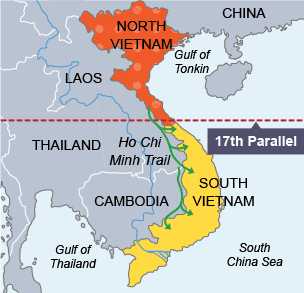
What theory caused the U.S. to enter the Vietnam War in order to stop the expansion of communism across Southeast Asia?

a)

Marshall Plan

b)

Domino Theory

c)

Open Door Policy

d)

Dollar Diplomacy

11.

What amendment was passed to lower the voting age because it was unfair that 18-20 year olds could be drafted into the army but not vote?

a)

17th amendment

b)

21st amendment

c)

22nd amendment

d)

26th amendment

12.

What words should you immediately associate with the Cold War?

a)

Hitler & the Nazis

b)

Economic recession

c)

Containment of Communism

d)

Corruption & Industrialization

13.
What two nations were in competition with each other during the Cold War?
a)
Spain and Portugal
b)
England and France
c)
Germany and Italy
d)
United States and Soviet Union
14.

Where was Korea divided?

a)

18 parallel

b)

34 parallel

c)

38 parallel

d)

15 parallel

15.
In the 1950s, the United States became involved in the Vietnam War. Why did the United States become involved in this war?
a)
to prevent the collapse of the government of North Vietnam
b)
to stop Vietnam from taking over Hong Kong
c)
to stop the spread of communism to South Vietnam
d)
to prevent attacks against United States shipping
16.
This "figurative" wall divided communist countries from democratic counties--
a)
Great Wall of China
b)
Berlin Wall
c)
Iron Curtain
d)
Wall of Democracy
17.
The physical barrier separating Communist East Berlin and Democratic West Berlin--
a)
Berlin Bloackade
b)
Berlin Base
c)
Berlin Wall
d)
Berlin Barrier
18.
What was the mutual defense alliance of non communist nations?
a)
NATO
b)
Warsaw Pact
c)
Truman Doctrine
d)
Open Skies
19.
What was the name for the 1955 alliance of Soviet-dominated countries of Eastern Europe  that were the counterpart to the western alliance?
a)
NATO
b)
Warsaw Pact
c)
European Alliance
d)
Iron Curtain
20.
By applying the strategy of containment, the United States hoped to prevent the
a)
emergence of an economic crisis in Europe
b)
return of Nazi ideas to postwar Germany
c)
expansion of the Soviet Union's influence around the world
d)
spread of nationalism from China to the rest of Asia 
21.
What is an Arms Race?
a)
When two countries compete to create the best and most weapons 
b)
When two countries compete to create new colonies
c)
When two countries compete over resources
22.
Why did the U.S. and the Soviet Union “Fight” the Cold War?
a)
World Power
b)
Differences in Communism and Capitalism 
c)
Nuclear Weapons Production
d)
All of the above
23.
Why is the Cold War considered a “cold” war, compared to WWII, a “hot” war?
a)
Most of the fighting took place in the cooler Northern Hemisphere
b)
The Soviet Union is located in a fairly cold area
c)
The Soviets and Americans never actually fought against one another with weapons
d)
The United States believed a nuclear war would end the seasons and it would be cold on Earth
24.
“To counter the possibility that the Western countries could not protect themselves against the Soviet Union, the Truman Administration formed a European-American alliance that would commit the United States to bolstering the security of Western Europe.”
.
The above statement is describing which organization?
a)
The Big Three 
b)
NATO 
c)
Warsaw Pact 
d)
Marshall Plan
25.
“…An iron curtain has descended across the Continent. Behind that line lie all the capitals of the ancient states of Central and Eastern Europe… and the populations around them lie in what I must call the Soviet sphere…”  - Winston Churchill
.
Winston Churchill’s remark above on the “iron curtain” in  Europe is describing what?
a)
the division in Europe during the Cold War
b)
the destruction of Europe during the Cold War
c)
the diversity in Europe during the Cold War
d)
the depression in Europe during the Cold War
26.
 One reason for the construction of the Berlin Wall in 1961 was to:
a)
a.   promote reunification of East Germany and West Germany
b)
b.   keep East Germans from fleeing to the Western sector of Berlin
c)
c.   complete the post–World War II rebuilding of Berlin
d)
d.   meet the requirements of the North Atlantic  Treaty Organization (NATO)
27.
Select the best cause and effect relationship that describes the Korean War--
a)
Threat of Communism spreading --> Communism is contained to North Korea
b)
Threat of Communism spreading --> Communism infiltrates South Korea
c)
Threat of Democracy spreading --> Communism leaves Korean Peninsula
d)
Threat of Democracy spreading --> Communism spreads to China
28.
Which of the following was a failed invasion by the United States under Kennedy in an attempt to overthrow Fidel Castro?
a)
Invasion of Moscow
b)
Cuban Missile Crisis
c)
Bay of Pigs Invasion
d)
Korean Invasion
29.
Because of a Soviet blockade of West Germany to West Berlin--
a)
the US bombed the Soviets until they retreated
b)
the Soviets flew supplies into East Germany
c)
the US flew supplies into East Germany
d)
the US flew supplies into West Germany
30.
During the Cold War, the fear of Communism infiltrating the US and McCarthyism both contributed to the--
a)
Red Fever
b)
Domino Theory
c)
Red Scare
d)
Red Army
31.

Brown V. Board of Education

a)

Court ruled that segregation was unconstitutional

b)

Supreme Court decision which legalized state ordered segregation so long as the facilities for blacks and whites were equal.

c)

All state laws prohibiting abortions were made unconstitutional based on a woman's right to privacy

d)

Ruled that a defendant in a felony trial must be provided a lawyer free of charge if the defendant cannot afford one.

32.

This act made racial, religious, and sex discrimination by employers illegal and gave the government the power to enforce all laws governing civil rights, including desegregation of schools and public places.

a)

Civil Rights Act of 1964

b)

Voting Rights Law 1975

c)

Civil Rights Law of 1988

d)

Civil Service Act of 1960

33.

The 24th Amendment prohibits Congress and States from...?

a)

Allowing citizens to license, produce, supply, or possess substances which are recognized as mind altering.

b)

Verifying the owner's right to their own creative work.

c)

Using any method to keep someone from voting based on ethnicity.

d)

­Abolishing an earlier quota system based on national origin and

established a new immigration policy.

34.
William J. Levitt contributed to the growth of the suburbs by
a)
Mass-producing houses
b)
Criticizing urban life
c)
Designing interstate highways   
d)
Providing low-interest mortgage loans
35.

When soldiers returned home from World War II, what helped them get lower mortgage rates and paid for their continued education?

a)

The Consitution

b)

Veteran's Fund

c)

G.I. Bill of Rights

d)

Military Service Reimbursement Bill

36.
What peacetime improvement developed as a result of growth in the automobile industry? 
a)
national rail system
b)
regional airports
c)
interstate highways
d)
wagon trains
37.

Built during the Cold War - these "super" structures connected multiple states across the country.

a)

Transcontinental Railroad

b)

Amtrak Rail System

c)

Federal Highway System

d)

Old Town Road

38.

This planned communities sprang up after WWII. They were usually located outside major market cities; families would commute to work with their new luxury cars and homes were "cookie cutter" and affordable

a)

Suburbs

b)

Inner City

c)

Ultraburbs

d)

Shopping Malls

39.

What body was created for the nations near the end of World War II to try to prevent future global wars?

a)

League of Nations

b)

Allied Powers

c)

Axis Powers

d)

United Nations

40.

Examine the cartoon. What aspect of American society in the 1950s was the cartoonist making?

a)

high culture

b)

stay-at-home moms

c)

suburban conformity

d)

planned obsolescence

41.
Why did President Truman fire General Douglas MacArthur?
a)
He failed to win the Korean War
b)
His troops revolted against him in Korea
c)
He allowed Berlin to be trapped
d)
He challenged the authority of the President
42.
What did HUAC investigate?
a)
Domestic Communists
b)
Athletes accused of using PEDs
c)
Douglas MacArthur's losses in Korea
d)
The use of an atomic bomb on Japan in WWII
43.
Why did the US and Britain begin the Berlin Airlift?
a)
Prevent Germany from falling to Communism
b)
Prevent Berlin from falling to Communism 
c)
To allow Eastern Europe to return to democracy
d)
To help the Communists gain influence in the world 
44.
What upset the US about Sputnik?
a)
The satellite was flown over US land
b)
Showed that the US had passed the USSR in the areas of education and science
c)
Showed that the Soviets had passed the US in education and science
d)
President Truman thought the satellite was used to spy on the US
45.
Which was a distinguishing aspect of US society during the 1950s?
a)
conformity
b)
poverty
c)
repression
d)
nonconformity
46.
What was Joseph McCarthy's profession?
a)
U.S. Senator
b)
Wisconsin Senator
c)
Cincinnati Zoo zookeeper 
d)
None of the above
47.

As a result of McCarthy's actions, what caused many US government members to lose their jobs?

a)

They were communists

b)

Wrong accusations of being communists

c)

Wrong accusations of being Nazis

48.
Which of the following is not true about McCarthyism?
a)
It was the hunting down of suspected Communist in America
b)
Its leader was Joseph McCarthy
c)
The House Un-American Activities Committe (HUAC) participated
d)
If Communist were discovered they were immediately executed
49.
What organization was created by Congress to hunt for communist spies?
a)
Federal Civil Defense Administration (FCDA)
b)
Central Intelligence Agency (CIA)
c)
North Atlantic Treaty Organization (NATO)
d)
House Un-American Activites Commitee (HUAC)
50.
I the 1950's Senator Joseph McCarthy won national attention when he...
a)
Was convicted as a spy.
b)
Claimed hundreds of government employees were communists.
c)
Helped Eisenhower become president.
d)
Went to Korea and said atomic weapons should be used to break the stalemate.
51.
The couple that was executed for spying and allegedly passing nuclear secrets to the Soviet Union were the                  
a)
Hiss’s
b)
Greenglass’s
c)
Rosenberg’s
d)
Chamber’s
52.
McCarthyism was what?
a)
a system of government that is centralized and dictatorial and requires complete subservience to the state.
b)
an economic and political system in which a country's trade and industry are controlled by private owners for profit, rather than by the state.
c)
a political theory derived from Karl Marx, advocating class war and leading to a society in which all property is publicly owned and each person works and is paid according to their abilities and needs.
d)
The practice of making accusations of subversion or treason without proper regard for evidence.
53.
Once someone was placed on a blacklist, what was the consequence?
a)
They would not get hired
b)
They would be executed
c)
They would be removed from public office
d)
The would be put on trial
54.

During the Cold War, students practiced nuclear safety drills in school known as?

a)

Bert the Turtle

b)

Duck and Cover

c)

Stop, Drop, and Roll

d)

Operation Alert

55.

Who was the president at the time that the Little Rock 9 led the integration in Little Rock high schools?

a)

Bill Clinton

b)

George W. Bush

c)

Richard Nixon

d)

Dwight Eisenhower

56.

Why did these students enroll in the all-white school?

a)

To follow the 1954 Supreme Court ruling in Brown v. Board of Education that school boards make a "prompt and reasonable start" to desegregate

b)

To spur rage and cause violence to prove their point.

c)

To bring press to an important issue.

d)

They felt like it.

57.

Which of the following best describes the initial reaction to the Brown decision?

a)

Southern leaders supported the decision, but the voters did not.

b)

President Eisenhower provided active support for the decision.

c)

Resistance was widespread and initially few schools were integrated.

d)

It was implemented with little opposition in larger cities.

58.

"Eisenhower was the first American president to have atomic weapons and not use them .... He refused when his advisers begged him to use those weapons and when they urged him to develop plans for fighting smaller nuclear wars in remote areas of the world. We can only wonder how humanity's course might have been different if Eisenhower acceded to those who believed America would have been best served by use of the weapons under his control. "But, he was not always right. He was enamored of covert action, and he did not fully apprehend the moral imperatives of civil rights .... If Earl Warren and the Supreme Court sometimes baffled or annoyed him ... when the South threatened to defy the court, Ike restored order and supremacy by force, as only he could."


Which of the following best supports the observation that "Ike restored order and supremacy by force"?

a)

Using "modern Republicanism" to defeat the Democrats.

b)

Sending U.S. troops into Indochina.

c)

Ordering federal troops to Little Rock Central High School.

d)

Supporting the "brinkmanship" policies of John Foster Dulles.

59.
Supreme Court case where the court ruled, "separate but equal is inherently unequal."
a)
Brown v. Board of Education
b)
Desegregation
c)
Lau v. Nichols
d)
Civil Rights Act
60.
What was the main idea of The Truman Doctrine?
a)
The Truman Doctrine was the American policy in 1947 of providing economic and military aid to Greece and Turkey
b)
To show how everyone in the U.S. care about other countries in the world.
c)
He tried to get the government to leave.
d)
I didnt even listen to you
61.

Court case declared that separate black and white public schools to be unconstitutional.

a)

Plessy v. Ferguson

b)

Tinker v. Des Moines

c)

Brown v. Board of Education

d)

Dred Scott v. Sandford

62.

Companies discriminated African Americans so the federal government answered by passing the-

a)

Title IX

b)

Civil Rights Act of 1957

c)

Civil Rights Act of 1964

d)

24th Amendment

63.

President who imposed a ruling to integrate public schools

a)

Lyndon B. Johnson

b)

John F. Kennedy

c)

Harry S. Truman

d)

Dwight D. Eisenhower

64.

Court case that made legal justification for segregation

a)

Delgado v. Bastrop ISD

b)

Brown v. Board of Education

c)

Plessy v. Ferguson

d)

Tinker v. Des Moines

65.
Court case that created "Separate-but-equal" doctrine.
a)
Sweatt v. Painter
b)
Brown v. Board of Education
c)
Plessy v. Ferguson
d)
Mendez v. Kirby ISD
66.

Which of the following would Stokely Carmichael most likely support?

a)

"Black Power" and black separatism

b)

Exclusively non-violent protest

c)

creating a community that blended black and white culture

d)

the tactics of Martin Luther King Jr.

67.
What was the purpose of LBJ's Great Society?
a)
end poverty
b)
end drug trafficking
c)
end lynching
d)
fix the economy
68.
What failed invasion of Cuba embarrassed JFK & led to his distrust of the CIA?
a)
Bay of Pigs
b)
D-Day
c)
Operation Havana
d)
Cuban Offensive
69.

Under the Great Society, what health insurance program was created to help the elderly?

a)

Medicare

b)

Medicaid

c)

Social Security

d)

G.I. Bill

70.
The _________________ is a program in which the assistance of U.S. volunteers is offered to the developing nations in Asia, Africa, and Latin America.
a)
Fair Deal
b)
Economic Opportunity Act
c)
Peace Corp
d)
Great Society
71.

Under President Johnson's The Great Society, these provided free or low-cost medical insurance to welfare recipients and most Americans age 65 and over.

a)

Civil Rights Services

b)

Privatization of Medicine

c)

Medicare and Medicaid

d)

Equal Insurance Policy (EIP)

72.
What was unique about the election of 1960 (specifically the debates)?
a)
They were on radio
b)
They were on TV
c)
They were live on Instagram
d)
They were held in foreign countries
73.
What was Johnson's plan for providing civil rights, medical, environmental, and social programs for Americans called?
a)
New Frontier
b)
Great Society
c)
New Deal
d)
New Society
74.
How was Vietnam covered differently by the media than previous wars?
a)
television
b)
radio
c)
internet
d)
newsreels
75.
How was the Vietnam war viewed on the domestic front?
a)
There was strong disagreement in   the United States about American   involvement in the Vietnam War.
b)
All supported the war in Vietnam
c)
Everyone protested against the war in Vietnam
d)
Vietnam was a place that needed the US to step in and help them
76.

Before World War II, Korea was ruled by

a)

Russia

b)

China

c)

Japan

d)

USA