
 Worksheets
Teddy Roosevelt Final Review
Total questions: 74
Worksheet time: 37mins

Which of the following laws expanded the Interstate Commerce Commission's enforcement powers & set minimum prices for ferries, bridge tolls and oil pipelines?

Why did TR want to regulate the monopolies (trusts) in the US?
2 answers
to keep trusts from taking over the government
to prove that the government, not business, was in charge of US
to stop "bad trusts" that cheated consumers and bullied small business.
to prove that he knew how to use executive orders
According to TR, what is the difference between a "good trust" and a "bad trust?"
A good trust is one that runs efficiently.
A good trust is one that pays its taxes.
A bad trust cheats consumers and bullies small business.
A bad trust is one that pollutes the environment.
Which was a policy of Teddy Roosevelt's?
The New Deal
The Civil Rights Act
The Square Deal
The Emancipation Proclamation
Teddy Roosevelt was called a "trust-buster." What does that mean?
What were the two main ideas of environmental protection during Roosevelt's presidency?
Conservation
Progressivism
Rational Use
Reclamation
President Theodore Roosevelt was very interested in the conservation movement that had evolved during the late 1800s. Which of the following best describes Roosevelt's role in the conservation movement?
He promoted recycling programs and encouraged people to consume less.
He became interested in renewable sources of energy and worked to increase energy efficiency.
He expanded the national park system and supported government policies that managed natural resources.
The Progressive Movement was characterized by...
politically active farmers who were united by a platform to abandon the gold standard for currency
efforts to better American society through reform, expanded democracy, science, and government regulations
the belief that the United States should involve itself more actively in foreign affairs and become expansionist
Which of the following individuals fought for wilderness conservation with Teddy Roosevelt and founded the Sierra Club for conserving California's natural areas?
John Muir
Alice Paul
Andrew Carnegie
What is the name of the 1890 law that banned the formation of trusts and monopolies in the United States?
The Sherman Antitrust Act
The Pendleton Civil Service Act
The Conservation Authority Amendment
How did TR end up being president?
Enforces food purity and label accuracy laws.
Interstate Commerce Commission
Department of Commerce and Labor
Food and Drug Administration
Federal Government decides where and how water would be distributed.
Elkins Act
National Reclamation Act
Hepburn Act
Determined fines for railroads that gave special rates to favorite clients.
Elkins Act
Sherman Antitrust Act
Hepburn Act
Determined rules for fair labeling & safety of medicines and food.
National Reclamation Act
Hepburn Act
Pure Food and Drug Act
Made rules for corporations and businesses.
Elkins Act
Sherman Antitrust Act
National Reclamation Act
Hepburn Act
Monitor businesses engaged in interstate commerce and keep capitalists/industrialists from abusing their power.
Interstate Commerce Commission
Department of Commerce and Labor
Food and Drug Administration
What did TR want his SQUARE DEAL program to achieve?
fairness in business & social reform (equality)
political power & control
segregation & business interests
economic growth & prosperity for small business owners & the poor
conservation of resources & labor reforms
What impact did TR's actions have on the government's role in the economy?
expanded the role to include monitoring businesses and making progressive laws to protect citizens on all levels
reduced the role to a laissez-faire style of economy- let businesses do what they will
How did Roosevelt's policies affect the environment?
Roosevelt's policies led to the destruction of natural habitats, an increase in pollution and deforestation.
Roosevelt's policies protected and preserved the environment through creation of national parks, national forests, and implementing conservation & resource management measures.
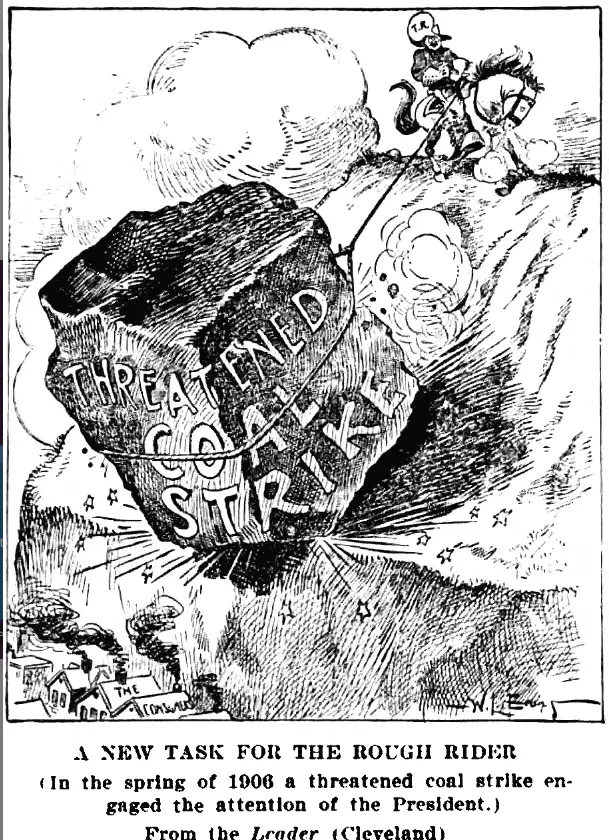
How did TR influence the 1902 Coal miner strike and how has it impacted the future?
Threatened to nationalize the mines and send in federal troops to ensure they remained open.
This impacted the future by setting a precedent for government intervention in labor disputes.
This impacted the future because the government stays out of strikes unless there is violence.
What political party was Roosevelt part of during his two terms as president?
Republican
Democrat
Bull Moose
Progressive
Teddy Roosevelt agreed with Alfred T. Mahan, who argued that:
now that there was no more open territory in North America, the US needed to look outside the US for new markets and expansion

In the cartoon above, President Theodore Roosevelt is depicted doing which of the following?
Enforcing the Sherman Anti-Trust Act
Leading a government take-over of large industries
Putting an end to industries that might harm the environment

Conservation is-
when a country's trade and industry are controlled by private owners for profit
using vigorous campaigning to bring about political or social change
protection of natural resources
What was the purpose of Roosevelt's Square Deal policy?
Promoting fairness and protecting workers' rights
Expanding American influence in Latin America
Increasing military spending and modernization
Supporting big business and economic growth
Roosevelt decided to run for a….
Second Term as a Democrat
Fourth Term as a Republican
Third Term as part of the Progressive, "Bull Moose" Party
none of these, he only ran for 2 terms
The _______________ was a foreign policy statement issued in 1823 stating that the U.S. would oppose any intervention by European nations to control nations in the Western Hemisphere.
Monroe Doctrine
Articles of Confederation
Mayflower Compact
Treaty of Paris
Which of the following would fit with the main arguments of the Anti-Imperialist League?
Imperialism is necessary for economic growth
Imperialism is a moral duty
Imperialism wrong as its a violation of consent of the people to determine their government
Imperialism goes against Jefferson's notions of freedom, democracy and self-determination

Why did Theodore Roosevelt want William Taft to succeed him as president?
Roosevelt valued Taft’s former experience as a governor of the Philippines.
Roosevelt thought Taft would carry out Roosevelt’s progressive reforms.
Roosevelt thought Taft had been a valuable vice president.
Why did the United States need to expand its trade into new markets after the Civil War?
America had an excess of agricultural and industrial goods and needed foreign markets to purchase these American goods.
America needed raw materials to industrialize like Europe had already done.
America needed to expand its trade with countries who would sell America arms to prepare for future wars.
Why did US Navy captain Alfred Mahan believe the US should expand overseas?
There were no more territories for the US to expand into in North America.
Great Britain had used its large navy to expand its trading and colonial empire around the world and he thought the US should do the same.
The US now had a large modern navy "the Great White Fleet" that could help protect and expand US territory.
What are the THREE factors that fueled American imperialism
Desire for Military Strength by expanding our military bases in the Pacific
Thirst for New Markets for our Agricultural and Manufactured goods
Belief in our Cultural Superiority and to spread our Religion
Desire to preserve peace
Why was a strong navy and foreign military bases important to U.S. interests at the turn of the 20th century? (Select TWO)
Foreign military bases were important for American ships to refuel and gather fresh supplies.
Europe was at war and the United States pledged to help Britain with a strong navy.
A strong navy, or control of the seas, would be important during wartime.
The US economy depended on manufacturing war ships.
Which of the following explains reasons that America wanted to engage in Imperialism with other nations?
Many Americans believed in conquering other nations in order to civilize them and spread Christianity
The United States wanted to Conquer other nations in order to prevent Russia from imperial dominance
The United States wanted to conquer other nations in order to get more raw materials and goods
A stronger country taking over a weaker country to control it militarily, economically, or politically.
Imperialism
World Power
Manifest Destiny
Treaty of Paris
What were the consequences of the annexation of Hawaii by the US?
It solidified US presence in the Pacific region by being able to use Hawaii as a base.
It benefited American agricultural businesses like Dole for bananas, pineapples and sugar.
It resulted in loss of culture and self-determination for the indigenous Hawaiian people.
It resulted in conflict with Christian missionaries that supported the independence of the Hawaiian people.
Select the THREE reasons the acquisition of Hawaii and Alaska made America a world power
We took land like other imperialist powers
We gained resources we used to trade globally
We increased our global military presence
We defeated a historically strong world power
This is a country that is strong enough (economically, militarily, politically) that their actions and decisions affect the WORLD
World Power
Manifest Destiny
Imperialism
Annexation
What are the THREE causes of the Spanish-American War?
USS Maine Explodes
Yellow Journalism
De Lome Letter
Desire for Military Strength
Select ALL OF the reasons that the Spanish-American War made America a world power.
We defeated a historically strong world power in Spain.
We gained land like Puerto Rico, Guam, Cuba, and the Philippines
We demonstrated our naval superiority
We took over Spain

Describe how the United States acquired Hawaii.
The U.S government won Hawaii in a battle with Japan
After Queen Liliuokalani died the U.S. purchased Hawaii for 20 million dollars
U.S. won a war with Spain and Spain sold Hawaii for $7million to the U.S.
U.S. Overthrew Queen Liliuokalani and Hawaii then became a U.S. territory in 1898
Which of the following is a belief of imperialists?
The United States has a powerful military, which gives it the right to intervene in other nations.
Seizing land and announcing control over entire groups of people goes against core American values of freedom and democracy.
Bringing Christianity to other nations through missionaries and other means is enough justification for the United States to take control
Intervention in another nation’s business will lead to resentment from our trading partners and wars.
Which statement describes the main role played by the US journalists during the Spanish-American war?
Journalists focused on the losses and negative aspects of the war in order to criticize the decisions made by the president and military leaders
Journalists ignored the signs of impending war until it was too late to inform the public of the government’s intentions to declare war on Spain.
Journalists exaggerated events to build up support for the war, giving the president and Congress little change to resolve the conflict diplomatically.

The map shows shipping routes before and after construction of the Panama Canal. The “Old Route” (dotted line) was befor, and the “New Route” was afterwards. Based on the map, why did many Americans want to build the Panama Canal?
to increase American trade in Europe
to create a shortcut for commercial and military shipping
to protect U.S. investments in Latin America
to gain control over Colombia and Panama
Leading up to the Spanish-American War, the sudden explosion of the _____________ off of the coast of Cuba led Americans to believe that _______________ was to blame, despite there being no concrete evidence.
U.S.S. Maine; Cuba
U.S.S. Alabama; Spain
U.S.S. Maine; Spain
The _____ was an extension of the Monroe Doctrine and enabled the United States to act like a policeman and intervene in Latin American countries struggling with unstable conditions.
Yellow Journalism
Great White Fleet
Rough Riders
Roosevelt Corollary
The term _______ refers to the idea that through financial investment in foreign nations, the United States would develop a sphere of influence that would provide both stability and economic opportunity.
Roosevelt Corollary
Dollar diplomacy
Open Door Policy

As a result of the Spanish- American War, the US became a political power in
The Hawaiian Islands
Puerto Rico, Guam, and the Philippines
Samoa
Panama
President Theodore Roosevelt’s commitment to the proverb, “Speak softly and carry a big stick; you will go far,” was most clearly shown when he
opposed consumer protection laws
intervened in Latin American affairs
promoted the conservation of natural resources
conducted the Bull Moose campaign of 1912
What did the Treaty of Paris (1898) result in?
Spain freeing Cuba
U.S. acquiring Guam and Puerto Rico
U.S. purchasing the Philippines
All of the above
What did the Open Door Notes issued by John Hay ask imperialism nations to do?
Share trading rights with the U.S.
Expel foreigners from China
Establish spheres of influence in China
Put down the Boxer Rebellion
American Secretary of State John Hay called the Spanish-American War a “splendid little war” since it was a quick victory for the USA and expanded our trading and political power.
How was his Open Door Note an extension of this expansionism/ imperialism?
It allowed the United States to develop new wartime technologies as we expanded our military presence around the world.
It encouraged the USA to expand its sphere of influence to Latin America and China, where the USA expanded trade.
It led to the USA pushing European countries like France out of China and the independence of China.
Why did President Roosevelt order the group of battleships known as the Great White Fleet to sail around the world?
He wanted them to conduct secret spying on other nations.
He wanted to use America’s navy to trigger the start of World War I.
He wanted to demonstrate that the United States had "a big stick" that would back up our goals.
He wanted them to conduct American business by trading goods around the world.
“Chronic wrongdoing, or an impotence which results in a general loosening of the ties of civilized society, may in America, as elsewhere, ultimately require intervention by some civilized nation, and in the Western Hemisphere the adherence of the United States to the Monroe Doctrine may force the United States, however reluctantly, in flagrant cases of such wrongdoing or impotence, to the exercise of an international police power. . . .”
—from the Roosevelt Corollary
What does President Roosevelt argue would cause the United States to intervene in another nation’s affairs?
President Roosevelt argues that a nation abusing its police force’s power could trigger intervention by the United States.
President Roosevelt argues that wrongdoing and deterioration of civilization could cause the United States to exercise international police power.
President Roosevelt argues that the idea of American exceptionalism allows the United States to act as a police force over all other nations in the Western Hemisphere.
How did the Roosevelt Corollary relate to the Monroe Doctrine?
The Monroe Doctrine made the USA the protector of democracies in the Western Hemisphere, the Roosevelt Corollary stated the USA would now act as the enforcer/ policeman for the Monroe Doctrine.
The Monroe Doctrine made the USA the international policeman for the world, the Roosevelt Corollary said we could make countries part of our territory.
The Monroe Doctrine gave the US the right to invest in foreign countries to help them, now known as the Roosevelt Corollary or Dollar Diplomacy.
How did Teddy Roosevelt's foreign policy goals and the Spanish American War affect US History and our place in the world?
Teddy Roosevelt's policies led to the U.S. withdrawing from global affairs after they took the Panama Canal.
Teddy Roosevelt's territorial expansion into Hawaii and islands in the Pacific along with the use of the Great White Fleet led to increased spheres of influence.
What country did the U.S. purchase Alaska from?
England
Germany
Russia
Japan
The USA purchased Alaska from Russia in 1867. How much did the American government pay for the territory?
$25,000
$7.2 Million
$900 Million
It was basically free because we won the war fought over it.

Russia initially colonized Alaska for fur trading, but soon was looking to get rid of it. What were 3 reasons Russia was ready to sell?
Fur trade had declined
Russia was worried American settlers would overrun it like they did Texas
Russia feared losing the nearly defenseless colony to Great Britain, a naval power that had defeated Russia in the Crimean War
Wendigos had eaten most of the Russian fur traders
Cholera had infected most of the people there.
What was the role of American sugar planters in the annexation of Hawaii?
Lobbying for annexation to protect their economic interests
Advocating for the rights of indigenous people in Hawaii
Supporting the establishment of a monarchy in Hawaii
Fighting for Hawaiian independence

What does this political cartoon depict?
(a)
What was Hawaii's biggest export?
Timber
Oil
Sugarcane
The purchase of Alaska proved to be beneficial to the U.S. because
there was an abundance of bears provided a place for Teddy Roosevelt to hunt
it made the United States look powerful
it was rich in timber, minerals, and oil
It was not beneficial because it was a barren wasteland
Why did Seward think purchasing Alaska was a good idea?
It had good ports and was rich in natural resources.
It was the best place to launch an invasion of China.
The US could banish unwanted criminal there.
He thought he could find a yeti.
The USA received Hawaii by--
purchasing it from Japan
annexing it (through Congress)
throwing pineapples
enjoying the sugar there
What did people call the purchase of Alaska?
Breadbasket
Seward's Folly
Gold Rush
Fulton's Folly
Hawaii is in which ocean?
Pacific
Arctic
Atlantic
Indian

