
 Worksheets
Growth and Expansion
Total questions: 70
Worksheet time: 47mins
Name
Class
Date
1.
Which of the following was NOT associated with early factory working conditions?
a)
Low wages
b)
Widespread pollution
c)
Dangerous working conditions
d)
Safe working conditions
2.
The cottage industry system involved manufacturing...
a)
of steam engines.
b)
of luxury goods.
c)
in the home.
d)
in small factories.
3.
A place where people and machines join together to mass produce goods.
a)
School
b)
Corporation
c)
Factory
d)
Urbanization
4.
What innovation increased the transportation of goods and people?
a)
Flying Shuttle
b)
Spinning Jenny
c)
Steam Engine
d)
Water Frame
5.
This machine separated the seed from cotton fibers.
a)
Spinning Mule
b)
Spinning Jenny
c)
Steam Engine
d)
Cotton Gin
6.
Before the Industrial Revolution all products were created by
a)
Factories
b)
Hand
c)
Slaves
d)
Royalty
7.
Why did "cottage industry" come to an end?
a)
Too many people moved to the city.
b)
It was replaced by the factory system.
c)
The need for textiles decreased.
d)
Women who worked in cottage industries went on strike.
8.
How did the Industrial Revolution affect the cities?
a)
Made the crime rate decrease
b)
Led to an increase in farm workers
c)
Make the cities cleaner and safer
d)
Led to an increase in population in the cities
9.
One effect of the cotton gin was that ____.
a)
farmers could plant more cotton in limited space
b)
the need for enslaved labor decreased
c)
the seeds of the cotton plant no longer stuck to the fibers
d)
workers could process more cotton
10.

Who invented the cotton gin?
a)
Eli Whitney
b)
Jim Morse
c)
James Watt
d)
the guy that delivers your pizza
11.
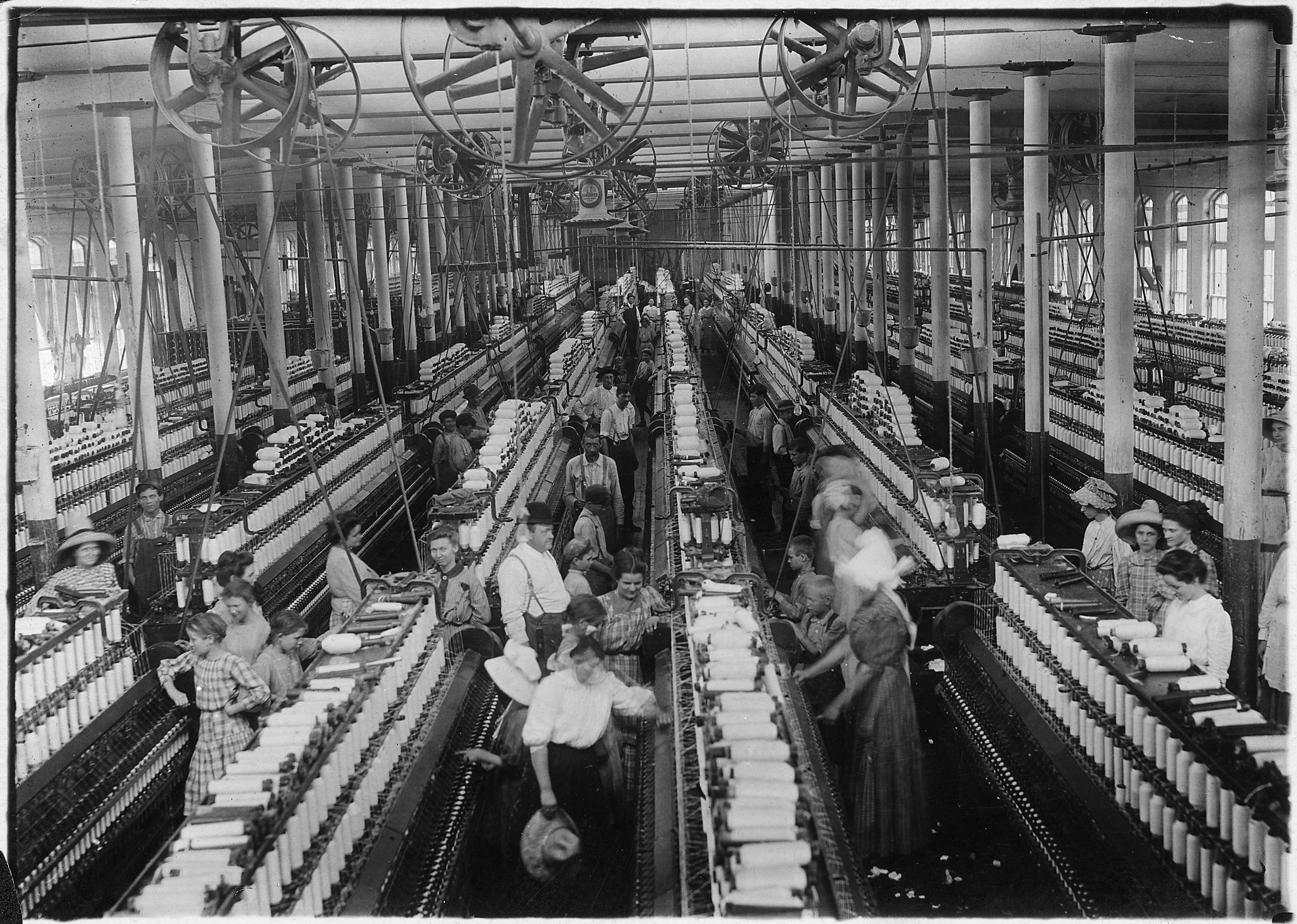
Where were most factories built before the steam engine was invented?
a)
in the mountains
b)
in the desert
c)
along rivers
d)
anywhere
12.

Who invented the steamboat?
a)
Robert Fulton
b)
Samuel Morse
c)
Cyrus McCormick
d)
Francis Cabot Lowell
13.
What were living conditions in the city like during the Industrial Revolution?
a)
Very extravagant
b)
Strict housing regulations
c)
Spacious and luxurious
d)
Crowded and unsanitary
14.
What is the movement of people from farms to cities?
a)
Utilitarianism
b)
Urbanization
c)
Proletariat
d)
Enclosure Movement
15.
What are identical components that can be used in place of each other?
a)
Interchangeable parts
b)
Factories
c)
Dynamos
d)
Assembly Lines
16.
The _________ was invited by Samuel Morse in order to help the railroads.
a)
Telegraph
b)
Telephone
c)
Telescope
d)
Television
17.
The invention of the cotton gin decreased slavery.
a)
False
b)
True
18.
During the Industrial Revolution in the United States, factories were being built in the North.
a)
False
b)
True
19.
During the Industrial Revolution, the need for factory workers caused a shift in population from the city to the country.
a)
True
b)
False
20.
The Erie Canal made it possible for people to ship more goods more quickly.
a)
True
b)
False
21.
Change in production methods in the early 19th century from human to machine power was called...
a)
Farm Revolution
b)
Industrial Revolution
c)
Sewell/Booth Revolution
d)
Dance, Dance Revolution
22.
How does the Monroe Doctrine support the idea of Manifest Destiny?
a)
It encouraged taking land from Native Americans
b)
America could grow and expand without European interference
c)
America could go make colonies in Central America
d)
America could expand their army and navy for enforcing their boundaries
23.
Which of the following would NOT be a characteristic of the Era of Good Feelings?
a)
James Monroe was elected president after serving as Madison’s Secretary of State
b)
The federal government became very weak as state governments gained strength
c)
The Democratic-Republicans were the only major political party due to the fall of the Federalists
d)
A time period of strong nationalism and a growing economy
24.
Protective tariffs are taxes placed on imported goods. They are designed to protect
a)
American businesses
b)
American farmers
c)
American banks
d)
American gov’ts
25.
How would a typical southern farmer feel about protective tariffs?
a)
They would like protective tariffs because they protect their crops
b)
They would dislike protective tariffs because they reduce the markets for them to sell their crops
c)
They would like protective tariffs because they build foreign markets free of taxes
d)
The would dislike protective tariffs because they protect businesses, not farmers
26.
The Monroe Doctrine was meant to
a)
Protect US interests by condemning further European involvement in Latin/South American affairs
b)
Invite European nations to establish settlements in the Louisiana Territory
c)
Break off all trade relations with European countries
d)
Establish a standard between Europe and the US for shared colonization of Latin America
27.
Who introduced the factory system to America?
a)
Winfield Scott
b)
Robert Fulton
c)
Sam Slater
d)
John Tyler
28.

What is the name of the
man-made waterway that connects Lake Erie to the Hudson River
and then to the Atlantic Ocean
man-made waterway that connects Lake Erie to the Hudson River
and then to the Atlantic Ocean
a)
Panama Canal
b)
Buffalo River
c)
Niagara Falls
d)
Erie Canal
29.
This was the selling and transporting of goods from one state to another?
a)
interstate commerce
b)
commercial consequence
c)
economic pursuit
d)
autocracy
30.
Which region benefited most from protective tariffs on industry?
a)
North
b)
South
c)
East
d)
West
31.
What did the Monroe Doctrine tell European nations?
a)
Stop colonizing in the Western Hemisphere!
b)
Stop colonizing in the Eastern Hemisphere!
c)
Get out of the USA!
d)
Stop trading with Great Britain!
32.
What does America get out of the Adams-Onis Treaty of 1819?
a)
Flordia & land near Oregon
b)
Georgia & Florida
c)
Georgia & land near Oregon
d)
Nothing!
33.
Did Missouri have slaves after the Missouri Compromise?
a)
Yes
b)
No
34.
Why was another state brought in at the same time as Missouri?
a)
Coincidence
b)
Maintain slave/nonslave state balance
c)
Maintain Federalist/Republican balance
d)
Settle slavery dispute once and for all
35.
Which of the following is NOT an effect of the Industrial Revolution?
a)
Mass Production of Goods
b)
Growth of cities
c)
Increase in homemade textiles
d)
Interchangeable Parts
36.
Overall, who got more power from the Supreme Court Cases of the Era of Good Feelings?
a)
President
b)
States
c)
Federal Government
d)
Supreme Court
37.

Who came up with the idea of the Missouri Compromise?
a)
James Monroe
b)
George Washington
c)
Thomas Jefferson
d)
Henry Clay
38.
Which president is responsible for the Monroe Doctrine?
a)
Thomas Monroe
b)
James Monroe
c)
George Monroe
d)
John Monroe
39.
This case established the power of the national government over the states?
a)
Marbury v. Madison
b)
Roe v. Wade
c)
McCulloch v. Maine
d)
McCulloch v. Maryland
40.
How would a typical southern farmer feel about protective tariffs?
a)
They would like protective tariffs because they protect their crops
b)
They would dislike protective tariffs because they reduce the markets for them to sell their crops
c)
They would like protective tariffs because they build foreign markets free of taxes
d)
The would dislike protective tariffs because they protect businesses, not farmers
41.

What serious problem in the U.S. led to the Civil War?
a)
sectionalism
b)
free enterprise
c)
patriotism
d)
consumerism
42.
One economic effect of the War of 1812 was -
a)
American manufacturing increased
b)
American manufacturing decreased
c)
British imports increased
d)
British exports increased
43.
Who proposed the Missouri Compromise?
a)
Andrew Jackson
b)
John Adams
c)
John Quincy Adams
d)
Henry Clay
44.
The American System called for what?
a)
A tariff to stimulate American industry
b)
An embargo to slow American industry
c)
To expand the national government
d)
To close the national bank
45.
A key factor in the American Free Enterprise System is that individuals, families, or groups have the right to
a)
private property
b)
freedom to choose their own business
c)
compete
d)
profit motive
46.
During the 1800's, factories were located along _______.
a)
the ocean
b)
mountains
c)
lakes
d)
rivers
47.
All of the following led to the growth of American Manufacturing except:
a)
government intervention
b)
private ownership
c)
profit motive
d)
voluntary exchange of goods and services
48.
Who brought over ideas from England for beginning textile mills in the U.S.?
a)
Francis Lowell
b)
Robert Fulton
c)
Samuel Slater
d)
Eli Whitney
49.
The factory system is categorized by all of the following except:
a)
gave lower wage workers opportunities
b)
set schedule
c)
workers and machines under same roof
d)
labor unions
50.
Which of the following is a lasting impact of the War of 1812 on the American Economy?
a)
Industrial Revolution
b)
foreign trade increased
c)
Era of Good Feelings
d)
bankruptcy
51.
Which part of the country opposed protective tariffs?
a)
West
b)
South
c)
North
52.
What is an element of the free enterprise system?
a)
private ownership
b)
all of the other three
c)
voluntary exchange of goods
d)
profit motive
53.
All of the following played a significant role in directly uniting the different regions of the country except the:
a)
steamboat
b)
locomotives
c)
telegraph
d)
cotton gin
54.
Who would benefit the most from the success of the Clermont?
a)
merchants on the river
b)
settlers out west
c)
fish
d)
European countries
55.
Who invented new methods of manufacturing?
a)
Eli Whitney
b)
Samuel Slater
c)
Eli and Samuel
d)
neither of them
56.
In the north, increase cotton production led to factories _______________.
a)
needing more supplies
b)
shutting down
c)
needing more workers
d)
buying more slaves
57.
Which invention expanded slavery?
a)
steam boats
b)
mechanical reaper
c)
cotton gin
d)
factory system
58.
The Missouri Compromise entered Missouri as a slave state and _________ as a free state.
a)
Maine
b)
Kansas
c)
Ohio
d)
Florida
59.
The importance of cotton to the south created an economy and society were dominated by
a)
slaves
b)
entrepreneurs
c)
factory owners
d)
large land owners
60.
Which of the following did not lead to the growth of a plantation economy?
a)
demand for raw materials
b)
industrialization of the north
c)
sectionalism
d)
labor intensive jobs
61.
All of the following led to an increase in slavery except:
a)
increase number of factories in the north
b)
spread of plantations in the south
c)
technological advancements
d)
slave trade made easier
62.
What prevented European powers from becoming involved in affairs in the Western Hemisphere?
a)
Missouri Compromise
b)
Adams-Onis Treaty
c)
Convention of 1818
d)
Monroe Doctrine
63.
What established a bond between the Midwest and Northeast?
a)
Trains
b)
rivers
c)
trade
d)
political similarities
64.
The Erie Canal connects Lake Erie to
a)
The Hudson River
b)
The Atlantic Ocean
c)
St. Lawrence River
d)
Lake Ontario
65.
The American system is categorized by the following except:
a)
protective tariffs
b)
embargos
c)
internal improvements
d)
national bank
66.
Which court case involved interstate commerce?
a)
McCulloch v. Maryland
b)
Worcester v. Georgia
c)
Gibbons v. Ogden
d)
Marbury v. Madison
67.
The United States obtained Florida through the
a)
Adams-Onis Treaty
b)
Treaty of Ghent
c)
Convention of 1818
d)
Monroe Doctrine
68.
Which of the following was to make the U.S. more economically self-sufficient?
a)
Embargos
b)
Adams-Onis Treaty
c)
American System
d)
Missouri Compromise
69.
Large numbers of workers leaving their farms for manufacturing jobs in the cities led to __________.
a)
Colonization
b)
Urbanization
c)
Capitalization
d)
Americanization
70.
The most significant cause of sectional tension between the north and south was
a)
tariffs
b)
admittance of states as free or slave
c)
Factory system
d)
American system
100 %

