wayground logo

Free Printable Worksheets

Font size

S
M
L
XL
Worksheets

Final Exam Review May 2019 Algebra 2

Total questions: 142

Worksheet time: 15hrs 40mins

Name
Class
Date
1.
What Is the end behavior of this graph?
a)
lim f(x)→∞ as x→∞
lim f(x)→−∞ as x→-∞
b)
lim f(x)→-∞ as x→∞
lim f(x)→-∞ as x→-∞
c)
lim f(x)→∞ as x→∞
lim f(x)→∞ as x→-∞
d)
lim f(x)→-∞ as x→∞
lim f(x)→∞ as x→-∞
2.
What Is the end behavior of this graph?
a)
lim f(x)→∞ as 
x→∞
lim f(x)→−∞ as
x→-∞
b)
lim f(x)→-∞ as
x→∞
lim f(x)→-∞ as
x→-∞
c)
lim f(x)→∞ as
x→∞
lim f(x)→∞ as
x→-∞
d)
lim f(x)→-∞ as
x→∞
lim f(x)→∞ as
x→-∞
3.
Is the Graph an even or odd degree polynomials?
a)
Odd
b)
Even
4.
Is the Graph an even or odd degree polynomials?
a)
Odd
b)
Even
5.

What is the degree of this function?

a)

4

b)

3

c)

2

d)

1

6.

What is the leading coefficient of this function?

a)

1

b)

4

c)

-3

d)

18265603

7.
Identify the degree of the polynomial and the sign of the leading coefficient, using the graph.
a)
Leading Coefficient Positive
Degree - Even
b)
Leading Coefficient Positive
Degree - Odd
c)
Leading Coefficient Negative
Degree - Even
d)
Leading Coefficient Negative
Degree - Odd
8.

√(− 1)

a)

1

b)

−1

c)

i

d)

− i

9.
Simplify:
 √24
a)
2√6
b)
4√6
c)
2√12
d)
3√8
10.

Simplify :

(x5y10z11 )0 =

a)

1

b)

0

c)

(xyz)1

d)

(x5y10z11 )1

11.
Evaluate.
log381
a)
4
b)
1/4
c)
-4
d)
-1/4
12.
Evaluate.
log6(1/216)
a)
3
b)
1/3
c)
-1/3
d)
-3
13.
Write in logarithmic form.
52 = 25
a)
log52 = 25
b)
log225 = 5
c)
log255 = 2
d)
log525 = 2
14.

Expand the logarithm expression

log 5x/4y

a)

log 5x + log 4y

b)

log 5x - 4log y

c)

(log 5 + log x) - (log 4 + logy)

d)

5log x - 4 logy

15.

Use logarithm properties to condense the expression log b2 + log d

a)

b2 + d

b)

log b2d

c)

log2b + logd

d)

log(2bd)

16.

What type of functions are logarithms the inverse of?

a)

Quadratic functions

b)

Linear functions

c)

Radical functions

d)

Exponential functions

17.

In the equation log8 64 = 2 , what is the exponent?

a)

8

b)

64

c)

2

18.

In the equation log2 (1/32) = -5 , what is the argument?

a)

2

b)

1/32

c)

32

d)

-5

19.
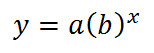
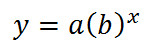
In an exponential function, what does the 'a' represent? 
a)
SLOPE
b)
RATE OF CHANGE
c)
INITIAL AMOUNT
d)
GROWTH OR DECAY FACTOR
20.
In an exponential function, what does the 'b' represent? 
a)
SLOPE
b)
RATE OF CHANGE
c)
INITIAL AMOUNT
d)
GROWTH OR DECAY  FACTOR
21.

What is the initial amount, for the function: f(x) = 300(1.16)x?

a)

300

b)

1.16

c)

.16

d)

x

22.

What type of function is y = 7(6.25)x?

a)

Exponential Growth

b)

Exponential Decay

c)

Linear

d)

None of the above

23.

What type of function is f(x)=2(1/7)x ? How do you know?

a)

Exponential Growth because 2> 0

b)

Linear because there is not any growth

c)

Exponential Decay because 0 < (1/7) < 1

d)

None of the Above

24.

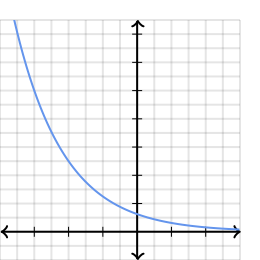
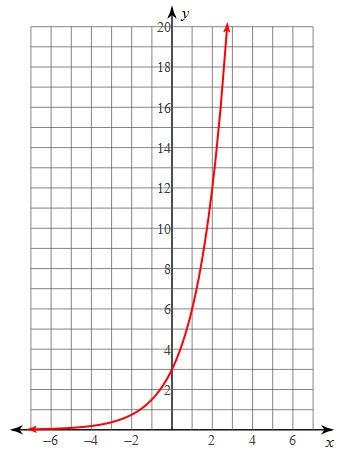
Is the Graph Linear, Exponential Growth, or Exponential Decay, or, Neither:

a)

Linear

b)

Exponential Growth

c)

Exponential Decay

d)

Neither

25.

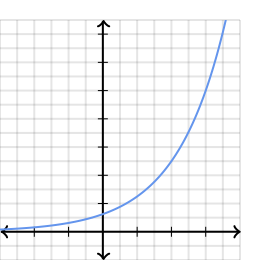
Is the Graph Linear, Exponential Growth, or Exponential Decay, or, Neither:

a)

Linear

b)

Exponential Growth

c)

Exponential Decay

d)

Neither

26.

Does the following equation represent an exponential growth or decay function?

f(x) = 34(0.05)x

a)

Growth because 34 is greater than 1

b)

Growth because 0.05 is between 0 and 1

c)

Decay because 34 is greater than 1

d)

Decay because 0.05 is between 0 and 1

27.

What is the initial value of the situation represented by f(x)=0.05(2)x?

a)

0.05

b)

2

c)

0.1

d)

1

28.
What is the y-intercept of the function?
a)
2
b)
3
c)
1
d)
-2
29.

Divide using synthetic division

(2x³ + 4x² - 5) by (x + 3). Find the quotient and the remainder.

a)

2x² + 2x - 4 R(-12)

b)

2x² - 2x + 6 R(-23)

c)

2x² - 2x + 8 R(-20)

d)

2x² - 4x + 1 R0

30.
The answer to a division problem is known as the...?
a)
product
b)
sum
c)
difference
d)
quotient
31.
If you are missing an exponent in your polynomial you must put a zero as a coefficient place holder for that exponent
a)
True
b)
False
32.

What is the proper way to write the answer for the following problem?

a)

2x3-x2-25x+12

b)

2x4-x3-25x2-12x+0

c)

2x3-x2-25x-12

d)

2x4-x3-25x2-12x-0

33.

Cam divided (x4 + 3x2 - 4x - 2) by factor of (x-2) using synthetic division. His work is shown above. Which best describes his mistake?

a)

Cam wrote the remainder incorrectly.

b)

Cam did not use a zero place holder for the x3 term.

c)

Cam added instead of subtracting the rows.

d)

Cam should have used -2 as his division since the factor was x-2.

34.
If you were dividing x6 + 4x3 + 2, how many 0's would you need when setting up the top row of your synthetic division?
a)
0
b)
2
c)
4
d)
6
35.
Classify by number of terms:
3x2 – 8x + 1
a)
Monomial
b)
Binomial
c)
Trinomial
d)
4-Term Polynomial
36.
1 Term
a)
Monomial
b)
Binomial
c)
Trinomial
d)
Polynomial
37.

Choose all the binomials ( 3 Correct answers)

a)

x + 5

b)

2x - 6y

c)

8x

d)

5x - 9y + 7

e)

76a - 90b2

38.

Choose all the monomials ( 3 correct answers )

a)

5

b)

7xy

c)

8u + 5s

d)

18a

e)

6x + 5y

39.
Put in Standard Form.
12 - 3x3 - 10x - x2
a)
 - 3x3 - x2 - 10x + 12
b)
 3x3 - x2 + 10x + 12
c)
12 - 3x3 - 10x - x2
It is in Standard Form.
d)
12 - 10x - 3x3 - x2
40.

What letter usually represent imaginary number?

a)

a

b)

i

c)

j

d)

x

41.

Simplify.√( −25)

a)

− 5 i

b)

5

c)

5i

d)

− 5

42.

Simplify

a)

5i

b)

-5i

c)

5+i

d)

-5

43.

2 - 3i What is its complex conjugate?

a)

-2 + 3i

b)

2 + 3i

c)

-2 - 3i

d)

2 - 3i

44.

What is the complex conjugate of -8i?

a)

-8i

b)

8i

45.

What is the complex conjugate of -2i + 7

a)

-2i - 7

b)

2i - 7

c)

-7 + 2i

d)

7 + 2i

46.
What is the name of this function?
a)
Parabola
b)
Rational Function 
c)
Ellipse 
d)
Cubic 
47.
What is the parent function seen here?
a)
Logarithmic
b)
Exponential
c)
Square Root
d)
Constant Function
48.

Which parent function contains the point (1,0)?

a)

Exponential

b)

Quadratic

c)

Square Root

d)

Logarithmic

49.
Describe the transformation to graph the following equation from it's parent function:
f(x) = 2(x + 3) - 4
a)
Shift left 3, down 4
b)
Shift right 3 down 4
c)
Shift left 4, up 3
d)
Shift right 4, up 3
50.
What transformation best describes the function?
a)
stretch 
b)
shrink 
c)
reflection
d)
shift down
51.
What type of function is shown?
a)
cube root
b)
square root
c)
logarithm
d)
exponential
52.
Which parent function matches the graph?
a)
y = |x|
b)
y = ∛(x)
c)
y = x2
d)
y = a⋅bx
53.
What type of function is shown?
a)
exponential
b)
logarithm
c)
quadratic
d)
square root
54.
What type of function is shown?
a)
absolute value
b)
quadratic
c)
linear
d)
exponential
55.
DOMAIN?
a)
(-∞,∞)
b)
[0,∞)
c)
(-∞,0]
d)
(0,∞)
56.
RANGE?
a)
(-∞,∞)
b)
[0,∞)
c)
(-∞,0]
d)
(0,∞)
57.
Name the parent function.
a)
cube root
b)
square root
c)
quadratic
d)
linear
58.
Condense
a)
A
b)
B
c)
C
d)
D
59.
When a logarithm has division inside of it, it expands using ________________.
a)
Addition
b)
Subtraction
c)
Multiplication
d)
Division
60.
Expand.
a)
A
b)
B
c)
C
d)
D
61.
Rewrite log3t = 5 in exponential form.
a)
5t=3
b)
log35 = log3t
c)
t5=3
d)
35=t
62.
log381 = 
a)
2
b)
3
c)
4
d)
5
63.
Rewrite 34 = 81 in logarithmic form.
a)
log34 = 81
b)
log813 = 4
c)
log381 = 4
d)
log481 = 3
64.
Evaluate.
a)
1
b)
10
c)
7
d)
0
65.
logaa is equivalent to
a)
0
b)
a
c)
1
d)
2a
66.
Evaluate:
log416
a)
2
b)
4
c)
1/2
d)
-2
67.
Evaluate.
2log212
a)
6
b)
2
c)
9
d)
12
68.
log41 = 
a)
0
b)
1
c)
4
d)
DNE
69.
Evaluate: 15log15137
a)
15137
b)
137
c)
15
d)
9.133333
70.
Write logb(xy) as two logs
a)
logbx+logby
b)
logbx-logby
c)
logbx*logby
d)
logbx/logby
71.
Write logb(x/y) as two logs
a)
logbx-logby
b)
logbx+logby
c)
logbx*logby
d)
logbx/logby
72.
Rewrite logb(xn)
a)
nlogbx
b)
(logbx)n
c)
xnlogbx
d)
logb(xn)
73.
a)
6log8(xyz)
b)
log8(x) - log8(y) - 6log8(z)
c)
log8(x) + log8(y) - log8(z)
d)
log8(x) + log8(y) + 6log8(z)
74.
Find the sum.
(5-2i) + (-7+8i)
a)
-2+6i
b)
12+6i
c)
-35-16i2
d)
-35 -16i
75.
Solve for x:
log4 x = 3
a)
4
b)
12
c)
32
d)
64
76.
What are the asymptotes?
a)
x=-2 and y=-1
b)
x=-2 and y=1
c)
x=2 and y=1
d)
x=2 and y = -1
77.

A particular type of cell triples in number every hour. Which function can be used to find the number of cells present at the end of h hours if there are initially 6 of these cells?

a)

f(h) = 3(6)h

b)

f(h) = 6xh

c)

f(h) = 6(3)h

d)

f(h) = 3(6h)

78.

The amount of cola in a soda machine decreases by a rate of 5% each hour. The amount of cola in the machine was originally 75 gallons.

Which function models the amount of cola in gallons after h hours?

a)

f(h) = 75(-5)h

b)

f(h) = -5(75)h

c)

f(h) = .95(75)h

d)

f(h) = 75(.95)h

79.

Suppose a culture of bacteria begins with 5000 cells and dies by 30% each year. Which equation best represents this situation?

a)

y=5000(0.7)x

b)

y=30(5000)x

c)

y=5000(1.3)x

d)

y=5000xx

80.
What is the range of this graph?
a)
y = 6
b)
(0, -4)
c)
y > -6
d)
y < -6
81.

In the equation y=2(5)x , the a value (y-intercept) is...

a)

356

b)

5

c)

10

d)

2

82.
Which of the following functions shows an initial amount of $15 and an increase of 35% each year?
a)
y = 15(35)x
b)
y = 15(1.35)x
c)
y = 15(0.35)x
d)
y = 35(1.15)x
83.
What's the name of the inverse of g(x)?
a)
f(x)
b)
f-1(x)
c)
y
d)
g-1(x)
84.
What is the first step in finding the equation of the inverse of a function?
a)
get x by itself
b)
switch x and y
c)
solve for y
d)
write the function in inverse function notation
85.
What is the inverse of the function
f(x) = 2x + 4   ?
a)
f-1(x) = 4(x -2)
b)
f-1(x) = (x-4)/2
c)
f-1(x) = x/2 - 4
d)
f-1(x) = x/4 + 2
86.
Are these inverse functions?
a)
yes
b)
no
c)
no way to tell
87.

Simplify

a)

4x√(2x)

b)

4√(2x)

c)

4x√(2x2)

d)

16x√(x)

88.

Solve for x

a)

3

b)

4

c)

5

d)

6

89.

Solve for x

a)

0

b)

1

c)

2

d)

3

90.

One of the step when solving for x is

a)

21x = 42

b)

42x = 21

c)

10x = 42

d)

3x/7 = 42

91.

One of the steps in solving this problem is

a)

64 = 2x

b)

60 = 4x

c)

40 = 2x

d)

24 = 6x

92.

One of the step in solving this problem is

a)

32 + 4 = 9x

b)

32 − 4 = 9x

c)

9x = 32

d)

9x = 4

93.

Next step in solving this problem could be

a)

e3x +10 = 0

b)

3x + 10 = 0

c)

e0 = 3x + 10

d)

3x + 10 = e

94.

Evaluate

a)

0

b)

1

c)

Cannot be done

d)

None of the above

95.

Evaluate

a)

0

b)

1

c)

10

d)

None of the above

96.

Evaluate

a)

0

b)

1

c)

e

d)

None of the above

97.
a)

8

b)

8x

c)

8x2

d)

8x3

98.

Write in terms of powers of 10

a)

1012

b)

1010

c)

108

d)

107

99.

Simplify

a)

a6b8

b)

a5b6

c)

(ab)11

d)

None of the above

100.
a)

x10

b)

x30

c)

x1

d)

None of the above

101.

What is the base?

a)

3

b)

10

c)

x

d)

y

102.

What is the exponent?

a)

3

b)

10

c)

x

d)

y

103.

What is the base?

a)

4

b)

64

c)

3

d)

log

104.

What is the base?

a)

a

b)

5

c)

y

105.

Simplify (2 answers)

a)

3√3 +√3

b)

1√3

c)

4√3

d)

4

106.
a)

√2 +9 √2

b)

√20

c)

4√2

d)

√2 + √(9×2)

107.

Simplify (2 answers)

a)

−√(4×8) + 3√(3

b)

−√(4×3) + 3√(3

c)

1√3

d)

4√3

108.

Simplify(2 answers)

a)

2√(9×5) − 2√5

b)

0√5

c)

4√5

d)

7√5

109.
(5-2i) + (-7+8i)
a)
-2+6i
b)
12+6i
c)
-35-16i2
d)
-35 -16i
110.
What letter usually represent imaginary number?
a)
a
b)
i
c)
j
d)
x
111.
a)

A

b)

B

c)

C

d)

D

112.
a)

A

b)

B

c)

C

d)

D

113.

How many real solutions are NOT possible for this polynomial ?

y = 2x7 + 3x6 + ...

a)

0

b)

1

c)

3

d)

5

e)

7

114.

Factor with GCF:

a)

3v2( v2−9v−10)

b)

3( v2−9v−10)

c)

3v( v2−9v−10)

d)

9v( v2−3v−10)

115.

Factor using GCF

a)

2vm( m − 7)

b)

2vm( m2 − 7)

c)

2v( m2 − 7)

d)

2vm( m2 − 7m)

116.

Is the graph even, odd, both, or neither?

a)

Even

b)

Odd

c)

Neither

d)

Both

117.

Is the graph even, odd, both, or neither?

a)

Even

b)

Odd

c)

Neither

d)

Both

118.

How many x-intercepts does this function have?

a)

1

b)

2

c)

3

d)

4

119.

f(x)=x(x+4)(x-3)

Select ALL zeros for this function. Select 3 answers.

a)

x = -4

b)

x = 4

c)

x = -3

d)

x = 3

e)

x = 0

120.

The point(s) where a function touches the x-axis are called....

a)

x-intercepts

b)

zeros

c)

roots

d)

all of these.

121.

f(x)=2(x+4)(x-3)(x-2) What is the y-intercept of the function?

a)

(0, 24)

b)

(0, 48)

c)

(0, -24)

d)

(0, -48)

122.

What are the x-intercept(s) of:

y = 2x(x + 4)(x - 3)2? Select 3 answers

a)

0

b)

-2

c)

-4

d)

3

e)

9

123.
Solve for the values of x:
(x - 5)(x - 1) = 0
a)
{ 5, 1 }
b)
{ 5, -1 }
c)
{ -5, 1 }
d)
{ -5, -1 }
124.

True or false:

The solution, root, x-intercept, and zero of a problem are the same.

a)

True

b)

False, because the solution and root are the same but the x-intercept and zero are different

c)

False, because the x-intercept and root are the same but the zero and solution are different

d)

False, they are all different

125.

Given y= (x−1)(x−2)(x+3)(x+4) ; What is the degree of this polynomial?

a)

1

b)

2

c)

3

d)

4

126.

Given a polynomial of degree 4 ; Out of the 4 solutions for this polynomial can there be 0 Real solutions?

a)

Yes

b)

No

c)

Depends on the leading coefficient

127.

Given y = 2x7+ 3x5+... What is the degree and how many solutions?

a)

Degree 7 , 7 solutions

b)

Degree 2 , 3 solutions

c)

Degree 7 , 5 solutions

d)

Degree 5 , 7 solutions

128.
Multiply
x2(2x+3)
a)
x2+2x+3
b)
2x+3
c)
2x2+3x
d)
2x3+3x2
129.
What is the Fundamental Theorem of Algebra?
a)
The degree of the polynomial determines what the x value will be
b)
The degree of the polynomial tells us how many solutions the polynomial will have.
c)
The number of possible rational zeros
d)
States that a complex number and its conjugate are solutions
130.
All imaginary roots comes in pairs.
a)
True
b)
False
131.

A Polynomial of Degree 6 CAN have the following number of imaginary roots:

a)

1

b)

4

c)

3

d)

8

132.
How many extrema (maxes and mins) are in the picture?
a)
2
b)
3
c)
4
d)
5
133.
The domain of a polynomial function is always (-∞, +∞).
a)
True
b)
False
134.
Factor
n2 + 5n - 6
a)
(n - 2)(n - 3)
b)
(n - 1)(n + 6)
c)
(n + 1)(n - 6)
d)
(n + 2)(n - 3)
135.

Given x2 + 9x - 36

The correct factor for -36 is

a)

+12 and - 3

b)

+9 and - 4

c)

-12 and +3

d)

-9 and - 4

136.

Write in exponential form ∛ x

a)

(x)1/3

b)

(x)3

c)

(1/3) x

d)

x⋅x⋅x

137.

Write in radical form. 51/2

a)

(5)1/2

b)

√2⋅5

c)

5 (1/2)

d)

√5

138.

Write in radical form y(1/4)

a)

∜ y

b)

y4

c)

4y

d)

√ (y/4)

139.

What is the transformation from parent function for y = − 2x

a)

Horizontal Translation left 2

b)

Vertical Translation down 2

c)

No transformation

d)

Reflection across the x- axis

140.
What transformations occur in the following function?
a)
right 3, up 2
b)
left 3, up 2
c)
left 3, down 2
d)
right 3, down 2
141.
Determine the order of transformations
a)
left 1, reflected over x-axis
b)
up 1, reflected over y-axis
c)
right 1, reflected over x-axis
d)
left 1, reflected over y-axis
142.

Select all the transformations that apply.

y = log 5 (x + 1) +1

a)

Horizontal shift left 1

b)

Horizontal shift right 1

c)

Vertical shift up 1

d)

Vertical shift down 1