wayground logo

Free Printable Worksheets

NEW

Font size

S
M
L
XL
Worksheets

Bio Final Exam Review

Total questions: 56

Worksheet time: 59mins

Name
Class
Date
1.
Identify the phase of mitosis.
a)
prophase
b)
metaphase
c)
anaphase
d)
telophase
2.
Which is the correct order?
a)
C,D, B, A, F, E
b)
D,A,F,C,E,B
c)
B,E,C,F,A,D
d)
C,B,D,A E,F
3.
This picture shows which process? 
a)
mitosis
b)
meiosis
c)
the cell cycle
4.
This diagram depicts which phase of mitosis? 
a)
prophase
b)
metaphase
c)
anaphase
d)
telophase
5.
In the diagram, in which structure(s) are homologous pairs of chromosomes normally be present?
a)
Sperm only
b)
Egg only
c)
Zygote only
d)
Sperm and Egg
6.
The uncontrolled division of cells...
a)
meiosis
b)
cancer
c)
nondisjunction
d)
crossing over
7.
Stage in which the cell's nuclear material divides and separates...
a)
G1
b)
Synthesis
c)
G2
d)
Mitosis
8.
The chromosomes line up across the middle of the cell
a)
Anaphase
b)
Interphase
c)
Prophase
d)
Metaphase
9.
What phase of mitosis is pictured?
a)
Prophase
b)
metaphase
c)
anaphase
d)
telephase
10.
How many daughter cells are produced in mitosis?
a)
4 new cells
b)
2 new cells
c)
One new cell
d)
none of these
11.
How many times does the cell divide in meiosis?
a)
twice (PMAT)
b)
none of these
c)
3 times
d)
once
12.
How many daughter cells are produced in meiosis?
a)
4 daughter cells
b)
none of these
c)
3
d)
1
13.
The cells produced via meiosis are called:
a)
gametes
b)
somatic cells
c)
body cells
d)
skin cells
14.
The end of meiosis results in  ________ to each other.
a)
2 cells that are identical
b)
4 cells that are identical
c)
2 cells that are not identical
d)
4 cells that are not identical
15.
Name that process...
a)
Mitosis
b)
Meiosis
c)
Cell Cycle 
d)
DNA replication
16.
During the ___ phase, DNA is replicated.
a)
G1
b)
S
c)
G2
d)
M
17.

When an area of a chromatid is exchanged with the matching area on a chromatid of its homologous chromosome, _____ occurs.

a)

crossing over

b)

mutagenesis

c)

hybridization

d)

fertilization

18.
Human eggs and sperm are _____, and each has ____ chromosomes.
a)
diploid, 23
b)
diploid, 46
c)
haploid, 23
d)
haploid, 46
19.
is a set of instructions for an inherited trait; it can have multiple forms
a)
gene
b)
phenotype
c)
genotype
d)
homologous chromosome
20.
which process is shown?
a)
diffusion
b)
repiration
c)
recombination
d)
translation
21.
A sugar, a phosphate group, and a nitrogen base form the building blocks of which organic compound?
a)
carbohydrates
b)
nucleic acids
c)
lipids
d)
proteins
22.
The process to go from DNA to mRNA is _______
a)
translation
b)
transcription
c)
replication
23.
The process to go from mRNA to a protein is called ____
a)
transcription
b)
rRNA
c)
replication
d)
translation
24.
DNA holds the code for
a)
lipids
b)
carbohydrates
c)
protein
d)
sugar
25.
Choose the nucleotide sequence of the RNA strand that would be complementary to the following strand: 
GTAGTCA
a)
UATUAGA
b)
ACGACTG
c)
CAUCAGU
d)
CATCAGT
26.
The main function of tRNA is to...
a)
carry a message that, when translated, forms proteins
b)
form a portion of ribosomes
c)
string together complementary RNA and DNA strands
d)
bring amino acids from the cytoplasm to the ribosomes
27.
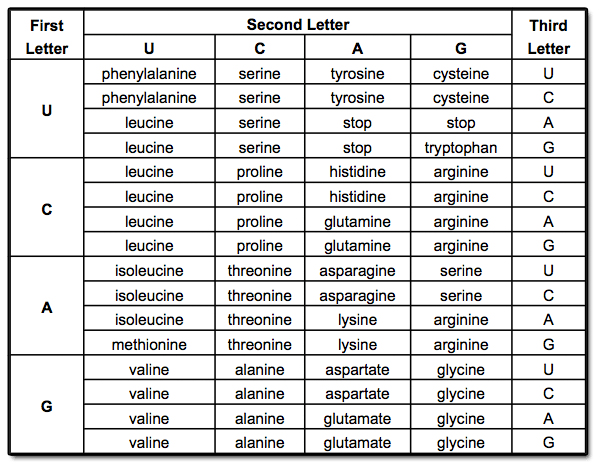
What amino acid is represented by the codon UUA?
a)
Phenylalanine
b)
Tyrosine
c)
Leucine
d)
Stop codon
28.
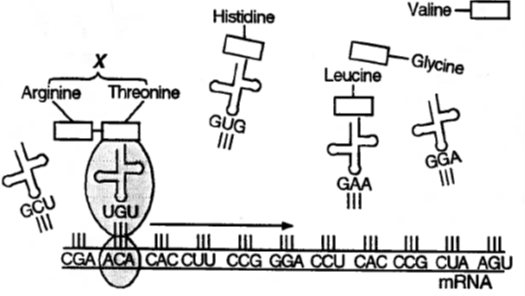
What process is going on in this photo? 
a)
Transcription 
b)
Translation 
c)
Replication 
d)
All the above 
29.
Which component of DNA determines the traits of an organism? 
a)
Nitrogen Bases
b)
Sugar-Phosphate Backbone
c)
Hydrogen bonds
30.

What is the location in the cell for translation?

a)

nucleus

b)

mitochondria in cytoplasm

c)

ribosome in cytoplasm

d)

chloroplast in cytoplasm

31.
What is the location in the cell for transcription?
a)
nucleus
b)
cytoplasm
c)
ribosome
d)
mitochondria
32.
The different forms of a gene
a)
heredity
b)
genetics
c)
gene
d)
alleles
33.
The factors that control a trait
a)
genetics
b)
trait
c)
gene
d)
alleles
34.
This trait is hidden whenever the dominant allele is present
a)
dominant allele
b)
codominance
c)
recessive allele
d)
Punnett Square
35.
In the second generation-how many people have the disease or display the physical trait?
a)
2
b)
4
c)
5
d)
6
36.
Which individual in the first generation is a carrier?
a)
The male
b)
The female
c)
individual 1
d)
None of the above
37.
How many people in this whole pedigree have the trait/disease?
a)
2
b)
3
c)
4
d)
6
38.
How many kids did the mother and father from the first generation have?
a)
2
b)
4
c)
5
d)
6
39.

This type of allele is expressed whether there are one or two copies present.

a)

dominant

b)

recessive

c)

homozygous

d)

heterozygous

40.
A trait that is expressed over other traits.
a)
Recessive
b)
Co-dominant
c)
Incomplete Dominant
d)
Dominant
41.
The combination of alleles.
a)
DNA
b)
Phenotype
c)
Genotype
d)
Genetics
42.
The physical or behavioral appearance of a trait
a)
Phenotype
b)
DNA
c)
Genotype
d)
Genetics
43.
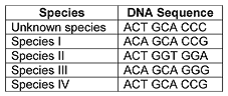
According to this data, the unknown bacterial species is most closely related to: 
a)
Species I
b)
Species II
c)
Species III
d)
Species IV
44.

Which scientist is known for his work that he did on the Galapagos Islands to develop his theory of natural selection?

a)

Gregor Mendel

b)

Charles Darwin

c)

Anton Van Leewenhoek

d)

Robert Brown

45.
What is the process in which humans breed organisms for certain traits?
a)
natural selection
b)
inheritance
c)
artificial selection
d)
descent withOUT modification
46.
Some organisms have genes that improve their ability to survive and reproduce. If the gene also help their offspring survive and reproduce, then which of the following will most likely increase?
a)
The number of genes in a species
b)
The frequency of genes in a population
c)
The frequency of genes in one individual 
47.
The opossum and kangaroo both incubate their young in a pouch. This provides evidence that they---
a)
are descended from a common ancestor
b)
Have very similar skeletal structures
c)
belong to the same species
d)
must range great distances to eat
48.

Which of the following is an example of a vertebrate animal?

a)

fly

b)

worm

c)

bird

d)

starfish

49.

Invertebrates do NOT have a

a)

brain.

b)

heart.

c)

stomach.

d)

backbone.

50.

Which group of vertebrates possesses gills, two sets of paired fins, and is generally adapted to living in water?

a)

fish

b)

reptiles

c)

mammals

d)

amphibians

51.

Animals that are warm blooded, have body hair, and produce milk for their young are grouped into which of the following classes?

a)

amphibians

b)

mammal

c)

birds

d)

reptiles

52.

Tulips and oak tree are both plants that look different. However, they both belong to the classification of plants that make

a)

leaves

b)

pine cones

c)

flowers

d)

seeds

53.
An organism that has cells that lack a nucleus are called:
a)
Eukaryote
b)
Heterotroph
c)
Prokaryote
d)
Autotroph
54.
An organism that gets its food by consuming other organisms is known as a:
a)
heterotroph
b)
autotroph
c)
prokaryote
d)
eukaryote
55.
Which characteristics best describes the Plant Kingdom?
a)
unicellular; eukaryote; autotroph
b)
multicellular, prokaryote, autotroph
c)
multicellular, eukaryote, autotroph
d)
unicellular, prokaryote, heterotroph
56.
Which characteristics best describe the Kingdom Fungi?
a)
multicellular and unicellular, eukaryote, autotroph
b)
multicellular and unicellular, prokaryote, heterotroph
c)
multicellular, eukaryote, heterotoph
d)
multicellular and unicellular, eukaryote, heterotroph