Worksheets
Evolution Test Review
Total questions: 54
Worksheet time: 57mins
Natural selection acts on _________________ which in turn may result in the evolution of________________ over time.
Populations, individuals
Individuals, populations
Species, species
The main mechanism of evolution is
Natural Selection
Comparative Anatomy
Mutations
Migration of organisms
Which of the following discuss areas of high UV radiation
Along the poles and in high altitude areas
Along the equator and in high altitude areas
Areas with lots of clouds along the equator
Areas with lots of clouds along the poles
UV radiation is necessary for your body to produce which of the following?
Melanin
Vitamin D
Folate
Rickets
In areas of low UV radiation, darker skin was less fit because they could not absorb enough UV radiation to produce
melanin
folate
vitamin D
rickets
In areas of high UV light, people with low melanin are less fit because the extra UV radiation breaks down what in their blood stream?
Melanin
Vitamin D
Folate
Rickets
What protein gives skin its color?
Folate
Melanin
Vitamin D
Rickets
Organisms that are more biologically fit always
run the fastest
are the strongest
reproduce more often
survive the longest
Natural selection produces organisms perfectly suited to their environment
True
False
Natural selection acts on the genetic variation in a population
True
False
Natural selection causes genetic mutations
True
False
What is common descent?
The main mechanism of evolution
The ability of an organism to survive and reproduce in its environment
the idea that all living things are related
the branch of biology that investigates the patterns in the distribution of living and fossil species
What is descent with modification?
The main mechanism of evolution
The ability of an organism to survive and reproduce in its environment
Group organisms that can breed and reproduce
The fact that when parents have children, the children look slightly different than the parents and each other
Scientists observe evolution in progress today
True
False
Genetic mutations arise in response to changes in the environment
True
False
The same mutation could be advantageous in some environments but deleterious in others
True
False
Which of the following is required for natural selection to occur, check all that apply.
There is variation in the genetic information between organisms in a population
Some variations in a species are more successful than others, allowing individuals with those variations to survive and produce more often
More organisms are born than can survive
Organisms that try and adapt are more successful
Mutations occur that give organisms what they need
A volcano erupted on an island. The ash released from the volcano changed the acidity(pH) of the soil from the level it had been for hundreds of years. This significant changer resulted in new environmental pressures on species in the soil. Which of the following is a likely outcome of these pressures?
Some species will disappear from the soil because they do not have individuals with traits that allow them to survive in more acidic soil.
Only some species will generate the needed mutations to adapt to the change in pH; other species will become extinct.
Most species gain additional genetically-based traits, and this increase in complexity allows them to live in the more acidic soil.
Individuals in each species will evolve the traits necessary to survive under these new conditions.
A ship that had been used for many years in arctic exploration was sold and moved to a harbor in the warm waters of the Caribbean. Worms that had lived on the ship bottom crawled off in the warm waters and attempted to attach to other ships in this tropical area where there were no similar worms. Some of the worms were able to survive and reproduce. What would you expect to happen to this group of worms over many generations in this new environment?
The worms will mate and produce offspring just as they did in their previous environment, and the group’s traits will likely remain unchanged after many generations.
The worms will gain new, more complex traits through natural selection that will help them better adapt to the warmer waters because natural selection leads to more complex and better adapted organisms.
Worms possessing genetic variations that help them to survive and thrive in the new environment will leave more offspring than others lacking those traits. Over time, the proportion of the worm population with these adaptive traits will likely increase.
The mutation rate will increase in this group of worms in order to promote
Bacillus thuringienses (Bt) bacteria produce a natural insecticide. Widespread use of Bt has lead to Bt resistance among insects. Why is this occurring?
Individual insects that have mutations providing resistance to Bt can survive in the presence of Bt. The survivors pass this Bt resistance on to their offspring
Bt-resistant insects increase in the population by chance. There are so many insects that some of them are resistant to each type of insecticide.
In the presence of Bt, individual insects evolve to become Bt resistant.
A chef sprays antimicrobial cleaner on her counter top. At the first, the bacteria population declines significantly. However, even though she continues to spray in following weeks, the number of bacteria begins to increase again. Why did this happen?
Some bacteria had traits that allowed them to survive the initial antimicrobial application. They produced offspring also carrying those traits.
After the application of antimicrobial spray, the bacteria needed to adapt by developing antimicrobial spray-resistant traits.
The antimicrobial compound caused a mutation for resistance to it. This trait increased in the population over time.
The bacteria that tried hardest to become resistant left more offspring, who were also resistant.
Why do some adaptive traits, such as thicker fur or flowers of different colors, evolve over time within a population of organisms?
These traits evolve in response to environmental challenges, ensuring that the population will survive any changes in its habitat.
Such traits are necessary to ensure survival of the species.
These traits evolved randomly, and just happened to persist over time.
Organisms with these traits survived longer and had more offspring than other organisms in the population, so their traits were passed on to more offspring.
Evolutionary theory implies that life evolved (and continues to evolve) randomly, or by chance.
True
False


Resistance is best defined as...
An organism that is unaffected by a toxin / chemical
A bug that is stronger than a chemical
A bacteria that has the ability to digest an antibiotic
An organism that does not undergo any type of natural selection
An antibiotic is...
A chemical that kills a bug / insect
A substance that kills bacteria
A chemical that destroys any toxins in the stomach
A substance created by biotechnology to induce mutations in bacteria
Why is it important to finish ALL of an antibiotic, even if you feel better?
If all of the infectious bacteria are not killed, the bacteria may continue to multiply. Some of these bacteria may have a mutation that makes them resistant to the antibiotic. This could cause resistant bacteria to spread.
If all of the antibiotic is not used, the surviving bacteria may learn how to fight off the antibiotic, causing the sickness to get even worse.
If all of the antibiotic is not used, the bacteria may begin ingesting your skin cells, causing a new sickness to arise.
If all of the antibiotic is not used, the surviving bacteria may cooperate with other infectious bacteria, resulting in two separate infections at the same time.
Which of the following best describes how natural selection results in bacteria that are antibiotic resistant?
When you take an antibiotic when you're sick, a few bacteria survive. These bacteria happen to have a random mutation that makes them resistant to the antibiotic. These bacteria survive and reproduce, eventually resulting in an antibiotic-resistant population.
When you take an antibiotic when you're sick, the bacteria respond by mutating their DNA, making them resistant to the antibiotic. Therefore, an antibiotic-resistant population evolves.
When you take an antibiotic when you're sick, it causes mutations in the bacteria DNA. Some of these mutations make the bacteria antibiotic-resistant. These bacteria now form a bacteria-resistant population.
When you take an antibiotic when you're sick, it kills the bacteria, which allows a new species of bacteria to infect the body. Some of species are antibiotic resistant, thus a new population of antibiotic-resistant bacteria appears.
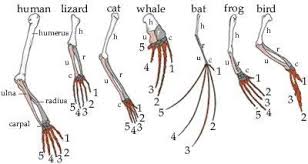
Some organisms that share a common ancestor have features that have different functions, but similar structures. These are known as
vestigial structures
analogous structures
homologous structures
embryology
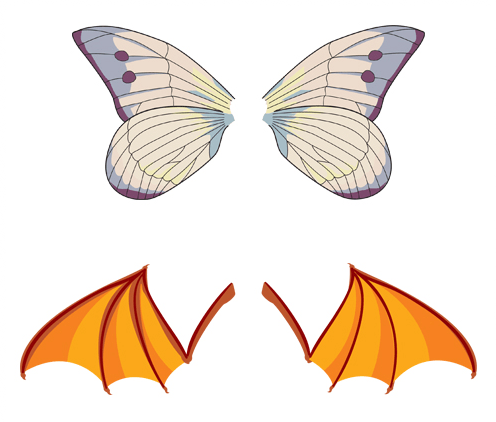
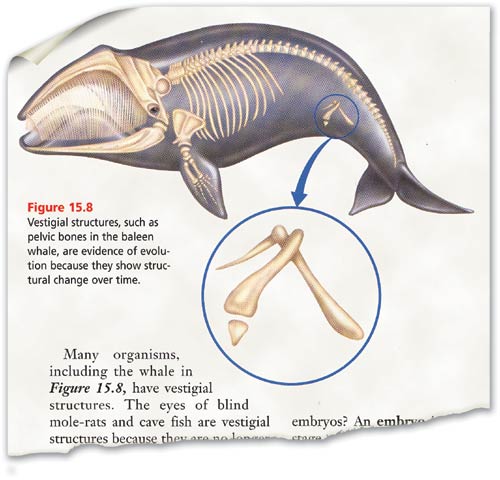
What is this an example of?
Homologous structure
Analogous structure
Vestigial organs
Functional adaption
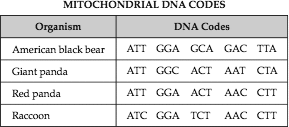
What conclusions can be made based on this table shown?
the American black bear and the giant panda are most closely related
the giant panda and the red panda are most closely related
the red panda and the racoon are the most closely related
the giant panda and the racoon are most closely related


The fossil record shows
Most species have not evolved
Some species are “inbetween” major groups of organisms
All species are today just as they were when they were created
A complete record of all life that has ever existed on Earth
he front legs of amphibians, birds, and reptiles all have the same basic bones, this shows that
Natural selection created the same bones multiple times
They lived in similar habitats, so natural selection led to similar adaptations
They inherited the bone structure from a common ancestor
Aliens from Mars genetically modified the structures to be similar
According to Darwin’s theory of natural selection, the individuals that tend to survive are those that have
Characteristics their parents acquired by use and disuse
Characteristics that plant and animal breeders value
The greatest number of offspring
Variations best suited for environmental conditions
Molecular evidence in support of natural selection includes
The nearly universal genetic code
The presence of vestigial structures
A tendency toward perfect, unchanging DNA in various species
The transmission of acquired characteristics by DNA
If a mutation introduces a new skin color in a lizard population, which factor might determine whether the frequency of the new allele will increase?
How many alleles are present
Whether the mutation makes some lizards more fit for their environment than other lizards
How many phenotypes the population has
Whether the mutation was caused by nature or human intervention
Which of the following does not provide evidence for evolution?
Fossil record
Homologous structures
Geographical distribution of organisms
Genetic disorders
A factor in the environment that can reduce the reproductive success of a population and therefore, can result in evolution by natural selection is
Common Descent
Descent with Modification
Natural Selection
Selective Pressure
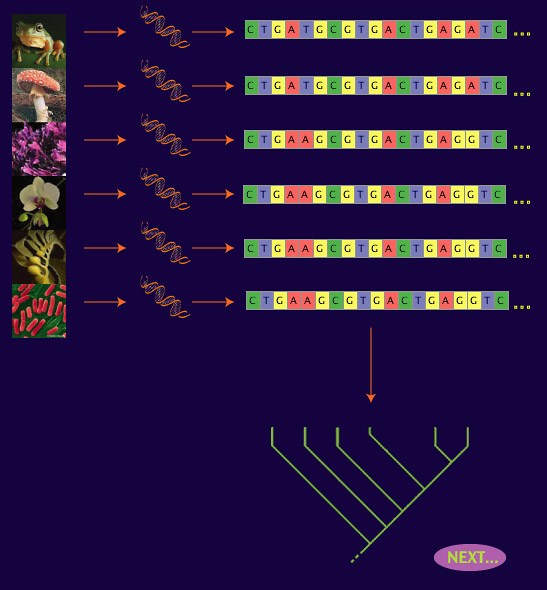
DNA evidence can help show the _______ relationships of species and how species have changed.
Natural selection
Evolutionary
Selective Pressure
Mutation