wayground logo

Free Printable Worksheets

Font size

S
M
L
XL
Worksheets

Lithosphere Review

Total questions: 130

Worksheet time: 1hrs 11mins

Name
Class
Date
1.

What layer of the earth is made of liquid magma?

a)

innner core

b)

mantle

c)

crust

d)

outer core

2.
What layer of the earth is made of soild iron and nickel?
a)
innner core
b)
mantle
c)
crust
d)
outer core
3.
Which is not a characteristic of all minerals?
a)
definite chemical composition
b)
man-made
c)
organic
d)
soild
4.
type of rock made of sediments - organic remains and particles of weathered and eroded rocks
a)
sedimentary
b)
igneous
c)
metamorphic
d)
this doesn't apply to any rocks
5.
forms when an existing rock is subjected to high temperatures or high pressures
a)
sedimentary
b)
igneous
c)
metamorphic
d)
this doesn't apply to any rocks
6.
forms below or on earth's surface when magma wells up from earth's mantle and then cools
a)
sedimentary
b)
igneous
c)
metamorphic
d)
this doesn't apply to any rocks
7.
Which type of sedimentary rock forms from the remains of plants and animals?
a)
clastic
b)
chemical
c)
organic
d)
none of these
8.
Which soil horizon is on the very bottom?
a)
parent rock
b)
subsoil
c)
organic
d)
topsoil
9.

fossil fuels are

a)

renewable

b)

nonrenewable

10.
Alfred Wegener’s theory of continental drift was crucial to the development of plate tectonic theory today. Which of the following data was used by Wegener to support his hypothesis?  
I.  Identical fossils of plants and animals on continents separated by ocean.

II.  Fossils of plants and animals that lived in climates that did not match the modern environment.
III. Similar mineral formations and crustal features on continents separated by ocean.
IV. Land formations that had undergone similar patterns of weathering.
a)
Only I
b)
III and IV
c)
I, II, and III
d)
I, II, III, and IV
11.
What would you be most likely to find at a divergent boundary between two pieces of continental crust?
a)
Mid-Ocean Ridge
b)
Mountain
c)
Rift
d)
Island Arc
12.
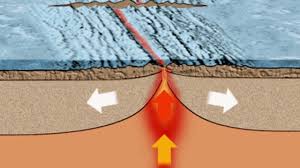
The model shows a plate boundary.  Arrows have been added to indicate the movement of the plates.  What plate boundary feature is shown?
a)
A fault formed at an active transform 
b)
A volcano formed at an active   transform boundary
c)
A valley formed at an active   divergent boundary 
d)
A ridge formed by an inactive   convergent boundary
13.
The model below shows two continental   plates.  The folded mountains in this   model form at which type of plate   boundary?
a)
Divergent boundary
b)
Convergent boundary
c)
Transform boundary
d)
Subduction boundary
14.
A section of a topographic map from Big Bend National Park is shown below.
What is the difference in elevation in feet between Point Y and Point Z on the map?
a)
6920 feet 
b)
520 feet
c)
200 feet
d)
40 feet
15.
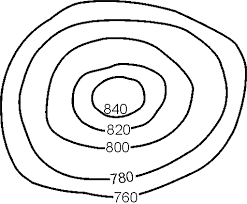
A student stands at the point marked X on the topographic map below.  What height in   meters must the student climb in order to reach the top of the hill?  Record your Answer 
a)
1601
b)
401
c)
400
d)
501
16.
The diagram below shows a model of the movement of two tectonic plates.  When the plates collide, one plate often moves below the other plate.  The rising magma that can result from this type of plate movement may produce – 
a)
Seafloor spreading
b)
Deep-sea sediment
c)
Volcanic islands
d)
Fossil layers
17.
What do contour lines that are farther apart represent?
a)
waterfall
b)
steep area
c)
gentle slope
d)
river
18.
What would you be most likely to find at a transform boundary?
a)
Earthquakes
b)
Volcanoes
c)
Mountains
d)
Rift
19.
What would you be most likely to find at a convergent boundary between two pieces of continental crust?
a)
Volcano
b)
Mountain
c)
Rift
d)
Island Arc
20.
Whenever a subduction zone is formed a ______ is formed.
a)
Mountain
b)
Island Arc
c)
Rift
d)
Volcano
21.
Determine the contour interval:
a)
5 m
b)
10 m
c)
15 m
d)
20 m
22.
The map above shows the location of the Andes Mountains on the western coast of South America. Which of the following best describes the geologic processes responsible for the formation of the Andes Mountains?
a)
The Nazca and South American plates have spaces where magma is erupting from the sea floor.
b)
The Nazca and South American plates are diverging.
c)
The Nazca and South American plates are transforming.
d)
The Nazca and South American plates are converging.
23.
A subduction zone is formed...
a)
when one tectonic plate sinks below another
b)
at every type of convergent plate boundary
c)
at every type of divergent plate boundary
d)
at transform boundaries
24.
What is the difference in elevation between Point X and Point Y?
a)
120 m
b)
240 m
c)
360 m
d)
340 m
25.

What is the process that breaks down rocks?

a)

Erosion

b)

Weathering

c)

Convection current

d)

Equilibrium

26.

__________ is the upper layer of soil containing most of the minerals and humus.

a)

Bedrock

b)

Strata

c)

Subsoil

d)

Topsoil

27.

Magma in the mantle circulates, causing ___________.

a)

climate change

b)

equilibrium

c)

magma

d)

convection currents

28.

Deforestation has caused changes in _________ .

a)

precipitation levels

b)

the amount of oxygen available

c)

temperature

d)

all of these

29.
Example: Waves dropping sand on the beach
a)
Weathering 
b)
Erosion
c)
Deposition
30.
Example: Caves being formed by acid rain dissolving underground limestone
a)
Weathering
b)
Erosion
c)
Deposition
31.
Example: Rain washing away soil from a hillside
a)
Weathering
b)
Erosion
c)
Deposition
32.

Which one of these is NOT an impact of using fossil fuels?

a)

Radioactive decay of nuclear waste

b)

Increase in the heating of the Earth's surface due to more greenhouse gases being emitted

c)

Increase in greenhouse gases such as Carbon Dioxide

d)

Air pollution

33.

Which one of these is NOT an impact of using fossil fuels?

a)

Radioactive decay of nuclear waste

b)

Increase in the heating of the Earth's surface due to more greenhouse gases being emitted

c)

Increase in greenhouse gases such as Carbon Dioxide

d)

Air pollution

34.
The major cause of extinction is ____________________.
a)
habitat fragmentation
b)
habitat destruction
c)
pollution
d)
poaching
35.
what is the leading cause of deforestation?
a)
Diseases 
b)
Housing market
c)
Agriculture and Farming
d)
Paper mill
36.
What is Deforestation?
a)
A forest in which there are too many deers.
b)
A forest party where deers hang out
c)
The adding of trees in a forest.
d)
The clearing of trees; transforming of a forest into cleared land.
37.
What is THE most major cause of extinction today?
a)
habitat destruction by humans
b)
poaching
c)
disease
d)
hunting
38.
a)
They both are formed from the remains of dead organisms.
b)
They both are acquired by mining the lithosphere.
c)
They both release energy through combustion.
d)
They both generate radioactive wastes. 
39.
a)
to maintain the public dependence on fossil fuels
b)
to maintain the success of the petroleum industry
c)
to confirm that the alternative fuel is cleaner than fuels currently used
d)
to confirm that the alternative fuel increases atmospheric carbon dioxide
40.
a)
tidal
b)
water
c)
solar
d)
coal
41.
a)
oil and coal
b)
coal and solar energy
c)
geothermal energy and oil
d)
solar energy and geothermal energy
42.
a)
Renewable resources are mostly acquired above Earth's surface.  Nonrenewable resources are mostly acquired below Earth's surface.
b)
Nonrenewable resources are mostly acquired above Earth's surface.  Renewable resources are mostly acquired below Earth's surface.
c)
Both renewable resources and nonrenewable resources are mostly acquired below Earth's surface.
d)
Both renewable resources and nonrenewable resources are mostly acquired above Earth's surface. 
43.
a)
transporting oil over the ocean surface
b)
drilling for oil on the ocean floor
c)
polluting land with oil that reaches the oceans in runoff
d)
polluting air with oil that reaches the ocean in precipitation
44.
a)
steep hillsides and mile climate
b)
frequent heavy rains and steep hillsides
c)
mild climate and proximity to the ocean
d)
proximity to the ocean and frequent heavy rains
45.
a)
crop rotation
b)
crop irrigation
c)
use of fertilizers
d)
use of machinery
46.
a)
Abiotic factors will cause the topsoil to erode.
b)
Biotic factors will increase the amount of fertilizer in the ground.
c)
Abiotic factors will increase the chances of a good watermelon harvest.
d)
Biotic factors will cause the watermelon to continue growing until the rains return.
47.
a)
Abiotic factors will cause the topsoil to erode.
b)
Biotic factors will increase the amount of fertilizer in the ground.
c)
Abiotic factors will increase the chances of a good watermelon harvest.
d)
Biotic factors will cause the watermelon to continue growing until the rains return.
48.
a)
applying nitrogen-rich fertilizers
b)
keeping grasses trimmed short
c)
building houses on stilts
d)
planting trees along cliffs
49.
a)
applying nitrogen-rich fertilizers
b)
keeping grasses trimmed short
c)
building houses on stilts
d)
planting trees along cliffs
50.
a)
removing grass from the steepest slope.
b)
building terraces into the sides of a slope.
c)
heavily watering the vegetation on the slope.
d)
increasing the slope of the land by adding more soil.
51.
a)
removing grass from the steepest slope.
b)
building terraces into the sides of a slope.
c)
heavily watering the vegetation on the slope.
d)
increasing the slope of the land by adding more soil.
52.
What is molten rock that has formed deep within the Earth?
a)
Hot Spot
b)
Magma
c)
Lava
d)
Volcano
53.
Why does magma tend to rise to the surface?
a)
It has large amounts of silica.
b)
It contains very little silica.
c)
It is denser than the surrounding material.
d)
It is less dense than the surrounding material.
54.
What is the principal ingredient to all types of magma?
a)
Iron
b)
Magnesium
c)
Silica
d)
Water
55.
What are solid rock fragments that are ejected during a volcanic eruption?
a)

Lahar

b)
Magma
c)
Pyroclastic Material
d)
Silica
56.
Where are most volcanoes found?
a)
Southern Hemisphere
b)
Ring of Fire
c)
Mid-Atlantic Ridge
d)
Hot Spots
57.
What is molten rock that has reached the Earth's surface?
a)
Aa
b)
Lava
c)
Magma
d)
Pahoehoe
58.
What is molten rock that has reached the Earth's surface?
a)
Aa
b)
Lava
c)
Magma
d)
Pahoehoe
59.
Volcanoes are found...
a)
on land
b)
under water
c)
on islands
d)
all of the above
60.
Volcanoes are found...
a)
on land
b)
under water
c)
on islands
d)
all of the above
61.
Most volcanoes occur at which 2 types of plate boundaries? 
a)
convergent w/ subduction and divergent
b)
divergent and transform
c)
divergent and hot spots
d)
convergent w/ subduction and hot spots
62.
Most volcanoes occur at which 2 types of plate boundaries? 
a)
convergent w/ subduction and divergent
b)
divergent and transform
c)
divergent and hot spots
d)
convergent w/ subduction and hot spots
63.
What is an epicenter? 
a)
Where an earthquake started
b)
The surface right above where an earthquake started 
64.
What is a fault?
a)
A crack in a plate.
b)
Where two plates move toward each other.
65.
Which travels fastest, always being the first detected by seismic stations?
a)
P waves
b)
S waves
66.
An instrument that detects and measures earthquakes is a 
a)
seismogram
b)
focus seismic map
c)
focus
d)
seismograph 
67.
Most earthquakes happen along the _________________. 
a)
coast
b)
faults
c)
desert
d)
directions
68.
Earthquakes under the water can cause _________________________________.
a)
tornadoes
b)
tsunamis
c)
lightening
d)
hailstorms
69.
A tracing of earthquake motion that is created by a seismograph. This can be on a huge sheet of paper, shows P-waves 
a)
Seimogram 
b)
Seismic wave
c)
Carrollton 
d)
Deformed 
70.
P-wave 
a)
The center of a earthquake. 
b)
Also know as shear or secondary wave. 
c)
Always the first to arrive;  seismic wave that causes particles of rock to move in back-and-forth direction
d)
Hilbert
71.
Seismology
a)
Branch of science that studies earthquakes 
b)
Earthquakes 
c)
The sudden return to elastically deformed rock to its original shape. 
d)
Focus 
72.
Many earthquakes happen along the borders of...
a)
Countries
b)
Tetonic Plates
c)
Climate Zones
d)
None of the above.
73.
This earthquake is......?
a)
Convergent
b)
Transform
c)
Divergent
d)
Rift Zone
74.
Second waves to arrive that cause earthquakes
a)
P waves
b)
S waves
c)
Surface waves
75.
Smaller earthquakes that occur in the same area after a larger earthquake has occurred.
a)
aftershock
b)
liquefaction
c)
tsunami
76.

In sea-floor spreading, molten material rises from the mantle and erupts

a)

along the edges of all the continents.

b)

along mid-ocean ridges.

c)

in deep-ocean trenches.

d)

at the north and south poles.

77.

The process by which the ocean floor sinks beneath a deep-ocean trench and back into the mantle is known as _______

a)

convection.

b)

continental drift.

c)

subduction.

d)

conduction.

78.

The geological theory of _______ states that pieces of Earth’s lithosphere are in constant, slow motion.

a)

subduction

b)

plate tectonics

c)

deep-ocean trenches

d)

sea-floor spreading

79.

A place where two plates slip past each other, moving in opposite directions, is known as a _______

a)

transform boundary

b)

divergent boundary.

c)

convergent boundary.

d)

rift valley.

80.
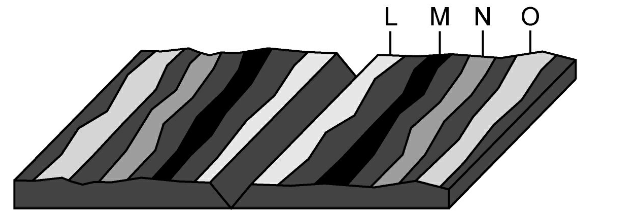
Where would the oldest rock be found?
a)
L
b)
M
c)
N
d)
O
81.
A German scientist Alfred Wegener was the first to hypothesize that ...........
a)
Continents were once joined
b)
The sea floor is spreading
c)
Continents are moving
d)
The Earth's magnetic pole flips
82.
Pangaea was an ancient supercontinent made up of...
a)
America, Greenland, and Europe.
b)
Antarctica, India, and America.
c)
all of Earth’s continents.
d)
South Africa, India, Australia, and South America.
83.
What are the 3 main fossil fuels?
a)
Coal, Oil, and Gasoline
b)
Coal, Oil, and Natural Gas
c)
Electricity, Gasoline, Petroleum
d)
Coal, Oil, Non-renewable Resources
84.
Fossil fuels are classified as nonrenewable because they.......
a)
require expensive equipment
b)
take millions of years to replace
c)
can be found all over 
d)
provide all the energy we use
85.
What is coal made of?
a)
decomposed animal and plant remains
b)
water
c)
electricity
d)
all of the above
86.

This is the cleanest burning of the fossil fuels:

a)

Natural Gas

b)

Coal

c)

Petroleum

d)

Shale

87.
A poison used to destroy pests
a)
Biological Pest Control
b)
Pesticide
c)
Genetic Engineering
d)
Overharvesting
88.
Removing more organisms from a population than can be replaced
a)
Livestock
b)
Domesticated
c)
Overharvesting
d)
Yield
89.
Raising of aquatic plants or animals for human use
a)
Aquaculture
b)
Overharvesting
c)
Arable
d)
Famine
90.
Domesticated animals raised to be used on a farm or sold for profit
a)
Domesticated
b)
Diet
c)
Biological pest control
d)
Livestock
91.
Desertification is caused by:
a)
An increase in the eating of desserts
b)
A decrease in population in desert areas
c)
The degradation of soil in semi-arid regions
d)
Droughts in tropical regions
92.
An igneous rock that is formed on the surface of the earth is called what?
a)
Intrusive
b)
Organic
c)
Extrusive
d)
Clastic
93.
When rock particles are deposited somewhere, the process is called?
a)
Erosion
b)
Weathering
c)
Cementation
d)
Sedimentation
94.
The process of returning soil and vegetation to a mine site is called?
a)
Reversing
b)
Rehabilitation
c)
Removal
d)
Restoring
95.
A person who looks for minerals is called a:
a)
Physicist
b)
Anthropologist
c)
Geologist
d)
Measurer
96.
Which agent of erosion leads to the formation of sand dunes? 
a)
Wind
b)
Water
c)
Ice
d)
Gravity
97.
How can water be an agent for physical weathering? 
a)
by absorbing gases from the atmosphere and ground to chemically react with minerals 
b)
by seeping into the soil and dissolving the minerals in rocks 
c)
by absorbing sulfur oxides and creating acid precipitation
d)
by seeping into the cracks of rocks and freezing
98.
Which is most likely a prevention strategy for flooding?
a)
building artificial levees
b)
reducing water consumption
c)
recycling bottled-water containers
99.
Cracks in rocks widen as water in them freezes and thaws. How does this affect the surface of the Earth? 
a)
It reduces the rates of soil formation
b)
It changes the chemical composition of the rocks.
c)
It exposes rocks to increased rates of erosion and weathering. 
d)
It limits the exposure of rocks to acid precipitation. 
100.
Which is formed when a section of impermeable rock forces groundwater to move laterally and emerge onto the surface of Earth? 
a)
spring
b)
an aquifer
c)
geyser
d)
well
101.
Which is the most common contamination source for freshwater resources? 
a)
runoff
b)
digging wells
c)
melting
d)
lightning
102.
Weathering and erosion help to shape the surface of Earth. Which best represents an example of weathering? 
a)
Flowing water transports rocks to the ocean.
b)
Pieces of rock pile on top of each other in layers.
c)
Wind and rain break large rocks into smaller pieces.
d)
Wind blows small pieces of rock from one area to another.
103.
 Which of the following processes changes Earth's surface?
a)
erosion only
b)
deposition only 
c)
both erosion and deposition
d)
neither erosion nor deposition
104.
How are trees agents of mechanical weathering?
a)
Growing tree roots physically break apart rock.
b)
Tree roots secrete acids that react with minerals in rock
c)
Trees break down into organic matter that forms an important part of soil
d)
all of the above
105.
How could the removal of trees and other vegetation impact an environment?
a)
by increasing oxygen production
b)
by increasing soil formation
c)
by increasing transpiration
d)
by increasing erosion
106.
Which of the following is NOT an agent of erosion?
a)
gravity
b)
water dissolving
c)
wind
d)
glacier
107.
Waves move out through the ground from the ..........
a)
rift
b)
focus
c)
epicenter
d)
fault line
108.

What do geologists notice about the rocks along the sea floor?

a)

They get older as they get farther away from mid ocean ridges

b)

They get thicker closer to continents

c)

Density is impossible to measure

d)

Youngest parts of the crust are along the continents

109.
The volcanoes on the Hawaiian Islands form due to which of the following?
a)
Divergent Boundary
b)
Hot Spot
c)
Subduction Boundary
d)
Transform Boundary
110.
This image represents a famous feature found in California, that could lead to a future disaster for the people of California?
a)
A volcano
b)
A ocean trench
c)
San Andreas Fault
d)
San Antonio Fault
111.
Which scale measures the intensity of the ground movement?
a)
Mercalli Scale
b)
Richter Scale
c)
Seismogram Scale
d)
Bernoulli Scale
112.

What is the "driving force" behind plate tectonics?

a)

the cooling of the Earth's crust

b)

gravitational pull of the moon

c)

convection currents in the Earth's mantle

d)

the Earth's magnetic field

113.

most earthquakes are caused by

a)

meteorite impacts

b)

fracking

c)

stress that builds up along plate boundaries

d)

atomic bomb testing

114.
______________ is the amount of damage done to structures by the Earthquake.
a)
Probability
b)
Amplitude
c)
Seismic Gap
d)
Intensity
115.
The arrival times of S and P waves is used to determine.......
a)
where the seismic station is located
b)
why the Earthquake occurred
c)
distance to epicenter 
d)
Volcano location
116.
What is the most exact way to measure the magnitude of an earthquake?
a)
Mercalli Scale
b)
Moment Magnitude
c)
Richter Scale
d)
Triple Beam Balance
117.
What is a smaller earthquake that follows a larger earthquake?
a)
Aftershock
b)
Liquefaction
c)
Seismic Gap
d)
Tsunami
118.
The earth's ________ is broken up into pieces just like a jigsaw puzzle.
a)
Inner Core
b)
Lithosphere
c)
Mantle
d)
Outer Core
119.
What is the name of the geologic process when one plate slips underneath another plate?
a)
Subduction
b)
Subway
c)
Convergence
d)
Slip
120.
Which crust is thicker?
a)
Oceanic Crust
b)
Continental Crust
121.
Which type of rock results from melting and cooling of magma?
a)
Igneous
b)
Metamorphic
c)
Sedimentary
d)
Extrusive
122.
Which type of rock forms from extreme heat and pressure?
a)
Igneous
b)
Sedimentary
c)
Organic
d)
Metamorphic
123.
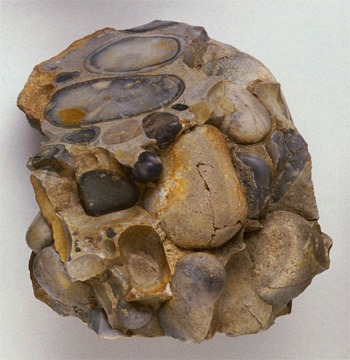
This rock was formed by smaller pieces of rock that settled at the bottom of a lake millions of years ago. What type of rock is this?
a)
Sedimentary
b)
Igneous
c)
Metamorphic
124.
Rocks along a riverbed that are smoothed from continuously moving water and sediment rubbing against them is an example of:
a)
mechanical weathering
b)
chemical weathering
125.
A piece of sandstone changing color (from brown to rusty red) from exposure to water and air is an example of:
a)
mechanical weathering
b)
chemical weathering
126.
Which of the following is the name of the ancient supercontinent formed 28 Million Years ago.
a)
Pangea
b)
Gondwanda
c)
Laurasia
d)
Neverland
127.
What is another term for P Wave?
a)
Compression Wave
b)
Principal Wave
c)
Shear Wave
d)
Secondary Wave
128.
This hazard is caused by the chemical dissolution process in sandstone or chemical dissolution of carbonate rocks that causes erosion of the soil beneath the ground.
a)
sinkhole
b)
liquefaction
c)
land subsidence
d)
ground rupture
129.
Which natural disaster is the sliding down of a mass of earth or rock from a mountain or cliff?
a)
Landslide
b)
Tsunami 
c)
Thunderstorm
d)
Tornado 
130.
Which wave can travel through solids, liquids, and gases?
a)
P
b)
S
c)
Surface
d)
Seismic