wayground logo

Free Printable Worksheets

NEW

Font size

S
M
L
XL
Worksheets

1960s Review

Total questions: 50

Worksheet time: 2hrs 30mins

Name
Class
Date
1.

Who was the Cuban Dictator during the Cuban Missile Crisis?

a)

John F. Kennedy

b)

Nikita Khrushchev

c)

Fidel Castro

d)

Dwight Eisenhower

e)

Edwardo Obstinado

2.

Which of the following justifies Kennedy's Navy block around Cuba?

a)

Khrushchev removed all Soviet missiles from Cuba.

b)

An American spy plane caught the Soviet Union placing nuclear weapons in Cuba.

c)

Fidel Castro becomes dictator of Cuba and launches his new line of army fatigues with matching beards.

d)

Khrushchev led a conference in Yalta but the US was not invited.

e)

Castro threatened to launch four missiles at the US if Kennedy refused to take down the US missiles in Turkey.

3.

The failed US attempt to overthrow the communist Cuban government in 1961 was called the:

a)

Bay of Pigs Invasion

b)

Cuban Missile Crisis

c)

Project to Eliminate Cuban Communism (PECC)

d)

Inchon Invasion

e)

Anti-Totalitarian Takeover (ATT)

4.

How did the US discover that nuclear missile sites were being constructed in Cuba?

a)

from American CIA spies in Cuba posing as farmers

b)

from US spy satellites

c)

from listening in on secret Soviet-Cuban radio transmissions

d)

the British intercepted the telegram which outlined the nuclear missile project in Cuba

e)

from photographs taken from an American U-2 spy plane

5.

Shutting off of a port to keep people or supplies from moving in or out.

a)

blockade

b)

containment

c)

perestroika

d)

satellites

6.

The leader of the communist revolution in Cuba during the 1950's, who became an anti-American dictator.

a)

Fidel Castro

b)

Lech Walesa

c)

Mikhail Gorbachev

d)

Ho Chi Minh

7.

An attempt by the Soviet Union in 1962 to place nuclear missiles in Cuba directed toward the United States.

a)

Cuban Missile Crisis

b)

Iron Curtain

c)

Berlin Airlift

d)

Detente

8.

A competition between superpowers to develop new, more deadly nuclear and controversial weapons.

a)

Arms Race

b)

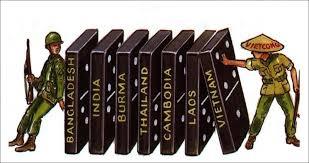
Domino Theory

c)

Glasnost

d)

Warsaw Pact

9.

A massive concrete barrier, dividing democratic West Berlin from communist East Berlin. The wall acted as a symbol of the Cold War and Soviet Union restrictions.

a)

Berlin Wall

b)

Cold War

c)

Warsaw Pact

d)

Iron Curtain

10.

How did the "Bay of Pigs" failure lead to the Cuban Missile Crisis?

a)

Khruschev believed the United States was too weak to oppose Soviet expansion into Cuba

b)

Kennedy announced a blockade of Cuba following the failure of the Bay of Pigs invasion

c)

Castro protested his country's being used as a tool for the Cold War & asked Khrushchev to intervene

d)

The Bay of Pigs troops were used to build the missile bases

11.
Which statement best describes the Cuban Missile Crisis? 
a)
The Soviets let the Cuban government borrow their missiles to scare the US. 
b)
US planes spotted Soviet missiles in Cuba and were worried they would be launched to attack the US. 
c)
The US gave Cuba missiles to use against the Soviets. 
d)
Cuba threatened to place an embargo on the US.
12.
What did Khrushchev want when sending the missiles to Cuba?
a)
To increase the Soviet Union's nuclear capability
b)
Aid the Cuba
c)
Aid the US
d)
To increase the US nuclear capability
13.

What ended the Cuban Missile Crisis?

a)

The USSR removes missiles and the US leaves Cuba alone.

b)

The US uses all of their missiles and destroys Cuba

c)

Cuba forfiets

d)

JFK got tired of fighting and just made a treaty

14.

President John F. Kennedy supported the 1961 Bay of Pigs invasion of Cuba as an effort to...

a)

remove a communist dictator from power

b)

stop the flow of illegal drugs to the United States

c)

support Fidel Castro’s efforts for reform

d)

rescue hostages held by Cuban freedom fighters

15.

JFK's plan for improving America was called the

a)

Fair Deal

b)

Dynamic Conservatism

c)

New Frontier

d)

Great Society

16.

For the first time in US history, the election of 1960 featured

a)

no Republican candidate for president

b)

the use of TV ads to support candidates

c)

a national TV debate between candidates

d)

a third party candidate

17.

The US backed invasion of Cuba in 1961 to overthrow Castro was called the

a)

Cuban Missile Crisis

b)

Tet Offensive

c)

Bay of Pigs

d)

Guantanamo Bay

18.

The event that brought the Cold War closest to a direct conflict was the

a)

sending of US troops to South Vietnam

b)

Cuban Missile Crisis

c)

Bay of Pigs Invasion

d)

building of the Berlin Wall

19.

What was JFK's major decision in regard to the conflict in Vietnam?

a)

divide Vietnam into North & South

b)

send 16,000 US advisers

c)

make a personal visit to the country to talk peace

d)

encourage the protests by Buddhist monks against the government of South Vietnam

20.

Who assassinated JFK?

a)

Jack Ruby

b)

Fidel Castro

c)

Lee Harvey Oswald

d)

Ngo Dinh Diem

21.

Who ran against JFK in the election of 1960?

a)

Dwight D. Eisenhower

b)

Lyndon Johnson

c)

Richard Nixon

d)

Henry Wallace

22.

When JFK was assassinated, this man became the next president.

a)

Richard Nixon

b)

Lyndon Johnson

c)

Dwight D. Eisenhower

d)

Harry Truman

23.
Which side of Berlin was controlled by the Soviet's military aggression?
a)
North Berlin
b)
East Berlin
c)
West Berlin
d)
South Berlin
24.
The side of Berlin that was aided by the U.S. Democracy
a)
North Berlin
b)
West Berlin
c)
East Berlin
d)
South Berlin
25.
The _________________ is a program in which the assistance of U.S. volunteers is offered to the developing nations in Asia, Africa, and Latin America.
a)
Fair Deal
b)
Economic Opportunity Act
c)
Peace Corp
d)
Great Society
26.
This created the Job Corps, VISTA, and Project Head Start in an effort to fight the “war on poverty”
a)
Civil Rights Act
b)
Economic Opportunity Act 
c)
Pendleton Service Act
d)
Warren Court 
27.
These provided free or low-cost medical insurance to welfare recipients and most Americans age 65 and over.  
a)
Civil Rights Services
b)
Privatization of Medicine
c)
Medicare and Medicaid
d)
Equal Insurance Policy (EIP)
28.
The establishment of the National Aeronautics and Space Administration (NASA) was most influenced by the:
a)
Need to employ Nazis scientists to keep them from working for the Soviets
b)
Successful launch and orbit of Sputnik I by the Soviet Union
c)
United States' desire to develop a space station orbiting the Earth
d)
Increased global tension and insecurity due to the Cuban Missile Crisis
29.
Who was the president elected in 1961 who promised that his administration would blaze a “new frontier?”
a)
Lyndon B. Johnson
b)
Abraham Lincoln
c)
John F. Kennedy
d)
Richard Nixon
30.
President Johnson’s goals in the areas of healthcare, education, the environment, discrimination, and poverty were known as _________________. 
a)
Great Society
b)
New Deal
c)
New Frontier
d)
War on Poverty
31.

Commission made by LBJ after the assassination of John F. Kennedy.The point was to investigate if someone paid for the assassination of Kennedy. This concluded that Oswald killed Kennedy on his own.

a)

Black Commission

b)

Warren Commission ­

c)

Justice Commission

d)

Johnson Commission

32.
He was the communist leader of North Vietnam
a)
Diem
b)
Johnson
c)
Ho Chi Minh
d)
Castro
33.
The idea that if South Vietnam fell to communism, other nations would soon follow...
a)
Vietnamization 
b)
Communism
c)
Domino Theory
d)
Imperialism
34.
Allowed the public to be negatively influenced concerning the  Vietnam war?
a)
Television and media bias
b)
Radio 
c)
Telegraph
d)
Internet
35.
What event caused a negative shift in U.S. public opinion during the Vietnam War?
a)
The Geneva Accords
b)
Operation Rolling Thunder
c)
The Tet Offensive
d)
Gulf of Tonkin
36.
The Vietcong fought against
a)
North Vietnam
b)
United States
c)
France
d)
Japan
37.
What was one effect of the My Lai massacre?
a)
Americans began to perceive the Johnson Administration as honest
b)
The Johnson Administration lost the support of wealthy Americans
c)
Support for the war among college students nearly doubled.
d)
Many Americans began to question U.S. involvement in the war
38.
Which of the following best describes the domino theory?
a)
If atomic weapons were used once to end a war, they would be used to end all wars.
b)
If the United States waged one war against communism, it would have to wage other wars
c)
If one nation became Communist, nearby countries would also fall to communism
d)
If the Soviets took over one Asian nation, they would take over the entire continent.
39.
What did President Kennedy intend  to do by establishing the Peace Corps?
a)
bring a nonviolent end to racial segregation in the United States
b)
design a treaty that would end the conflict with Cuba
c)
provide young people with a chance to express their views
d)
help developing countries with tasks such as building schools and digging wells
40.
The Vietnam War ended when
a)
the United States and North Vietnam signed the Hanoi Accords in 1973.
b)
North Vietnamese forces captured Saigon in 1975.
c)
Communist dictators took over Laos and Cambodia in 1977.
d)
North Vietnam returned all American prisoners of war in 1979.
41.
By the end of 1967, U.S. military leaders claimed they were nearing victory in Vietnam, but the ________________________ in January 1968 proved they were wrong.
a)
Tet Offensive 
b)
Tonkin Gulf Resolution
42.
The ________________________ revealed that U.S. officials had been lying to the American people about the progress of the Vietnam War for years.
a)
Pentagon Papers 
b)
War Powers Act
43.
After the ________________________, the United States and the Soviet Union signed a treaty that banned  aboveground testing of new nuclear weapons. 
a)
Tonkin Gulf Resolution 
b)
Cuban missile crisis
44.
strategy calling for the South Vietnamese Army to take over fighting the war in Vietnam
a)
Vietnamization
b)
Tonkin Gulf Resolution
45.
commanded U.S. ground forces in Vietnam
a)
Ho Chi Minh
b)
William Westmoreland
c)
Maya Ying Lin
46.
requires the president to get congressional approval before committing U.S. troops to an armed struggle
a)
24th Amendment
b)
Limited Test Ban Treaty
c)
War Powers Act
47.
banned testing of nuclear weapons above ground
a)
Limited Test Ban Treaty
b)
Vietnamization
c)
escalation
48.

Congress granted LBJ power to go to war with North Vietnam by passing the __________.

a)

Great Society

b)

War Powers Act

c)

26th Amendment

d)

Gulf of Tonkin Resolution

49.
What were the problems of fighting in Vietnam?
a)
Identifying the enemy 
b)
Jungle/Location provided cover and a place to transport enemy supplies
c)
Weather and climate
d)
all of these
50.
Networks of jungle paths used by N. Vietnam to transport supplies to the Vietcong?
a)
Saigon Route
b)
Bataan Death March
c)
Trail of Tears
d)
Ho Chi Minh Trail