wayground logo

Free Printable Worksheets

NEW

Font size

S
M
L
XL
Worksheets

Earth Science Final Review

Total questions: 76

Worksheet time: 1hrs 10mins

Name
Class
Date
1.
Water takes 3 forms as it moves through the water cycle.  They are:
a)
solid, liquid, plasma
b)
solid, liquid, gas
c)
liquid, gas, plasma
d)
solid, liquid, sublimation
2.
Water reaches the atmosphere in 3 ways.  Which occurs when liquid water changes into water vapor?
a)
sublimation
b)
precipitation
c)
evaporation
d)
condensation
3.
Any form of water that falls to Earth from clouds is called:
a)
sublimation
b)
precipitation
c)
evaporation
d)
condensation
4.
It takes energy for liquid or solid water to turn into water vapor.  This energy comes from:
a)
water cycle
b)
matter
c)
hydrosphere
d)
the sun
5.
On a cold morning, Sandy observed that the grass looked wet.  Which process occurred when the water formed droplets on the grass?
a)
deposition
b)
sublimation
c)
evaporation
d)
condensation
6.
As water changes state, the water either gains or loses energy.  Which change of state would involve water gaining energy?
a)
condensation
b)
deposition
c)
evaporation
d)
freezing
7.
What can be dissolved in water?
a)
sand
b)
leaves
c)
pebbles
d)
minerals (like salt)
8.
The continuous movement of water between the atmosphere, the land, the oceans, and living things is called:
a)
universal solvent
b)
sublimation
c)
the water cycle
9.
Water is the universal _______ because it dissolves many things
a)
adhesion
b)
cohesion
c)
polarity
d)
solvent
10.
What is the volume of the screw?
a)
10 mL
b)
13 mL
c)
16 mL
d)
3 mL
11.
What type of energy does this produce?
a)
solar energy
b)
wind energy 
c)
hydroelectric energy
d)
geothermal energy
12.
This theory states that Earth's  plates move on top of the mantle at a slow and constant rate due to convection currents
a)
plate tectonics
b)
continental drift
c)
seafloor spreading
d)
pangaea
13.
What occurs when two plates come together and the denser one is forced under back into the mantle?
a)
reduction
b)
conduction
c)
subduction
d)
convection
14.
Where is the epicenter for this earthquake located based on triangulation?
a)
A
b)
B
c)
C
d)
D
15.
Where do convection currents happen in the model we are studying?
a)
crust
b)
Outer Core
c)
Inner Core
d)
Mantle
16.
Studies of earthquake waves have helped scientists determine the
a)
depth of the oceans
b)
size of the earth
c)
age of the earth
d)
structure of Earth's interior
17.
What type of heat transfer is indicated by the arrows in the beaker
a)
Condensation
b)
Convection
c)
Radiation
d)
Conduction
18.
The asthenosphere can be found .
a)
in the center of the earth
b)
between the lithosphere and the mantle
c)
on the surface of the earth
d)
in the core
19.
The process that continually adds new material to the ocean floor.
a)
subduction
b)
sea-floor spreading
c)
convection
d)
trench
20.
"200-300" million years ago suposedly, the continents were joined in a single land mass called...
a)
Pan America
b)
Pangaea
c)
Pan Acean
d)
'Murica
21.
What drives tectonic plate movement? 
a)
gravity
b)
coriolis effect
c)
convection currents
d)
the earth's magnetic core
22.
Movement of Earth's crust along plate boundaries produces?
a)
fronts
b)
earthquakes
c)
hurricanes
d)
tides
23.
Large pieces of Earth's lithosphere that move around are called?
a)
sections
b)
plates
c)
land masses
d)
faults
24.
The arrows on either side of the fault in the diagram represent
a)
volcanoes
b)
rock formation
c)
plate movement
d)
movement of air masses
25.
What direction do seismic waves carry the energy from an earthquake?
a)
away from the focus
b)
towards the focus
c)
through the mantle
d)
there aren't any waves
26.
A break or crack in the Earth's crust is called a
a)
plate
b)
fault
c)
fold
d)
crack
27.
The San Andreas Fault is a result of 
a)
overpopulation
b)
weathering
c)
plate movement
28.
Most of Earth's major earthquakes are caused by
a)
cooling of Earth's surface
b)
weathering
c)
gravity
d)
faulting of rock in Earth's crust
29.
What is the correct order (starting from the surface) of Earth’s layers? 
a)
crust, outer core, inner core, mantle 
b)
mantle, outer core, inner core, crust 
c)
crust, mantle, outer core, inner core 
d)
outer core, inner core, crust, mantle 
30.
The rigid layer that includes the upper part of the mantle and the crust is called.
a)
Core
b)
Asthenosphere
c)
Lithosphere
d)
Mantle
31.
Because stress is a force, it
a)
squeezes energy out of rock?
b)
adds energy to rock
c)
uses up energy in rock
32.
What can form when two plates collide?
a)
mountains
b)
volcanic islands
c)
rift valleys
d)
mid-ocean ridges
33.
Which property of the galena and calcite is being tested in the picture?
a)
Density
b)
Hardness
c)
Streak
d)
Luster
34.
Which property of the calcite is being tested?
a)
Streak
b)
Hardness
c)
Cleavage
d)
Fracture
35.
What is the best information to identify a mineral?
a)
size and streak
b)
color and luster
c)
color and fracture
d)
streak and hardness
36.
________________ describes the color of the minerals powder
a)
Color
b)
Hardness
c)
Fracture
d)
Streak
37.
Which of the following describes the procedure that can be used to test the hardness of a mineral?
a)
Scratch the mineral with items such as a penny, a nail, or your fingernail.
b)
Rub the mineral on a tile and observe the color of the powder left behind.
c)
Find the mass and volume of the mineral, and then divide the mass by the volume.
d)
Break off pieces of the mineral and observe the pattern of the break.
38.

This rock was formed by smaller pieces of rock that settled at the bottom of a lake thousands of years ago. What type of rock is this?

a)

Sedimentary

b)

Igneous

c)

Metamorphic

39.

What layer would be the oldest in the pictured cross section?

a)

Top layer

b)

Middle layers

c)

They are all the same age

d)

Bottom layer

40.

Rocks are classified by

a)

How they look

b)

How old they are

c)

How they are formed

d)

Their color

41.

All rocks are composed of

a)

fossils

b)

cells

c)

metals

d)

minerals

42.

The natural chemical or physical processes that breaks down rock on Earth's surface.

a)

weathering

b)

erosion

c)

deposition

43.

The process by which water, ice, wind or gravity moves weathered rock and soil from one place to another.

a)

weathering

b)

erosion

c)

deposition

44.
If contour lines are close together, then the slope is
a)
gentle
b)
steep
c)
flat
d)
going up and down
45.

What is the contour interval?

a)

1 ft

b)

5 ft

c)

10 ft

d)

60 ft

46.

What is a possible elevation of point B

a)

100

b)

210

c)

165

d)

185

47.
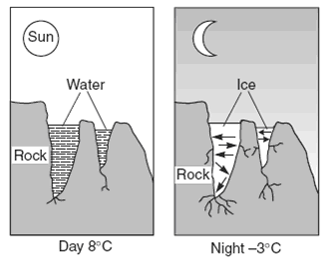
The diagrams  shows a natural process that weathers rock.
 Which statement best explains why this process results in weathering?
a)
frozen water acts as a solute
b)
water expands when it freezes
c)
the mass of water increases when it freezes
d)
frozen water dissolves most types of rock
48.

How does a sedimentary rock become a metamorphic rock?

a)

Heat and pressure

b)

Melting and cooling

c)

Weathering/Erosion and Cementation

d)

Cycling

49.

Which missing rock type is the arrow pointing at?

a)

Igneous

b)

Sedimentary

c)

Metamorphic

50.
Which type of rock results from melting and cooling of magma?
a)
Igneous
b)
Metamorphic
c)
Sedimentary
d)
Extrusive
51.
What does the Mohs Scale measure?
a)
Streak
b)
Luster
c)
Hardness
d)
Cleavage
52.
This rock was molten magma that slowly cooled under the ground. What type of rock is this?
a)
Sedimentary
b)
Igneous
c)
Metamorphic
53.
Fossils are most commonly found in _______ rock. 
a)
Igneous
b)
Sedimentary
c)
Paleolithic
54.
________is the instrument used to measure air pressure.
a)
barometer
b)
thermometer
c)
mercury
d)
watch
55.

What are the average atmospheric conditions from season to season and year to year at a certain location?

a)

weather

b)

climate

56.

What are the daily conditions of temperature, humidity and precipitation at a particular time and place?

a)

weather

b)

climate

57.
During which part of the water cycle does a cloud form?
a)
Evaporation
b)
Precipitation
c)
condensation
d)
Run off
58.

Earth's weather is causes by

a)

drifting crustal plates.

b)

changing distance between the Earth and the Sun.

c)

uneven heating of the Earth's surface.

d)

gravitational attraction of the moon.

59.
Which cloud is this?
a)
cumulus
b)
cumulonimbus
c)
cirrus
d)
stratus
60.
Which cloud is this?
a)
cumulus
b)
cumulonimbus
c)
cirrus
d)
stratus
61.
Which cloud is this?
a)
cumulus
b)
cumulonimbus
c)
cirrus
d)
stratus
62.

What is the order of the layers of the atmosphere, starting with the layer closest to Earth's surface?

a)

Stratosphere, Troposphere, Mesosphere, Thermosphere

b)

Troposphere, Stratosphere, Mesosphere, Thermosphere

c)

Thermosphere, Troposphere, Stratosphere, Mesosphere,

d)

Troposphere, Stratosphere, Thermosphere, Mesosphere
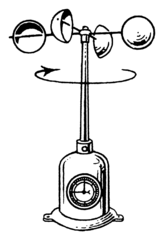
63.

This weather instrument measures wind speed.

a)

wind vane

b)

anemometer

c)

barometer

d)

thermometer

64.

This instrument measures humidity...

a)

Thermometer

b)

Anemometer

c)

Barometer

d)

Psychrometer

65.

Which instrument measures air pressure?

a)

anemometer

b)

barometer

c)

thermometer

d)

weather balloon

66.
What two gases make up the majority of air?
a)
helium & argon
b)
helium & oxygen
c)
ozone & nitrogen
d)
nitrogen & oxygen
67.

Which of the following is NOT a reason why the atmosphere is important?

a)

It is made of many layers.

b)

It provides gases living things need.

c)

It regulates temperatures.

d)

It protects us from UV rays and meteors.

68.

Which diagram shows convection currents on a warm afternoon in Florida?

a)
b)
c)
d)
69.

The lines on this map show__________

a)

temperature.

b)

wind speed.

c)

wind direction.

d)

air pressure.

70.

Once air mass A reaches location B, the weather at location B will become

a)

warmer and drier

b)

warmer and more humid

c)

colder and more humid

d)

colder and drier

71.

Weather forecasts are more accurate now than in the past due to

a)

air quality control

b)

plate tectonics

c)

use of images from space

d)

global warming

72.
Low pressure will usually bring what kind of weather?
a)
Sunny
b)
Calm
c)
Stormy
73.

What is the boundary between two air masses called?

a)

front

b)

barometer

c)

maritime

d)

occluded

74.

Our weather moves in the general direction of

a)

North to South

b)

East to West

c)

West to East

d)

South to North

75.
High pressure will usually bring what kind of weather?
a)
clear and dry
b)
cloudy and wet
76.

Which weather event is shown in the picture?

a)

tornado

b)

blizzard

c)

hurricane

d)

thunderstorm